Page 6 of 429
Table of Contents (cont'd)
Maintenance Schedule Service and Appearance Care
Section
7
Section
6
Scheduled Maintenance
Owner Checks and Services
Periodic Maintenance InspectionsRecommended Fluids and Lubricants
Maintenance Records Fuel
Checking Fluids and Lubricants
GM Oil Life System™
Engine Air Cleaner/Filter
Passenger Compartment Air Filter
Brakes
Bulb ReplacementWindshield Wiper Blade Replacement
Tires and Wheels
Appearance Care
Electrical System/Fuses and Circuit Breakers
Capacities and Specifications
Normal Maintenance Replacement Parts
iv
Page 325 of 429

6-
6-1
Section 6 Service and Appearance Care
Here you will find information about the care of your vehicle. This section begins with service and fuel information,
and then it shows how to check important fluid and lubricant levels. There is also technical information about your
vehicle, and a part devoted to its appearance care.
6
-2 Service
6
-3 Fuel
6
-5 Fuels in Foreign Countries
6
-5 Filling Your Tank
6
-7 Filling a Portable Fuel Container
6
-8 Checking Things Under the Hood
6
-11 Engine Oil
6
-15 Engine Air Cleaner/Filter
6
-16 Passenger Compartment
Air Filter Replacement
6
-18 Automatic Transaxle Fluid
6
-21 Engine Coolant
6
-24 Radiator Pressure Cap
6
-24 Power Steering Fluid
6
-25 Windshield Washer Fluid
6
-26 Brakes6
-30 Battery
6
-31 Bulb Replacement
6
-38 Windshield Wiper Blade Replacement
6
-40 Tires
6
-48 Appearance Care
6
-48 Cleaning the Inside of Your Vehicle
6
-52 Cleaning the Outside of Your Vehicle
6
-55 Underbody Maintenance
6
-55 Chemical Paint Spotting
6
-56 GM Vehicle Care/Appearance Materials
6
-57 Vehicle Identification Number (VIN)
6
-57 Electrical System
6
-65 Replacement Bulbs
6
-65 Capacities and Specifications
6
-66 Normal Maintenance Replacement Parts
Page 334 of 429
6-10
When you lift the hood, you'll see these items:
A. Underhood Fuse
and Relay Center
B. Remote Positive (+) Terminal
C. Windshield Washer
Fluid ReservoirD. Radiator Pressure Cap
E. Power Steering Fluid Reservoir
F. Engine Oil Fill Cap
G. Engine Oil DipstickH. Transaxle Fluid Dipstick
I. Brake Master Cylinder
J. Engine Air Cleaner/Filter
K. Engine Coolant Reservoir
Page 339 of 429
6-15
How to Reset the Change Engine Oil Message
1. With the ignition key in RUN but the engine off,
fully push and release the accelerator pedal slowly
three times within five seconds.
2. Turn the key to OFF.
If the CHANGE ENGINE OIL message comes
back on, the engine oil life monitor has not reset.
Repeat the procedure.
What to Do with Used Oil
Did you know that used engine oil contains certain elements
that may be unhealthy for your skin and could even cause
cancer? Don't let used oil stay on your skin for very long.
Clean your skin and nails with soap and water, or a good hand
cleaner. Wash or properly throw away clothing or rags
containing used engine oil. (See the manufacturer's warnings
about the use and disposal of oil products.)
Used oil can be a real threat to the environment. If you
change your own oil, be sure to drain all free
-flowing oil
from the filter before disposal. Don't ever dispose of oil by
putting it in the trash, pouring it on the ground, into
sewers, or into streams or bodies of water. Instead, recycle
it by taking it to a place that collects used oil. If you have
a problem properly disposing of your used oil, ask your
dealer, a service station or a local recycling center for help.
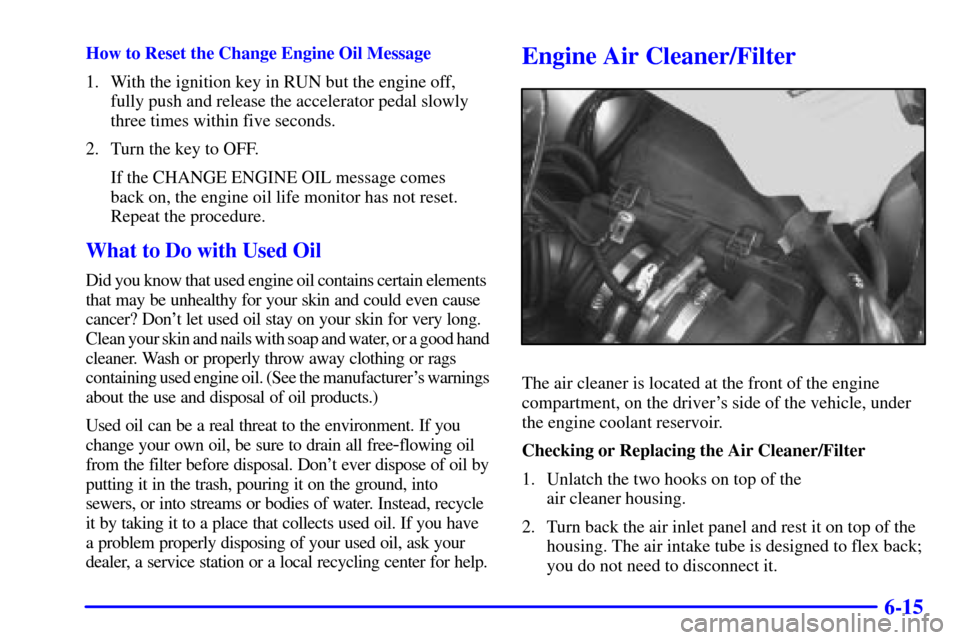
Engine Air Cleaner/Filter
The air cleaner is located at the front of the engine
compartment, on the driver's side of the vehicle, under
the engine coolant reservoir.
Checking or Replacing the Air Cleaner/Filter
1. Unlatch the two hooks on top of the
air cleaner housing.
2. Turn back the air inlet panel and rest it on top of the
housing. The air intake tube is designed to flex back;
you do not need to disconnect it.
Page 340 of 429
6-16
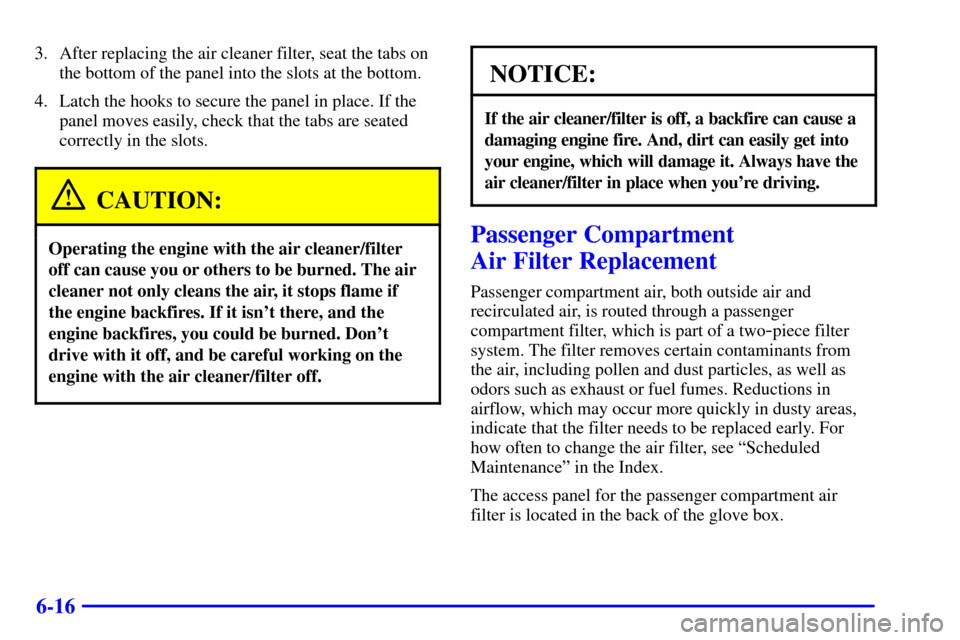
3. After replacing the air cleaner filter, seat the tabs on
the bottom of the panel into the slots at the bottom.
4. Latch the hooks to secure the panel in place. If the
panel moves easily, check that the tabs are seated
correctly in the slots.
CAUTION:
Operating the engine with the air cleaner/filter
off can cause you or others to be burned. The air
cleaner not only cleans the air, it stops flame if
the engine backfires. If it isn't there, and the
engine backfires, you could be burned. Don't
drive with it off, and be careful working on the
engine with the air cleaner/filter off.
NOTICE:
If the air cleaner/filter is off, a backfire can cause a
damaging engine fire. And, dirt can easily get into
your engine, which will damage it. Always have the
air cleaner/filter in place when you're driving.
Passenger Compartment
Air Filter Replacement
Passenger compartment air, both outside air and
recirculated air, is routed through a passenger
compartment filter, which is part of a two
-piece filter
system. The filter removes certain contaminants from
the air, including pollen and dust particles, as well as
odors such as exhaust or fuel fumes. Reductions in
airflow, which may occur more quickly in dusty areas,
indicate that the filter needs to be replaced early. For
how often to change the air filter, see ªScheduled
Maintenanceº in the Index.
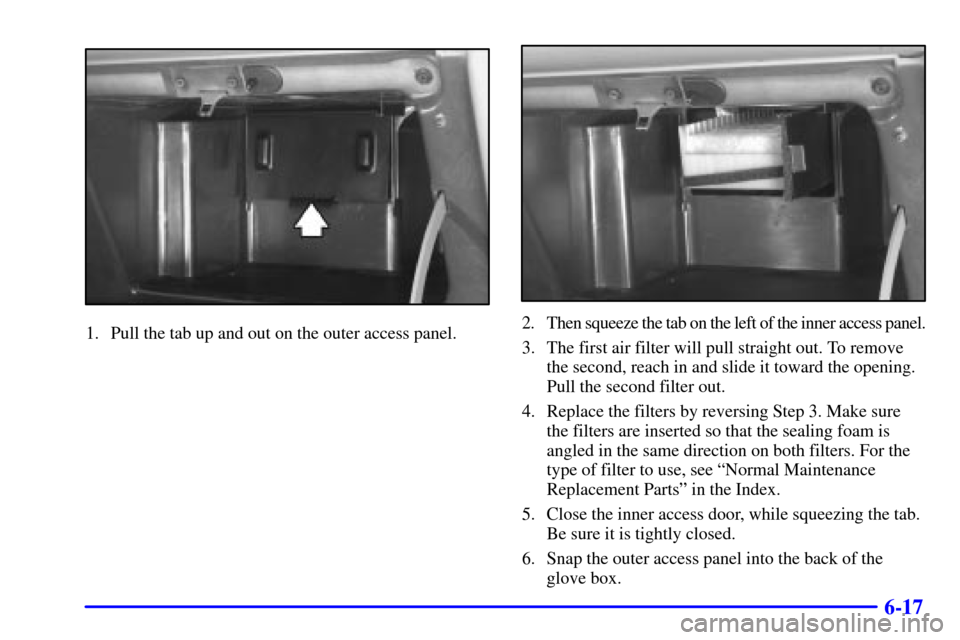
The access panel for the passenger compartment air
filter is located in the back of the glove box.
Page 341 of 429
6-17
1. Pull the tab up and out on the outer access panel.2. Then squeeze the tab on the left of the inner access panel.
3. The first air filter will pull straight out. To remove
the second, reach in and slide it toward the opening.
Pull the second filter out.
4. Replace the filters by reversing Step 3. Make sure
the filters are inserted so that the sealing foam is
angled in the same direction on both filters. For the
type of filter to use, see ªNormal Maintenance
Replacement Partsº in the Index.
5. Close the inner access door, while squeezing the tab.
Be sure it is tightly closed.
6. Snap the outer access panel into the back of the
glove box.
Page 347 of 429
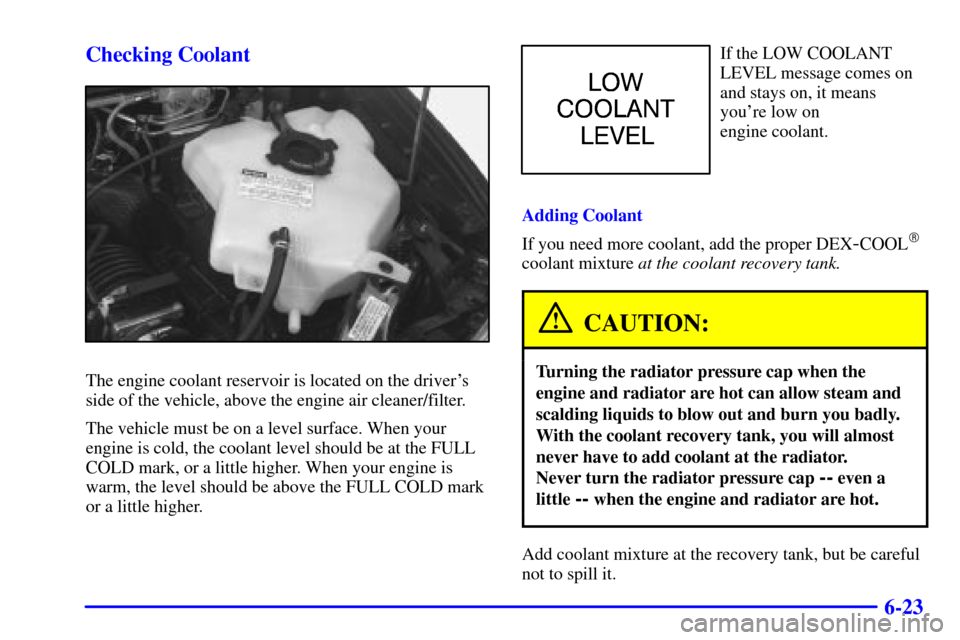
6-23 Checking Coolant
The engine coolant reservoir is located on the driver's
side of the vehicle, above the engine air cleaner/filter.
The vehicle must be on a level surface. When your
engine is cold, the coolant level should be at the FULL
COLD mark, or a little higher. When your engine is
warm, the level should be above the FULL COLD mark
or a little higher.
If the LOW COOLANT
LEVEL message comes on
and stays on, it means
you're low on
engine coolant.
Adding Coolant
If you need more coolant, add the proper DEX
-COOL�
coolant mixture at the coolant recovery tank.
CAUTION:
Turning the radiator pressure cap when the
engine and radiator are hot can allow steam and
scalding liquids to blow out and burn you badly.
With the coolant recovery tank, you will almost
never have to add coolant at the radiator.
Never turn the radiator pressure cap
-- even a
little
-- when the engine and radiator are hot.
Add coolant mixture at the recovery tank, but be careful
not to spill it.
Page 389 of 429
6-65
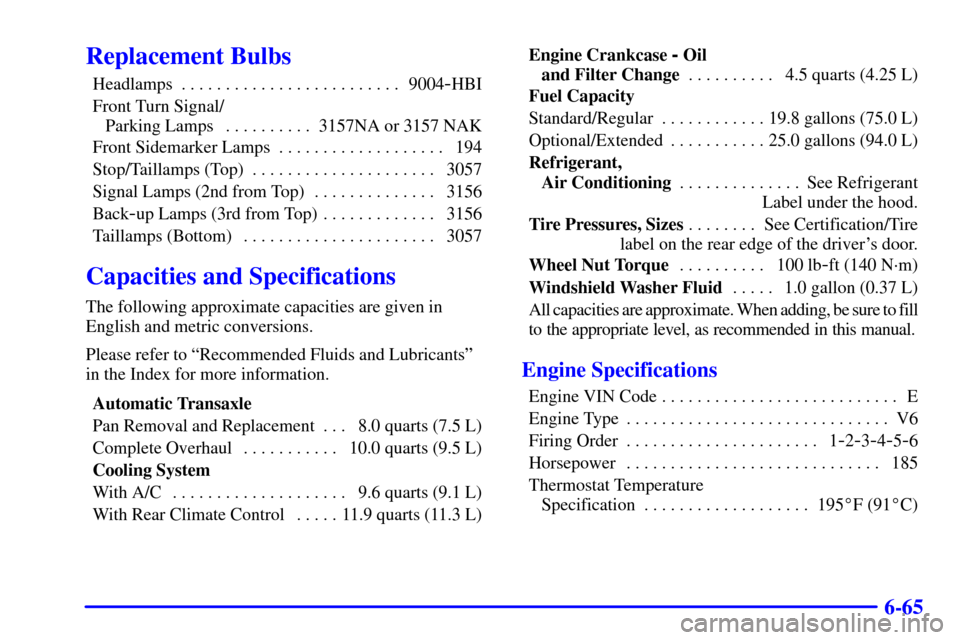
Replacement Bulbs
Headlamps 9004-HBI . . . . . . . . . . . . . . . . . . . . . . . . .
Front Turn Signal/
Parking Lamps 3157NA or 3157 NAK. . . . . . . . . .
Front Sidemarker Lamps 194. . . . . . . . . . . . . . . . . . .
Stop/Taillamps (Top) 3057. . . . . . . . . . . . . . . . . . . . .
Signal Lamps (2nd from Top) 3156. . . . . . . . . . . . . .
Back
-up Lamps (3rd from Top) 3156. . . . . . . . . . . . .
Taillamps (Bottom) 3057. . . . . . . . . . . . . . . . . . . . . .
Capacities and Specifications
The following approximate capacities are given in
English and metric conversions.
Please refer to ªRecommended Fluids and Lubricantsº
in the Index for more information.
Automatic Transaxle
Pan Removal and Replacement 8.0 quarts (7.5 L). . .
Complete Overhaul 10.0 quarts (9.5 L). . . . . . . . . . .
Cooling System
With A/C 9.6 quarts (9.1 L). . . . . . . . . . . . . . . . . . . .
With Rear Climate Control 11.9 quarts (11.3 L). . . . . Engine Crankcase
- Oil
and Filter Change4.5 quarts (4.25 L) . . . . . . . . . .
Fuel Capacity
Standard/Regular 19.8 gallons (75.0 L). . . . . . . . . . . .
Optional/Extended 25.0 gallons (94.0 L). . . . . . . . . . .
Refrigerant,
Air ConditioningSee Refrigerant . . . . . . . . . . . . . .
Label under the hood.
Tire Pressures, SizesSee Certification/Tire . . . . . . . .
label on the rear edge of the driver's door.
Wheel Nut Torque100 lb
-ft (140 N´m) . . . . . . . . . .
Windshield Washer Fluid1.0 gallon (0.37 L) . . . . .
All capacities are approximate. When adding, be sure to fill
to the appropriate level, as recommended in this manual.
Engine Specifications
Engine VIN Code E. . . . . . . . . . . . . . . . . . . . . . . . . . .
Engine Type V6. . . . . . . . . . . . . . . . . . . . . . . . . . . . . .
Firing Order 1
-2-3-4-5-6 . . . . . . . . . . . . . . . . . . . . . .
Horsepower 185. . . . . . . . . . . . . . . . . . . . . . . . . . . . .
Thermostat Temperature
Specification 195�F (91�C) . . . . . . . . . . . . . . . . . . .