Page 324 of 429
5-34
If You're Stuck: In Sand, Mud,
Ice or Snow
In order to free your vehicle when it is stuck, you will
need to spin the wheels, but you don't want to spin your
wheels too fast. The method known as ªrockingº can
help you get out when you're stuck, but you must
use caution.
CAUTION:
If you let your tires spin at high speed, they can
explode, and you or others could be injured. And,
the transaxle or other parts of the vehicle can
overheat. That could cause an engine
compartment fire or other damage. When you're
stuck, spin the wheels as little as possible. Don't
spin the wheels above 35 mph (55 km/h) as shown
on the speedometer.
NOTICE:
Spinning your wheels can destroy parts of your
vehicle as well as the tires. If you spin the wheels
too fast while shifting your transaxle back and
forth, you can destroy your transaxle.
For information about using tire chains on your vehicle,
see ªTire Chainsº in the Index.
Rocking Your Vehicle To Get It Out
First, turn your steering wheel left and right. That will
clear the area around your front wheels. If your vehicle
has traction control, you should turn your traction
control system off. (See ªTraction Control Systemº in
the Index.) Then shift back and forth between
REVERSE (R) and a forward gear, spinning the wheels
as little as possible. Release the accelerator pedal while
you shift, and press lightly on the accelerator pedal
when the transaxle is in gear. By slowly spinning your
wheels in the forward and reverse directions, you will
cause a rocking motion that may free your vehicle. If
that doesn't get you out after a few tries, you may need
to be towed out. If you do need to be towed out, see
ªTowing Your Vehicleº in the Index.
Page 342 of 429
6-18
Automatic Transaxle Fluid
When to Check and Change
A good time to check your automatic transaxle fluid
level is when the engine oil is changed.
Change both the fluid and filter every 50,000 miles
(83 000 km) if the vehicle is mainly driven under one or
more of these conditions:
�In heavy city traffic where the outside temperature
regularly reaches 90�F (32�C) or higher.
�In hilly or mountainous terrain.
�When doing frequent trailer towing.
�Uses such as found in taxi, police or delivery service.
If you do not use your vehicle under any of
these conditions, change the fluid and filter at
100,000 miles (166 000 km).
See ªScheduled Maintenance Servicesº in the Index.
How to Check
Because this operation can be a little difficult, you may
choose to have this done at the dealership service department.
If you do it yourself, be sure to follow all the instructions
here, or you could get a false reading on the dipstick.
NOTICE:
Too much or too little fluid can damage your
transaxle. Too much can mean that some of the
fluid could come out and fall on hot engine parts
or exhaust system parts, starting a fire. Be sure to
get an accurate reading if you check your
transaxle fluid.
Wait at least 30 minutes before checking the transaxle
fluid level if you have been driving:
�When outside temperatures are above 90�F (32�C).
�At high speed for quite a while.
�In heavy traffic
-- especially in hot weather.
�While pulling a trailer.
To get the right reading, the fluid should be at normal
operating temperature, which is 180�F to 200�F
(82�C to 93�C).
Get the vehicle warmed up by driving about 15 miles
(24 km) when outside temperatures are above 50�F
(10�C). If it's colder than 50�F (10�C), you may have
to drive longer.
Page 401 of 429
Scheduled Maintenance
7-11
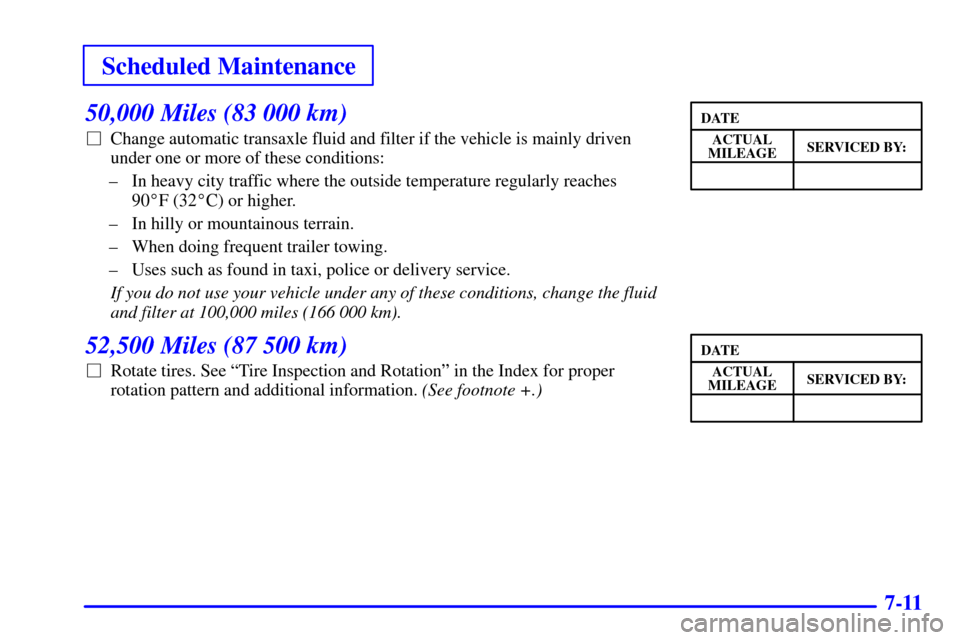
50,000 Miles (83 000 km)
�Change automatic transaxle fluid and filter if the vehicle is mainly driven
under one or more of these conditions:
± In heavy city traffic where the outside temperature regularly reaches
90�F (32�C) or higher.
± In hilly or mountainous terrain.
± When doing frequent trailer towing.
± Uses such as found in taxi, police or delivery service.
If you do not use your vehicle under any of these conditions, change the fluid
and filter at 100,000 miles (166 000 km).
52,500 Miles (87 500 km)
�Rotate tires. See ªTire Inspection and Rotationº in the Index for proper
rotation pattern and additional information. (See footnote +.)
ACTUAL
SERVICED BY:MILEAGE
DATE
ACTUAL
SERVICED BY:MILEAGE
DATE
Page 404 of 429
Scheduled Maintenance
7-14
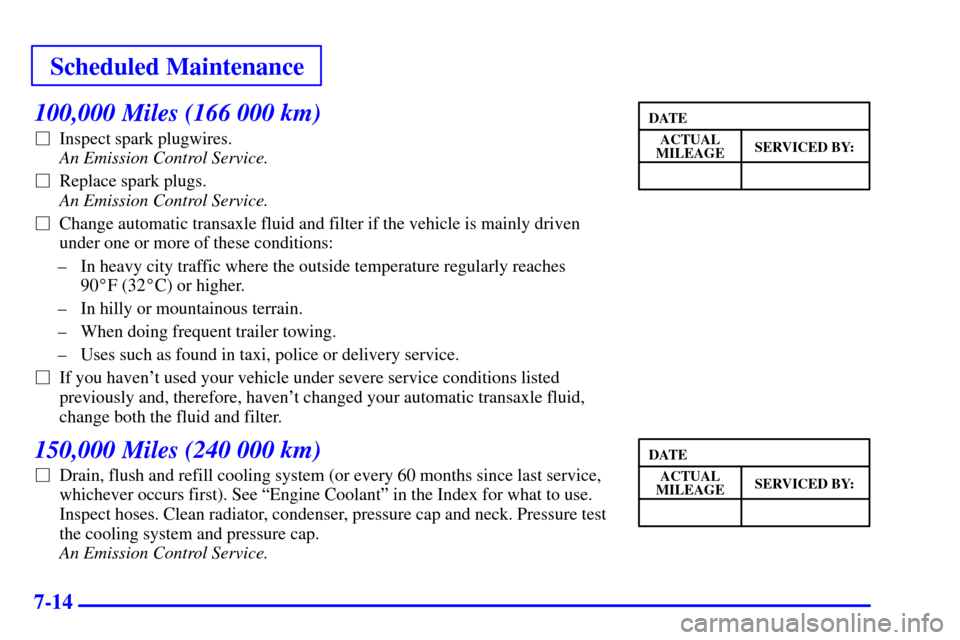
100,000 Miles (166 000 km)
�Inspect spark plugwires.
An Emission Control Service.
�Replace spark plugs.
An Emission Control Service.
�Change automatic transaxle fluid and filter if the vehicle is mainly driven
under one or more of these conditions:
± In heavy city traffic where the outside temperature regularly reaches
90�F (32�C) or higher.
± In hilly or mountainous terrain.
± When doing frequent trailer towing.
± Uses such as found in taxi, police or delivery service.
�If you haven't used your vehicle under severe service conditions listed
previously and, therefore, haven't changed your automatic transaxle fluid,
change both the fluid and filter.
150,000 Miles (240 000 km)
�Drain, flush and refill cooling system (or every 60 months since last service,
whichever occurs first). See ªEngine Coolantº in the Index for what to use.
Inspect hoses. Clean radiator, condenser, pressure cap and neck. Pressure test
the cooling system and pressure cap.
An Emission Control Service.
ACTUAL
SERVICED BY:MILEAGE
DATE
ACTUAL
SERVICED BY:MILEAGE
DATE
Page 422 of 429
8-6
Chevrolet Roadside Assistance Program
To enhance Chevrolet's strong commitment to customer
satisfaction, Chevrolet is excited to announce the
establishment of the Chevrolet Roadside Assistance
Center. As the owner of a 2000 Chevrolet, membership
in Roadside Assistance is free.
Roadside Assistance is available 24 hours a day,
365 days a year, by calling 1
-800-CHEV-USA (243-8872).
This toll-free number will provide you over
-the-phone
roadside assistance with minor mechanical problems. If your problem cannot be resolved over the
phone, our advisors have access to a nationwide network
of dealer recommended service providers. Roadside
membership is free; however some services may incur costs.
Roadside offers two levels of service to the customer,
Basic Care and Courtesy Care:
�Toll
-free number, 1-800-CHEV-USA (243-8872)
�Free towing for warranty repairs
�Basic over
-the-phone technical advice
�Available dealer services at reasonable costs (i.e.,
wrecker services, locksmith/key service, glass
repair, etc.)
ROADSIDE Courtesy Care PROVIDES:
�Roadside Basic Care services (as outlined previously)
Plus:
�FREE Non
-Warranty Towing (to the closest dealer
from a legal roadway)
�FREE Locksmith/Key Service (when keys are lost
on the road or locked inside)
�FREE Flat Tire Service (spare installed on the road)
�FREE Jump Start (at home or on the road)
�FREE Fuel Delivery ($5 of fuel delivered on
the road)