Page 82 of 429
1-70
Child Restraints
Every time infants and young children ride in vehicles,
they should have protection provided by
appropriate restraints.
Q:What are the different types of add-on
child restraints?
A:Add-on child restraints are available in four basic
types. When selecting a child restraint, take into
consideration not only the child's weight and size,
but also whether or not the restraint will be
compatible with the motor vehicle in which it will
be used.
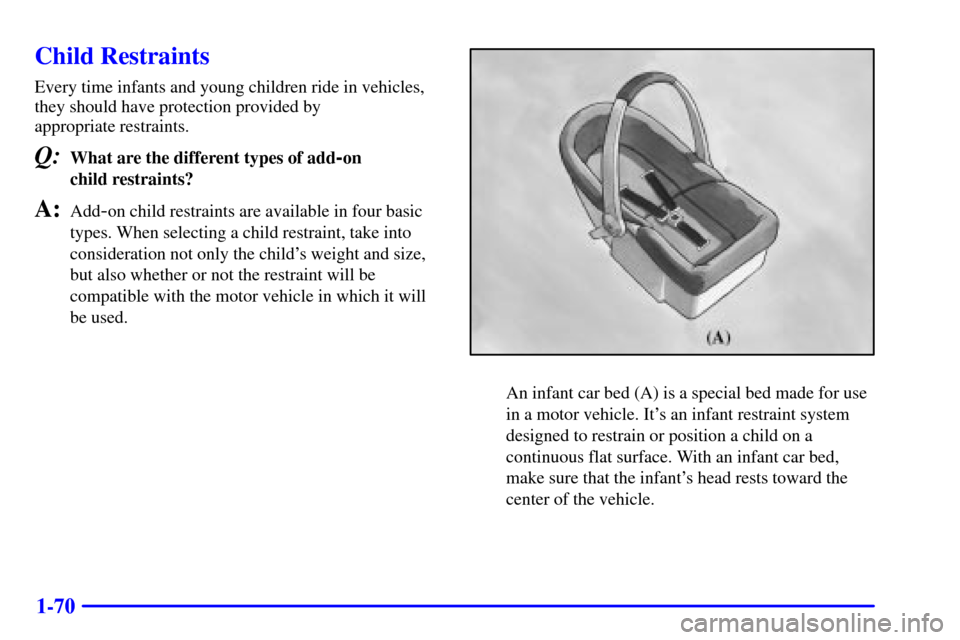
An infant car bed (A) is a special bed made for use
in a motor vehicle. It's an infant restraint system
designed to restrain or position a child on a
continuous flat surface. With an infant car bed,
make sure that the infant's head rests toward the
center of the vehicle.
Page 101 of 429
1-89
Accident statistics show that children are safer if they
are restrained in the rear seat. But they need to use the
safety belts properly.
�Children who aren't buckled up can be thrown out in
a crash.
�Children who aren't buckled up can strike other
people who are.
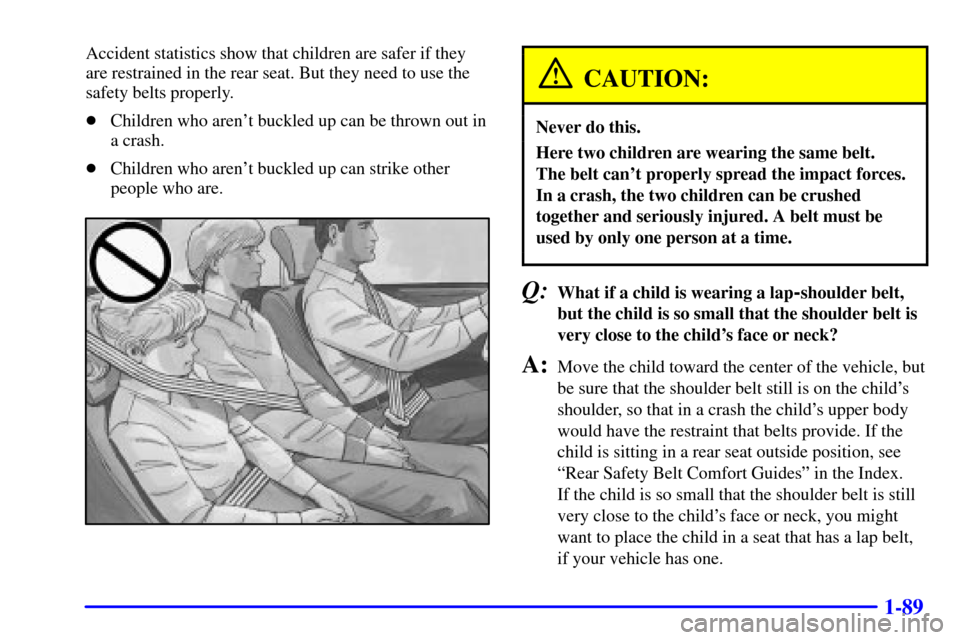
CAUTION:
Never do this.
Here two children are wearing the same belt.
The belt can't properly spread the impact forces.
In a crash, the two children can be crushed
together and seriously injured. A belt must be
used by only one person at a time.
Q:What if a child is wearing a lap-shoulder belt,
but the child is so small that the shoulder belt is
very close to the child's face or neck?
A:Move the child toward the center of the vehicle, but
be sure that the shoulder belt still is on the child's
shoulder, so that in a crash the child's upper body
would have the restraint that belts provide. If the
child is sitting in a rear seat outside position, see
ªRear Safety Belt Comfort Guidesº in the Index.
If the child is so small that the shoulder belt is still
very close to the child's face or neck, you might
want to place the child in a seat that has a lap belt,
if your vehicle has one.
Page 108 of 429
2-4
Door Locks
CAUTION:
Unlocked doors can be dangerous.
Passengers -- especially children -- can easily
open the doors and fall out. When a door is
locked, the inside handle won't open it.
Outsiders can easily enter through an unlocked
door when you slow down or stop your vehicle.
This may not be so obvious: You increase the
chance of being thrown out of the vehicle in a
crash if the doors aren't locked. Wear safety belts
properly, lock your doors, and you will be far
better off whenever you drive your vehicle.
There are several ways to lock and unlock your vehicle.
From the outside, use your key or the remote keyless
entry transmitter (if your vehicle has this option).
To unlock either front door from the outside with the
key, insert the key and turn it toward the front of
the vehicle.You can lock either front door from the outside with
your key by inserting and turning it toward the rear of
the vehicle.
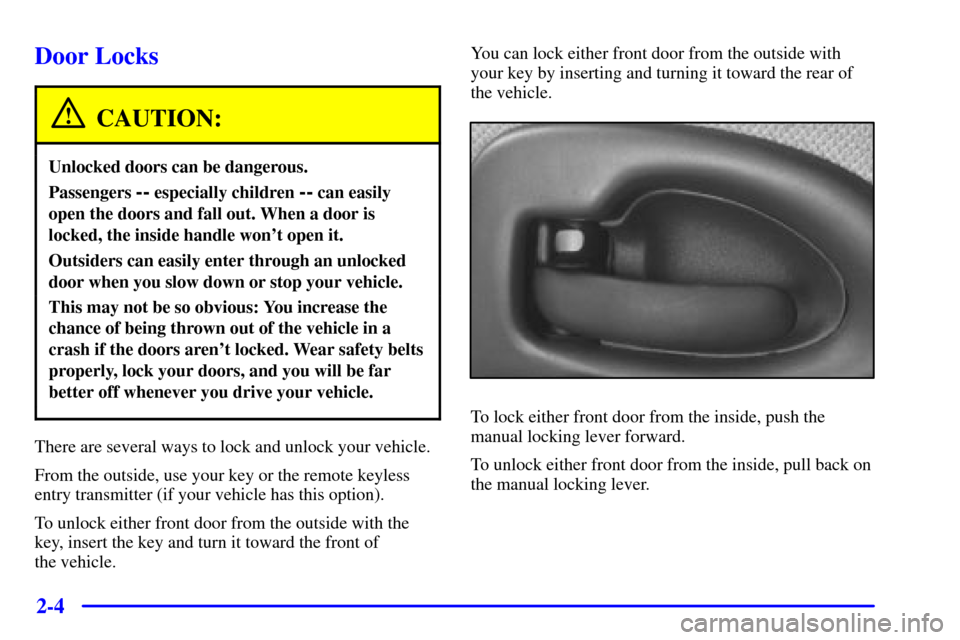
To lock either front door from the inside, push the
manual locking lever forward.
To unlock either front door from the inside, pull back on
the manual locking lever.
Page 119 of 429

2-15
Entering Programming Mode
To program features, your vehicle must be in the
programming mode. Follow these steps:
1. The content theft
-deterrent system (if equipped)
must be disarmed. See ªContent Theft
-Deterrent
Systemº in this section.
2. Remove the BCM PRGRM fuse from the instrument
panel fuse block, located to the right of the glove
box. (See ªFuses and Circuit Breakersº in the Index.)
3. Close the driver's door.
4. Turn the ignition key towards you to ACCESSORY.
5. Count the number of chimes you hear. You will hear
two to four chimes depending on the features your
vehicle is equipped with. Refer to the chart
shown previously.
You can now program your choices.
To exit the programming mode, follow the steps listed
under ªExiting Programming Modeº later in
this section.
Delayed Illumination and Exit Lighting
With delayed illumination, the interior lamps will stay
on for about 25 seconds after all the doors and the
liftgate are closed.
With exit lighting, the interior lamps will come on and
stay on for about 25 seconds whenever you remove the
key from the ignition.
To customize these features to your preference,
see ªProgrammable Modesº following.
Programmable Modes
Your vehicle can be programmed to one of the
following modes.
Mode 1: Both Features Off (The interior lamps will turn
on or off at the same instant that a door is opened
or closed.)
Mode 2: Delayed Illumination Only (The interior lamps
will stay on for about 25 seconds after all the doors and
liftgate are closed, or until you lock the doors.)
Mode 3: Exit Lighting Only (The interior lamps will
come on whenever you remove the key from the ignition
and stay on for about 25 seconds, or until you lock
the doors.)
Page 128 of 429

2-24 Exiting Programming Mode
To exit programming mode, just turn the key from
ACCESSORY to OFF and put the BCM PRGRM fuse
back into the instrument panel fuse block.
After programming a feature, you can exit the
programming mode at anytime. Also, if your vehicle is
equipped with the content
-theft deterrent system,
remember to arm the system before exiting.
Sliding Door
To open the sliding door from outside the vehicle, pull
the handle out and then pull the door toward the rear. If
you slide the door all the way back, the door will rest in
a detent position. The door must overcome this detent
when closing.
To move the door forward, you must first pull the door
past the open detent position.
If your vehicle has a sliding door on the driver's side,
the door is designed to open only a little if the fuel door
is open. If this ever happens, don't try to force the
sliding door. Just close the driver's side sliding door.
Then when the fuel filler door is closed, the driver's side
sliding door can be opened normally.
Sliding Door Lock
Page 133 of 429
2-29
If you want to open the power sliding door when the
switch is turned on, pull the inside or outside handle and
let go. The door will open fully.
To open the power sliding door when the power sliding
door switch is off, pull the inside or outside handle and
slide the door all the way back.
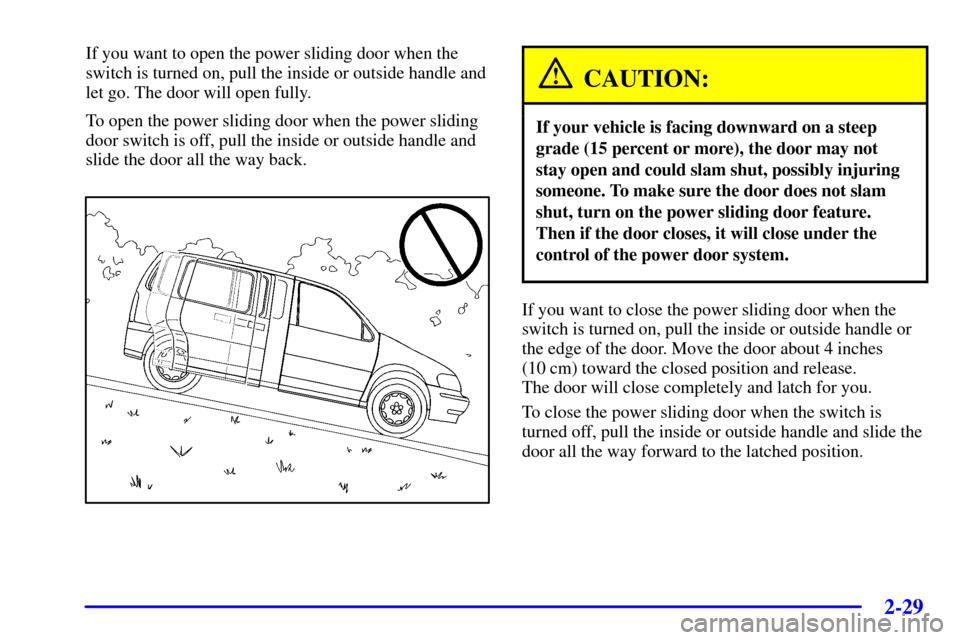
CAUTION:
If your vehicle is facing downward on a steep
grade (15 percent or more), the door may not
stay open and could slam shut, possibly injuring
someone. To make sure the door does not slam
shut, turn on the power sliding door feature.
Then if the door closes, it will close under the
control of the power door system.
If you want to close the power sliding door when the
switch is turned on, pull the inside or outside handle or
the edge of the door. Move the door about 4 inches
(10 cm) toward the closed position and release.
The door will close completely and latch for you.
To close the power sliding door when the switch is
turned off, pull the inside or outside handle and slide the
door all the way forward to the latched position.
Page 142 of 429

2-38
New Vehicle ªBreak-Inº
NOTICE:
Your vehicle doesn't need an elaborate
ªbreak
-in.º But it will perform better in the long
run if you follow these guidelines:
�Don't drive at any one speed -- fast or
slow
-- for the first 500 miles (805 km).
Don't make full
-throttle starts.
�Avoid making hard stops for the first
200 miles (322 km) or so. During this time
your new brake linings aren't yet broken
in. Hard stops with new linings can mean
premature wear and earlier replacement.
Follow this breaking
-in guideline every
time you get new brake linings.
�Don't tow a trailer during break
-in.
See ªTowing a Trailerº in the Index for
more information.
Ignition Positions
With the key in the ignition, you can turn the switch to
five positions.
ACCESSORY (A): This is an on position in which you
can operate your electrical power accessories. Press in
the ignition switch as you turn the top of it toward you.
LOCK (B): This is the only position in which you can
remove the key. This locks your steering wheel,
ignition and transaxle.
Page 143 of 429

2-39
NOTICE:
If your key seems stuck in LOCK and you can't
turn it, be sure you are using the correct key;
if so, is it all the way in? If it is, then turn the
steering wheel left and right while you turn the
key hard. But turn the key only with your hand.
Using a tool to force it could break the key or the
ignition switch. If none of this works, then your
vehicle needs service.
OFF (C): This position unlocks the steering wheel,
ignition and transaxle, but does not send electrical
power to any accessories. Use this position if your
vehicle must be pushed or towed, but never try to
push
-start your vehicle. A warning chime will sound if
you open the driver's door when the ignition is off and
the key is in the ignition.RUN (D): This is an on position to which the switch
returns after you start your engine and release the
switch. The switch stays in RUN when the engine is
running. But even when the engine is not running, you
can use RUN to operate your electrical power
accessories, and to display some instrument panel
warning lights.
START (E): This position starts the engine. When the
engine starts, release the key. The ignition switch will
return to RUN for normal driving.
If the engine is not running, ACCESSORY and RUN are
positions that allow you to operate your electrical
accessories, such as the radio.
Retained Accessory Power (RAP)
With RAP, the power windows (option), the power rear
quarter windows (if equipped), audio system and
electronic level control (ELC) will continue to work up
to 10 minutes after the ignition key is turned to OFF and
none of the doors are opened.