Page 154 of 407

2-78
NOTICE:
If you keep driving your vehicle with this light
on, after a while, your emission controls may not
work as well, your fuel economy may not be as
good and your engine may not run as smoothly.
This could lead to costly repairs that may not be
covered by your warranty.
NOTICE:
Modifications made to the engine, transmission,
exhaust or fuel system of your vehicle or the
replacement of the original tires with other
than those of the same Tire Performance
Criteria (TPC) can affect your vehicle's emission
controls and may cause the SERVICE ENGINE
SOON or CHECK ENGINE light to come on.
Modifications to these systems could lead to
costly repairs not covered by your warranty.
This may also result in a failure to pass a
required Emission Inspection/Maintenance test.
This light should come on, as a check to show you it is
working, when the ignition is on and the engine is not
running. If the light doesn't come on, have it repaired.
This light will also come on during a malfunction in one
of two ways:
�Light Flashing
-- A misfire condition has been
detected. A misfire increases vehicle emissions and
may damage the emission control system on your
vehicle. Dealer or qualified service center diagnosis
and service may be required.
�Light On Steady
-- An emission control system
malfunction has been detected on your vehicle.
Dealer or qualified service center diagnosis and
service may be required.
If the Light Is Flashing
The following may prevent more serious damage to
your vehicle:
�Reducing vehicle speed.
�Avoiding hard accelerations.
�Avoiding steep uphill grades.
�If you are towing a trailer, reduce the amount of
cargo being hauled as soon as it is possible.
Page 160 of 407

2-84
The following situations can cause the transmission to
operate at higher temperatures:
�Towing a trailer
�Hot outside air temperatures
�Hauling a large or heavy load
�Low transmission fluid level
�High transmission fluid level
�Restricted air flow to the radiator and the auxiliary
transmission oil cooler (if equipped).
A temporary solution to hotter transmission operating
temperatures may be to let the transmission cool down.
If the transmission is operated at higher temperatures on
a frequent basis, see ªScheduled Maintenanceº in the
Index for the proper transmission maintenance intervals.TRANS HOT...IDLE ENGINE
Your vehicle has a transmission over-temperature
display contained in the message center.
If this warning message is
displayed, pull the vehicle
off the roadway when it is
safe to do so.
Set the parking brake and place the transmission in
PARK (P). Idle the engine until the message center no
longer displays a message. If idling the engine does not
turn the warning message off after 10 to 15 minutes,
contact your nearest dealer or the GM Roadside Assistance
Center. See ªRoadside Assistanceº in the Index.
NOTICE:
If you keep driving your vehicle with the
transmission TRANS HOT...IDLE ENGINE
message displayed, you can damage the
transmission. This could lead to costly repairs
that may not be covered under your warranty.
Page 161 of 407

2-85
The following situations can cause the transmission to
operate at higher temperatures:
�Towing a trailer
�Hot outside air temperatures
�Hauling a heavy load
�Low transmission fluid level
�High transmission fluid level
�Restricted air flow to the radiator and the auxiliary
transmission oil cooler (if equipped).
A temporary solution to hotter transmission operating
temperatures may be to let the transmission cool down.
If the transmission is operated at higher temperatures on
a frequent basis, see ªScheduled Maintenanceº in the
Index for the proper transmission maintenance intervals.LOW COOLANT
This message is displayed
when the cooling system is
low on coolant.
The engine may overheat. See ªEngine Coolantº in the
Index and have your vehicle serviced as soon as you can.
CHECK COOLANT TEMP
This message is displayed
when the cooling system
temperature gets hot.
Check the coolant temperature gage and the coolant
level. See ªEngine Coolantº and ªEngine Coolant
Temperature Gageº in the Index. See ªEngine
Overheatingº in the Index for further information.
Page 202 of 407
4-
4-1
Section 4 Your Driving and the Road
Here you'll find information about driving on different kinds of roads and in varying weather conditions. We've also
included many other useful tips on driving.
4
-2 Defensive Driving
4
-3 Drunken Driving
4
-6 Control of a Vehicle
4
-6 Braking
4
-9 Traction Assist System (Option)
4
-11 Steering
4
-13 Off-Road Recovery
4
-14 Passing
4
-15 Loss of Control
4
-16 Off-Road Driving with Your
Four
-Wheel-Drive Vehicle4
-31 Driving at Night
4
-32 Driving in Rain and on Wet Roads
4
-35 City Driving
4
-36 Freeway Driving
4
-37 Before Leaving on a Long Trip
4
-38 Highway Hypnosis
4
-38 Hill and Mountain Roads
4
-40 Winter Driving
4
-44 Recreational Vehicle Towing
4
-46 Loading Your Vehicle
4
-51 Towing a Trailer
Page 245 of 407
4-44
Recreational Vehicle Towing
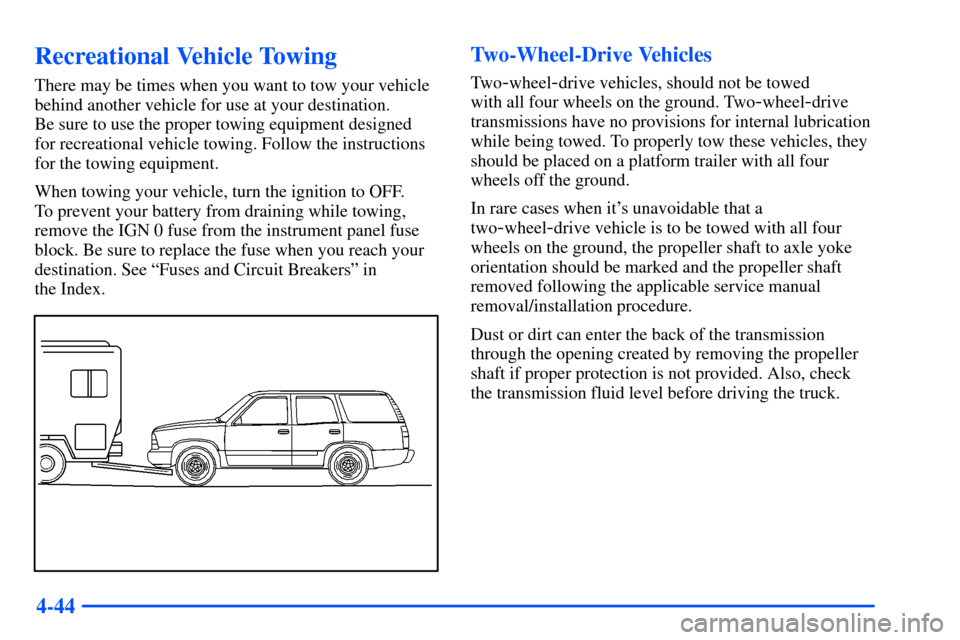
There may be times when you want to tow your vehicle
behind another vehicle for use at your destination.
Be sure to use the proper towing equipment designed
for recreational vehicle towing. Follow the instructions
for the towing equipment.
When towing your vehicle, turn the ignition to OFF.
To prevent your battery from draining while towing,
remove the IGN 0 fuse from the instrument panel fuse
block. Be sure to replace the fuse when you reach your
destination. See ªFuses and Circuit Breakersº in
the Index.
Two-Wheel-Drive Vehicles
Tw o-wheel-drive vehicles, should not be towed
with all four wheels on the ground. Two
-wheel-drive
transmissions have no provisions for internal lubrication
while being towed. To properly tow these vehicles, they
should be placed on a platform trailer with all four
wheels off the ground.
In rare cases when it's unavoidable that a
two
-wheel-drive vehicle is to be towed with all four
wheels on the ground, the propeller shaft to axle yoke
orientation should be marked and the propeller shaft
removed following the applicable service manual
removal/installation procedure.
Dust or dirt can enter the back of the transmission
through the opening created by removing the propeller
shaft if proper protection is not provided. Also, check
the transmission fluid level before driving the truck.
Page 246 of 407
4-45 Four-Wheel-Drive Vehicles
CAUTION:
Shifting the transfer case into NEUTRAL (N) can
cause your vehicle to roll even if the transmission
is in PARK (P), for an automatic transmission.
You or others could be injured. Make sure the
parking brake is firmly set before you shift the
transfer case into NEUTRAL (N).
�Firmly set the parking brake.
�Shift the transmission to PARK (P).�Securely attach the vehicle being towed to
the tow vehicle.
�Shift the transfer case to NEUTRAL (N).
See ªFour
-Wheel Driveº in the Index for
the proper procedure to select the NEUTRAL
position for your vehicle.
�Release the parking brake only after the
vehicle being towed is firmly attached to the
towing vehicle.
�Turn the ignition to OFF. The OFF position
unlocks the steering column and reduces battery
drain as long as the IGN 0 fuse is removed.
Unlocking the steering column will allow the
proper movement of the front wheels and tires
during towing.
Page 251 of 407

4-50
For example, adding a 700 lb. ( 318 kg) snow plow
adds more than 700 lb. ( 318 kg) to the front axle.
Using the formula, if the snow plow is 4 ft. (122 cm)
in front of the front axle and the wheel base is
10 ft. (305 cm), then:
W= 700 lb. ( 318 kg), A= 4 ft. (122 cm) and
W.B.= 10 ft. (305 cm)
(W x (A+W.B.)) / W.B. = (700 x (4ft. + 10 ft.)) /
10 ft. = 980 lbs.
So, if your truck's front axle reserve capacity is more
than 980 lbs. (445 kg), you could add this snow plow
without exceeding the front GAWR.
You can add heavier equipment on the front of the
vehicle if you compensate for it by carrying fewer
passengers, less cargo or by positioning cargo more
towards the rear. This has the effect of reducing the
load on the front. However, the front GAWR, rear
GAWR and the GVWR must never be exceeded.Total Vehicle Reserve Capacity
This is the difference between your GVWR and the
weight of your truck with full fuel and passengers.
It is the amount of weight you can add to your vehicle
before reaching your GVWR.
The reserve capacity numbers are intended as a guide
when selecting the amount of equipment or cargo your
truck can carry. If you are unsure of your truck's front,
rear or total weight, go to a weigh station and weigh
your vehicle. Your dealer can help you with this.
Trailer Recommendations
You must subtract your hitch loads from the CWR
for your vehicle. Weigh your vehicle with the trailer
attached, so that you won't go over the GVWR or
GAWR. If you are using a weight
-distributing hitch,
weigh the vehicle without the equalizer bars in place.
You'll get the best performance if you spread out the
weight of your load the right way, and if you choose the
correct hitch and trailer brakes.
For more information, see ªTrailer Towingº in the Index.
Page 252 of 407

4-51
Towing a Trailer
CAUTION:
If you don't use the correct equipment and drive
properly, you can lose control when you pull a
trailer. For example, if the trailer is too heavy,
the brakes may not work well
-- or even at all.
You and your passengers could be seriously
injured. Pull a trailer only if you have followed
all the steps in this section. Ask your dealer for
advice and information about towing a trailer
with your vehicle.
NOTICE:
Pulling a trailer improperly can damage your
vehicle and result in costly repairs not covered by
your warranty. To pull a trailer correctly, follow
the advice in this part, and see your dealer for
important information about towing a trailer
with your vehicle.
To identify what the vehicle trailering capacity is
for your vehicle, you should read the information
in ªWeight of the Trailerº that appears later in
this section.
If yours was built with trailering options, as many are,
it's ready for heavier trailers. But trailering is different
than just driving your vehicle by itself. Trailering means
changes in handling, durability and fuel economy.
Successful, safe trailering takes correct equipment,
and it has to be used properly.
That's the reason for this part. In it are many
time
-tested, important trailering tips and safety rules.
Many of these are important for your safety and that of
your passengers. So please read this section carefully
before you pull a trailer.