Page 242 of 407
4-41
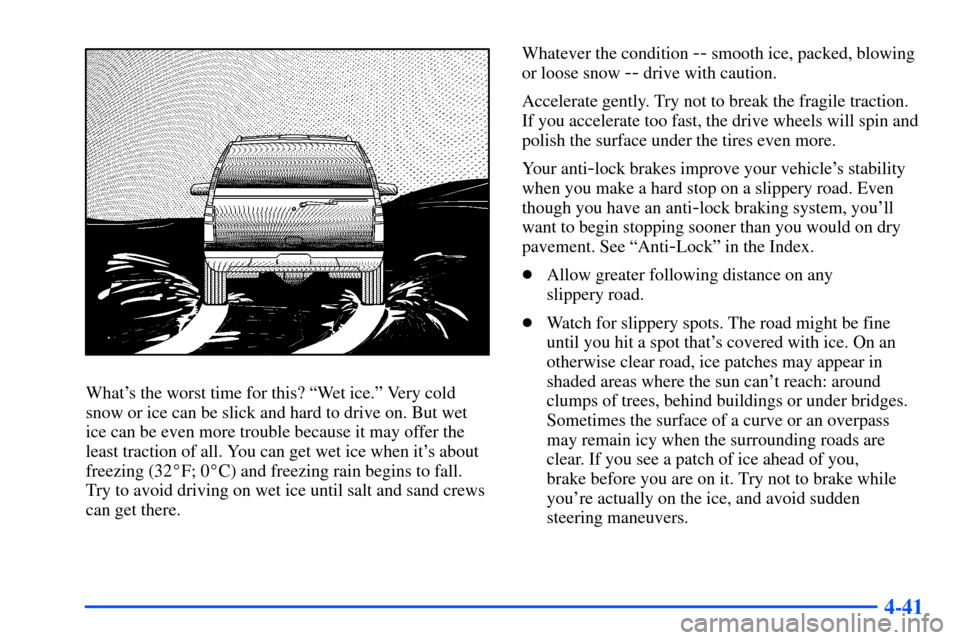
What's the worst time for this? ªWet ice.º Very cold
snow or ice can be slick and hard to drive on. But wet
ice can be even more trouble because it may offer the
least traction of all. You can get wet ice when it's about
freezing (32�F; 0�C) and freezing rain begins to fall.
Try to avoid driving on wet ice until salt and sand crews
can get there.Whatever the condition
-- smooth ice, packed, blowing
or loose snow
-- drive with caution.
Accelerate gently. Try not to break the fragile traction.
If you accelerate too fast, the drive wheels will spin and
polish the surface under the tires even more.
Your anti
-lock brakes improve your vehicle's stability
when you make a hard stop on a slippery road. Even
though you have an anti
-lock braking system, you'll
want to begin stopping sooner than you would on dry
pavement. See ªAnti
-Lockº in the Index.
�Allow greater following distance on any
slippery road.
�Watch for slippery spots. The road might be fine
until you hit a spot that's covered with ice. On an
otherwise clear road, ice patches may appear in
shaded areas where the sun can't reach: around
clumps of trees, behind buildings or under bridges.
Sometimes the surface of a curve or an overpass
may remain icy when the surrounding roads are
clear. If you see a patch of ice ahead of you,
brake before you are on it. Try not to brake while
you're actually on the ice, and avoid sudden
steering maneuvers.
Page 244 of 407

4-43
CAUTION:
Snow can trap exhaust gases under your vehicle.
This can cause deadly CO (carbon monoxide) gas
to get inside. CO could overcome you and kill
you. You can't see it or smell it, so you might not
know it is in your vehicle. Clear away snow from
around the base of your vehicle, especially any
that is blocking your exhaust pipe. And check
around again from time to time to be sure snow
doesn't collect there.
Open a window just a little on the side of the
vehicle that's away from the wind. This will help
keep CO out.
Run your engine only as long as you must. This saves
fuel. When you run the engine, make it go a little faster
than just idle. That is, push the accelerator slightly.
This uses less fuel for the heat that you get and it
keeps the battery charged. You will need a well
-charged
battery to restart the vehicle, and possibly for signaling
later on with your headlamps. Let the heater run
for a while.
Then, shut the engine off and close the window almost
all the way to preserve the heat. Start the engine again
and repeat this only when you feel really uncomfortable
from the cold. But do it as little as possible. Preserve the
fuel as long as you can. To help keep warm, you can get
out of the vehicle and do some fairly vigorous exercises
every half hour or so until help comes.
Page 245 of 407
4-44
Recreational Vehicle Towing
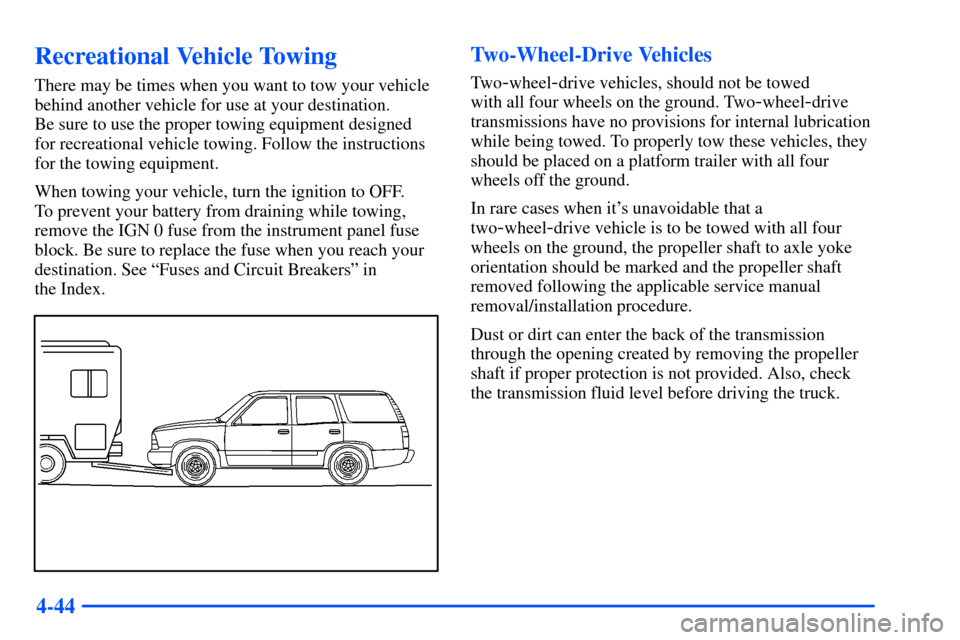
There may be times when you want to tow your vehicle
behind another vehicle for use at your destination.
Be sure to use the proper towing equipment designed
for recreational vehicle towing. Follow the instructions
for the towing equipment.
When towing your vehicle, turn the ignition to OFF.
To prevent your battery from draining while towing,
remove the IGN 0 fuse from the instrument panel fuse
block. Be sure to replace the fuse when you reach your
destination. See ªFuses and Circuit Breakersº in
the Index.
Two-Wheel-Drive Vehicles
Tw o-wheel-drive vehicles, should not be towed
with all four wheels on the ground. Two
-wheel-drive
transmissions have no provisions for internal lubrication
while being towed. To properly tow these vehicles, they
should be placed on a platform trailer with all four
wheels off the ground.
In rare cases when it's unavoidable that a
two
-wheel-drive vehicle is to be towed with all four
wheels on the ground, the propeller shaft to axle yoke
orientation should be marked and the propeller shaft
removed following the applicable service manual
removal/installation procedure.
Dust or dirt can enter the back of the transmission
through the opening created by removing the propeller
shaft if proper protection is not provided. Also, check
the transmission fluid level before driving the truck.
Page 246 of 407
4-45 Four-Wheel-Drive Vehicles
CAUTION:
Shifting the transfer case into NEUTRAL (N) can
cause your vehicle to roll even if the transmission
is in PARK (P), for an automatic transmission.
You or others could be injured. Make sure the
parking brake is firmly set before you shift the
transfer case into NEUTRAL (N).
�Firmly set the parking brake.
�Shift the transmission to PARK (P).�Securely attach the vehicle being towed to
the tow vehicle.
�Shift the transfer case to NEUTRAL (N).
See ªFour
-Wheel Driveº in the Index for
the proper procedure to select the NEUTRAL
position for your vehicle.
�Release the parking brake only after the
vehicle being towed is firmly attached to the
towing vehicle.
�Turn the ignition to OFF. The OFF position
unlocks the steering column and reduces battery
drain as long as the IGN 0 fuse is removed.
Unlocking the steering column will allow the
proper movement of the front wheels and tires
during towing.
Page 266 of 407
4-65 Power Winches
If you wish to use a power winch on your vehicle, only
use it when your vehicle is stationary or anchored.
NOTICE:
Using a power winch with the transmission in
gear may damage the transmission. When
operating a power winch, always leave the
transmission in NEUTRAL (N).
Use the regular brakes, set the parking brake, or block
the wheels to keep your vehicle from rolling.
Step-Bumper Pad
If your vehicle has a rear step bumper, it may be
equipped with a rear step pad at the center of the bumper.
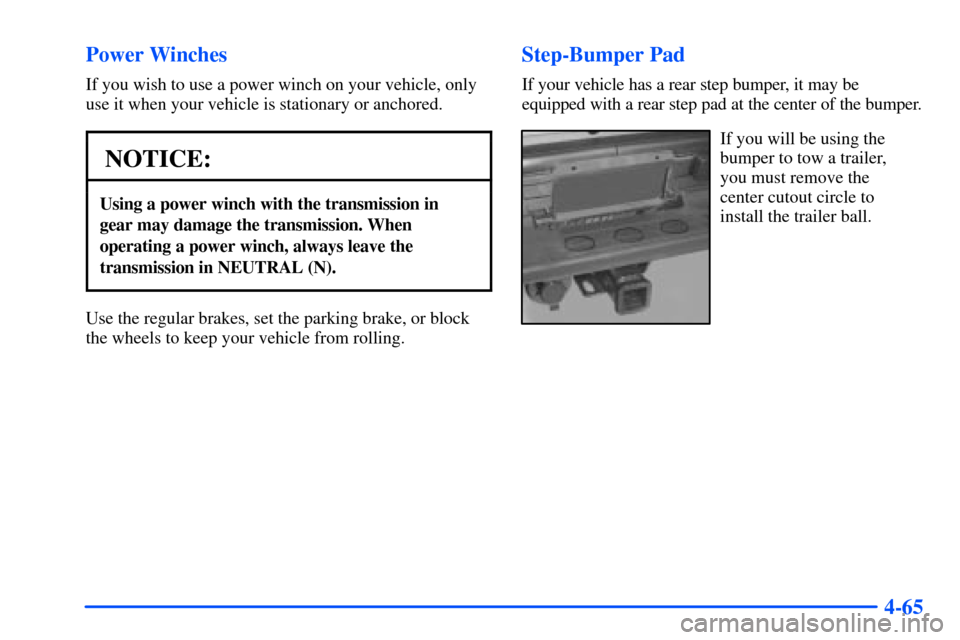
If you will be using the
bumper to tow a trailer,
you must remove the
center cutout circle to
install the trailer ball.
Page 282 of 407
5-16
1. You can remove the coolant surge tank pressure
cap when the cooling system, including the coolant
surge tank pressure cap and upper radiator hose,
is no longer hot. Turn the pressure cap slowly
counterclockwise (left) about one full turn. If you
hear a hiss, wait for that to stop. A hiss means there
is still some pressure left.
2. Then keep turning the pressure cap slowly, and
remove it.3. Then fill the coolant surge tank with the proper
mixture, to the FILL COLD mark.
Page 285 of 407
5-19
Changing a Flat Tire
If a tire goes flat, avoid further tire and wheel damage
by driving slowly to a level place. Turn on your hazard
warning flashers.
CAUTION:
Changing a tire can cause an injury. The vehicle
can slip off the jack and roll over you or other
people. You and they could be badly injured.
Find a level place to change your tire. To help
prevent the vehicle from moving:
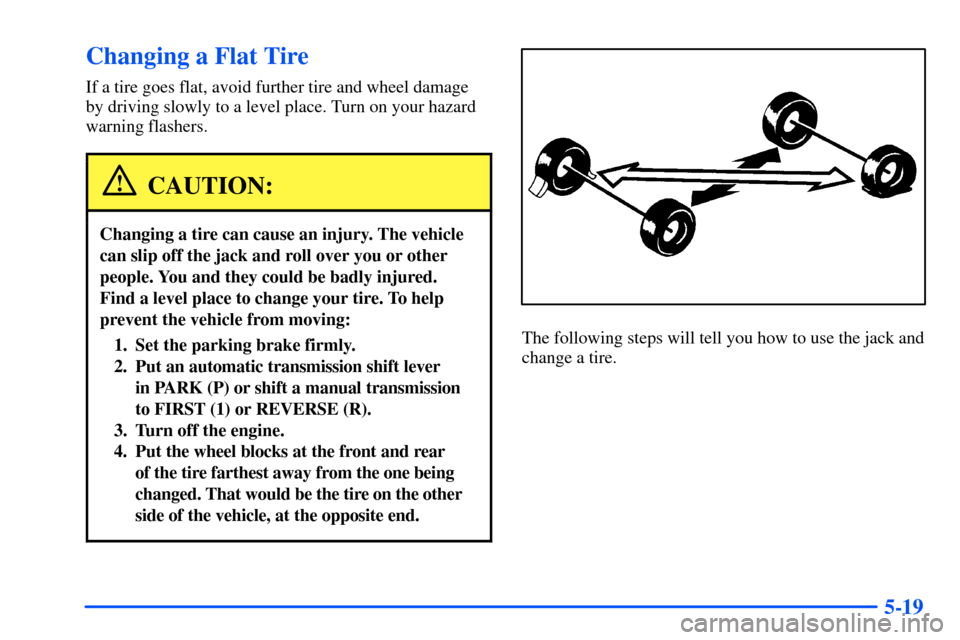
1. Set the parking brake firmly.
2. Put an automatic transmission shift lever
in PARK (P) or shift a manual transmission
to FIRST (1) or REVERSE (R).
3. Turn off the engine.
4. Put the wheel blocks at the front and rear
of the tire farthest away from the one being
changed. That would be the tire on the other
side of the vehicle, at the opposite end.The following steps will tell you how to use the jack and
change a tire.
Page 286 of 407
5-20 Removing the Spare Tire and Tools
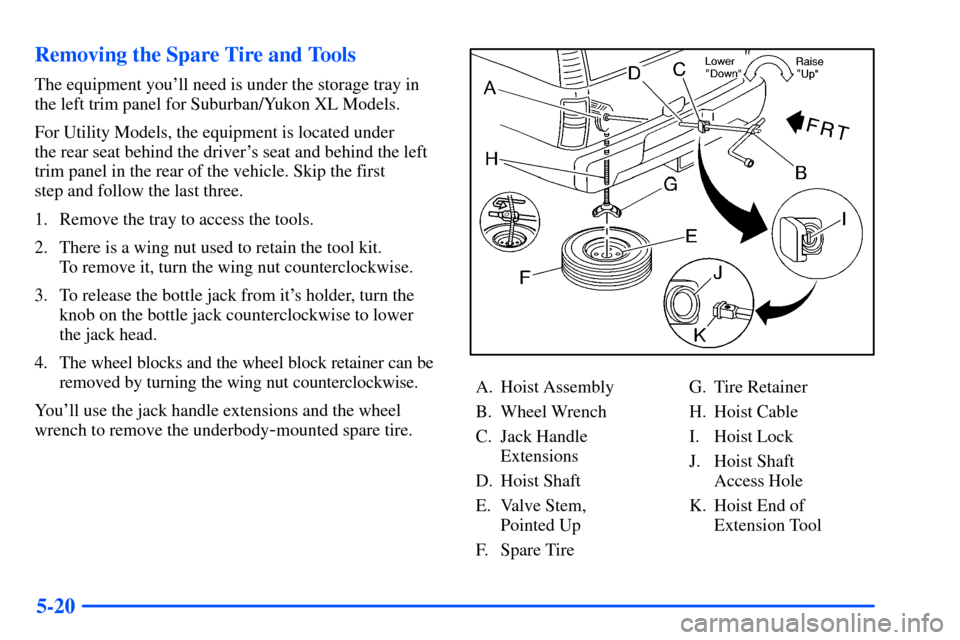
The equipment you'll need is under the storage tray in
the left trim panel for Suburban/Yukon XL Models.
For Utility Models, the equipment is located under
the rear seat behind the driver's seat and behind the left
trim panel in the rear of the vehicle. Skip the first
step and follow the last three.
1. Remove the tray to access the tools.
2. There is a wing nut used to retain the tool kit.
To remove it, turn the wing nut counterclockwise.
3. To release the bottle jack from it's holder, turn the
knob on the bottle jack counterclockwise to lower
the jack head.
4. The wheel blocks and the wheel block retainer can be
removed by turning the wing nut counterclockwise.
You'll use the jack handle extensions and the wheel
wrench to remove the underbody
-mounted spare tire.
A. Hoist Assembly
B. Wheel Wrench
C. Jack Handle
Extensions
D. Hoist Shaft
E. Valve Stem,
Pointed Up
F. Spare TireG. Tire Retainer
H. Hoist Cable
I. Hoist Lock
J. Hoist Shaft
Access Hole
K. Hoist End of
Extension Tool