Page 268 of 407
5-2
Hazard Warning Flashers
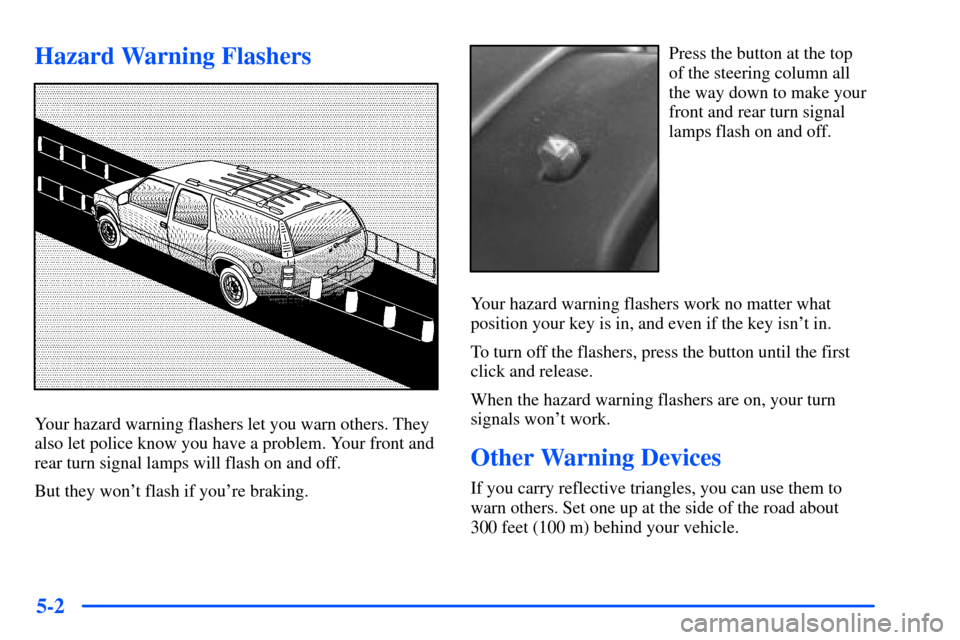
Your hazard warning flashers let you warn others. They
also let police know you have a problem. Your front and
rear turn signal lamps will flash on and off.
But they won't flash if you're braking.
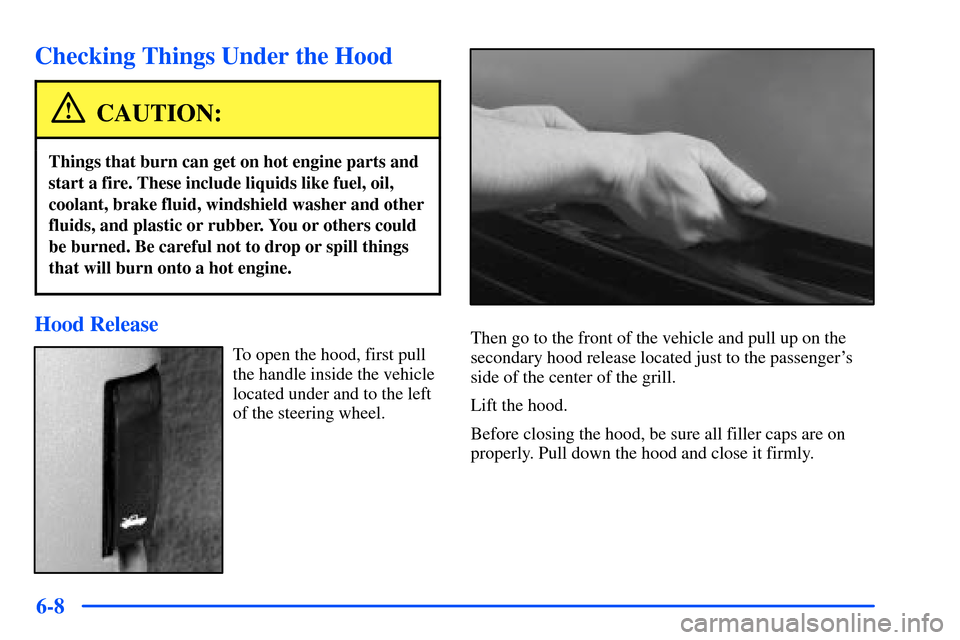
Press the button at the top
of the steering column all
the way down to make your
front and rear turn signal
lamps flash on and off.
Your hazard warning flashers work no matter what
position your key is in, and even if the key isn't in.
To turn off the flashers, press the button until the first
click and release.
When the hazard warning flashers are on, your turn
signals won't work.
Other Warning Devices
If you carry reflective triangles, you can use them to
warn others. Set one up at the side of the road about
300 feet (100 m) behind your vehicle.
Page 284 of 407
5-18
Engine Fan Noise
Your vehicle has a clutched engine cooling fan. When
the clutch is engaged, the fan spins faster to provide
more air to cool the engine. In most everyday driving
conditions, the fan is spinning slower and the clutch is
not fully engaged. This improves fuel economy and
reduces fan noise. Under heavy vehicle loading, trailer
towing and/or high outside temperatures, the fan speed
increases as the clutch more fully engages. So you may
hear an increase in fan noise. This is normal and should
not be mistaken as the transmission slipping or making
extra shifts. It is merely the cooling system functioning
properly. The fan will slow down when additional
cooling is not required and the clutch disengages.
You may also hear this fan noise when you start
the engine. It will go away as the fan clutch
partially disengages.
If a Tire Goes Flat
It's unusual for a tire to ªblow outº while you're driving,
especially if you maintain your tires properly. If air goes
out of a tire, it's much more likely to leak out slowly.
But if you should ever have a ªblowout,º here are a
few tips about what to expect and what to do:
If a front tire fails, the flat tire will create a drag that
pulls the vehicle toward that side. Take your foot off
the accelerator pedal and grip the steering wheel firmly.
Steer to maintain lane position, and then gently brake to
a stop well out of the traffic lane.
A rear blowout, particularly on a curve, acts much like
a skid and may require the same correction you'd use
in a skid. In any rear blowout, remove your foot from
the accelerator pedal. Get the vehicle under control by
steering the way you want the vehicle to go. It may be
very bumpy and noisy, but you can still steer. Gently
brake to a stop
-- well off the road if possible.
If a tire goes flat, the next part shows how to use your
jacking equipment to change a flat tire safely.
Page 298 of 407
5-32 Rocking Your Vehicle To Get It Out
First, turn your steering wheel left and right. That will
clear the area around your front wheels. If you have a
four
-wheel drive vehicle, shift into 4HI or 4LO. If your
vehicle has the Traction Assist System, you should turn
it off by pressing the TAS on/off button. Then shift back
and forth between REVERSE (R) and a forward gear,
spinning the wheels as little as possible. Release the
accelerator pedal while you shift, and press lightly on the
accelerator pedal when the transmission is in gear. By
slowly spinning your wheels in the forward and reverse
directions, you will cause a rocking motion that may free
your vehicle. If that doesn't get you out after a few tries,
you may need to be towed out. Or, you can use your
recovery hooks if your vehicle has them. If you do need
to be towed out, see ªTowing Your Vehicleº in the Index.
Using the Recovery Hooks
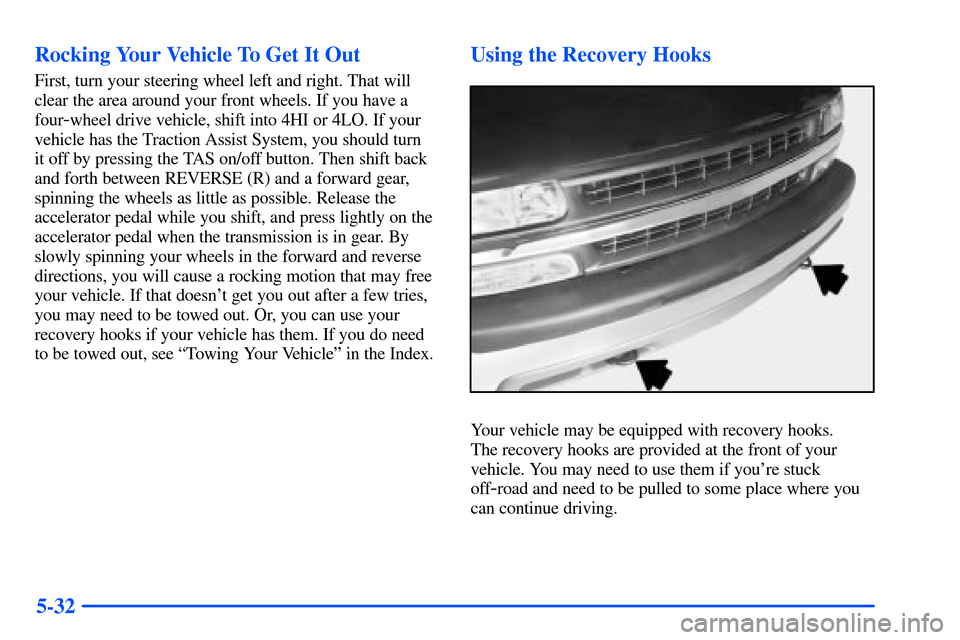
Your vehicle may be equipped with recovery hooks.
The recovery hooks are provided at the front of your
vehicle. You may need to use them if you're stuck
off
-road and need to be pulled to some place where you
can continue driving.
Page 300 of 407
6-
6-1
Section 6 Service and Appearance Care
Here you will find information about the care of your vehicle. This section begins with service and fuel information,
and then it shows how to check important fluid and lubricant levels. There is also technical information about your
vehicle, and a part devoted to its appearance care.
6
-2 Service
6
-3 Fuel
6
-5 Fuels in Foreign Countries
6
-5 Filling Your Tank
6
-7 Filling a Portable Fuel Container
6
-8 Checking Things Under the Hood
6
-10 Engine Oil
6
-14 Engine Air Cleaner/Filter
6
-16 Passenger Compartment Air Filter
(If Equipped)
6
-17 Automatic Transmission Fluid
6
-20 Rear Axle
6
-21 Four-Wheel Drive
6
-22 Engine Coolant
6
-25 Coolant Surge Tank Pressure Cap
6
-26 Power Steering Fluid6
-27 Windshield Washer Fluid
6
-28 Brakes
6
-32 Battery
6
-32 Bulb Replacement
6
-36 Windshield Wiper Blade Replacement
6
-36 Tires
6
-45 Appearance Care
6
-46 Cleaning the Inside of Your Vehicle
6
-49 Cleaning the Outside of Your Vehicle
6
-53 GM Vehicle Care/Appearance Materials
6
-54 Vehicle Identification Number (VIN)
6
-55 Electrical System
6
-63 Replacement Bulbs
6
-64 Capacities and Specifications
6
-67 Normal Maintenance Replacement Parts
Page 307 of 407
6-8
Checking Things Under the Hood
CAUTION:
Things that burn can get on hot engine parts and
start a fire. These include liquids like fuel, oil,
coolant, brake fluid, windshield washer and other
fluids, and plastic or rubber. You or others could
be burned. Be careful not to drop or spill things
that will burn onto a hot engine.
Hood Release
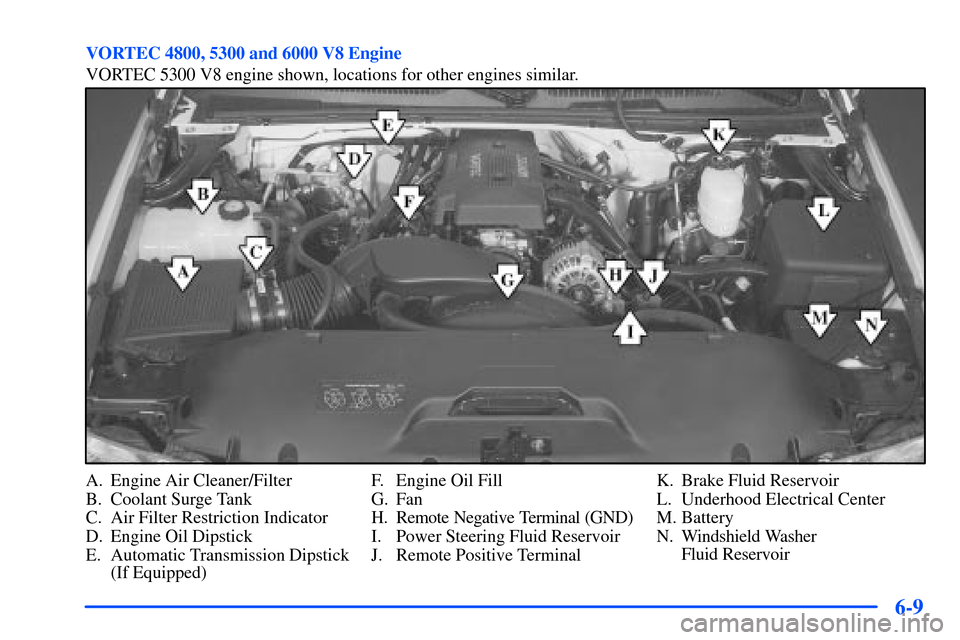
To open the hood, first pull
the handle inside the vehicle
located under and to the left
of the steering wheel.Then go to the front of the vehicle and pull up on the
secondary hood release located just to the passenger's
side of the center of the grill.
Lift the hood.
Before closing the hood, be sure all filler caps are on
properly. Pull down the hood and close it firmly.
Page 308 of 407
6-9
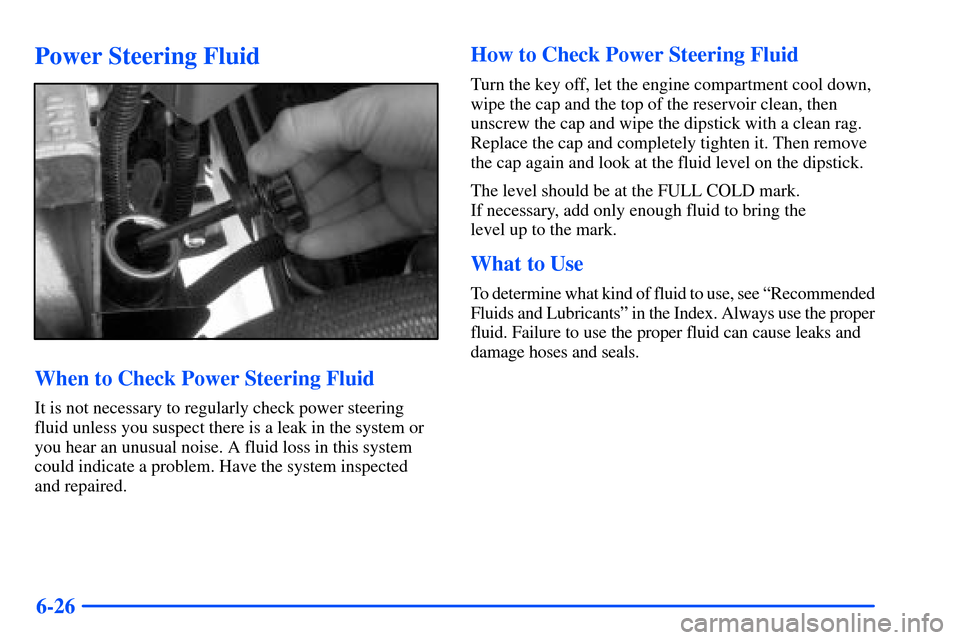
VORTEC 4800, 5300 and 6000 V8 Engine
VORTEC 5300 V8 engine shown, locations for other engines similar.
A. Engine Air Cleaner/Filter
B. Coolant Surge Tank
C. Air Filter Restriction Indicator
D. Engine Oil Dipstick
E. Automatic Transmission Dipstick
(If Equipped)F. Engine Oil Fill
G. Fan
H. Remote Negative Terminal (GND)
I. Power Steering Fluid Reservoir
J. Remote Positive TerminalK. Brake Fluid Reservoir
L. Underhood Electrical Center
M. Battery
N. Windshield Washer
Fluid Reservoir
Page 325 of 407
6-26
Power Steering Fluid
When to Check Power Steering Fluid
It is not necessary to regularly check power steering
fluid unless you suspect there is a leak in the system or
you hear an unusual noise. A fluid loss in this system
could indicate a problem. Have the system inspected
and repaired.
How to Check Power Steering Fluid
Turn the key off, let the engine compartment cool down,
wipe the cap and the top of the reservoir clean, then
unscrew the cap and wipe the dipstick with a clean rag.
Replace the cap and completely tighten it. Then remove
the cap again and look at the fluid level on the dipstick.
The level should be at the FULL COLD mark.
If necessary, add only enough fluid to bring the
level up to the mark.
What to Use
To determine what kind of fluid to use, see ªRecommended
Fluids and Lubricantsº in the Index. Always use the proper
fluid. Failure to use the proper fluid can cause leaks and
damage hoses and seals.
Page 357 of 407
6-58
Center Instrument Panel Utility Block
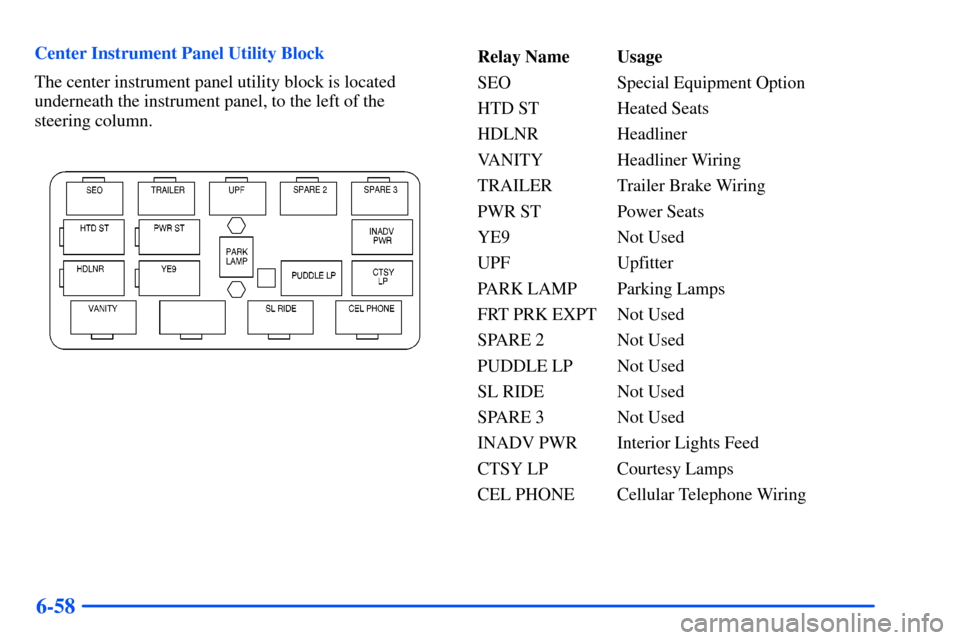
The center instrument panel utility block is located
underneath the instrument panel, to the left of the
steering column.Relay Name Usage
SEO Special Equipment Option
HTD ST Heated Seats
HDLNR Headliner
VANITY Headliner Wiring
TRAILER Trailer Brake Wiring
PWR ST Power Seats
YE9 Not Used
UPF Upfitter
PARK LAMP Parking Lamps
FRT PRK EXPT Not Used
SPARE 2 Not Used
PUDDLE LP Not Used
SL RIDE Not Used
SPARE 3 Not Used
INADV PWR Interior Lights Feed
CTSY LP Courtesy Lamps
CEL PHONE Cellular Telephone Wiring