Page 306 of 407
6-7
When you put the cap back on, turn it to the right
(clockwise) until you hear a clicking sound. Make sure
you fully install the cap. The diagnostic system can
determine if the fuel cap has been left off or improperly
installed. This would allow fuel to evaporate into the
atmosphere. See ªMalfunction Indicator Lampº in
the Index.
NOTICE:
If you need a new cap, be sure to get the right
type. Your dealer can get one for you. If you get
the wrong type, it may not fit properly. This may
cause your malfunction indicator lamp to light
and your fuel tank and emissions system may be
damaged. See ªMalfunction Indicator Lampº in
the Index.
Filling a Portable Fuel Container
CAUTION:
Never fill a portable fuel container while it is in
your vehicle. Static electricity discharge from the
container can ignite the gasoline vapor. You can
be badly burned and your vehicle damaged if this
occurs. To help avoid injury to you and others:
�Dispense gasoline only into
approved containers.
�Do not fill a container while it is inside a
vehicle, in a vehicle's trunk, pickup bed
or on any surface other than the ground.
�Bring the fill nozzle in contact with the
inside of the fill opening before operating
the nozzle. Contact should be maintained
until the filling is complete.
�Don't smoke while pumping gasoline.
Page 318 of 407
6-19
Then, without shutting off the engine, follow these steps:
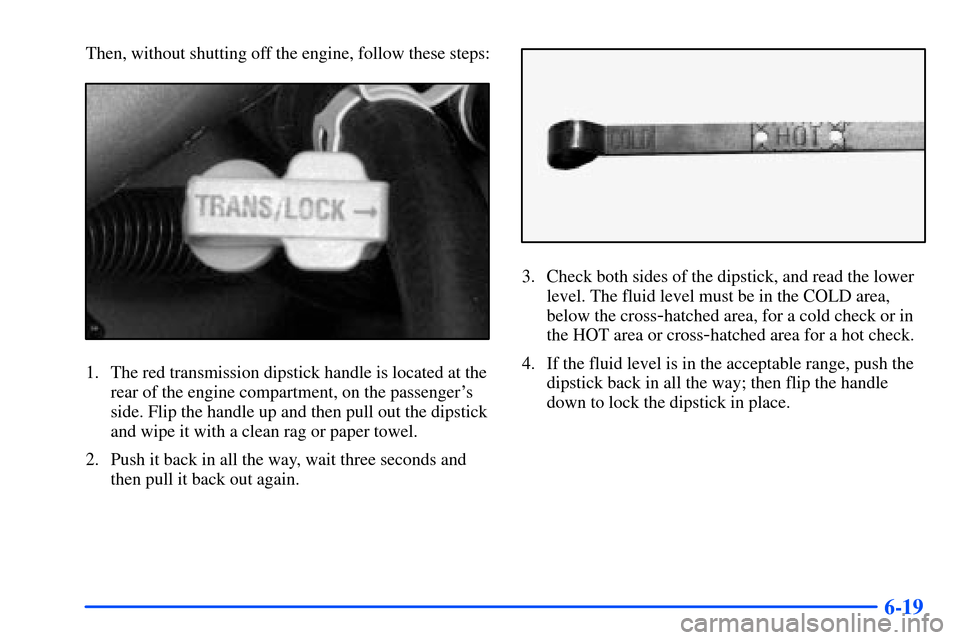
1. The red transmission dipstick handle is located at the
rear of the engine compartment, on the passenger's
side. Flip the handle up and then pull out the dipstick
and wipe it with a clean rag or paper towel.
2. Push it back in all the way, wait three seconds and
then pull it back out again.
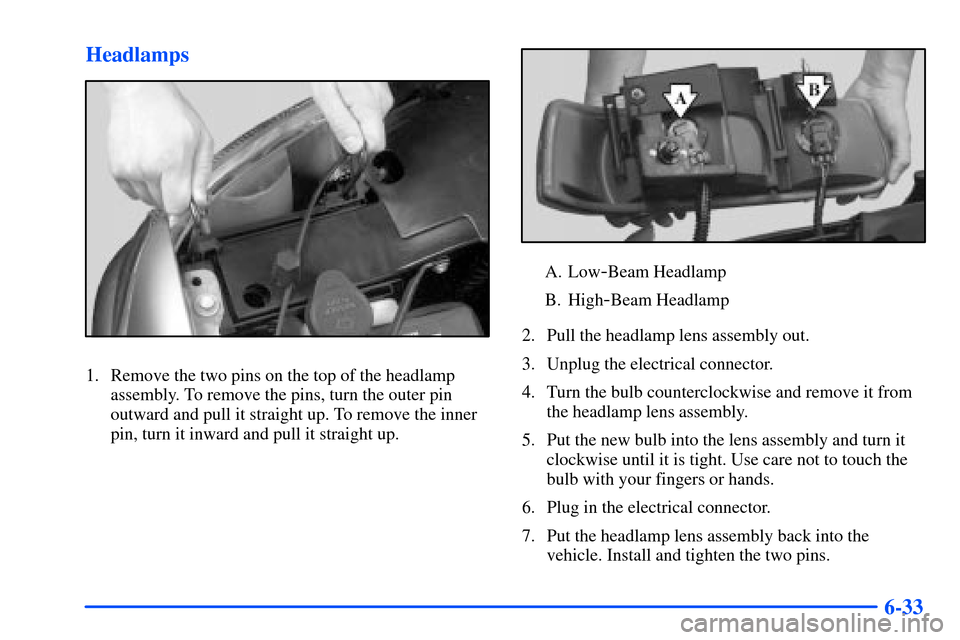
3. Check both sides of the dipstick, and read the lower
level. The fluid level must be in the COLD area,
below the cross
-hatched area, for a cold check or in
the HOT area or cross
-hatched area for a hot check.
4. If the fluid level is in the acceptable range, push the
dipstick back in all the way; then flip the handle
down to lock the dipstick in place.
Page 319 of 407
6-20 How to Add Fluid
Refer to the Maintenance Schedule to determine what
kind of transmission fluid to use. See ªRecommended
Fluids and Lubricantsº in the Index.
Add fluid only after checking the transmission fluid while
it is hot. (A cold check is used only as a reference.) If the
fluid level is low, add only enough of the proper fluid to
bring the level up to the HOT area for a hot check.
It doesn't take much fluid, generally less than one pint
(0.5 L). Don't overfill.
NOTICE:
We recommend you use only fluid labeled
DEXRON�-III, because fluid with that label is
made especially for your automatic transmission.
Damage caused by fluid other than DEXRON
�-III
is not covered by your new vehicle warranty.
�After adding fluid, recheck the fluid level as
described under ªHow to Check.º
�When the correct fluid level is obtained, push the
dipstick back in all the way; then flip the handle
down to lock the dipstick in place.
Rear Axle
When to Check Lubricant
Refer to the Maintenance Schedule to determine how
often to check the lubricant. See ªScheduled Maintenance
Servicesº in the Index.
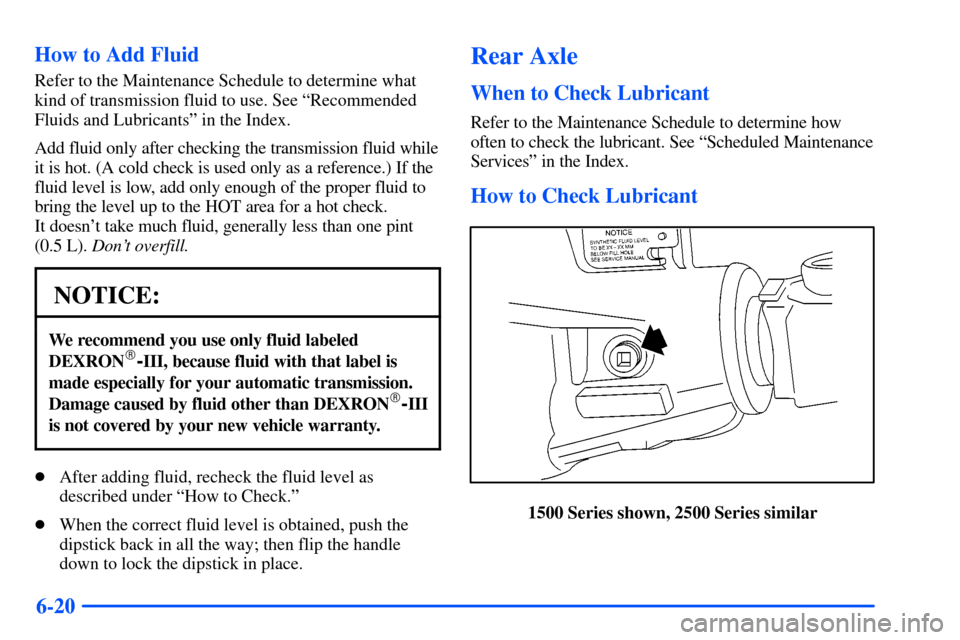
How to Check Lubricant
1500 Series shown, 2500 Series similar
Page 332 of 407
6-33 Headlamps
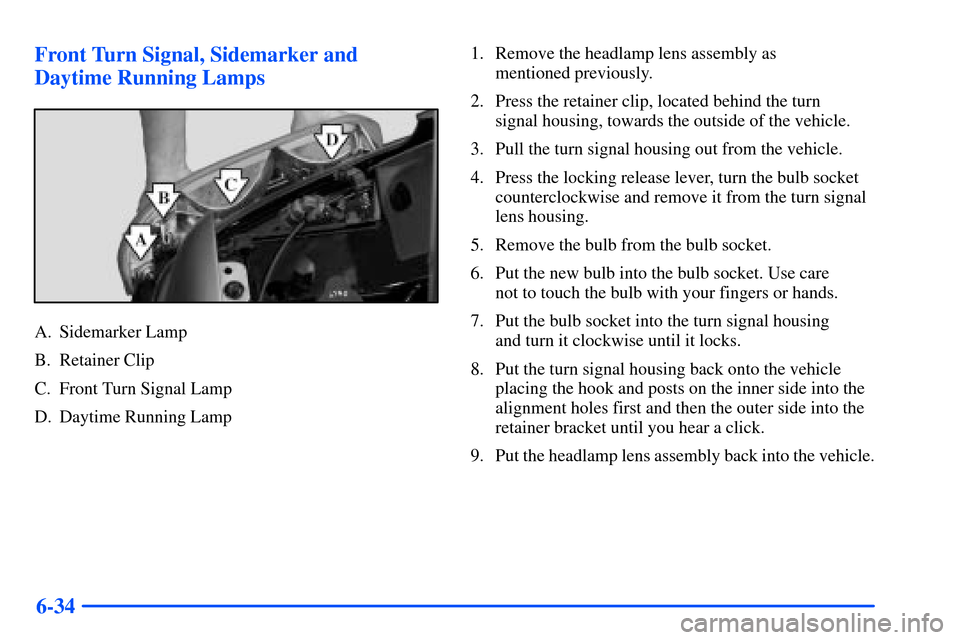
1. Remove the two pins on the top of the headlamp
assembly. To remove the pins, turn the outer pin
outward and pull it straight up. To remove the inner
pin, turn it inward and pull it straight up.
A. Low-Beam Headlamp
B. High
-Beam Headlamp
2. Pull the headlamp lens assembly out.
3. Unplug the electrical connector.
4. Turn the bulb counterclockwise and remove it from
the headlamp lens assembly.
5. Put the new bulb into the lens assembly and turn it
clockwise until it is tight. Use care not to touch the
bulb with your fingers or hands.
6. Plug in the electrical connector.
7. Put the headlamp lens assembly back into the
vehicle. Install and tighten the two pins.
Page 333 of 407
6-34 Front Turn Signal, Sidemarker and
Daytime Running Lamps
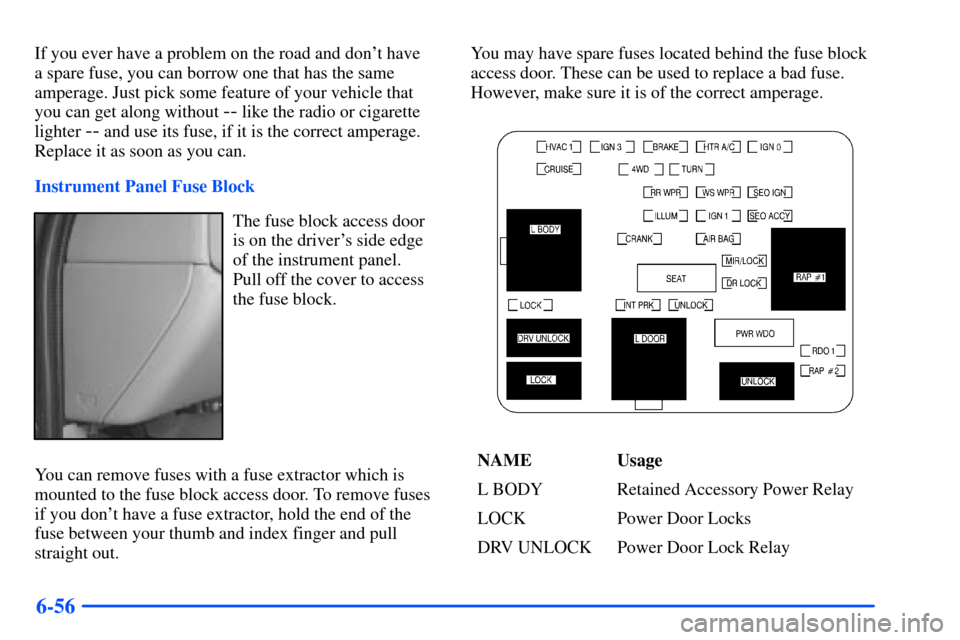
A. Sidemarker Lamp
B. Retainer Clip
C. Front Turn Signal Lamp
D. Daytime Running Lamp1. Remove the headlamp lens assembly as
mentioned previously.
2. Press the retainer clip, located behind the turn
signal housing, towards the outside of the vehicle.
3. Pull the turn signal housing out from the vehicle.
4. Press the locking release lever, turn the bulb socket
counterclockwise and remove it from the turn signal
lens housing.
5. Remove the bulb from the bulb socket.
6. Put the new bulb into the bulb socket. Use care
not to touch the bulb with your fingers or hands.
7. Put the bulb socket into the turn signal housing
and turn it clockwise until it locks.
8. Put the turn signal housing back onto the vehicle
placing the hook and posts on the inner side into the
alignment holes first and then the outer side into the
retainer bracket until you hear a click.
9. Put the headlamp lens assembly back into the vehicle.
Page 355 of 407
6-56
If you ever have a problem on the road and don't have
a spare fuse, you can borrow one that has the same
amperage. Just pick some feature of your vehicle that
you can get along without
-- like the radio or cigarette
lighter
-- and use its fuse, if it is the correct amperage.
Replace it as soon as you can.
Instrument Panel Fuse Block
The fuse block access door
is on the driver's side edge
of the instrument panel.
Pull off the cover to access
the fuse block.
You can remove fuses with a fuse extractor which is
mounted to the fuse block access door. To remove fuses
if you don't have a fuse extractor, hold the end of the
fuse between your thumb and index finger and pull
straight out.You may have spare fuses located behind the fuse block
access door. These can be used to replace a bad fuse.
However, make sure it is of the correct amperage.
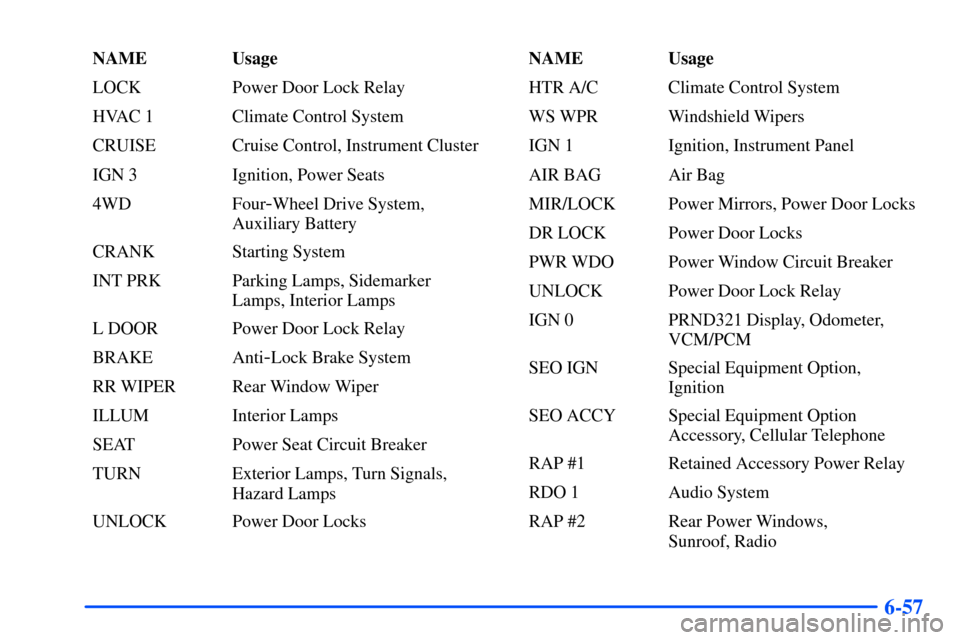
NAME Usage
L BODY Retained Accessory Power Relay
LOCK Power Door Locks
DRV UNLOCK Power Door Lock Relay
Page 356 of 407
6-57
NAME Usage
LOCK Power Door Lock Relay
HVAC 1 Climate Control System
CRUISE Cruise Control, Instrument Cluster
IGN 3 Ignition, Power Seats
4WD Four
-Wheel Drive System,
Auxiliary Battery
CRANK Starting System
INT PRK Parking Lamps, Sidemarker
Lamps, Interior Lamps
L DOOR Power Door Lock Relay
BRAKE Anti
-Lock Brake System
RR WIPER Rear Window Wiper
ILLUM Interior Lamps
SEAT Power Seat Circuit Breaker
TURN Exterior Lamps, Turn Signals,
Hazard Lamps
UNLOCK Power Door LocksNAME Usage
HTR A/C Climate Control System
WS WPR Windshield Wipers
IGN 1 Ignition, Instrument Panel
AIR BAG Air Bag
MIR/LOCK Power Mirrors, Power Door Locks
DR LOCK Power Door Locks
PWR WDO Power Window Circuit Breaker
UNLOCK Power Door Lock Relay
IGN 0 PRND321 Display, Odometer,
VCM/PCM
SEO IGN Special Equipment Option,
Ignition
SEO ACCY Special Equipment Option
Accessory, Cellular Telephone
RAP #1 Retained Accessory Power Relay
RDO 1 Audio System
RAP #2 Rear Power Windows,
Sunroof, Radio
Page 357 of 407
6-58
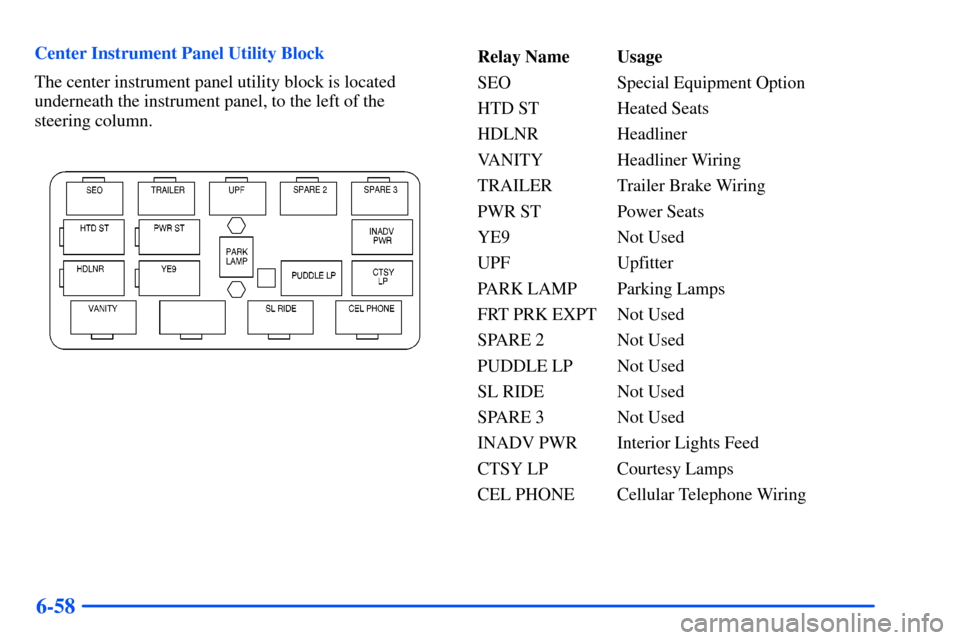
Center Instrument Panel Utility Block
The center instrument panel utility block is located
underneath the instrument panel, to the left of the
steering column.Relay Name Usage
SEO Special Equipment Option
HTD ST Heated Seats
HDLNR Headliner
VANITY Headliner Wiring
TRAILER Trailer Brake Wiring
PWR ST Power Seats
YE9 Not Used
UPF Upfitter
PARK LAMP Parking Lamps
FRT PRK EXPT Not Used
SPARE 2 Not Used
PUDDLE LP Not Used
SL RIDE Not Used
SPARE 3 Not Used
INADV PWR Interior Lights Feed
CTSY LP Courtesy Lamps
CEL PHONE Cellular Telephone Wiring