Page 171 of 421
yellowblue
3-3 Heater and Air Conditioning Comfort
Controls (If Equipped)
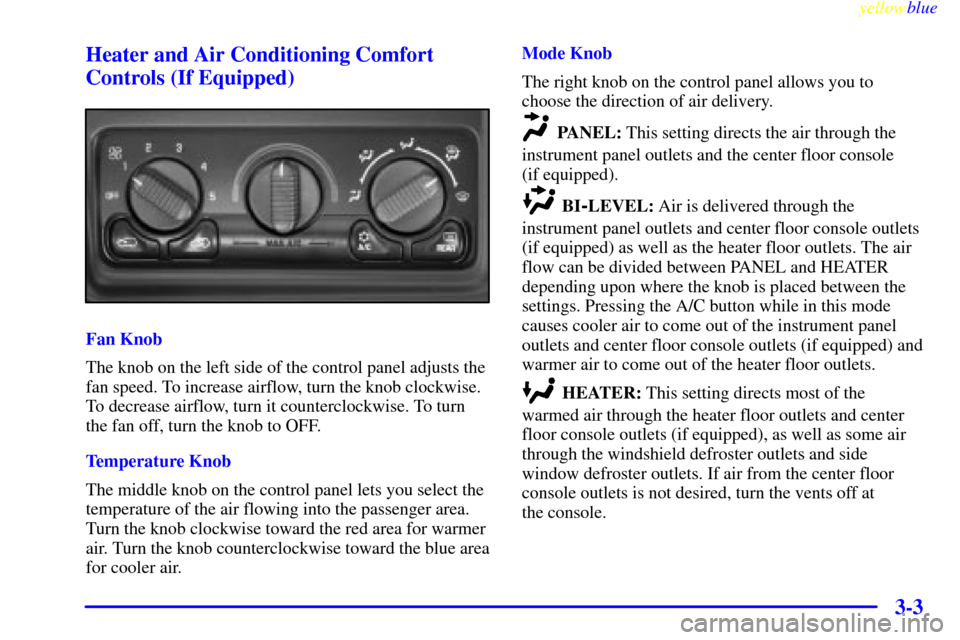
Fan Knob
The knob on the left side of the control panel adjusts the
fan speed. To increase airflow, turn the knob clockwise.
To decrease airflow, turn it counterclockwise. To turn
the fan off, turn the knob to OFF.
Temperature Knob
The middle knob on the control panel lets you select the
temperature of the air flowing into the passenger area.
Turn the knob clockwise toward the red area for warmer
air. Turn the knob counterclockwise toward the blue area
for cooler air.Mode Knob
The right knob on the control panel allows you to
choose the direction of air delivery.
PANEL: This setting directs the air through the
instrument panel outlets and the center floor console
(if equipped).
BI-LEVEL: Air is delivered through the
instrument panel outlets and center floor console outlets
(if equipped) as well as the heater floor outlets. The air
flow can be divided between PANEL and HEATER
depending upon where the knob is placed between the
settings. Pressing the A/C button while in this mode
causes cooler air to come out of the instrument panel
outlets and center floor console outlets (if equipped) and
warmer air to come out of the heater floor outlets.
HEATER: This setting directs most of the
warmed air through the heater floor outlets and center
floor console outlets (if equipped), as well as some air
through the windshield defroster outlets and side
window defroster outlets. If air from the center floor
console outlets is not desired, turn the vents off at
the console.
Page 174 of 421
yellowblue
3-6 Heating
The heater works best if you keep your windows closed
while using it. On cold days, use the HEATER or
VENT/HEAT setting with the temperature knob in the
red area.
On cold days, approximately 32�F (
-0�C) or lower, if
your vehicle is equipped with an automatic transmission,
you may experience differences in how the transmission
shifts until the engine is warm. This feature
automatically reduces the time it takes for the engine to
reach normal operating temperature and shortens the
time it takes the heater to reach full output.
If you use the engine coolant heater before starting your
engine in cold weather, 20�F (
-8�C) or lower, the
heating system will produce warmer air faster to heat the
passenger compartment.
The use of an engine coolant heater also reduces the
time it takes for the engine to reach normal operating
temperature. For more information, see ªEngine Coolant
Heaterº in the Index.
Defogging and Defrosting
On cool, humid days, use DEFOG to keep the
windshield and side windows clear. Use DEFROST to
remove fog or ice from the windshield in extremely
humid or cold conditions. Use DEFROST with the
temperature knob toward the red area and the fan control
turned all the way to the right.
Rear Window Defogger (If Equipped)
If you see lines running across the rear window, you
have a rear window defogger. The lines warm the glass.
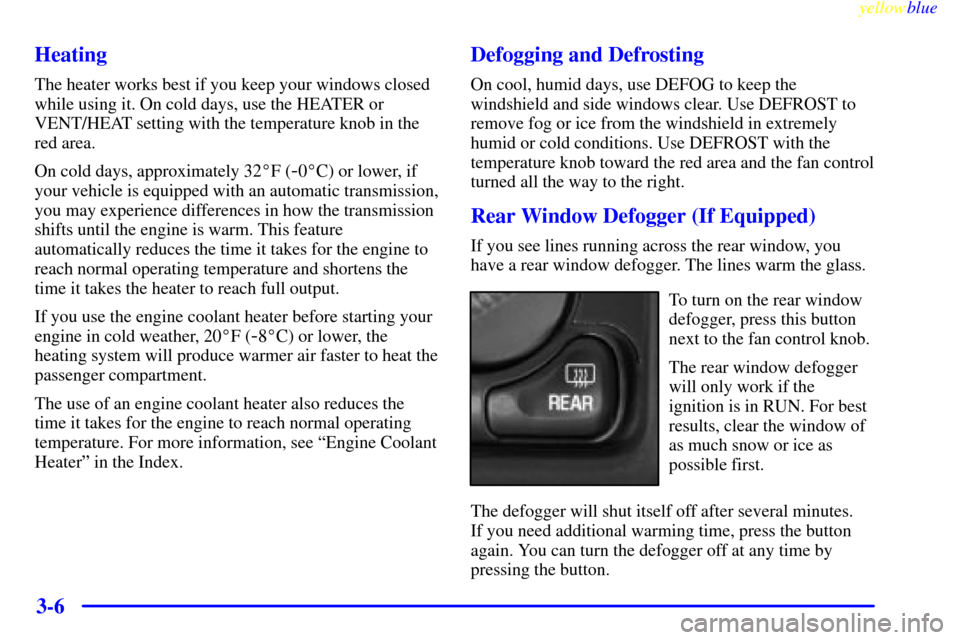
To turn on the rear window
defogger, press this button
next to the fan control knob.
The rear window defogger
will only work if the
ignition is in RUN. For best
results, clear the window of
as much snow or ice as
possible first.
The defogger will shut itself off after several minutes.
If you need additional warming time, press the button
again. You can turn the defogger off at any time by
pressing the button.
Page 197 of 421
4-
yellowblue
4-1
Section 4 Your Driving and the Road
Here you'll find information about driving on different kinds of roads and in varying weather conditions. We've also
included many other useful tips on driving.
4
-2 Defensive Driving
4
-3 Drunken Driving
4
-6 Control of a Vehicle
4
-6 Braking
4
-9 Steering
4
-11 Off-Road Recovery
4
-11 Passing
4
-13 Loss of Control
4
-14 Off-Road Driving with Your
Four
-Wheel-Drive Vehicle
4
-31 Driving at Night
4
-33 Driving in Rain and on Wet Roads4
-37 City Driving
4
-38 Freeway Driving
4
-39 Before Leaving on a Long Trip
4
-40 Highway Hypnosis
4
-40 Hill and Mountain Roads
4
-42 Winter Driving
4
-46 Recreational Vehicle Towing
4
-48 Loading Your Vehicle
4
-54 Camper Wiring Harness (If Equipped)
4
-55 Pickup Conversion to Chassis Cab
4
-55 Towing a Trailer
Page 212 of 421
yellowblue
4-16
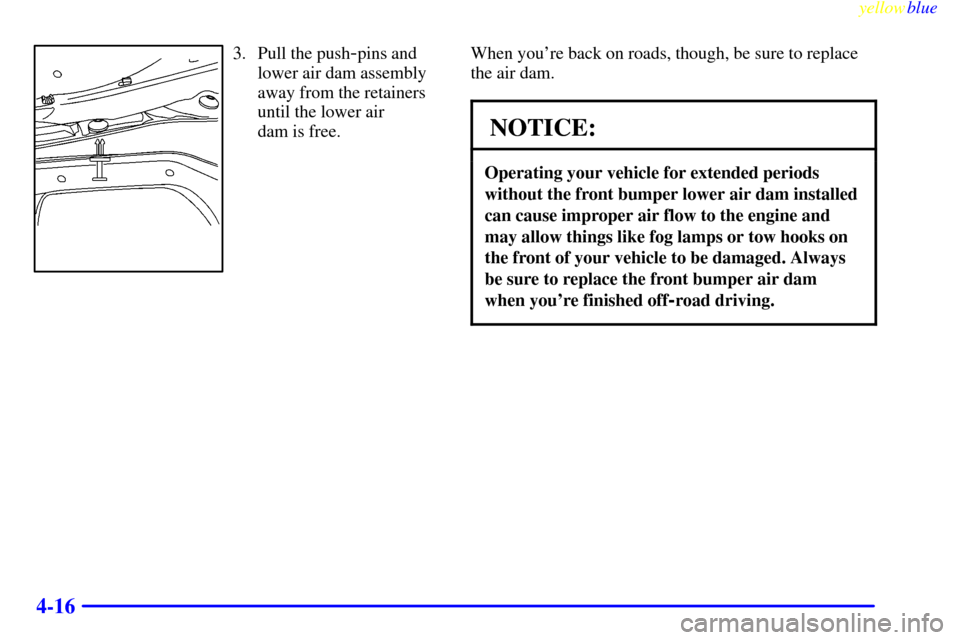
3. Pull the push-pins and
lower air dam assembly
away from the retainers
until the lower air
dam is free.When you're back on roads, though, be sure to replace
the air dam.
NOTICE:
Operating your vehicle for extended periods
without the front bumper lower air dam installed
can cause improper air flow to the engine and
may allow things like fog lamps or tow hooks on
the front of your vehicle to be damaged. Always
be sure to replace the front bumper air dam
when you're finished off
-road driving.
Page 213 of 421
yellowblue
4-17
To replace the lower air dam:
1. Line up each push-pin
with it's intended
retainer and push the
washer portion of the
push
-pin towards the
retainer until it locks
into place
2. Push the flat end of the
push
-pin towards the
retainer until it locks
into place, making sure
each is secure.
Page 242 of 421
yellowblue
4-46
Recreational Vehicle Towing
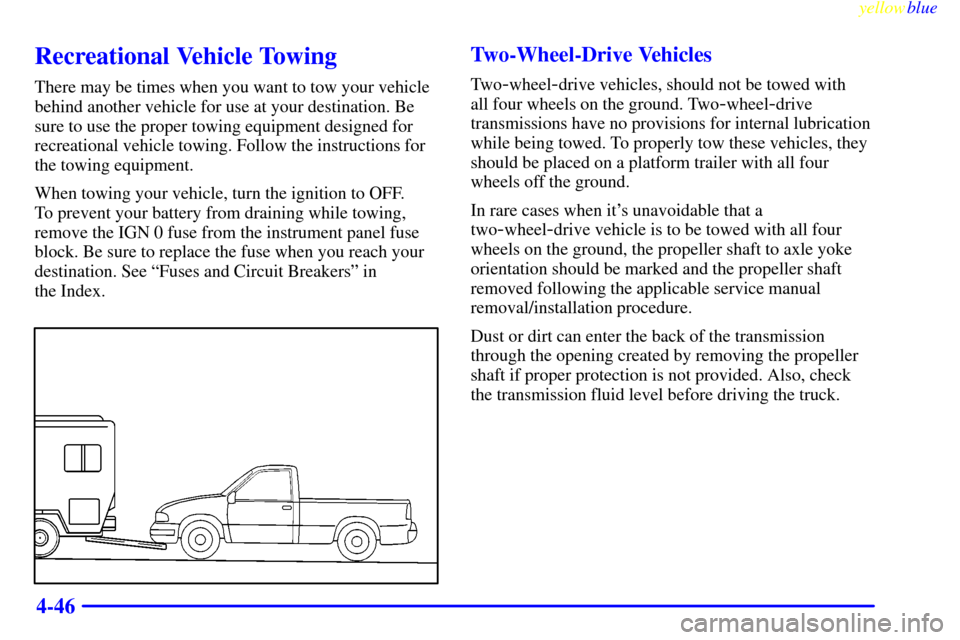
There may be times when you want to tow your vehicle
behind another vehicle for use at your destination. Be
sure to use the proper towing equipment designed for
recreational vehicle towing. Follow the instructions for
the towing equipment.
When towing your vehicle, turn the ignition to OFF.
To prevent your battery from draining while towing,
remove the IGN 0 fuse from the instrument panel fuse
block. Be sure to replace the fuse when you reach your
destination. See ªFuses and Circuit Breakersº in
the Index.
Two-Wheel-Drive Vehicles
Tw o-wheel-drive vehicles, should not be towed with
all four wheels on the ground. Two
-wheel-drive
transmissions have no provisions for internal lubrication
while being towed. To properly tow these vehicles, they
should be placed on a platform trailer with all four
wheels off the ground.
In rare cases when it's unavoidable that a
two
-wheel-drive vehicle is to be towed with all four
wheels on the ground, the propeller shaft to axle yoke
orientation should be marked and the propeller shaft
removed following the applicable service manual
removal/installation procedure.
Dust or dirt can enter the back of the transmission
through the opening created by removing the propeller
shaft if proper protection is not provided. Also, check
the transmission fluid level before driving the truck.
Page 243 of 421
yellowblue
4-47 Four-Wheel-Drive Vehicles
CAUTION:
Shifting the transfer case into NEUTRAL (N) can
cause your vehicle to roll even if the transmission
is in PARK (P), for an automatic transmission,
or if your vehicle is in gear, for a manual
transmission. You or others could be injured.
Make sure the parking brake is firmly set before
you shift the transfer case into NEUTRAL (N).
Use the following procedure to correctly tow your
vehicle on all four wheels:
1. Firmly set the parking brake.
2. Shift an automatic transmission to PARK (P), or a
manual transmission to FIRST (1).
3. Securely attach the vehicle being towed to the
tow vehicle.
4. Shift the transfer case to NEUTRAL (N). See
ªFour
-Wheel Driveº in the Index for the proper
procedure to select the neutral position for
your vehicle.
5. Release the parking brake only after the vehicle
being towed is firmly attached to the towing vehicle.
6. Turn the ignition to OFF. The OFF position unlocks
the steering column and reduces battery drain as long
as the IGN 0 fuse is removed. Unlocking the steering
column will allow the proper movement of the front
wheels and tires during towing.
Page 248 of 421

yellowblue
4-52
For example, adding a 700 lbs. (318 kg) snow plow
adds more than 700 lbs. (318 kg) to the front axle.
Using the formula, if the snow plow is 4 ft. (122 cm)
in front of the front axle and the wheel base is 10 ft.
(305 cm), then:
W= 700 lbs. (318 kg), A= 4 ft. (122 cm) and W.B.=
10 ft. (305 cm)
(W x (A+W.B.)) / W.B. = (700 x (4ft. + 10 ft.)) /
10 ft. = 980 lbs.
So, if your truck's front axle reserve capacity is more
than 980 lbs. (445 kg), you could add this snow plow
without exceeding the front GAWR.
You can add heavier equipment on the front of the
vehicle if you compensate for it by carrying fewer
passengers, less cargo or by positioning cargo more
towards the rear. This has the effect of reducing the load
on the front. However, the front GAWR, rear GAWR
and the GVWR must never be exceeded.Total Vehicle Reserve Capacity
This is the difference between your GVWR and the
weight of your truck with full fuel and passengers. It is
the amount of weight you can add to your vehicle before
reaching your GVWR.
The reserve capacity numbers are intended as a guide
when selecting the amount of equipment or cargo your
truck can carry. If you are unsure of your truck's front,
rear or total weight, go to a weigh station and weigh
your vehicle. Your dealer can help you with this.
Truck-Camper Loading Information
This label is inside your glove box. It will tell you if
your vehicle can carry a slide
-in camper, how much of a
load your vehicle can carry, and how to correctly spread
out your load. Also, it will help you match the right
slide
-in camper to your vehicle.
When you carry a slide
-in camper, the total cargo load
of your vehicle is the weight of the camper, plus
�everything else added to the camper after it left
the factory,
�everything in the camper and
�all the people inside.