Page 147 of 421
yellowblue
2-69
A. Dome Lamp Switch
B. Lamp Controls
C. Air Outlets
D. Automatic Transfer Case (If Equipped)
E. Multifunction Lever
F. Instrument Cluster
G. Gearshift Lever (Automatic Transmission)
H. Tow/Haul Selector Switch
I. Audio System
J. Comfort Control System
K. Glove BoxL. Passenger Air Bag Off Switch
M. Manual Selectable Ride Control (If Equipped)
N. Ashtray
O. Storage Area or Compact Disc Player (If Equipped)
P. Rear Window Defogger Switch (If Equipped)
Q. Lighter and Auxiliary Power Outlets
R. Parking Brake Release
S. Tilt Lever (If Equipped)
T. Center Instrument Panel Utility Block
U. Hood Release
V. Instrument Panel Fuse Block
Page 148 of 421
yellowblue
2-70
Instrument Panel Cluster
United States Heavy Duty Automatic Transmission version shown, Canada, Light Duty Automatic and
Manual Transmission clusters similar
Your instrument cluster is designed to let you know at a glance how your vehicle is running. You'll know how fast you're
going, about how much fuel you have and many other things you'll need to know to drive safely and economically.
Page 149 of 421
yellowblue
2-71 Speedometer and Odometer
Your speedometer lets you see your speed in both miles
per hour (mph) and kilometers per hour (km/h). Your
odometer shows how far your vehicle has been driven,
in either miles (used in the United States) or kilometers
(used in Canada).
Trip Odometer
The trip odometer can tell you how far your vehicle has
been driven since you last set the trip odometer to zero.
Press the reset button to toggle between the trip
odometer and the regular odometer. Holding the reset
button for two seconds while the trip odometer is
displayed will reset it.
To display the odometer reading with the ignition off,
press the reset button.
Engine Hour Meter Display
The odometer can also display the number of hours the
engine has run. To display the hour meter, turn the
ignition off, press and hold the reset button for at least
four seconds. The hour meter will be displayed for up to
30 seconds, or until the ignition is turned on.
Tachometer
Your tachometer displays the engine speed in
revolutions per minute (rpm).
NOTICE:
On vehicles with a manual transmission, if you
operate the engine with the tachometer in the red
area, your engine or other parts could be damaged.
Damage to your engine or vehicle caused by
operating the engine in the red area isn't covered
by your vehicle warranty. Don't operate the
engine with the tachometer in the red area.
Page 154 of 421

yellowblue
2-76
You can only drive for a short time with the reading in
either warning zone. If you must drive, turn off all
unnecessary accessories.
Readings in either warning zone indicate a possible
problem in the electrical system. Have the vehicle
serviced as soon as possible.
Shift Light (If Equipped)
This light is used on
some models with
manual transmissions.
The SHIFT indicator light will help you get the best fuel
economy. See ªShift Lightº or ªShift Speedsº in the
index for more information.
Brake System Warning Light
With the ignition on, the brake system warning light
will flash when you set the parking brake. The light will
flash if the parking brake doesn't release fully. If you
try to drive with the parking brake engaged, a chime
will sound when the vehicle speed is greater than
3 mph (5 km/h).
Your vehicle's hydraulic brake system is divided into
two parts. If one part isn't working, the other part can
still work and stop you. For good braking, though, you
need both parts working well.
If the warning light comes on, there could be a brake
problem. Have your brake system inspected right away.
This light should come
on briefly when you turn
the ignition key to RUN.
If it doesn't come on then,
have it fixed so it will be
ready to warn you if there's
a problem.
Page 156 of 421

yellowblue
2-78 Engine Coolant Temperature Gage
This gage shows the engine
coolant temperature.
It also provides an indicator of how hard your vehicle is
working. During a majority of the operation, the gage
will read 210�F (100�C) or less. If you are pulling a
load or going up hills, it is normal for the temperature to
fluctuate and approach the 250�F (122�C) mark. If the
gage reaches the 260�F (125�C) mark, it indicates that
the cooling system is working beyond its capacity.
The ªProblems on the Road,º section of this manual
shows what to do. See ªEngine Overheatingº in
the Index.
Transmission Temperature Gage
(If Equipped)
If your vehicle has a heavy
duty automatic transmission,
you will have a transmission
temperature gage.
When your ignition is on, the gage shows the
temperature of the transmission fluid. The normal
operating range is from 100�F (38�C) to about
265�F (130�C).
At approximately 265�F (130�C), the message center
will display a TRANS FLUID HOT message and the
transmission will enter a transmission protection mode.
When the transmission enters the protection mode, you
may notice a change in the transmission shifting
patterns. The transmission will return to normal shifting
patterns when the transmission fluid temperature falls
below 260�F (127�C).
Page 157 of 421
yellowblue
2-79
See ªMessage Centerº in the Index for
further information.
If the transmission fluid reaches temperatures of
approximately 275�F (135�C) or greater, the message
center will display a TRANS HOT...IDLE ENG warning
message. Pull the vehicle off the roadway when it is safe
to do so. Set the parking brake, place the transmission in
PARK (P) and allow the engine to idle until the
transmission temperature falls below 260�F (127�C). If
the transmission continues to operate above 265�F
(130�C), please contact your nearest dealer or the GM
Roadside Assistance Center.
NOTICE:
If you keep driving your vehicle with the
transmission temperature gage above the normal
operating range, you can damage the
transmission. This could lead to costly repairs
that may not be covered under your warranty.
The following situations can cause the transmission to
operate at higher temperatures:
�Towing a trailer
�Hot outside air temperatures
�Hauling a large or heavy load
�Low transmission fluid level
�High transmission fluid level
�Restricted air flow to the radiator and the auxiliary
transmission oil cooler (if equipped).
A temporary solution to hotter transmission operating
temperatures may be to let the transmission cool down.
If the transmission is operated at higher temperatures on
a frequent basis, see ªScheduled Maintenanceº in the
Index for the proper transmission maintenance intervals.
Page 158 of 421

yellowblue
2-80 Malfunction Indicator Lamp
(Service Engine Soon Light)
Your vehicle is equipped
with a computer which
monitors operation of the
fuel, ignition and emission
control systems.
This system is called OBD II (On
-Board
Diagnostics
-Second Generation) and is intended to
assure that emissions are at acceptable levels for the life
of the vehicle, helping to produce a cleaner
environment. The SERVICE ENGINE SOON light
comes on to indicate that there is a problem and service
is required. Malfunctions often will be indicated by the
system before any problem is apparent. This may
prevent more serious damage to your vehicle. This
system is also designed to assist your service technician
in correctly diagnosing any malfunction.
NOTICE:
If you keep driving your vehicle with this light
on, after a while, your emission controls may not
work as well, your fuel economy may not be as
good and your engine may not run as smoothly.
This could lead to costly repairs that may not be
covered by your warranty.
NOTICE:
Modifications made to the engine, transmission,
exhaust or fuel system of your vehicle or the
replacement of the original tires with other than
those of the same Tire Performance Criteria
(TPC) can affect your vehicle's emission controls
and may cause the SERVICE ENGINE SOON
light to come on. Modifications to these systems
could lead to costly repairs not covered by your
warranty. This may also result in a failure to pass
a required Emission Inspection/Maintenance test.
Page 162 of 421
yellowblue
2-84 Cruise Light (If Equipped)
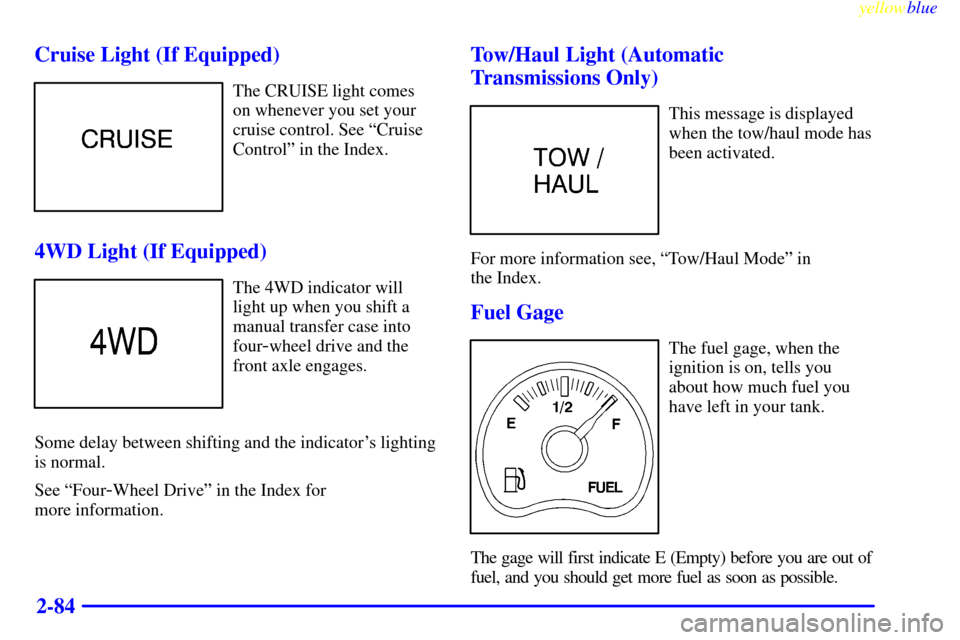
The CRUISE light comes
on whenever you set your
cruise control. See ªCruise
Controlº in the Index.
4WD Light (If Equipped)
The 4WD indicator will
light up when you shift a
manual transfer case into
four
-wheel drive and the
front axle engages.
Some delay between shifting and the indicator's lighting
is normal.
See ªFour
-Wheel Driveº in the Index for
more information.
Tow/Haul Light (Automatic
Transmissions Only)
This message is displayed
when the tow/haul mode has
been activated.
For more information see, ªTow/Haul Modeº in
the Index.
Fuel Gage
The fuel gage, when the
ignition is on, tells you
about how much fuel you
have left in your tank.
The gage will first indicate E (Empty) before you are out of
fuel, and you should get more fuel as soon as possible.