Page 228 of 381
5-19
Changing a Flat Tire
If a tire goes flat, avoid further tire and wheel damage
by driving slowly to a level place. Turn on your hazard
warning flashers.
CAUTION:
Changing a tire can cause an injury. The vehicle
can slip off the jack and roll over you or other
people. You and they could be badly injured.
Find a level place to change your tire.
To help prevent the vehicle from moving:
1. Set the parking brake firmly.
2. Put an automatic transmission shift lever in
PARK (P) or shift a manual transmission to
FIRST (1) or REVERSE (R).
3. Turn off the engine.
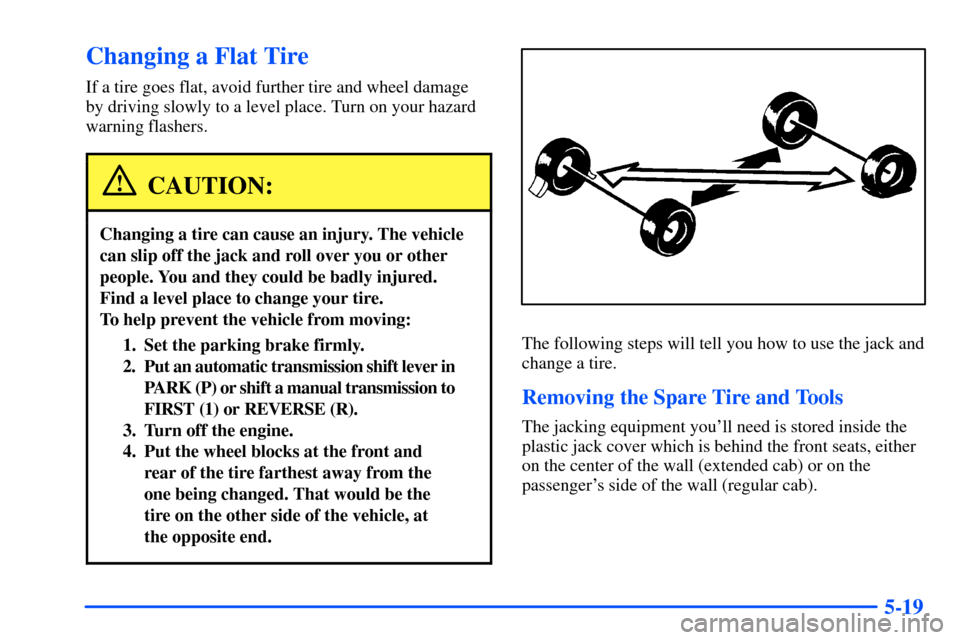
4. Put the wheel blocks at the front and
rear of the tire farthest away from the
one being changed. That would be the
tire on the other side of the vehicle, at
the opposite end.The following steps will tell you how to use the jack and
change a tire.
Removing the Spare Tire and Tools
The jacking equipment you'll need is stored inside the
plastic jack cover which is behind the front seats, either
on the center of the wall (extended cab) or on the
passenger's side of the wall (regular cab).
Page 241 of 381
5-32 Rocking Your Vehicle To Get It Out
First, turn your steering wheel left and right. That will
clear the area around your front wheels. If you have a
four
-wheel drive vehicle, shift into 4HI. Then shift back
and forth between REVERSE (R) and a forward gear
(or with a manual transmission, between FIRST (1) or
SECOND (2) and REVERSE (R)), spinning the wheels
as little as possible. Release the accelerator pedal while
you shift, and press lightly on the accelerator pedal
when the transmission is in gear. By slowly spinning
your wheels in the forward and reverse directions, you
will cause a rocking motion that may free your vehicle.
If that doesn't get you out after a few tries, you may
need to be towed out. Or, you can use your recovery
hooks if your vehicle has them. If you do need to be
towed out, see ªTowing Your Vehicleº in the Index.
Using the Recovery Hooks
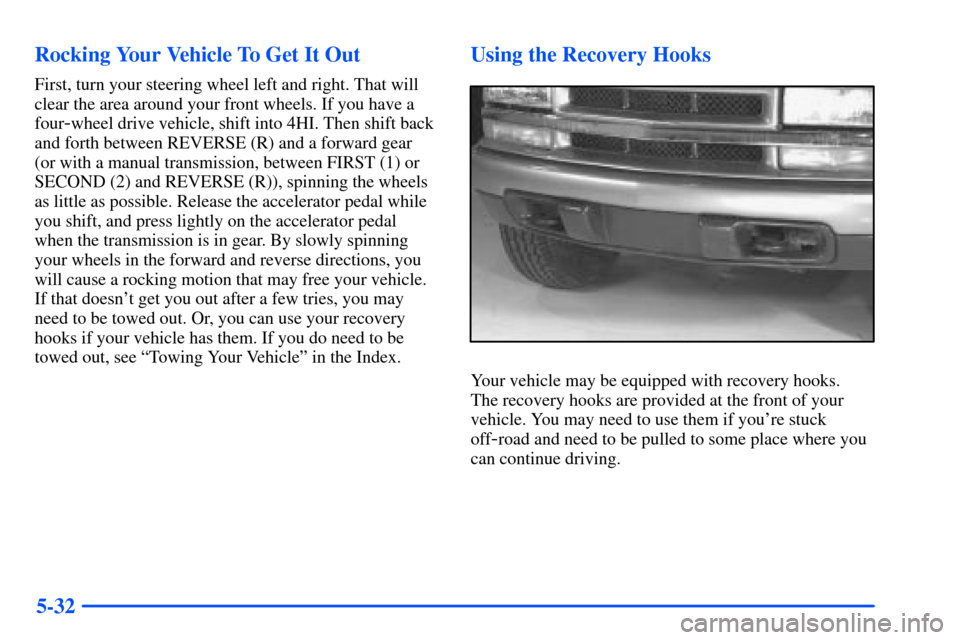
Your vehicle may be equipped with recovery hooks.
The recovery hooks are provided at the front of your
vehicle. You may need to use them if you're stuck
off
-road and need to be pulled to some place where you
can continue driving.
Page 243 of 381

6-
6-1
Section 6 Service and Appearance Care
Here you will find information about the care of your vehicle. This section begins with service and fuel information,
and then it shows how to check important fluid and lubricant levels. There is also technical information about your
vehicle, and a part devoted to its appearance care.
6
-2 Service
6
-3 Fuel (Gasoline)
6
-5 Fuel E-85 (85% Ethanol)
6
-6 Fuels in Foreign Countries
6
-7 Filling Your Tank
6
-9 Filling a Portable Fuel Container
6
-10 Checking Things Under the Hood
6
-13 Engine Oil
6
-18 Engine Air Cleaner/Filter
6
-19 Automatic Transmission Fluid
6
-23 Manual Transmission Fluid
6
-24 Hydraulic Clutch
6
-24 Rear Axle
6
-25 Four-Wheel Drive
6
-27 Engine Coolant
6
-30 Radiator Pressure Cap
6
-30 Power Steering Fluid
6
-31 Windshield Washer Fluid6
-32 Brakes
6
-36 Battery
6
-37 Bulb Replacement
6
-43 Windshield Wiper Blade Replacement
6
-45 Tires
6
-53 Appearance Care
6
-54 Cleaning the Inside of Your Vehicle
6
-56 Care of Safety Belts
6
-57 Cleaning the Outside of Your Vehicle
6
-60 GM Vehicle Care/Appearance Materials Chart
6
-61 Vehicle Identification Number (VIN)
6
-61 Service Parts Identification Label
6
-62 Electrical System
6
-67 Replacement Bulbs
6
-67 Capacities and Specifications
6
-69 Normal Maintenance Replacement Parts
Page 265 of 381

6-23
Manual Transmission Fluid
When to Check
A good time to have it checked is when the engine oil is
changed. However, the fluid in your manual
transmission doesn't require changing.
How to Check
Because this operation can be a little difficult, you
may choose to have this done at your GM dealership
service department.
If you do it yourself, be sure to follow all the
instructions here, or you could get a false reading.
NOTICE:
Too much or too little fluid can damage your
transmission. Too much can mean that some of
the fluid could come out and fall on hot engine
parts or exhaust system parts, starting a fire. Be
sure to get an accurate reading if you check your
transmission fluid.
Check the fluid level only when your engine is off, the
vehicle is parked on a level place and the transmission is cool
enough for you to rest your fingers on the transmission case.
Then, follow these steps:
1. Remove the filler plug.
2. Check that the lubricant level is up to the bottom of
the filler plug hole.
3. If the fluid level is good, install the plug and be sure
it is fully seated. If the fluid level is low, add more
fluid as described in the next steps.
Page 310 of 381
6-68 Wheels and Tires
Wheel Nut Torque 100 lb-ft (140 N´m) . . . . . . . . . . .
Tire Pressure See the Certification/Tire label.. . . . . .
See ªLoading Your Vehicleº in the Index.
Capacities (Approximate)
Cooling System Capacity*
Engine Quantity
2200 L4 Auto./Manual 11.5 quarts (11.0 L)
ªVORTECº 4300 V6 Auto. 11.7 quarts (11.1 L)
ªVORTECº 4300 V6 Manual 11.9 quarts (11.3 L)
Crankcase Capacity*
Engine Quantity with Filter
2200 L4 4.5 quarts (4.3 L)
ªVORTECº
4300 V64.5 quarts (4.3 L)Automatic Transmission Capacity*
Type Quantity (Drain and Refill)
4L60E 5.0 quarts (4.7 L)
*After refill, the level must be checked.
Differential Fluid
Axle Quantity
Rear 4.0 pints (1.9 L)
Front 2.6 pints (1.2 L)
Fuel Tank Capacity
Type Quantity
Standard Tank 18.5 U.S. gallons (70.0 L)
Page 311 of 381
6-69
Normal Maintenance Replacement Parts
Replacement part numbers listed in this section are based on the latest information available at the time of printing
and are subject to change. If a part listed in this manual is not the same as the part used in your vehicle when it was
built, or if you have any questions, please contact your GM dealer.
Engine 2200 L4 ªVORTECº 4300 V6
Thermostat 24577299 12559051
Oil Filter PF47 PF52
Air Cleaner Filter A1163C A1163C
PCV Valve N/A CV769C
Automatic Transmission Filter Kit 24200796 24200796
Spark Plugs
41
-948 41-932
Fuel Filter GF481 GF481
Windshield Wiper Blades Trico (20 inches/51 cm) Trico (20 inches/51 cm)
Page 330 of 381

Short Trip/City Scheduled Maintenance
7-18
48,000 Miles (80 000 km)
�Change engine oil and filter (or every 3 months, whichever occurs first).
An Emission Control Service.
�Lubricate chassis components (or every 3 months, whichever occurs first).
(See footnote #.)
�Check rear/front axle fluid level and add fluid as needed. Check constant
velocity joints and axle seals for leaking. (See footnote **.)
�Rotate tires. See ªTire Inspection and Rotationº in the Index for proper
rotation pattern and additional information. (See footnote +.)
50,000 Miles (83 000 km)
�If you haven't used your vehicle under severe service conditions listed
previously and, therefore, haven't changed your automatic transmission fluid,
change both the fluid and filter. Manual transmission fluid doesn't
require change.
51,000 Miles (85 000 km)
�Change engine oil and filter (or every 3 months, whichever occurs first).
An Emission Control Service.
�Lubricate chassis components (or every 3 months, whichever occurs first).
(See footnote #.)
�Check rear/front axle fluid level and add fluid as needed. Check constant
velocity joints and axle seals for leaking. (See footnote **.)
ACTUAL
SERVICED BY:MILEAGE
DATE
ACTUAL
SERVICED BY:MILEAGE
DATE
ACTUAL
SERVICED BY:MILEAGE
DATE
Page 340 of 381
Short Trip/City Scheduled Maintenance
7-28
99,000 Miles (165 000 km)
�Change engine oil and filter (or every 3 months, whichever occurs first).
An Emission Control Service.
�Lubricate chassis components (or every 3 months, whichever occurs first).
(See footnote #.)
�Check rear/front axle fluid level and add fluid as needed. Check constant
velocity joints and axle seals for leaking. (See footnote **.)
100,000 Miles (166 000 km)
�Inspect spark plug wires.
An Emission Control Service.
�Replace spark plugs.
An Emission Control Service.
�If you haven't used your vehicle under severe service conditions listed
previously and, therefore, haven't changed your automatic transmission fluid,
change both the fluid and filter. Manual transmission fluid doesn't
require change.
�4.3L V6 Engine Only: Inspect Positive Crankcase Ventilation (PCV) valve.
An Emission Control Service.
ACTUAL
SERVICED BY:MILEAGE
DATE
ACTUAL
SERVICED BY:MILEAGE
DATE


