Page 218 of 381
5-9 If No Steam Is Coming From Your Engine
If you get an engine overheat warning but see or hear no
steam, the problem may not be too serious. Sometimes
the engine can get a little too hot when you:
�Climb a long hill on a hot day.
�Stop after high
-speed driving.
�Idle for long periods in traffic.
�Tow a trailer. See ªDriving on Gradesº in the Index.
If you get the overheat warning with no sign of steam,
try this for a minute or so:
1. If you have an air conditioner and it's on, turn it off.
2. Turn on your heater to full hot at the highest fan
speed and open the window as necessary.
3. If you're in a traffic jam, shift to NEUTRAL (N);
otherwise, shift to the highest gear while
driving
-- DRIVE (D) or THIRD (3) for
automatic transmissions.If you no longer have the overheat warning, you can
drive. Just to be safe, drive slower for about 10 minutes.
If the warning doesn't come back on, you can
drive normally.
If the warning continues, pull over, stop, and park your
vehicle right away.
If there's still no sign of steam, push down the
accelerator until the engine speed is about twice as fast
as normal idle speed for at least three minutes while
you're parked. If you still have the warning, turn off
the engine and get everyone out of the vehicle until it
cools down.
You may decide not to lift the hood but to get service
help right away.
Page 219 of 381
5-10
Cooling System
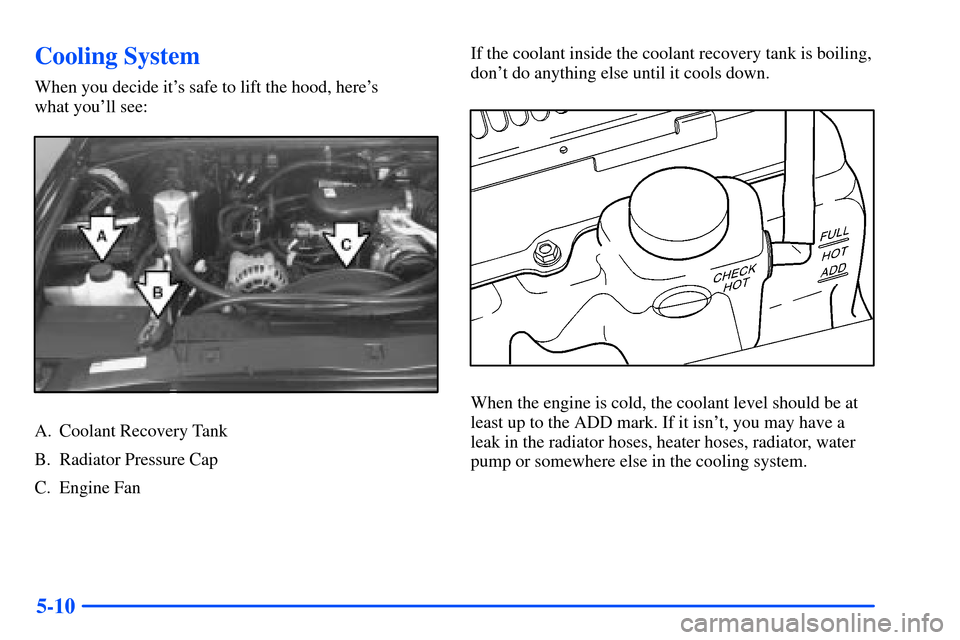
When you decide it's safe to lift the hood, here's
what you'll see:
A. Coolant Recovery Tank
B. Radiator Pressure Cap
C. Engine FanIf the coolant inside the coolant recovery tank is boiling,
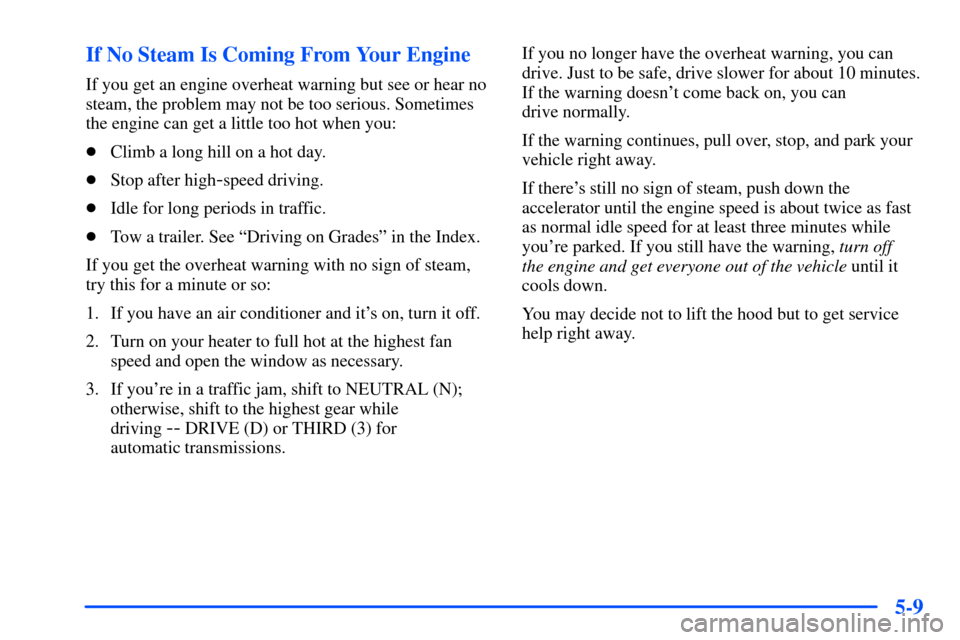
don't do anything else until it cools down.
When the engine is cold, the coolant level should be at
least up to the ADD mark. If it isn't, you may have a
leak in the radiator hoses, heater hoses, radiator, water
pump or somewhere else in the cooling system.
Page 220 of 381
5-11
CAUTION:
Heater and radiator hoses, and other engine
parts, can be very hot. Don't touch them.
If you do, you can be burned.
Don't run the engine if there is a leak. If you run
the engine, it could lose all coolant. That could
cause an engine fire, and you could be burned.
Get any leak fixed before you drive the vehicle.
NOTICE:
Engine damage from running your engine
without coolant isn't covered by your warranty.
NOTICE:
When adding coolant, it is important that you
use only DEX
-COOL� (silicate-free) coolant.
If coolant other than DEX-COOL is added to
the system, premature engine, heater core or
radiator corrosion may result. In addition, the
engine coolant will require change sooner
-- at
30,000 miles (50 000 km) or 24 months,
whichever occurs first. Damage caused by the
use of coolant other than DEX
-COOL� is not
covered by your new vehicle warranty.
If there seems to be no leak, start the engine again.
See if the engine cooling fan speed increases when idle
speed is doubled by pushing the accelerator pedal
down. If it doesn't, your vehicle needs service.
Turn off the engine.
Page 221 of 381
5-12 How to Add Coolant to the Coolant
Recovery Tank
If you haven't found a problem yet, but the coolant level
isn't at the ADD mark, add a 50/50 mixture of clean,
drinkable water and DEX
-COOL� engine coolant at the
coolant recovery tank. (See ªEngine Coolantº in the
Index for more information.)
CAUTION:
Adding only plain water to your cooling system
can be dangerous. Plain water, or some other
liquid like alcohol, can boil before the proper
coolant mixture will. Your vehicle's coolant
warning system is set for the proper
coolant mixture.
CAUTION: (Continued)
CAUTION: (Continued)
With plain water or the wrong mixture, your
engine could get too hot but you wouldn't get
the overheat warning. Your engine could catch
fire and you or others could be burned. Use a
50/50 mixture of clean, drinkable water and
DEX
-COOL� coolant.
NOTICE:
In cold weather, water can freeze and crack the
engine, radiator, heater core and other parts.
Use the recommended coolant and the proper
coolant mixture.
Page 247 of 381
6-5
NOTICE:
Your vehicle was not designed for fuel that
contains methanol. Don't use it. It can corrode
metal parts in your fuel system and also damage
plastic and rubber parts. That damage wouldn't
be covered under your warranty.
Fuel E-85 (85% Ethanol)
The 8th digit of your vehicle identification number
(VIN) shows the code letter for your engine. You will
find the VIN at the top left of your instrument panel.
(See ªVehicle Identification Numberº in the Index.)
If you have the 2200 L4 (Code 5) engine, you may
use either regular unleaded gasoline or ethanol fuel
up to 85% (E
-85); also see ªFuel (Gasoline)º listed
previously. If you have the 2200 L4 (Code 4) engine
or the 4.3L V6 engine use only regular gasoline.
Only vehicles with the 2200 L4 (Code 5) engine may
use 85% ethanol fuel (E
-85).Most service stations will not have an 85% ethanol fuel
(E
-85) pump available. Those stations that do have E-85
should have a label indicating minimum ethanol content.
Do not use the fuel if the minimum ethanol content is
greater than 85%. Your vehicle may not operate
properly if the ethanol content is greater than 85%.
At a minimum, E
-85 should meet ASTM
D 5798 specifications.
To insure quick starts in the wintertime, the E
-85 fuel
must be formulated properly for your climate according
to ASTM specification D 5798. If you have trouble
starting on E
-85, it may be because your E-85 fuel
is not properly formulated for your climate. If this
happens, switching to gasoline or adding gasoline to
your fuel tank may improve starting. Mixing gasoline
and E
-85 in your fuel tank will not cause any
problems with your vehicle. For good starting and
heater efficiency below 32�F (0�C), the fuel mix
in the fuel tank should contain a maximum of
50% ethanol.
Page 269 of 381
6-27
When the differential is cold, add enough lubricant to raise
the level to 1/2 inch (12 mm) below the filler plug hole.
When the differential is at operating temperature
(warm), add enough lubricant to raise the level to the
bottom of the filler plug hole.
What to Use
Refer to the Maintenance Schedule to determine what
kind of lubricant to use. See ªRecommended Fluids and
Lubricantsº in the Index.
Engine Coolant
The cooling system in your vehicle is filled with
DEX
-COOL� engine coolant. This coolant is designed
to remain in your vehicle for 5 years or 150,000 miles
(240 000 km), whichever occurs first, if you add only
DEX
-COOL� extended life coolant.
The following explains your cooling system and how to add
coolant when it is low. If you have a problem with engine
overheating, see ªEngine Overheatingº in the Index.A 50/50 mixture of clean, drinkable water and
DEX
-COOL� coolant will:
�Give freezing protection down to
-34�F (-37�C).
�Give boiling protection up to 265�F (129�C).
�Protect against rust and corrosion.
�Help keep the proper engine temperature.
�Let the warning lights and gages work as they should.
NOTICE:
When adding coolant, it is important that you
use only DEX
-COOL� (silicate-free) coolant.
If coolant other than DEX-COOL is added to
the system, premature engine, heater core or
radiator corrosion may result. In addition, the
engine coolant will require change sooner
-- at
30,000 miles (50 000 km) or 24 months,
whichever occurs first. Damage caused by the
use of coolant other than DEX
-COOL� is not
covered by your new vehicle warranty.
Page 270 of 381

6-28 What to Use
Use a mixture of one-half clean, drinkable water and
one
-half DEX-COOL� coolant which won't damage
aluminum parts. If you use this coolant mixture, you
don't need to add anything else.
CAUTION:
Adding only plain water to your cooling system
can be dangerous. Plain water, or some other
liquid like alcohol, can boil before the proper
coolant mixture will. Your vehicle's coolant
warning system is set for the proper coolant
mixture. With plain water or the wrong mixture,
your engine could get too hot but you wouldn't
get the overheat warning. Your engine could
catch fire and you or others could be burned.
Use a 50/50 mixture of clean, drinkable water
and DEX
-COOL� coolant.
NOTICE:
If you use an improper coolant mixture, your
engine could overheat and be badly damaged.
The repair cost wouldn't be covered by your
warranty. Too much water in the mixture can
freeze and crack the engine, radiator, heater core
and other parts.
If you have to add coolant more than four times a year,
have your dealer check your cooling system.
NOTICE:
If you use the proper coolant, you don't have to
add extra inhibitors or additives which claim to
improve the system. These can be harmful.