Page 53 of 381
1-40
When choosing a child restraint, be sure the child
restraint is designed to be used in a vehicle. If it is, it
will have a label saying that it meets federal motor
vehicle safety standards.
Then follow the instructions for the restraint. You may
find these instructions on the restraint itself or in a
booklet, or both. These restraints use the belt system in
your vehicle, but the child also has to be secured within
the restraint to help reduce the chance of personal injury.
The instructions that come with the infant or child
restraint will show you how to do that. Both the owner's
manual and the child restraint instructions are important,
so if either one of these is not available, obtain a
replacement copy from the manufacturer.
The child restraint must be secured properly in the right
front passenger seat. If you want to secure a rear
-facing
child restraint in the right front passenger's seat, turn off
the passenger's air bag. See ªAIR BAG OFF Switchº
and ªSecuring a Child Restraint in the Right Front Seat
Positionº in the Index for more on this, including
important safety information.
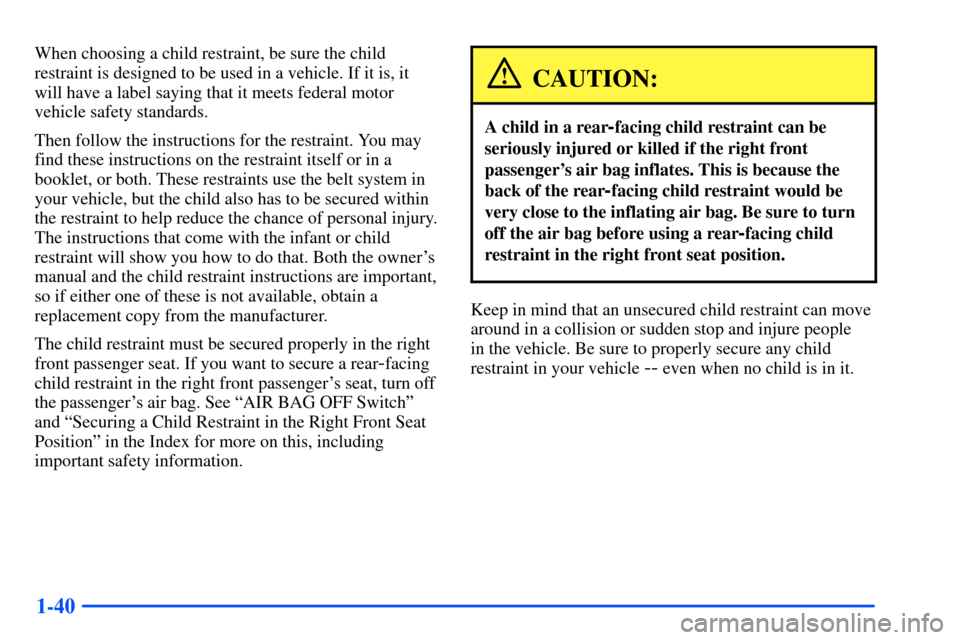
CAUTION:
A child in a rear-facing child restraint can be
seriously injured or killed if the right front
passenger's air bag inflates. This is because the
back of the rear
-facing child restraint would be
very close to the inflating air bag. Be sure to turn
off the air bag before using a rear
-facing child
restraint in the right front seat position.
Keep in mind that an unsecured child restraint can move
around in a collision or sudden stop and injure people
in the vehicle. Be sure to properly secure any child
restraint in your vehicle
-- even when no child is in it.
Page 54 of 381
1-41 Top Strap
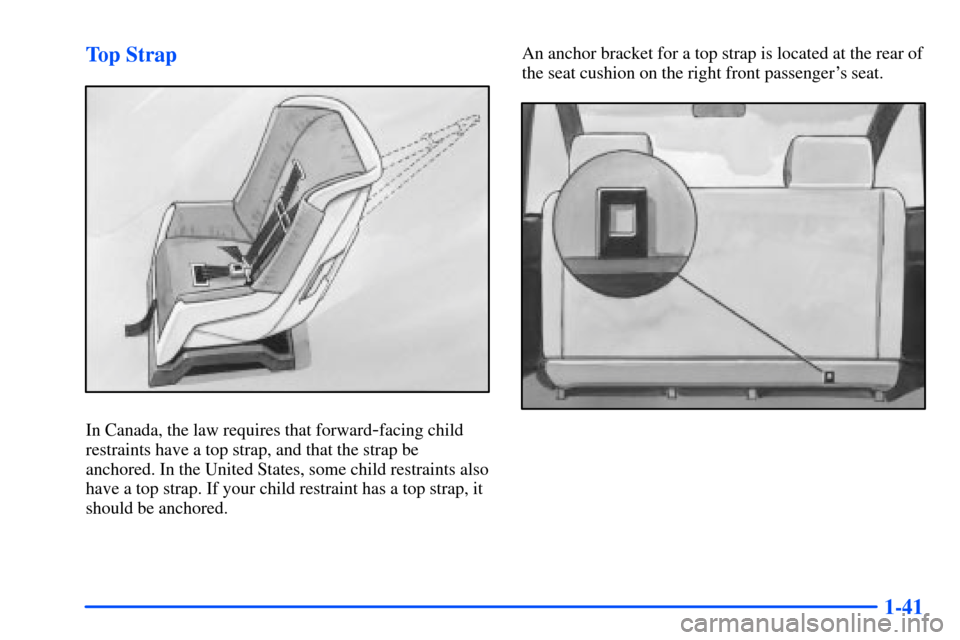
In Canada, the law requires that forward-facing child
restraints have a top strap, and that the strap be
anchored. In the United States, some child restraints also
have a top strap. If your child restraint has a top strap, it
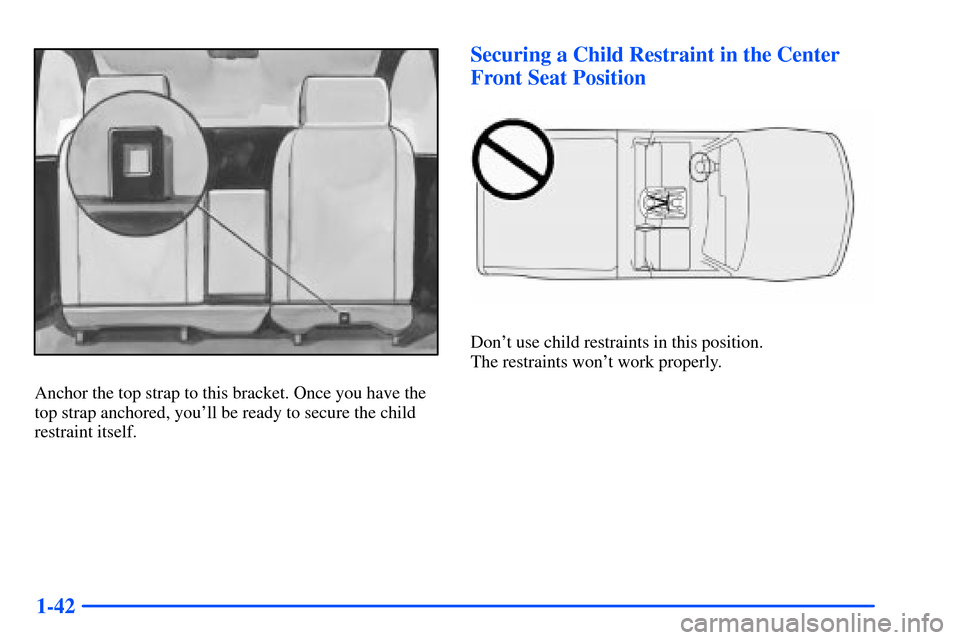
should be anchored.An anchor bracket for a top strap is located at the rear of
the seat cushion on the right front passenger's seat.
Page 55 of 381
1-42
Anchor the top strap to this bracket. Once you have the
top strap anchored, you'll be ready to secure the child
restraint itself.
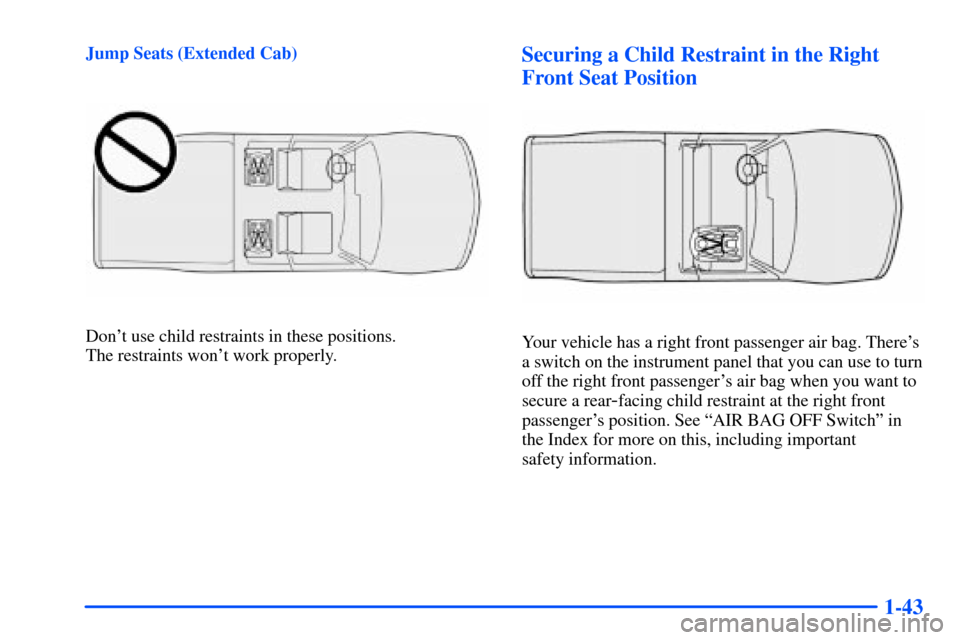
Securing a Child Restraint in the Center
Front Seat Position
Don't use child restraints in this position.
The restraints won't work properly.
Page 56 of 381
1-43
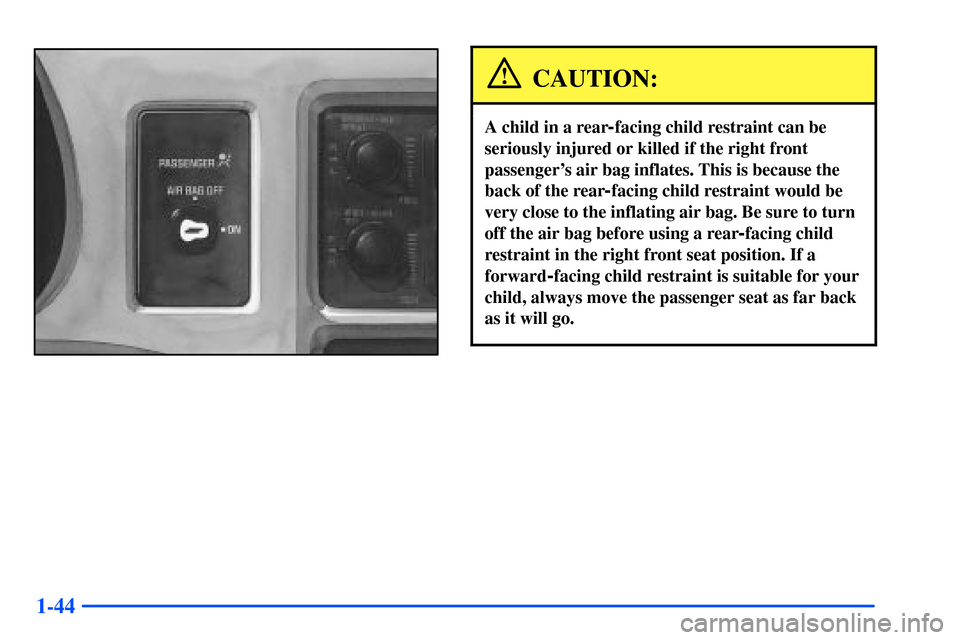
Jump Seats (Extended Cab)
Don't use child restraints in these positions.
The restraints won't work properly.
Securing a Child Restraint in the Right
Front Seat Position
Your vehicle has a right front passenger air bag. There's
a switch on the instrument panel that you can use to turn
off the right front passenger's air bag when you want to
secure a rear
-facing child restraint at the right front
passenger's position. See ªAIR BAG OFF Switchº in
the Index for more on this, including important
safety information.
Page 57 of 381
1-44
CAUTION:
A child in a rear-facing child restraint can be
seriously injured or killed if the right front
passenger's air bag inflates. This is because the
back of the rear
-facing child restraint would be
very close to the inflating air bag. Be sure to turn
off the air bag before using a rear
-facing child
restraint in the right front seat position. If a
forward
-facing child restraint is suitable for your
child, always move the passenger seat as far back
as it will go.
Page 58 of 381
1-45
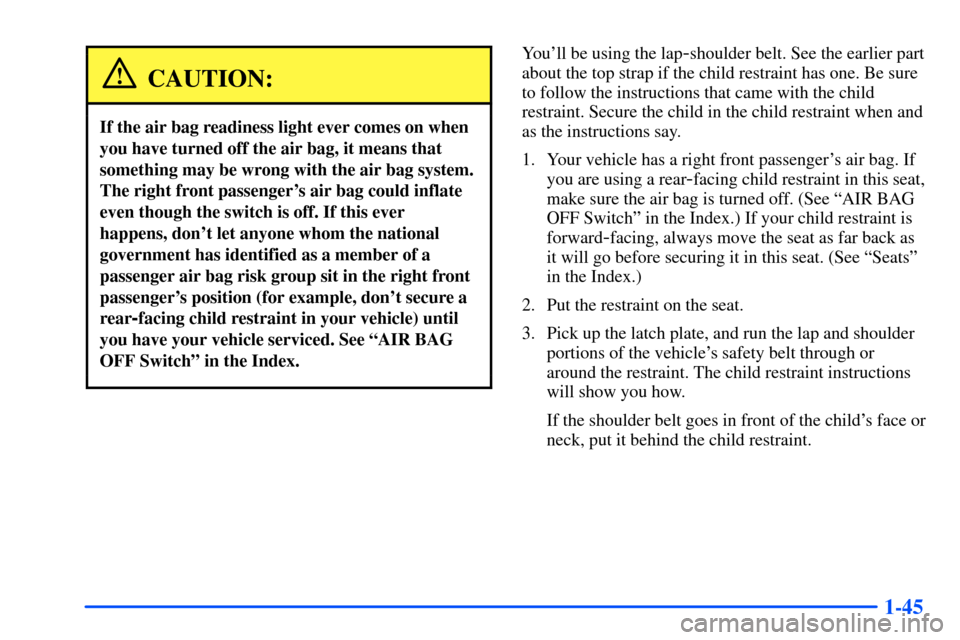
CAUTION:
If the air bag readiness light ever comes on when
you have turned off the air bag, it means that
something may be wrong with the air bag system.
The right front passenger's air bag could inflate
even though the switch is off. If this ever
happens, don't let anyone whom the national
government has identified as a member of a
passenger air bag risk group sit in the right front
passenger's position (for example, don't secure a
rear
-facing child restraint in your vehicle) until
you have your vehicle serviced. See ªAIR BAG
OFF Switchº in the Index.
You'll be using the lap-shoulder belt. See the earlier part
about the top strap if the child restraint has one. Be sure
to follow the instructions that came with the child
restraint. Secure the child in the child restraint when and
as the instructions say.
1. Your vehicle has a right front passenger's air bag. If
you are using a rear
-facing child restraint in this seat,
make sure the air bag is turned off. (See ªAIR BAG
OFF Switchº in the Index.) If your child restraint is
forward
-facing, always move the seat as far back as
it will go before securing it in this seat. (See ªSeatsº
in the Index.)
2. Put the restraint on the seat.
3. Pick up the latch plate, and run the lap and shoulder
portions of the vehicle's safety belt through or
around the restraint. The child restraint instructions
will show you how.
If the shoulder belt goes in front of the child's face or
neck, put it behind the child restraint.
Page 61 of 381
1-48
Larger Children
Children who have outgrown child restraints should
wear the vehicle's safety belts.
If you have the choice, a child should sit next to a
window so the child can wear a lap
-shoulder belt and
get the additional restraint a shoulder belt can provide.
�Children who aren't buckled up can be thrown out in
a crash.�Children who aren't buckled up can strike other
people who are.
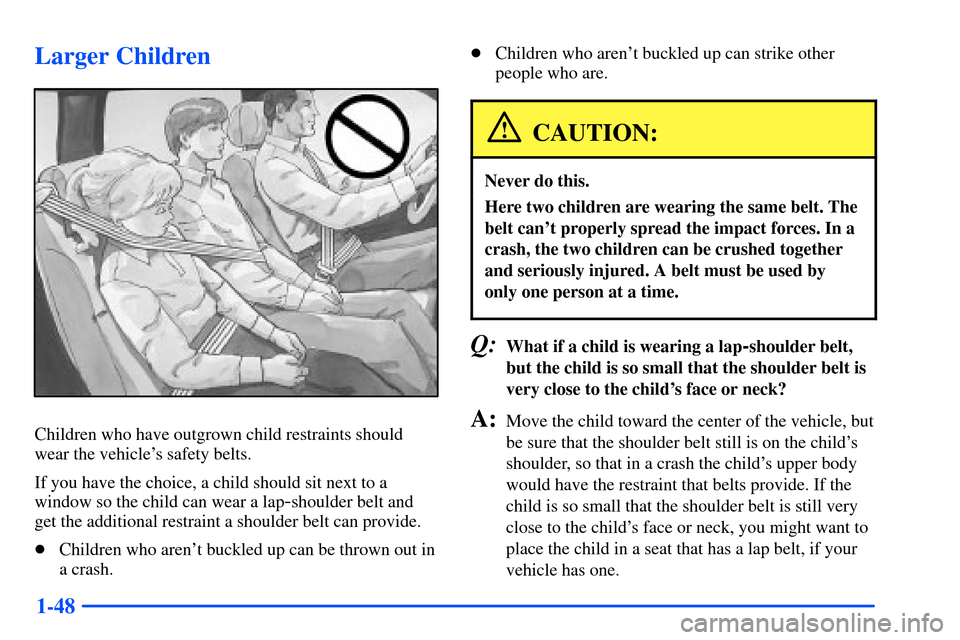
CAUTION:
Never do this.
Here two children are wearing the same belt. The
belt can't properly spread the impact forces. In a
crash, the two children can be crushed together
and seriously injured. A belt must be used by
only one person at a time.
Q:What if a child is wearing a lap-shoulder belt,
but the child is so small that the shoulder belt is
very close to the child's face or neck?
A:Move the child toward the center of the vehicle, but
be sure that the shoulder belt still is on the child's
shoulder, so that in a crash the child's upper body
would have the restraint that belts provide. If the
child is so small that the shoulder belt is still very
close to the child's face or neck, you might want to
place the child in a seat that has a lap belt, if your
vehicle has one.
Page 62 of 381
1-49
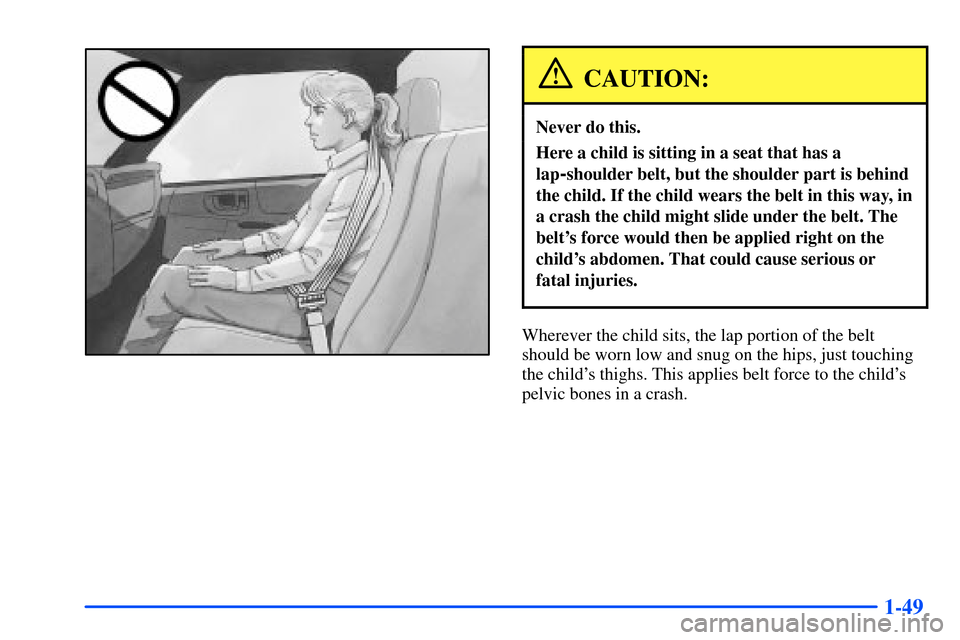
CAUTION:
Never do this.
Here a child is sitting in a seat that has a
lap
-shoulder belt, but the shoulder part is behind
the child. If the child wears the belt in this way, in
a crash the child might slide under the belt. The
belt's force would then be applied right on the
child's abdomen. That could cause serious or
fatal injuries.
Wherever the child sits, the lap portion of the belt
should be worn low and snug on the hips, just touching
the child's thighs. This applies belt force to the child's
pelvic bones in a crash.