Page 248 of 381
6-6
E-85 has less energy per gallon than gasoline, so you'll
need to refill your fuel tank more often when using E
-85
than when you're using gasoline. Use regular gasoline
when pulling a trailer. For payload capacity with ethanol
fuel see ªLoading Your Vehicleº in the Index.
NOTICE:
Some additives are not compatible with E-85 fuel
and may harm your fuel system. Damage caused
by additives may not be covered by your new
vehicle warranty. Don't use additives
with E
-85 fuel.
NOTICE:
Your vehicle was not designed for fuel that
contains methanol. Don't use it. It can corrode
metal parts in your fuel system and also damage
plastic and rubber parts. That damage wouldn't
be covered under your warranty.
Fuels in Foreign Countries
If you plan on driving in another country outside the
United States or Canada, the proper fuel may be hard to
find. Never use leaded gasoline or any other fuel not
recommended in the previous text on fuel. Costly repairs
caused by use of improper fuel wouldn't be covered by
your warranty.
To check on fuel availability, ask an auto club, or
contact a major oil company that does business in the
country where you'll be driving.
You can also write us at the following address for
advice. Just tell us where you're going and give your
Vehicle Identification Number (VIN).
General Motors Overseas Distribution Corporation
1908 Colonel Sam Drive
Oshawa, Ontario L1H 8P7
Page 256 of 381
6-14
Pull out the dipstick and clean it with a paper towel or
cloth, then push it back in all the way. Remove it again,
keeping the tip down, and check the level.When to Add Engine Oil
If the oil is at or below the ADD line, then you'll need
to add at least one quart of oil. But you must use the
right kind. This part explains what kind of oil to use. For
crankcase capacity, see ªCapacities and Specificationsº
in the Index.
NOTICE:
Don't add too much oil. If your engine has so
much oil that the oil level gets above the
cross
-hatched area that shows the proper
operating range, your engine could be damaged.
Be sure to fill it enough to put the level somewhere in
the proper operating range. Push the dipstick all the way
back in when you're through.
Page 293 of 381
6-51
Temperature -- A, B, C
The temperature grades are A (the highest), B, and C,
representing the tire's resistance to the generation of
heat and its ability to dissipate heat when tested under
controlled conditions on a specified indoor laboratory
test wheel. Sustained high temperature can cause the
material of the tire to degenerate and reduce tire life, and
excessive temperature can lead to sudden tire failure.
The grade C corresponds to a level of performance
which all passenger car tires must meet under the
Federal Motor Vehicle Safety Standard No. 109. Grades
B and A represent higher levels of performance on the
laboratory test wheel than the minimum required by law.
Warning: The temperature grade for this tire is
established for a tire that is properly inflated and
not overloaded. Excessive speed, underinflation, or
excessive loading, either separately or in combination,
can cause heat buildup and possible tire failure.
Wheel Alignment and Tire Balance
The wheels on your vehicle were aligned and balanced
carefully at the factory to give you the longest tire life
and best overall performance.Scheduled wheel alignment and wheel balancing are
not needed. However, if you notice unusual tire wear
or your vehicle pulling one way or the other, the
alignment may need to be reset. If you notice your
vehicle vibrating when driving on a smooth road,
your wheels may need to be rebalanced.
Wheel Replacement
Replace any wheel that is bent, cracked, or badly rusted
or corroded. If wheel nuts keep coming loose, the wheel,
wheel bolts and wheel nuts should be replaced. If the
wheel leaks air, replace it (except some aluminum
wheels, which can sometimes be repaired).
See your dealer if any of these conditions exist.
Your dealer will know the kind of wheel you need.
Each new wheel should have the same load
-carrying
capacity, diameter, width, offset and be mounted the
same way as the one it replaces.
If you need to replace any of your wheels, wheel bolts
or wheel nuts, replace them only with new GM original
equipment parts. This way, you will be sure to have the
right wheel, wheel bolts and wheel nuts for your vehicle.
Page 309 of 381
6-67
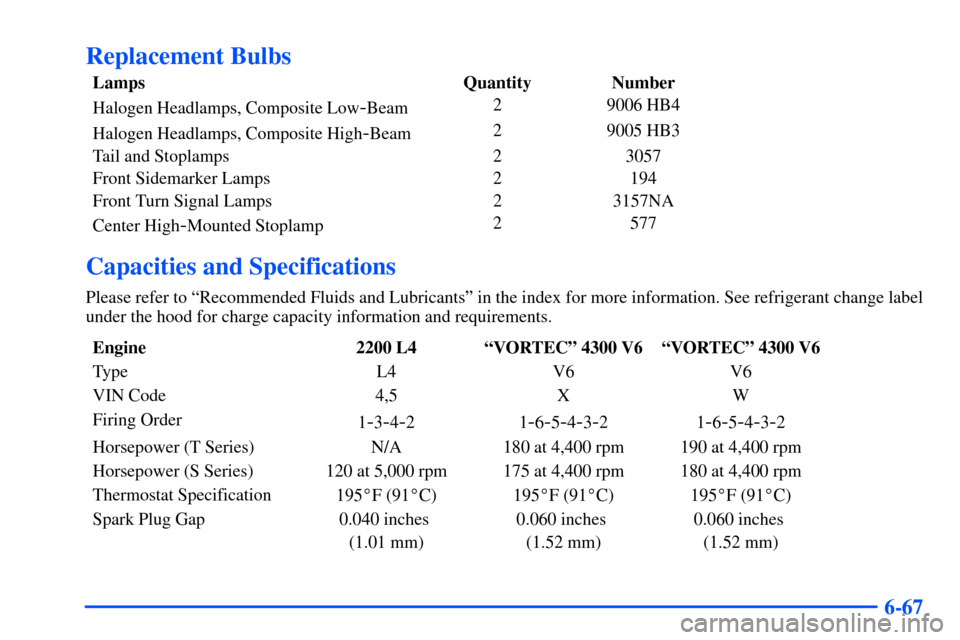
Replacement Bulbs
Lamps Quantity Number
Halogen Headlamps, Composite Low
-Beam2 9006 HB4
Halogen Headlamps, Composite High
-Beam2 9005 HB3
Tail and Stoplamps 2 3057
Front Sidemarker Lamps 2 194
Front Turn Signal Lamps 2 3157NA
Center High
-Mounted Stoplamp2 577
Capacities and Specifications
Please refer to ªRecommended Fluids and Lubricantsº in the index for more information. See refrigerant change label
under the hood for charge capacity information and requirements.
Engine 2200 L4 ªVORTECº 4300 V6 ªVORTECº 4300 V6
Type L4 V6 V6
VIN Code 4,5 X W
Firing Order
1
-3-4-21-6-5-4-3-21-6-5-4-3-2
Horsepower (T Series) N/A 180 at 4,400 rpm 190 at 4,400 rpm
Horsepower (S Series) 120 at 5,000 rpm 175 at 4,400 rpm 180 at 4,400 rpm
Thermostat Specification
195�F (91�C) 195�F (91�C) 195�F (91�C)
Spark Plug Gap 0.040 inches
(1.01 mm)0.060 inches
(1.52 mm)0.060 inches
(1.52 mm)
Page 310 of 381
6-68 Wheels and Tires
Wheel Nut Torque 100 lb-ft (140 N´m) . . . . . . . . . . .
Tire Pressure See the Certification/Tire label.. . . . . .
See ªLoading Your Vehicleº in the Index.
Capacities (Approximate)
Cooling System Capacity*
Engine Quantity
2200 L4 Auto./Manual 11.5 quarts (11.0 L)
ªVORTECº 4300 V6 Auto. 11.7 quarts (11.1 L)
ªVORTECº 4300 V6 Manual 11.9 quarts (11.3 L)
Crankcase Capacity*
Engine Quantity with Filter
2200 L4 4.5 quarts (4.3 L)
ªVORTECº
4300 V64.5 quarts (4.3 L)Automatic Transmission Capacity*
Type Quantity (Drain and Refill)
4L60E 5.0 quarts (4.7 L)
*After refill, the level must be checked.
Differential Fluid
Axle Quantity
Rear 4.0 pints (1.9 L)
Front 2.6 pints (1.2 L)
Fuel Tank Capacity
Type Quantity
Standard Tank 18.5 U.S. gallons (70.0 L)