Page 269 of 365
yellowblue
6-12
Before closing the hood, be sure all the filler caps
are on properly. Then just pull the hood down and
close it firmly.
Engine Oil
If the LOW OIL appears on
the instrument panel, it
means you need to check
your engine oil level
right away. For more
information, see ªLow Oil
Level Lightº in the Index.
You should check your engine oil level regularly; this is
an added reminder.
Checking Engine Oil
It's a good idea to check your engine oil every time you
get fuel. In order to get an accurate reading, the oil must
be warm and the vehicle must be on level ground.
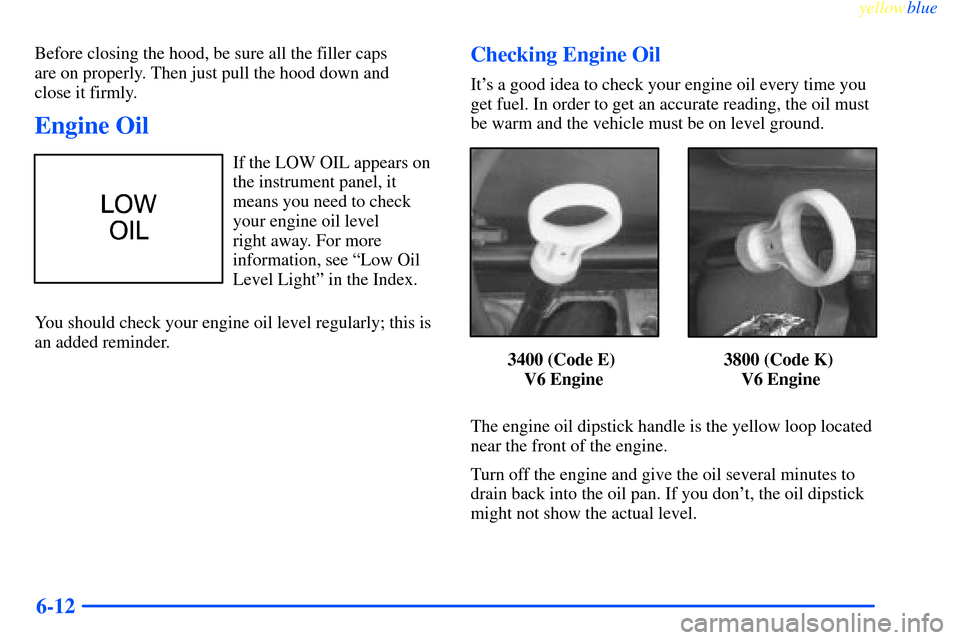
3400 (Code E)
V6 Engine3800 (Code K)
V6 Engine
The engine oil dipstick handle is the yellow loop located
near the front of the engine.
Turn off the engine and give the oil several minutes to
drain back into the oil pan. If you don't, the oil dipstick
might not show the actual level.
Page 301 of 365
yellowblue
6-44 Inflation -- Tire Pressure
The Tire-Loading Information label, which is on the
inside of the trunk lid, shows the correct inflation
pressures for your tires when they're cold. ªColdº
means your vehicle has been sitting for at least
three hours or driven no more than 1 mile (1.6 km).
NOTICE:
Don't let anyone tell you that underinflation or
overinflation is all right. It's not. If your tires
don't have enough air (underinflation), you can
get the following:
�Too much flexing
�Too much heat
�Tire overloading
�Bad wear
�Bad handling
�Bad fuel economy.
NOTICE: (Continued)
NOTICE: (Continued)
If your tires have too much air (overinflation),
you can get the following:
�Unusual wear
�Bad handling
�Rough ride
�Needless damage from road hazards.
When to Check
Check your tires once a month or more.
Don't forget your compact spare tire. It should be
at 60 psi (420 kPa).
How to Check
Use a good quality pocket
-type gage to check tire
pressure. You can't tell if your tires are properly inflated
simply by looking at them. Radial tires may look
properly inflated even when they're underinflated.
Be sure to put the valve caps back on the valve
stems. They help prevent leaks by keeping out dirt
and moisture.
Page 315 of 365
yellowblue
6-58
Cleaning Tires
To clean your tires, use a stiff brush with a tire cleaner.
NOTICE:
When applying a tire dressing always take care to
wipe off any overspray or splash from all painted
surfaces on the body or wheels of the vehicle.
Petroleum
-based products may damage the paint
finish and tires.
Sheet Metal Damage
If your vehicle is damaged and requires sheet metal
repair or replacement, make sure the body repair shop
applies anti
-corrosion material to the parts repaired or
replaced to restore corrosion protection.
Finish Damage
Any stone chips, fractures or deep scratches in the finish
should be repaired right away. Bare metal will corrode
quickly and may develop into a major repair expense.
Minor chips and scratches can be repaired with touch
-up
materials available from your dealer or other service
outlets. Larger areas of finish damage can be corrected
in your dealer's body and paint shop.
Underbody Maintenance
Chemicals used for ice and snow removal and dust control
can collect on the underbody. If these are not removed,
accelerated corrosion (rust) can occur on the underbody
parts such as fuel lines, frame, floor pan and exhaust
system even though they have corrosion protection.
At least every spring, flush these materials from the
underbody with plain water. Clean any areas where mud
and other debris can collect. Dirt packed in closed areas
of the frame should be loosened before being flushed.
Your dealer or an underbody car washing system can do
this for you.
Chemical Paint Spotting
Some weather and atmospheric conditions can create a
chemical fallout. Airborne pollutants can fall upon and
attack painted surfaces on your vehicle. This damage can
take two forms: blotchy, ringlet
-shaped discolorations, and
small irregular dark spots etched into the paint surface.
Although no defect in the paint job causes this,
Chevrolet will repair, at no charge to the owner, the
surfaces of new vehicles damaged by this fallout
condition within 12 months or 12,000 miles (20 000 km)
of purchase, whichever occurs first.
Page 323 of 365
yellowblue
6-66
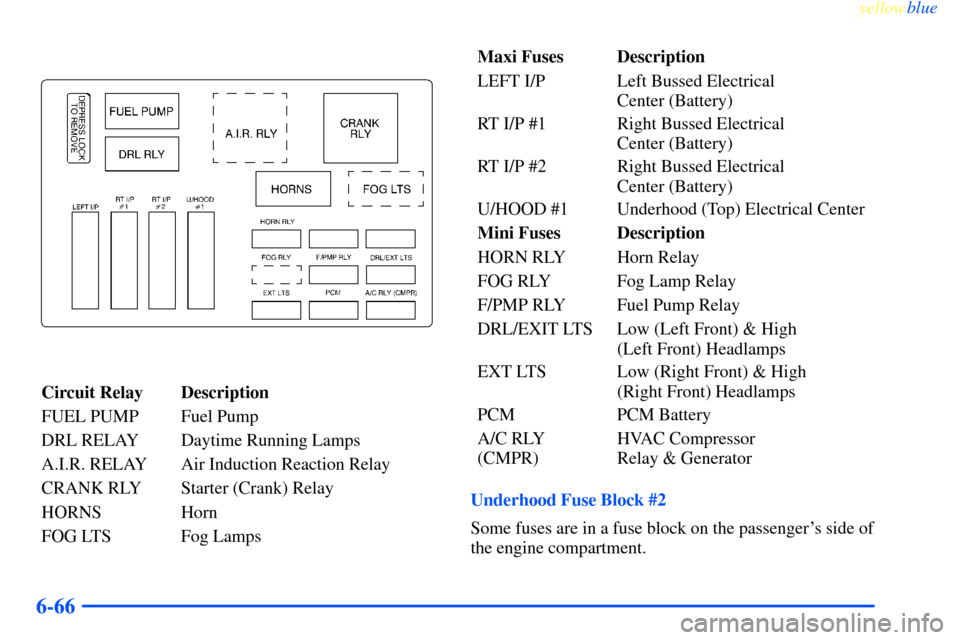
Circuit Relay Description
FUEL PUMP Fuel Pump
DRL RELAY Daytime Running Lamps
A.I.R. RELAY Air Induction Reaction Relay
CRANK RLY Starter (Crank) Relay
HORNS Horn
FOG LTS Fog LampsMaxi Fuses Description
LEFT I/P Left Bussed Electrical
Center (Battery)
RT I/P #1 Right Bussed Electrical
Center (Battery)
RT I/P #2 Right Bussed Electrical
Center (Battery)
U/HOOD #1 Underhood (Top) Electrical Center
Mini Fuses Description
HORN RLY Horn Relay
FOG RLY Fog Lamp Relay
F/PMP RLY Fuel Pump Relay
DRL/EXIT LTS Low (Left Front) & High
(Left Front) Headlamps
EXT LTS Low (Right Front) & High
(Right Front) Headlamps
PCM PCM Battery
A/C RLY
(CMPR)HVAC Compressor
Relay & Generator
Underhood Fuse Block #2
Some fuses are in a fuse block on the passenger's side of
the engine compartment.
Page 324 of 365
yellowblue
6-67
Circuit Relay Description
FAN CONT #3 Secondary Cooling Fan
(Passenger's Side)
FAN CONT #2 Cooling Fan Control Relay
FAN CONT #1 Primary Cooling Fan
(Driver's Side)
IGN RELAY Ignition Relay
A/C CMPR HVAC CompressorMaxi Fuses Description
IGN SW Ignition Switch
BLANK Blank
U/HOOD #2 Ignition Relay, AIR Pump
COOLING
FANSCooling Fans (Battery)
Mini Fuses Description
FAN CONT #2
& #3Cooling Fan Control
Relays #2 & #3
FAN CONT #1 Cooling Fan Control Relays #1
AIR PMP RLY Air Induction Reaction Pump
Relay (Battery)
FUEL INJ Fuel Injectors
TRANS SOL Transmission Solenoids
A/C RLY
(COIL)HVAC Control Relay
ENG
DEVICESCanister Purge Solenoid, Mass Air
Flow Sensor (MAF), AIR Pump
Relay & Valve Control
DFI MDL Direct Fire Ignition Module
OXY SEN Oxygen Sensors
(Pre and Post Converter)
Page 325 of 365
yellowblue
6-68
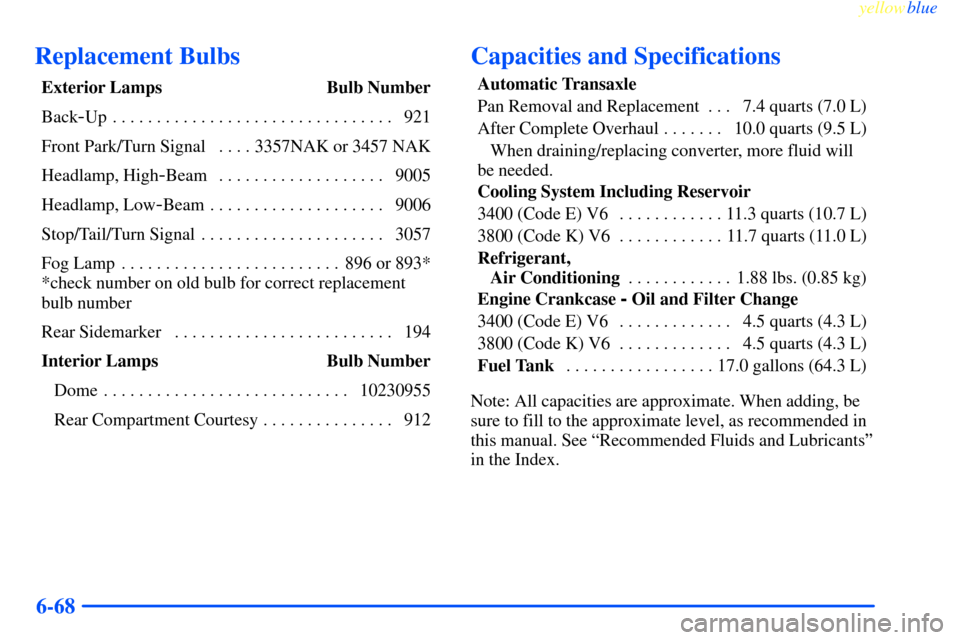
Replacement Bulbs
Exterior Lamps Bulb Number
Back
-Up 921. . . . . . . . . . . . . . . . . . . . . . . . . . . . . . . .
Front Park/Turn Signal 3357NAK or 3457 NAK. . . .
Headlamp, High
-Beam 9005. . . . . . . . . . . . . . . . . . .
Headlamp, Low
-Beam 9006. . . . . . . . . . . . . . . . . . . .
Stop/Tail/Turn Signal 3057. . . . . . . . . . . . . . . . . . . . .
Fog Lamp 896 or 893*. . . . . . . . . . . . . . . . . . . . . . . . .
*check number on old bulb for correct replacement
bulb number
Rear Sidemarker 194. . . . . . . . . . . . . . . . . . . . . . . . .
Interior Lamps Bulb Number
Dome 10230955. . . . . . . . . . . . . . . . . . . . . . . . . . . .
Rear Compartment Courtesy 912. . . . . . . . . . . . . . .
Capacities and Specifications
Automatic Transaxle
Pan Removal and Replacement 7.4 quarts (7.0 L). . .
After Complete Overhaul 10.0 quarts (9.5 L). . . . . . .
When draining/replacing converter, more fluid will
be needed.
Cooling System Including Reservoir
3400 (Code E) V6 11.3 quarts (10.7 L). . . . . . . . . . . .
3800 (Code K) V6 11.7 quarts (11.0 L). . . . . . . . . . . .
Refrigerant,
Air Conditioning1.88 lbs. (0.85 kg) . . . . . . . . . . . .
Engine Crankcase
- Oil and Filter Change
3400 (Code E) V6 4.5 quarts (4.3 L). . . . . . . . . . . . .
3800 (Code K) V6 4.5 quarts (4.3 L). . . . . . . . . . . . .
Fuel Tank17.0 gallons (64.3 L) . . . . . . . . . . . . . . . . .
Note: All capacities are approximate. When adding, be
sure to fill to the approximate level, as recommended in
this manual. See ªRecommended Fluids and Lubricantsº
in the Index.
Page 331 of 365
yellowblue
7-4
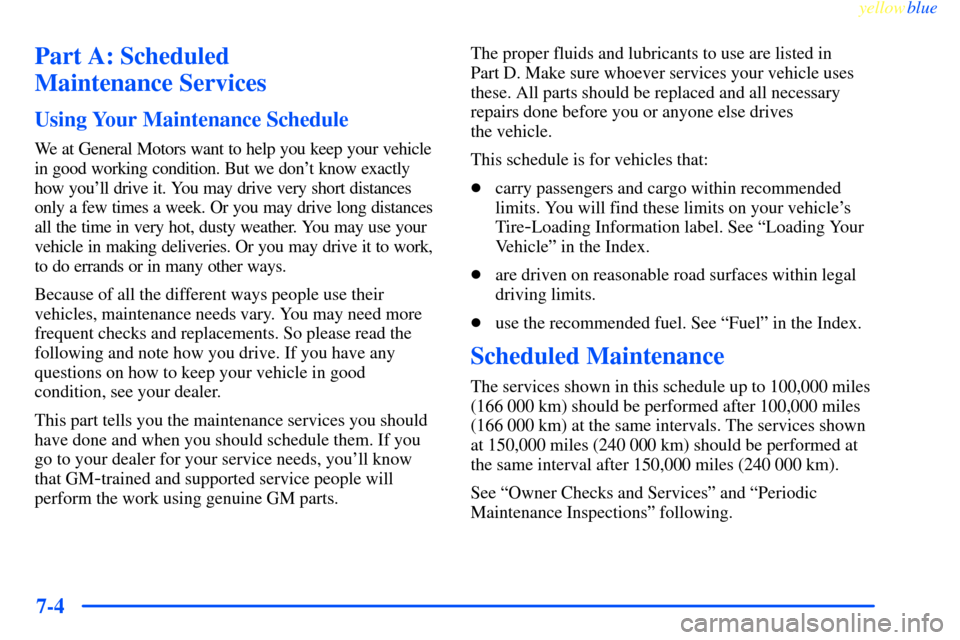
Part A: Scheduled
Maintenance Services
Using Your Maintenance Schedule
We at General Motors want to help you keep your vehicle
in good working condition. But we don't know exactly
how you'll drive it. You may drive very short distances
only a few times a week. Or you may drive long distances
all the time in very hot, dusty weather. You may use your
vehicle in making deliveries. Or you may drive it to work,
to do errands or in many other ways.
Because of all the different ways people use their
vehicles, maintenance needs vary. You may need more
frequent checks and replacements. So please read the
following and note how you drive. If you have any
questions on how to keep your vehicle in good
condition, see your dealer.
This part tells you the maintenance services you should
have done and when you should schedule them. If you
go to your dealer for your service needs, you'll know
that GM
-trained and supported service people will
perform the work using genuine GM parts.The proper fluids and lubricants to use are listed in
Part D. Make sure whoever services your vehicle uses
these. All parts should be replaced and all necessary
repairs done before you or anyone else drives
the vehicle.
This schedule is for vehicles that:
�carry passengers and cargo within recommended
limits. You will find these limits on your vehicle's
Tire
-Loading Information label. See ªLoading Your
Vehicleº in the Index.
�are driven on reasonable road surfaces within legal
driving limits.
�use the recommended fuel. See ªFuelº in the Index.
Scheduled Maintenance
The services shown in this schedule up to 100,000 miles
(166 000 km) should be performed after 100,000 miles
(166 000 km) at the same intervals. The services shown
at 150,000 miles (240 000 km) should be performed at
the same interval after 150,000 miles (240 000 km).
See ªOwner Checks and Servicesº and ªPeriodic
Maintenance Inspectionsº following.
Page 342 of 365
yellowblue
7-15
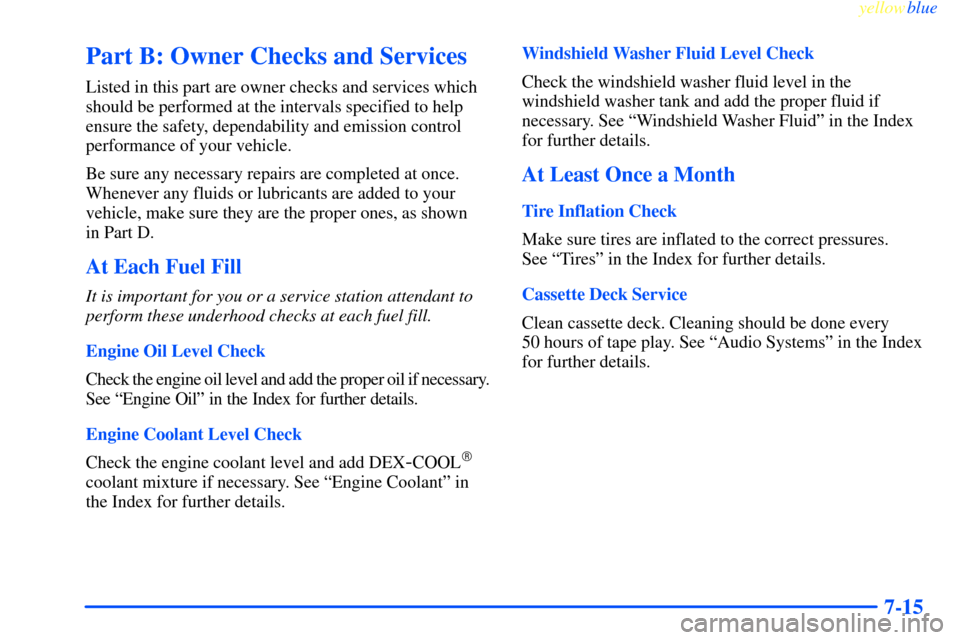
Part B: Owner Checks and Services
Listed in this part are owner checks and services which
should be performed at the intervals specified to help
ensure the safety, dependability and emission control
performance of your vehicle.
Be sure any necessary repairs are completed at once.
Whenever any fluids or lubricants are added to your
vehicle, make sure they are the proper ones, as shown
in Part D.
At Each Fuel Fill
It is important for you or a service station attendant to
perform these underhood checks at each fuel fill.
Engine Oil Level Check
Check the engine oil level and add the proper oil if necessary.
See ªEngine Oilº in the Index for further details.
Engine Coolant Level Check
Check the engine coolant level and add DEX
-COOL�
coolant mixture if necessary. See ªEngine Coolantº in
the Index for further details.Windshield Washer Fluid Level Check
Check the windshield washer fluid level in the
windshield washer tank and add the proper fluid if
necessary. See ªWindshield Washer Fluidº in the Index
for further details.
At Least Once a Month
Tire Inflation Check
Make sure tires are inflated to the correct pressures.
See ªTiresº in the Index for further details.
Cassette Deck Service
Clean cassette deck. Cleaning should be done every
50 hours of tape play. See ªAudio Systemsº in the Index
for further details.