Page 99 of 365
yellowblue
2-36
CAUTION:
It can be dangerous to get out of your vehicle if
the shift lever is not fully in PARK (P) with the
parking brake firmly set. Your vehicle can roll.
Don't leave your vehicle when the engine is
running unless you have to. If you've left the
engine running, the vehicle can move suddenly.
You or others could be injured. To be sure your
vehicle won't move, even when you're on fairly
level ground, always set your parking brake and
move the shift lever to PARK (P).
Follow the proper steps to be sure your vehicle won't
move. See ªShifting Into PARK (P)º in the Index.
If you are parking on a hill and if you're pulling a
trailer, also see ªTowing a Trailerº in the Index.
Windows
Power Windows
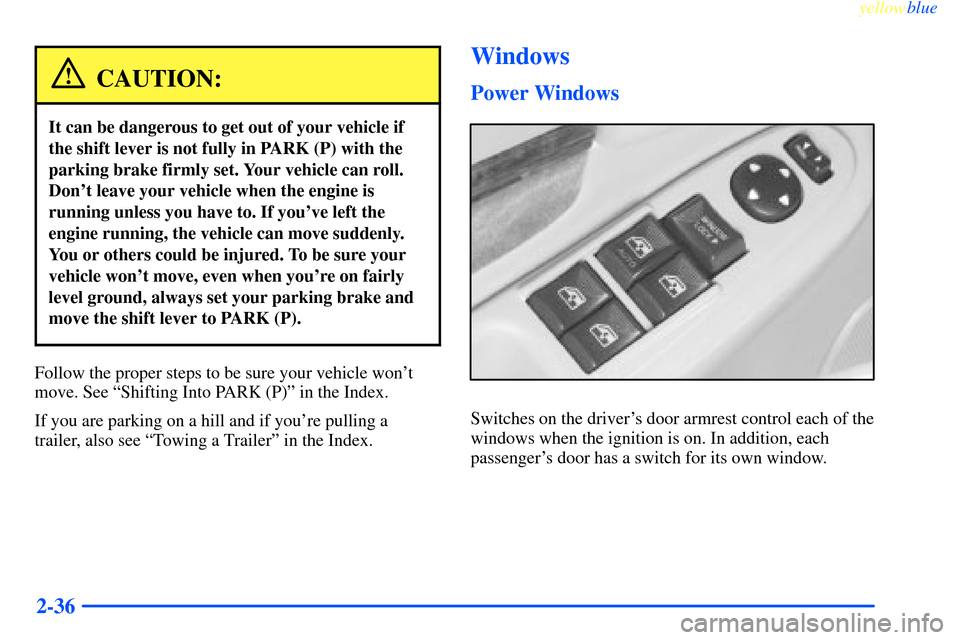
Switches on the driver's door armrest control each of the
windows when the ignition is on. In addition, each
passenger's door has a switch for its own window.
Page 108 of 365

yellowblue
2-45 Daytime Running Lamps
Daytime Running Lamps (DRL) can make it easier for
others to see the front of your vehicle during the day.
DRL can be helpful in many different driving
conditions, but they can be especially helpful in the
short periods after dawn and before sunset.
A light sensor on top of the instrument panel makes the
DRL work, so be sure it isn't covered.
The DRL system will make your high
-beam headlamps
come on at a reduced brightness when:
�the ignition is on,
�the headlamp switch is off,
�the gearshift is not in PARK (P) and
�the parking brake is released.
When the DRL are on, only your high
-beam headlamps,
at a reduced brightness, will be on. The headlamps,
taillamps, sidemarker and other lamps won't be on.
Your instrument panel won't be lit up either.
When it's dark enough outside, your high
-beam
headlamps will turn off and your vehicle's headlamps
and parking lamps will turn on. The other lamps that
come on with your headlamps will also come on.When it's bright enough outside, your headlamps will go
off and your high
-beam headlamps will come on.
As with any vehicle, you should turn on the regular
headlamp system when you need it.
Delayed Headlamp Illumination
Delayed headlamp illumination provides a period of
exterior lighting as you leave your vehicle's area. The
feature is activated when your vehicle's headlamps are
on due to the automatic headlamp control feature
described previously in this section, and when your
vehicle's ignition is turned off. Your headlamps will
then remain on until the headlamp switch is moved from
OFF to the parking lamp position or until either a
30 second or 60 second lighting period has ended.
If you turn off the ignition with the headlamp switch in
the parking lamp or headlamp position, the delayed
headlamp illumination cycle will not occur.
To disable the delayed headlamp illumination feature or
change the time of delay, see ªVehicle Customization
Settingsº in the Index.
Page 127 of 365

yellowblue
2-64 Brake System Warning Light
Your vehicle's hydraulic brake system is divided into
two parts. If one part isn't working, the other part can
still work and stop you. For good braking, though, you
need both parts working well.
If the warning light comes on, there is a brake problem.
Have your brake system inspected right away.
United States Canada
This light should come on briefly when you turn the
ignition key to ON. If it doesn't come on then, have it
fixed so it will be ready to warn you if there's a problem.If the light comes on while you are driving, pull off the
road and stop carefully. You may notice that the pedal is
harder to push. Or, the pedal may go closer to the floor.
It may take longer to stop. If the light is still on, have the
vehicle towed for service. (See ªAnti
-Lock Brake
System Warning Lightº and ªTowing Your Vehicleº in
the Index.)
CAUTION:
Your brake system may not be working properly
if the brake system warning light is on. Driving
with the brake system warning light on can lead
to an accident. If the light is still on after you've
pulled off the road and stopped carefully, have
the vehicle towed for service.
When the ignition is on, the brake system warning light
will also come on when you set your parking brake. The
light will stay on if your parking brake doesn't release
fully. If it stays on after your parking brake is fully
released, it means you have a brake problem.
Page 221 of 365
yellowblue
4-38 Parking on Hills
CAUTION:
You really should not park your vehicle, with a
trailer attached, on a hill. If something goes
wrong, your rig could start to move. People can
be injured, and both your vehicle and the trailer
can be damaged.
But if you ever have to park your rig on a hill, here's
how to do it:
1. Apply your regular brakes, but don't shift into
PARK (P) yet.
2. Have someone place chocks under the trailer wheels.
3. When the wheel chocks are in place, release the
regular brakes until the chocks absorb the load.
4. Reapply the regular brakes. Then apply your parking
brake, and then shift to PARK (P).
5. Release the regular brakes.
When You Are Ready to Leave After
Parking on a Hill
1. Apply your regular brakes and hold the pedal down
while you:
�Start your engine;
�Shift into a gear; and
�Release the parking brake.
2. Let up on the brake pedal.
3. Drive slowly until the trailer is clear of the chocks.
4. Stop and have someone pick up and store the chocks.
Maintenance When Trailer Towing
Your vehicle will need service more often when you're
pulling a trailer. See the Maintenance Schedule for more
on this. Things that are especially important in trailer
operation are automatic transaxle fluid (don't overfill),
engine oil, drive belts, cooling system and brake system.
Each of these is covered in this manual, and the Index will
help you find them quickly. If you're trailering, it's a good
idea to review this information before you start your trip.
Check periodically to see that all hitch nuts and bolts are tight.
Engine Cooling When Trailer Towing
Your cooling system may temporarily overheat during
severe operating conditions. See ªEngine Overheatingº
in the Index.
Page 245 of 365
yellowblue
5-24
Changing a Flat Tire
If a tire goes flat, avoid further tire and wheel damage
by driving slowly to a level place. Turn on your hazard
warning flashers.
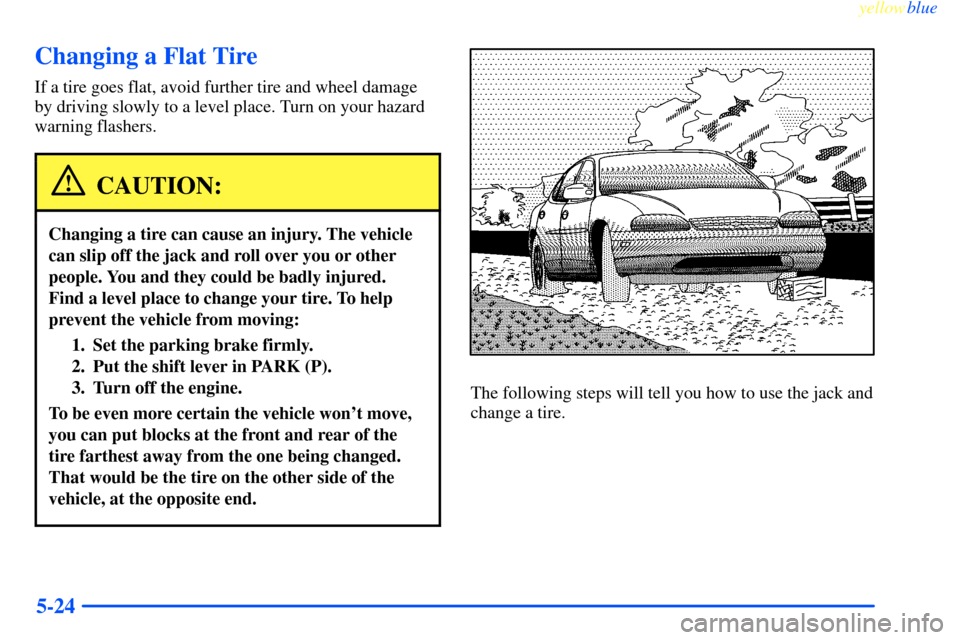
CAUTION:
Changing a tire can cause an injury. The vehicle
can slip off the jack and roll over you or other
people. You and they could be badly injured.
Find a level place to change your tire. To help
prevent the vehicle from moving:
1. Set the parking brake firmly.
2. Put the shift lever in PARK (P).
3. Turn off the engine.
To be even more certain the vehicle won't move,
you can put blocks at the front and rear of the
tire farthest away from the one being changed.
That would be the tire on the other side of the
vehicle, at the opposite end.
The following steps will tell you how to use the jack and
change a tire.
Page 266 of 365
yellowblue
6-9 Hood Release
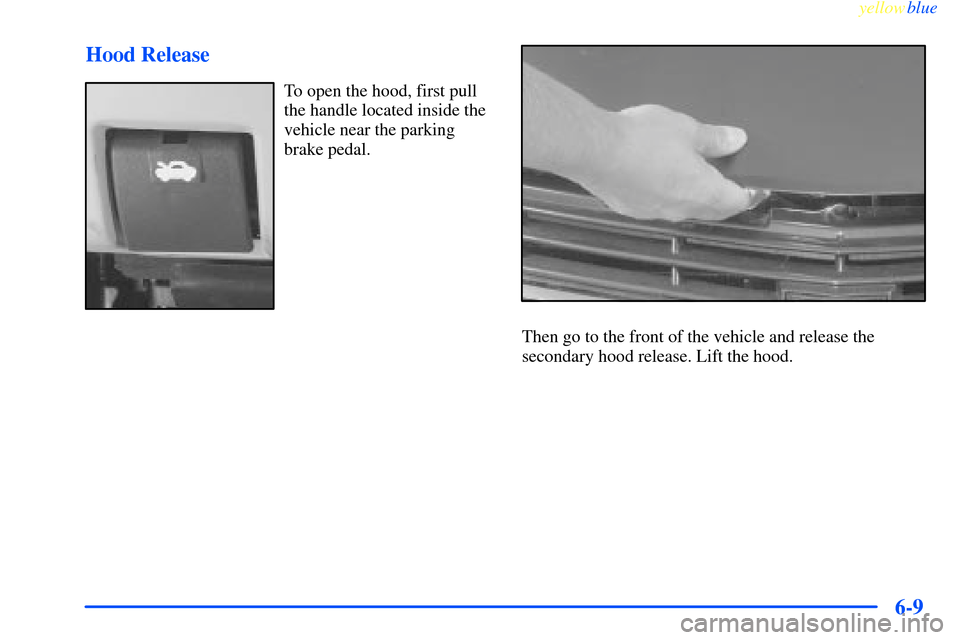
To open the hood, first pull
the handle located inside the
vehicle near the parking
brake pedal.
Then go to the front of the vehicle and release the
secondary hood release. Lift the hood.
Page 278 of 365
yellowblue
6-21 How to Check
Because this operation can be a little difficult, you
may choose to have this done at the dealership
service department.
If you do it yourself, be sure to follow all the instructions
here, or you could get a false reading on the dipstick.
NOTICE:
Too much or too little fluid can damage your
transaxle. Too much can mean that some of the
fluid could come out and fall on hot engine parts
or exhaust system parts, starting a fire. Be sure to
get an accurate reading if you check your
transaxle fluid.
Wait at least 30 minutes before checking the transaxle
fluid level if you have been driving:
�When outside temperatures are above 90�F (32�C).
�At high speed for quite a while.�In heavy traffic
-- especially in hot weather.
�While pulling a trailer.
To get the right reading, the fluid should be at normal
operating temperature, which is 180�F to 200�F
(82�C to 93�C).
Get the vehicle warmed up by driving about 15 miles
(24 km) when outside temperatures are above 50�F
(10�C). If it's colder than 50�F (10�C), you may have
to drive longer.
Checking the Fluid Level
Prepare your vehicle as follows:
�Park your vehicle on a level place. Keep the
engine running.
�With the parking brake applied, place the shift lever
in PARK (P).
�With your foot on the brake pedal, move the shift
lever through each gear range, pausing for about
three seconds in each range. Then, position the shift
lever in PARK (P).
�Let the engine run at idle for three to five minutes.
Page 322 of 365
yellowblue
6-65
Circuit Relay Description
BATT RUN
DOWN
PROTECTION
RELAYBattery Run Down
Protection Relay
REAR
DEFOG RELAYRear Defog Relay,
Heated Mirror Relay
Circuit Breaker Description
POWER
SEATS BRKRPower Seat Circuit Breaker
REAR
DEFOG BRKRRear Defog Breaker
Mini Fuses Description
RH HTD ST Passenger Heated Seat
PWR DROP Accommodated Device
B/U LP Back
-Up Lamps
DIC/RKE Driver Information Center,
Remote Keyless Entry, HVACMini Fuses Description
TRK/ROOF
BRPTrunk Lamps, Headliner Lamps
HVAC BLO HVAC Blower Relay
I/P BRP Instrument Panel Footwell Lamps,
Glovebox Lamps
HTD MIR Heated Mirrors
BRK SW Brake Switch
HAZ SW Hazard Switch
FRT PRK LP Front Parking Lamps
AUX PWR Auxiliary Power Outlet (Battery)
C/LTR Cigarette Lighter
RADIO Radio, Radio Amplifier
REAR
PARK LPRear Parking Lamps,
Instrumentation Lighting
Underhood Fuse Block #1
Some fuses are in a fuse block on the passenger's side of
the engine compartment.