Page 285 of 365
yellowblue
6-28 How to Check Power Steering Fluid
When the engine compartment is cool, wipe the cap and
the top of the reservoir clean, then unscrew the cap and
wipe the dipstick with a clean rag. Replace the cap and
completely tighten it. Then remove the cap again and
look at the fluid level on the dipstick.
When the 3400 V6 engine compartment is hot, the level
should be at the ªHº mark. When it's cold, the level
should be at the ªCº mark. If the fluid is at the
ADD mark, you should add fluid.
For the 3800 V6 engine, the level should be at the
HOT mark when the engine compartment is hot.
If the fluid is at the ADD mark, you should add fluid.
What to Use
To determine what kind of fluid to use, see
ªRecommended Fluids and Lubricantsº in the Index.
Always use the proper fluid. Failure to use the proper
fluid can cause leaks and damage hoses and seals.
Windshield Washer Fluid
What to Use
When you need windshield washer fluid, be sure to read
the manufacturer's instructions before use. If you will be
operating your vehicle in an area where the temperature
may fall below freezing, use a fluid that has sufficient
protection against freezing.
Adding Washer Fluid
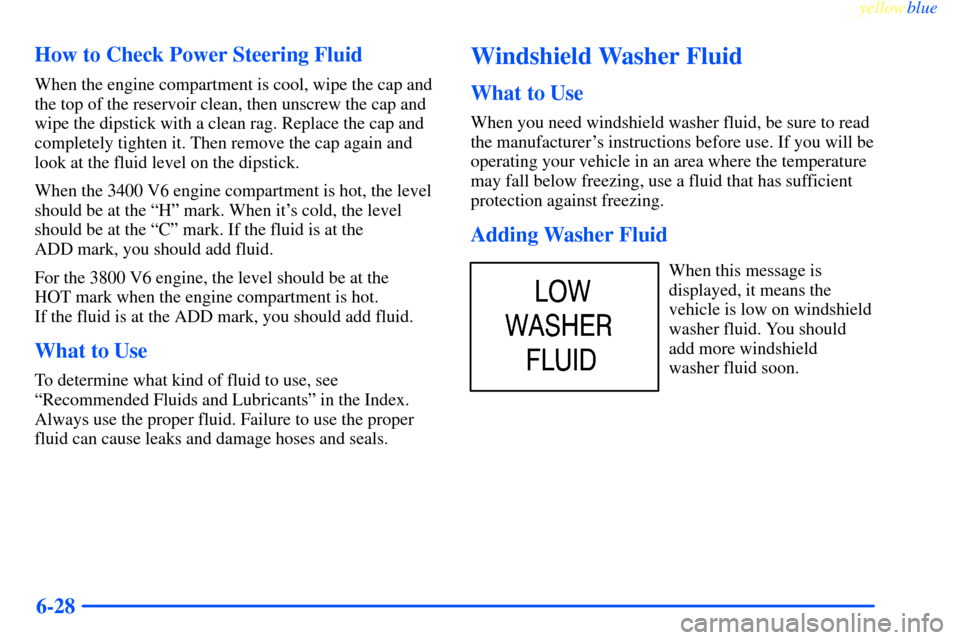
When this message is
displayed, it means the
vehicle is low on windshield
washer fluid. You should
add more windshield
washer fluid soon.
Page 286 of 365
yellowblue
6-29
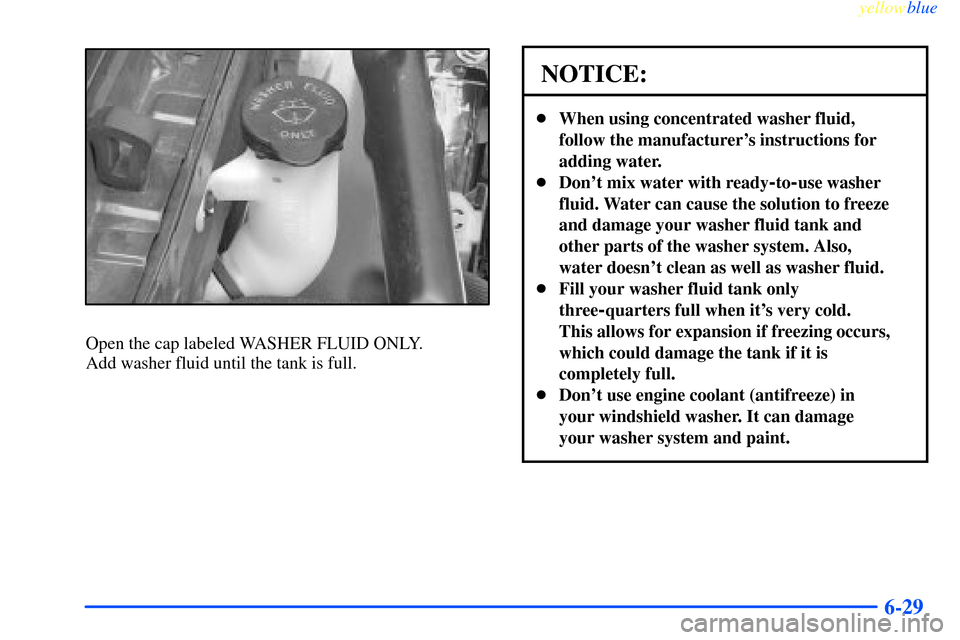
Open the cap labeled WASHER FLUID ONLY.
Add washer fluid until the tank is full.
NOTICE:
�When using concentrated washer fluid,
follow the manufacturer's instructions for
adding water.
�Don't mix water with ready
-to-use washer
fluid. Water can cause the solution to freeze
and damage your washer fluid tank and
other parts of the washer system. Also,
water doesn't clean as well as washer fluid.
�Fill your washer fluid tank only
three
-quarters full when it's very cold.
This allows for expansion if freezing occurs,
which could damage the tank if it is
completely full.
�Don't use engine coolant (antifreeze) in
your windshield washer. It can damage
your washer system and paint.
Page 287 of 365
yellowblue
6-30
Brakes
Brake Fluid
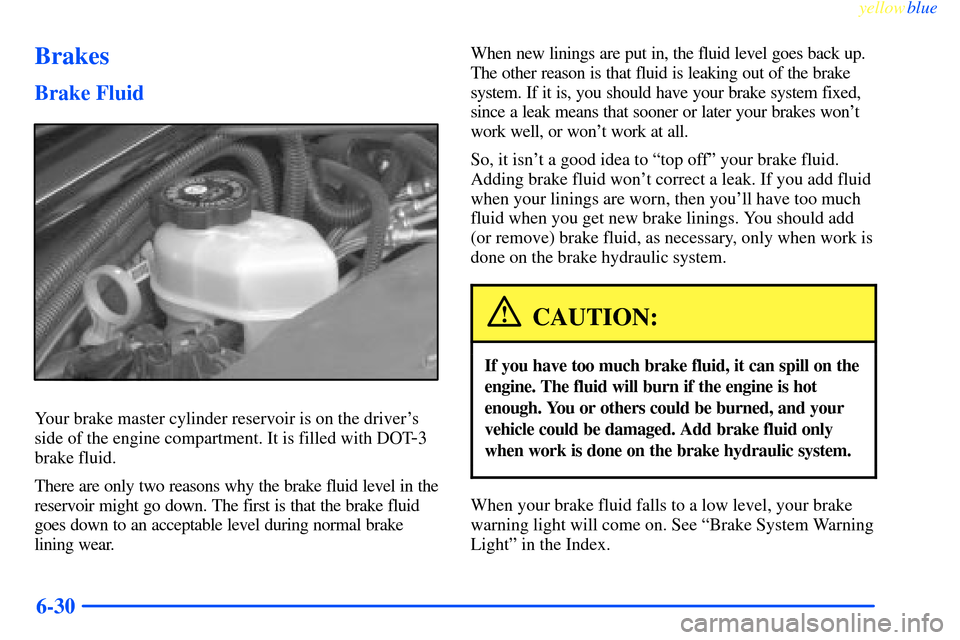
Your brake master cylinder reservoir is on the driver's
side of the engine compartment. It is filled with DOT
-3
brake fluid.
There are only two reasons why the brake fluid level in the
reservoir might go down. The first is that the brake fluid
goes down to an acceptable level during normal brake
lining wear. When new linings are put in, the fluid level goes back up.
The other reason is that fluid is leaking out of the brake
system. If it is, you should have your brake system fixed,
since a leak means that sooner or later your brakes won't
work well, or won't work at all.
So, it isn't a good idea to ªtop offº your brake fluid.
Adding brake fluid won't correct a leak. If you add fluid
when your linings are worn, then you'll have too much
fluid when you get new brake linings. You should add
(or remove) brake fluid, as necessary, only when work is
done on the brake hydraulic system.
CAUTION:
If you have too much brake fluid, it can spill on the
engine. The fluid will burn if the engine is hot
enough. You or others could be burned, and your
vehicle could be damaged. Add brake fluid only
when work is done on the brake hydraulic system.
When your brake fluid falls to a low level, your brake
warning light will come on. See ªBrake System Warning
Lightº in the Index.
Page 288 of 365
yellowblue
6-31
What to Add
When you do need brake fluid, use only DOT
-3 brake
fluid. Use new brake fluid from a sealed container only.
Refer to ªRecommended Fluids and Lubricantsº in the
Maintenance Schedule.
Always clean the brake fluid reservoir cap and the area
around the cap before removing it. This will help keep
dirt from entering the reservoir.
CAUTION:
With the wrong kind of fluid in your brake
system, your brakes may not work well, or they
may not even work at all. This could cause a
crash. Always use the proper brake fluid.
NOTICE:
�Using the wrong fluid can badly damage
brake system parts. For example, just a few
drops of mineral
-based oil, such as engine
oil, in your brake system can damage brake
system parts so badly that they'll have to be
replaced. Don't let someone put in the
wrong kind of fluid.
�If you spill brake fluid on your vehicle's
painted surfaces, the paint finish can be
damaged. Be careful not to spill brake fluid
on your vehicle. If you do, wash it off
immediately. See ªAppearance Careº in
the Index.
Page 317 of 365
yellowblue
6-60
Vehicle Identification Number (VIN)
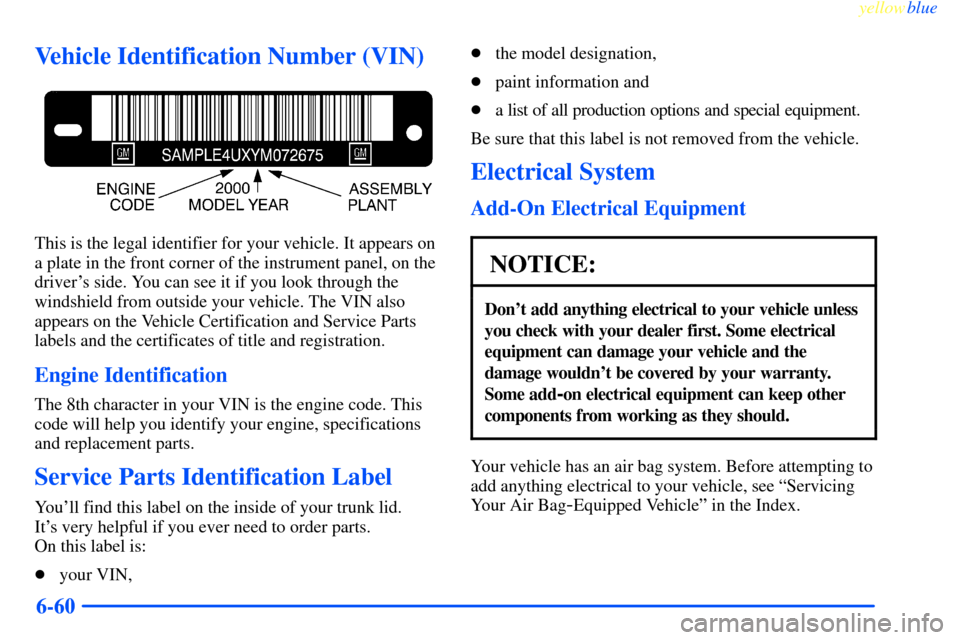
This is the legal identifier for your vehicle. It appears on
a plate in the front corner of the instrument panel, on the
driver's side. You can see it if you look through the
windshield from outside your vehicle. The VIN also
appears on the Vehicle Certification and Service Parts
labels and the certificates of title and registration.
Engine Identification
The 8th character in your VIN is the engine code. This
code will help you identify your engine, specifications
and replacement parts.
Service Parts Identification Label
You'll find this label on the inside of your trunk lid.
It's very helpful if you ever need to order parts.
On this label is:
�your VIN,�the model designation,
�paint information and
�a list of all production options and special equipment.
Be sure that this label is not removed from the vehicle.
Electrical System
Add-On Electrical Equipment
NOTICE:
Don't add anything electrical to your vehicle unless
you check with your dealer first. Some electrical
equipment can damage your vehicle and the
damage wouldn't be covered by your warranty.
Some add
-on electrical equipment can keep other
components from working as they should.
Your vehicle has an air bag system. Before attempting to
add anything electrical to your vehicle, see ªServicing
Your Air Bag
-Equipped Vehicleº in the Index.
Page 321 of 365
yellowblue
6-64
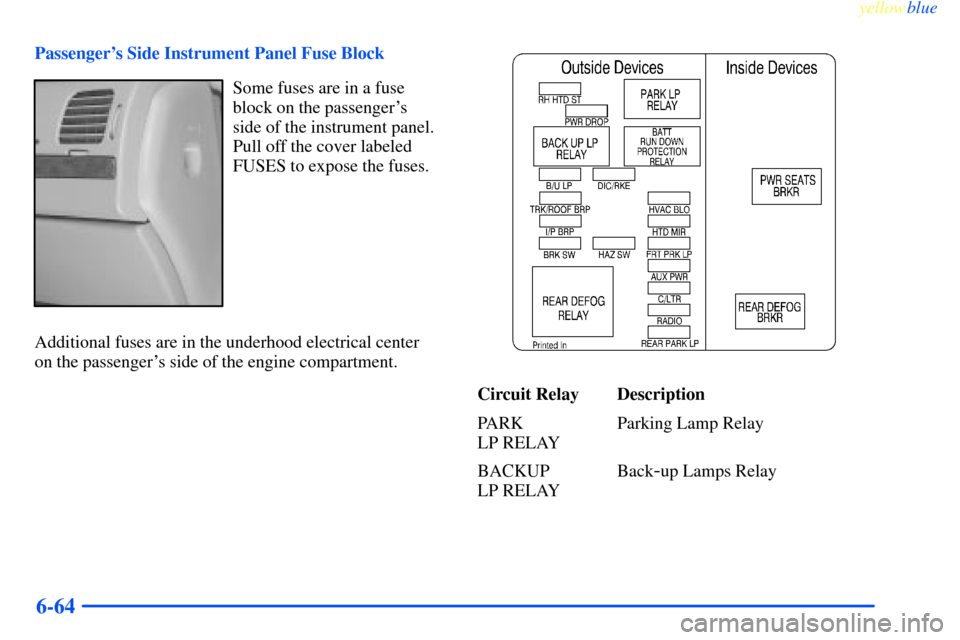
Passenger's Side Instrument Panel Fuse Block
Some fuses are in a fuse
block on the passenger's
side of the instrument panel.
Pull off the cover labeled
FUSES to expose the fuses.
Additional fuses are in the underhood electrical center
on the passenger's side of the engine compartment.
Circuit Relay Description
PARK
LP RELAYParking Lamp Relay
BACKUP
LP RELAYBack
-up Lamps Relay
Page 322 of 365
yellowblue
6-65
Circuit Relay Description
BATT RUN
DOWN
PROTECTION
RELAYBattery Run Down
Protection Relay
REAR
DEFOG RELAYRear Defog Relay,
Heated Mirror Relay
Circuit Breaker Description
POWER
SEATS BRKRPower Seat Circuit Breaker
REAR
DEFOG BRKRRear Defog Breaker
Mini Fuses Description
RH HTD ST Passenger Heated Seat
PWR DROP Accommodated Device
B/U LP Back
-Up Lamps
DIC/RKE Driver Information Center,
Remote Keyless Entry, HVACMini Fuses Description
TRK/ROOF
BRPTrunk Lamps, Headliner Lamps
HVAC BLO HVAC Blower Relay
I/P BRP Instrument Panel Footwell Lamps,
Glovebox Lamps
HTD MIR Heated Mirrors
BRK SW Brake Switch
HAZ SW Hazard Switch
FRT PRK LP Front Parking Lamps
AUX PWR Auxiliary Power Outlet (Battery)
C/LTR Cigarette Lighter
RADIO Radio, Radio Amplifier
REAR
PARK LPRear Parking Lamps,
Instrumentation Lighting
Underhood Fuse Block #1
Some fuses are in a fuse block on the passenger's side of
the engine compartment.
Page 323 of 365
yellowblue
6-66
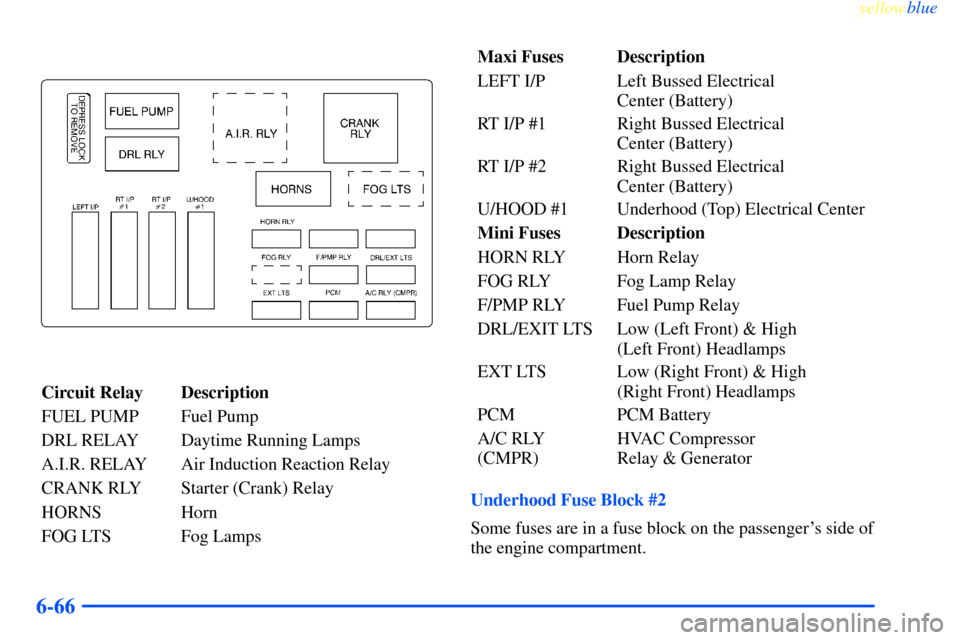
Circuit Relay Description
FUEL PUMP Fuel Pump
DRL RELAY Daytime Running Lamps
A.I.R. RELAY Air Induction Reaction Relay
CRANK RLY Starter (Crank) Relay
HORNS Horn
FOG LTS Fog LampsMaxi Fuses Description
LEFT I/P Left Bussed Electrical
Center (Battery)
RT I/P #1 Right Bussed Electrical
Center (Battery)
RT I/P #2 Right Bussed Electrical
Center (Battery)
U/HOOD #1 Underhood (Top) Electrical Center
Mini Fuses Description
HORN RLY Horn Relay
FOG RLY Fog Lamp Relay
F/PMP RLY Fuel Pump Relay
DRL/EXIT LTS Low (Left Front) & High
(Left Front) Headlamps
EXT LTS Low (Right Front) & High
(Right Front) Headlamps
PCM PCM Battery
A/C RLY
(CMPR)HVAC Compressor
Relay & Generator
Underhood Fuse Block #2
Some fuses are in a fuse block on the passenger's side of
the engine compartment.