Page 131 of 398
yellowblue
2-55
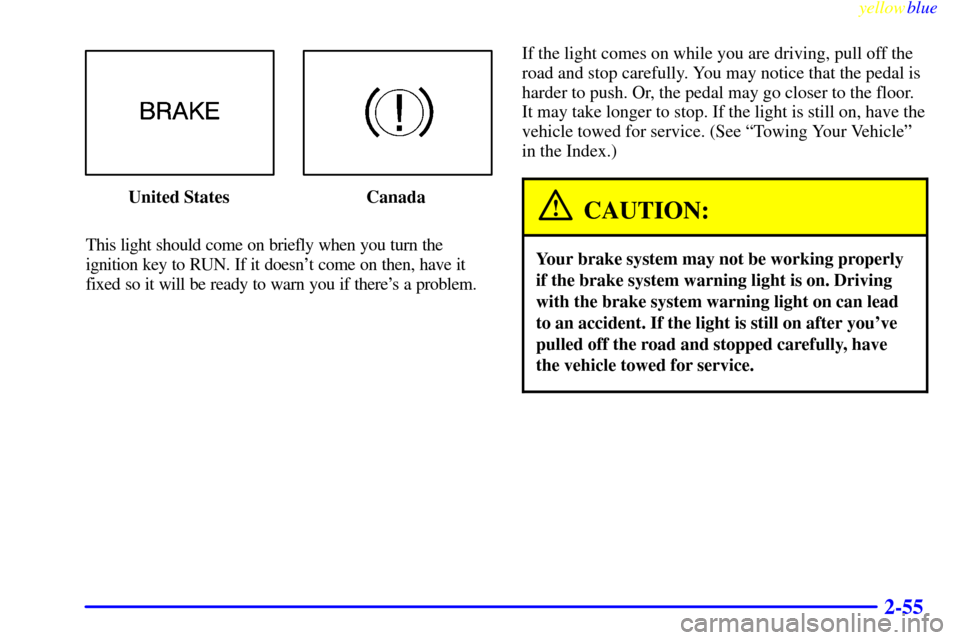
United States Canada
This light should come on briefly when you turn the
ignition key to RUN. If it doesn't come on then, have it
fixed so it will be ready to warn you if there's a problem.If the light comes on while you are driving, pull off the
road and stop carefully. You may notice that the pedal is
harder to push. Or, the pedal may go closer to the floor.
It may take longer to stop. If the light is still on, have the
vehicle towed for service. (See ªTowing Your Vehicleº
in the Index.)CAUTION:
Your brake system may not be working properly
if the brake system warning light is on. Driving
with the brake system warning light on can lead
to an accident. If the light is still on after you've
pulled off the road and stopped carefully, have
the vehicle towed for service.
Page 132 of 398

yellowblue
2-56 Anti-Lock Brake System Warning Light
United States Canada
With the anti
-lock brake system, this light will come on
when you start your engine and may stay on for several
seconds. That's normal.
If the light stays on, or comes on when you're driving,
your vehicle needs service. If the regular brake system
warning light isn't on, you still have brakes, but you
don't have anti
-lock brakes. If the regular brake system
warning light is also on, you don't have anti
-lock brakes
and there's a problem with your regular brakes. See
ªBrake System Warning Lightº earlier in this section.
The anti
-lock brake system warning light should come
on briefly when you turn the ignition key to RUN. If the
light doesn't come on then, have it fixed so it will be
ready to warn you if there is a problem.
Engine Coolant Temperature Gage
This gage shows the engine
coolant temperature. If the
gage pointer moves into the
red area your engine is
too hot!
It means that your engine coolant has overheated. If you
have been operating your vehicle under normal
operating conditions, you should pull off the road, stop
your vehicle, and turn off the engine as soon as possible.
The ªProblems on the Roadº section of this manual
shows what to do. See ªEngine Overheatingº in
the Index.
Page 179 of 398

yellowblue
4-7
Avoid needless heavy braking. Some people drive in
spurts
-- heavy acceleration followed by heavy
braking
-- rather than keeping pace with traffic.
This is a mistake. Your brakes may not have time to
cool between hard stops. Your brakes will wear out
much faster if you do a lot of heavy braking. If you
keep pace with the traffic and allow realistic following
distances, you will eliminate a lot of unnecessary
braking. That means better braking and longer
brake life.
If your engine ever stops while you're driving, brake
normally but don't pump your brakes. If you do, the
pedal may get harder to push down. If your engine
stops, you will still have some power brake assist. But
you will use it when you brake. Once the power assist is
used up, it may take longer to stop and the brake pedal
will be harder to push.
Anti-Lock Brakes (ABS)
Your vehicle has anti-lock brakes (ABS). ABS is an
advanced electronic braking system that will help
prevent a braking skid.
When you start your engine and begin to drive away,
your anti
-lock brake system will check itself. You may
hear a momentary motor or clicking noise while this test
is going on. This is normal.
United States Canada
If there's a problem with the anti
-lock brake system, this
warning light will stay on. See ªAnti
-Lock Brake
System Warning Lightº in the Index.
Page 189 of 398
yellowblue
4-17
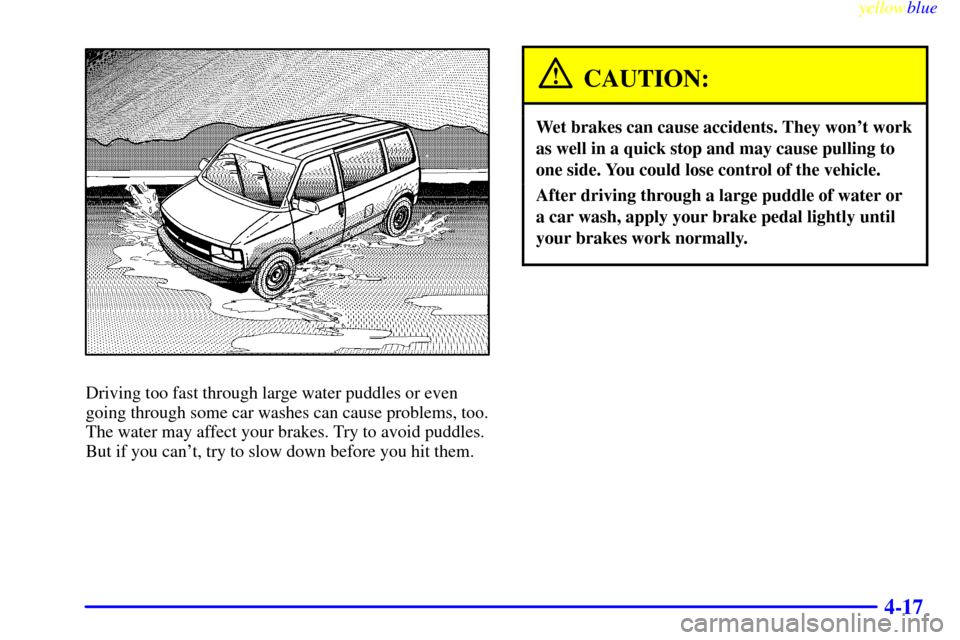
Driving too fast through large water puddles or even
going through some car washes can cause problems, too.
The water may affect your brakes. Try to avoid puddles.
But if you can't, try to slow down before you hit them.
CAUTION:
Wet brakes can cause accidents. They won't work
as well in a quick stop and may cause pulling to
one side. You could lose control of the vehicle.
After driving through a large puddle of water or
a car wash, apply your brake pedal lightly until
your brakes work normally.
Page 214 of 398

yellowblue
4-42 Trailer Wiring Harness
The optional heavy-duty trailer wiring package is an
eight
-wire harness assembly. The five-wire portion of
the harness assembly is stored under the vehicle, along
the driver's side rear corner of the frame rail. The
three
-wire portion of the harness assembly is stored
in a frame pocket under the rear of the vehicle, on the
driver's side. The heavy
-duty trailer wiring harness has
a 30
-amp feed wire. Both harnesses come without
connectors and should be wired by a qualified electrical
technician. The technician can use the following color
code chart when connecting the wiring harness to
your trailer.
Five
-Wire Harness
�Light Green: Back
-up lamps
�Brown: Parking lamps
�Yellow: Left stoplamp and turn signal
�Dark Green: Right stoplamp and turn signal
�White (light gage): Center high
-mounted stoplampThree
-Wire Harness
�Dark Blue: Use for electric trailer brakes (eight
-wire
harness only)
�Orange: Trailer accessory (eight
-wire harness only)
�White (heavy gage): Ground wire
Securely attach the harness to the trailer, then tape or
strap it to your vehicle's frame rail. Be sure you leave it
loose enough so the wiring doesn't bend or break, but
not so loose that it drags on the ground. Store the
harness in its original place. Wrap the harness together
and tie it neatly so it won't be damaged.
Page 284 of 398
yellowblue
6-30
CAUTION:
The brake wear warning sound means that soon
your brakes won't work well. That could lead to
an accident. When you hear the brake wear
warning sound, have your vehicle serviced.
NOTICE:
Continuing to drive with worn-out brake pads
could result in costly brake repair.
Some driving conditions or climates may cause a brake
squeal when the brakes are first applied or lightly
applied. This does not mean something is wrong with
your brakes.
Properly torqued wheel nuts are necessary to help
prevent brake pulsation. When tires are rotated, inspect
brake pads for wear and evenly torque wheel nuts in the
proper sequence to GM specifications.Your rear drum brakes don't have wear indicators, but if
you ever hear a rear brake rubbing noise, have the rear
brake linings inspected immediately. Also, the rear
brake drums should be removed and inspected each time
the tires are removed for rotation or changing. When
you have the front brake pads replaced, have the rear
brakes inspected, too.
Brake linings should always be replaced as complete
axle sets.
See ªBrake System Inspectionº in Section 7 of this manual
under Part C ªPeriodic Maintenance Inspections.º
Brake Pedal Travel
See your dealer if the brake pedal does not return to
normal height, or if there is a rapid increase in pedal
travel. This could be a sign of brake trouble.
Brake Adjustment
Every time you make a brake stop, your disc brakes
adjust for wear.
If your brake pedal goes down farther than normal, your
rear drum brakes may need adjustment. Adjust them by
backing up and firmly applying the brakes a few times.
Page 318 of 398
yellowblue
6-64 Engine Compartment Fuse Relay Center
The fuse block is on the driver's side of the engine
compartment at the rear.
NAME CIRCUITS PROTECTED
BLOWER Front Blower Motor
ABS Electronic Brake Control ModuleNAME CIRCUITS PROTECTED
IGN B Ignition Switch
IGN A Starter Relay, Ignition Switch
BATT Instrument Panel Fuse Block
LIGHTING Instrument Panel Fuse Block,
Headlamp Switch
RR BLOWER Rear Auxiliary Blower Motor
Relays
ENG
-I Heated O2 Sensors, Mass Air
Flow Sensor, EGR Valve
Solenoid, Evap Canister Purge
Valve, Crankshaft Position Sensor,
Secondary Air Injection Relay
(Diesel), Water in Fuel Sensor
(Diesel), Fuel Heater (Diesel),
Glowplug Relay (Diesel),
Wastegate Solenoid (Diesel)
A/C Air Conditioning Clutch Relay
SPARE Spare Fuses
AUX A Upfitter Provisions
AUX B Upfitter Provisions