Page 4 of 361
Table of Contents
Keys and Door Locks
Remote Keyless Entry (RKE) System
Hatch/Trunk Lid Release
Automatic Transmission (If Equipped)
Manual Transmission (If Equipped)
Parking Brake
Windows
Tilt Wheel
Turn Signal/Multifunction Lever
Windshield WipersCruise Control
Interior and Exterior Lamps
Mirrors
Storage Compartments
Convenience Net
Accessory Power Outlet
Instrument Panel, Warning Lights and Gages
Head-Up Display
Driver Information Center
Memory Seats and Seat Controls
Safety BeltsAir Bag System
Child Restraints
Section
1
Section
2
Seats and Restraint Systems
Features and Controls
ii
Page 28 of 361
1-10
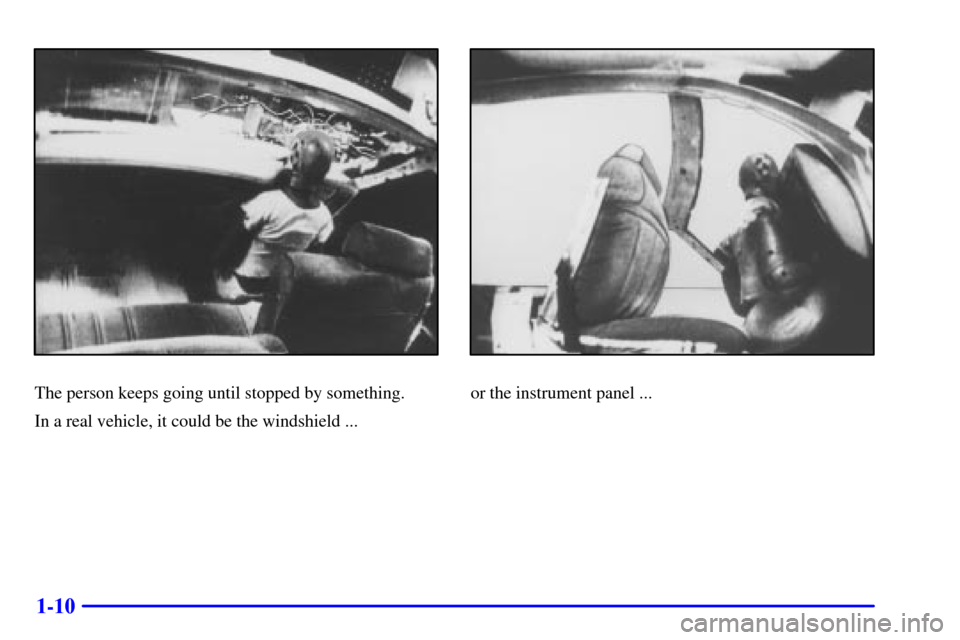
The person keeps going until stopped by something.
In a real vehicle, it could be the windshield ...or the instrument panel ...
Page 39 of 361
1-21
CAUTION:
Air bags inflate with great force, faster than the
blink of an eye. If you're too close to an inflating
air bag, as you would be if you were leaning
forward, it could seriously injure you. Safety
belts help keep you in position before and during
a crash. Always wear your safety belt, even
with air bags. The driver should sit as far back
as possible while still maintaining control of
the vehicle.
CAUTION:
Anyone who is up against, or very close to, any air
bag when it inflates can be seriously injured or killed.
Air bags plus lap
-shoulder belts offer the best
protection for adults, but not for young children and
infants. Neither the vehicle's safety belt system nor its
air bag system is designed for them. Young children
and infants need the protection that a child restraint
system can provide. Always secure children properly
in your vehicle. To read how, see the part of this
manual called ªChildren.º
There is an air bag readiness
light on the instrument
panel, which shows the
air bag symbol.
The system checks the air bag electrical system for
malfunctions. The light tells you if there is an electrical
problem. See ªAir Bag Readiness Lightº in the Index
for more information.
Page 40 of 361
1-22 How the Air Bag System Works
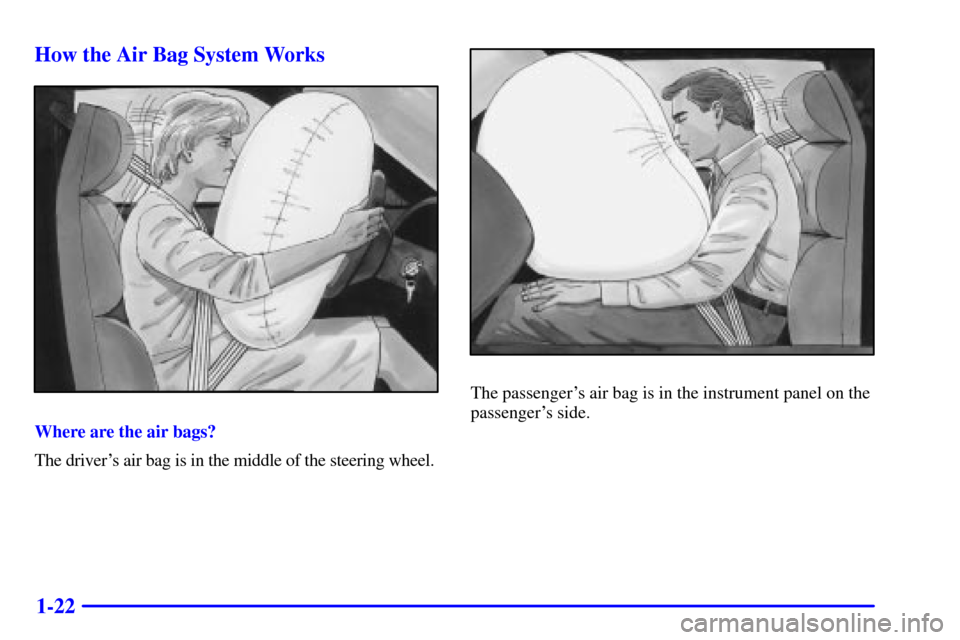
Where are the air bags?
The driver's air bag is in the middle of the steering wheel.
The passenger's air bag is in the instrument panel on the
passenger's side.
Page 42 of 361
1-24
What makes an air bag inflate?
In an impact of sufficient severity, the air bag sensing
system detects that the vehicle is in a crash. The sensing
system triggers a release of gas from the inflator, which
inflates the air bag. The inflator, air bag and related
hardware are all part of the air bag modules inside the
steering wheel and in the instrument panel in front of
the passenger.
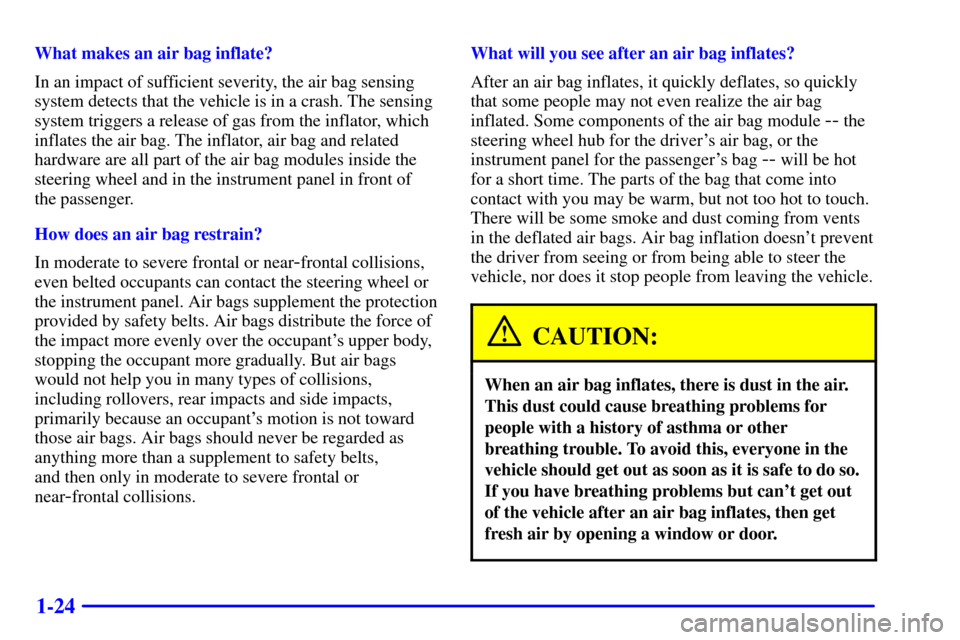
How does an air bag restrain?
In moderate to severe frontal or near
-frontal collisions,
even belted occupants can contact the steering wheel or
the instrument panel. Air bags supplement the protection
provided by safety belts. Air bags distribute the force of
the impact more evenly over the occupant's upper body,
stopping the occupant more gradually. But air bags
would not help you in many types of collisions,
including rollovers, rear impacts and side impacts,
primarily because an occupant's motion is not toward
those air bags. Air bags should never be regarded as
anything more than a supplement to safety belts,
and then only in moderate to severe frontal or
near
-frontal collisions.What will you see after an air bag inflates?
After an air bag inflates, it quickly deflates, so quickly
that some people may not even realize the air bag
inflated. Some components of the air bag module
-- the
steering wheel hub for the driver's air bag, or the
instrument panel for the passenger's bag
-- will be hot
for a short time. The parts of the bag that come into
contact with you may be warm, but not too hot to touch.
There will be some smoke and dust coming from vents
in the deflated air bags. Air bag inflation doesn't prevent
the driver from seeing or from being able to steer the
vehicle, nor does it stop people from leaving the vehicle.
CAUTION:
When an air bag inflates, there is dust in the air.
This dust could cause breathing problems for
people with a history of asthma or other
breathing trouble. To avoid this, everyone in the
vehicle should get out as soon as it is safe to do so.
If you have breathing problems but can't get out
of the vehicle after an air bag inflates, then get
fresh air by opening a window or door.
Page 43 of 361
1-25
In many crashes severe enough to inflate an air bag,
windshields are broken by vehicle deformation.
Additional windshield breakage may also occur from the
passenger air bag.
�Air bags are designed to inflate only once. After they
inflate, you'll need some new parts for your air bag
system. If you don't get them, the air bag system
won't be there to help protect you in another crash.
A new system will include air bag modules and
possibly other parts. The service manual for your
vehicle covers the need to replace other parts.
�Your vehicle is equipped with a diagnostic module,
which records information about the air bag system.
The module records information about the readiness
of the system, when the system commands air bag
inflation and driver's safety belt usage at
deployment. Some modules also record speed,
engine rpm, brake and throttle data.
�Let only qualified technicians work on your air bag
system. Improper service can mean that your air bag
system won't work properly. See your dealer
for service.
NOTICE:
If you damage the covering for the driver's or
the passenger's air bag, the bag may not work
properly. You may have to replace the air bag
module in the steering wheel or both the air
bag module and the instrument panel for the
passenger's air bag. Do not open or break the
air bag coverings.
Page 59 of 361

2-
2-1
Section 2 Features and Controls
Here you can learn about the many standard and optional features on your vehicle, and information on starting,
shifting and braking. Also explained are the instrument panel and the warning systems that tell you if everything is
working properly
-- and what to do if you have a problem.
2
-4 Door Locks
2
-5 Memory (Option)
2
-7 Remote Keyless Entry System
2
-12 Hatch/Trunk Lid Release
2
-15 Theft-Deterrent System
2
-17 PASS-Key�
2-18 New Vehicle ªBreak-Inº
2
-18 Ignition Switch
2
-20 Starting Your Engine
2
-22 Engine Coolant Heater (If Equipped)
2
-24 Automatic Transmission Operation
2
-27 Manual Transmission Operation
2
-31 Parking Brake
2
-32 Shifting Into PARK (P)
(Automatic Transmission Only)
2
-34 Shifting Out of PARK (P)
(Automatic Transmission)
2
-34 Parking Your Vehicle (Manual Transmission)2
-35 Parking Over Things That Burn
2
-35 Engine Exhaust
2
-36 Running Your Engine While You're Parked
(Automatic Transmission)
2
-36 Limited-Slip Rear Axle
2
-37 Selective Real Time Damping (SRTD) (Option)
2
-38 Windows
2
-40 Turn Signal/Multifunction Lever
2
-47 Exterior Lamps
2
-49 Interior Lamps
2
-51 Mirrors
2
-52 Storage Compartments
2
-57 Roof Panel (Option)
2
-63 Convertible Top (Option)
2
-70 The Instrument Panel -- Your
Information System
2
-73 Warning Lights, Gages and Messages
2
-88 Driver Information Center (DIC)
Page 70 of 361
2-12
Loss of synchronization will occur after transmitter
battery replacement or disconnection of the vehicle's
battery, fore more than three days.
If attempts to resynchronize your transmitter to the
vehicle are not successful, you may need to match the
transmitter to the vehicle. See ªMatching Transmitter(s)
to Your Vehicleº in the Index.
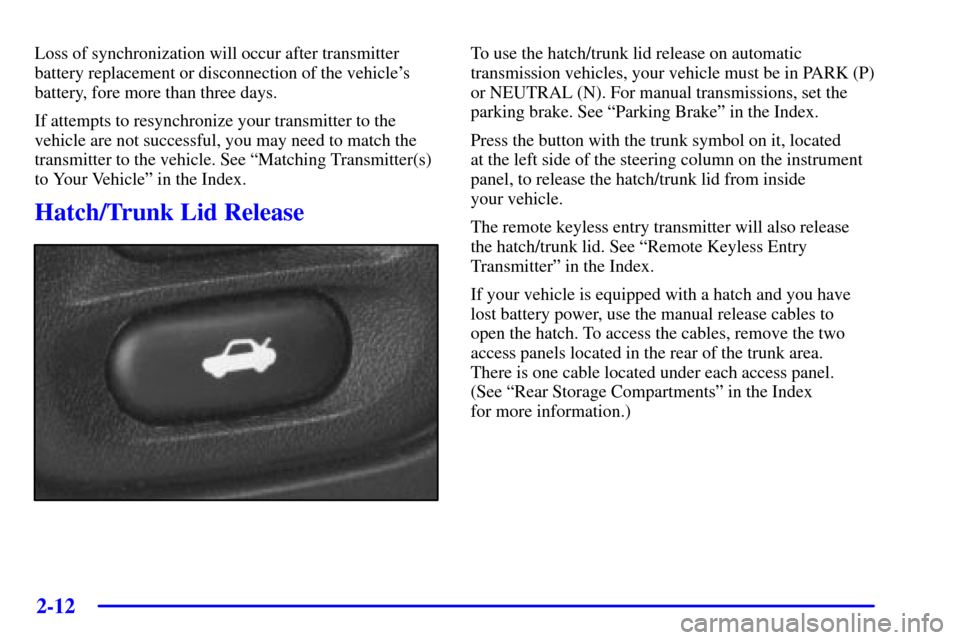
Hatch/Trunk Lid Release
To use the hatch/trunk lid release on automatic
transmission vehicles, your vehicle must be in PARK (P)
or NEUTRAL (N). For manual transmissions, set the
parking brake. See ªParking Brakeº in the Index.
Press the button with the trunk symbol on it, located
at the left side of the steering column on the instrument
panel, to release the hatch/trunk lid from inside
your vehicle.
The remote keyless entry transmitter will also release
the hatch/trunk lid. See ªRemote Keyless Entry
Transmitterº in the Index.
If your vehicle is equipped with a hatch and you have
lost battery power, use the manual release cables to
open the hatch. To access the cables, remove the two
access panels located in the rear of the trunk area.
There is one cable located under each access panel.
(See ªRear Storage Compartmentsº in the Index
for more information.)