Page 139 of 364
2-75 Service Vehicle Soon Light
This light will come on
briefly when you turn on
the ignition.
It will stay on or come on if it detects a problem on
the vehicle. If this happens, see your dealer service
department as soon as possible.
Passlock� Warning Light
United States Canada
This light will come on briefly when you turn the key
to START.
If the light flashes, the Passlock system has entered a
tamper mode. If the vehicle fails to start, see ªPasslockº
in the Index.
On vehicles equipped with the remote keyless entry
system, when the ignition is off and the security system
is armed, the light will flash to indicate that the security
system is active.
Page 140 of 364
2-76
If the light comes on continuously while driving and
stays on, there may be a problem with the Passlock
system. Your vehicle will not be protected by Passlock,
and you should see your dealer.
On vehicles equipped with remote keyless entry, the
Passlock warning light will flash to indicate that the
security system is active when the ignition is OFF
and the security system is armed.
Up-Shift Light (Manual Transaxle)
This light comes on when
you need to shift to the next
higher gear. See ªManual
Transaxleº in the Index.
United States Only
Check Gages Light
United States Canada
This light will come on briefly when you are starting
the engine. If it comes on and stays on while you are
driving, check your various gages to see if they are in
the warning zones or if you are low on fuel.
See ªEngine Coolant Temperature Gageº and
ªFuel Gageº in this section for more information.
Page 200 of 364
4-26
Winter Driving
Here are some tips for winter driving:
�Have your vehicle in good shape for winter.
�You may want to put winter emergency supplies in
your trunk.
Include an ice scraper, a small brush or broom, a supply
of windshield washer fluid, a rag, some winter outer
clothing, a small shovel, a flashlight, a red cloth and a
couple of reflective warning triangles. And, if you will
be driving under severe conditions, include a small bag
of sand, a piece of old carpet or a couple of burlap bags
to help provide traction. Be sure you properly secure
these items in your vehicle.
Page 208 of 364
4-34
CAUTION:
Things you put inside your vehicle can strike
and injure people in a sudden stop or turn, or
in a crash.
�Put things in the trunk or rear area of your
vehicle. In a trunk, put them as far forward
as you can. Try to spread the weight evenly.
If you have fold
-down rear seats, you'll find
four anchors on the back wall of your trunk.
You can use these anchors to tie down lighter
loads. They're not strong enough for heavy
things, however, so put them as far forward
as you can in the trunk or rear area.
�Never stack heavier things, like suitcases,
inside the vehicle so that some of them are
above the tops of the seats.
�Don't leave an unsecured child restraint in
your vehicle.
�When you carry something inside the vehicle,
secure it whenever you can.
�Don't leave a seat folded down unless you
need to.
Towing a Trailer (Models with
2.4L L4 Engine and 4
-Speed
Automatic Transaxle)
CAUTION:
If you don't use the correct equipment and drive
properly, you can lose control when you pull a
trailer. For example, if the trailer is too heavy,
the brakes may not work well
-- or even at all.
You and your passengers could be seriously
injured. You may also damage your vehicle; the
resulting repairs would not be covered by your
warranty. Pull a trailer only if you have followed
all the steps in this section. Ask your dealer for
advice and information about towing a trailer
with your vehicle.
If your vehicle is not a convertible, your vehicle can
tow a trailer if it is equipped with a 2.4L L4 engine
and 4 speed automatic transaxle and the proper trailer
towing equipment. If your vehicle is a convertible or
is not equipped as stated above, do not tow a trailer.
Page 212 of 364

4-38 Safety Chains
You should always attach chains between your vehicle
and your trailer. Cross the safety chains under the tongue
of the trailer so that the tongue will not drop to the road
if it becomes separated from the hitch. Instructions
about safety chains may be provided by the hitch
manufacturer or by the trailer manufacturer. Follow the
manufacturer's recommendation for attaching safety
chains and do not attach them to the bumper. Always
leave just enough slack so you can turn with your rig.
And, never allow safety chains to drag on the ground.
Trailer Brakes
Does your trailer have its own brakes? Be sure to read
and follow the instructions for the trailer brakes so
you'll be able to install, adjust and maintain them
properly. Because you have anti
-lock brakes, do not
try to tap into your vehicle's brake system. If you do,
both brake systems won't work well, or at all.
Driving with a Trailer
Towing a trailer requires a certain amount of experience.
Before setting out for the open road, you'll want to
get to know your rig. Acquaint yourself with the feel
of handling and braking with the added weight of the
trailer. And always keep in mind that the vehicle you
are driving is now a good deal longer and not nearly as
responsive as your vehicle is by itself.
Before you start, check the trailer hitch and platform
(and attachments), safety chains, electrical connector,
lamps, tires and mirror adjustment. If the trailer has
electric brakes, start your vehicle and trailer moving and
then apply the trailer brake controller by hand to be sure
the brakes are working. This lets you check your
electrical connection at the same time.
During your trip, check occasionally to be sure that the
load is secure, and that the lamps and any trailer brakes
are still working.
Following Distance
Stay at least twice as far behind the vehicle ahead as
you would when driving your vehicle without a trailer.
This can help you avoid situations that require heavy
braking and sudden turns.
Page 223 of 364
5-8
Towing Your Vehicle
CAUTION:
To help avoid serious personal injury to
you or others:
�Never let passengers ride in a vehicle that is
being towed.
�Never tow faster than safe or posted speeds.
�Never tow with damaged parts not
fully secured.
�Never get under your vehicle after it has
been lifted by the tow truck.
�Always secure the vehicle on each side with
separate safety chains when towing it.
�Use only the correct hooks.
NOTICE:
Use the proper towing equipment to avoid
damage to the bumper, fascia or fog lamp areas
of the vehicle.
With current trends in automotive styles and design, it is
essential that the correct towing equipment is used to
tow a vehicle. Your vehicle can be towed with
wheel
-lift or car carrier equipment.
Consult your dealer or a professional towing service if
you need to have your vehicle towed. See ªRoadside
Assistanceº in the Index.
Page 242 of 364
5-27 Storing the Flat Tire and Tools
CAUTION:
Storing a jack, a tire or other equipment in the
passenger compartment of the vehicle could
cause injury. In a sudden stop or collision, loose
equipment could strike someone. Store all these
in the proper place.
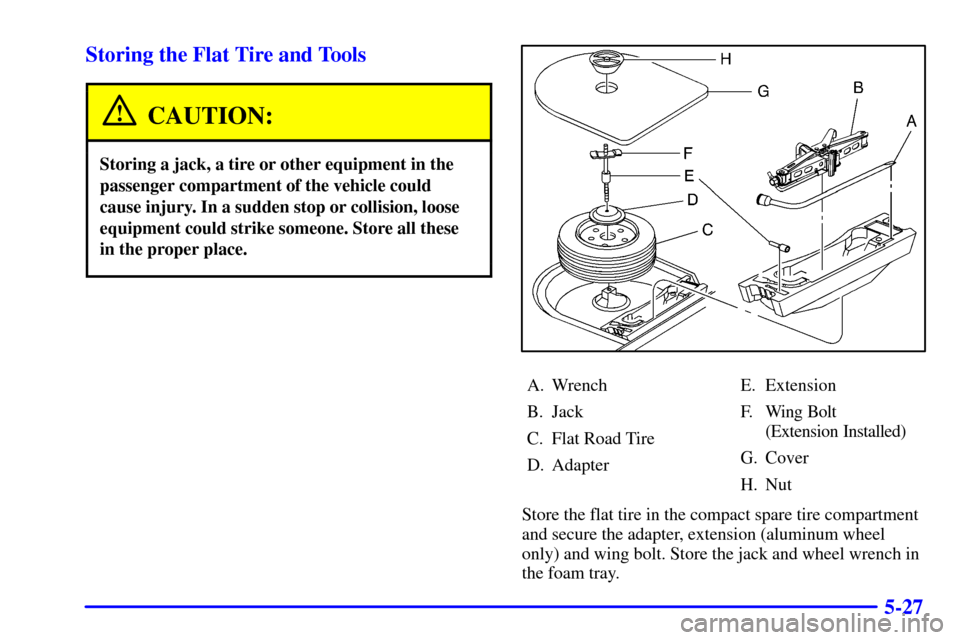
A. Wrench
B. Jack
C. Flat Road Tire
D. AdapterE. Extension
F. Wing Bolt
(Extension Installed)
G. Cover
H. Nut
Store the flat tire in the compact spare tire compartment
and secure the adapter, extension (aluminum wheel
only) and wing bolt. Store the jack and wheel wrench in
the foam tray.
Page 255 of 364
6-9
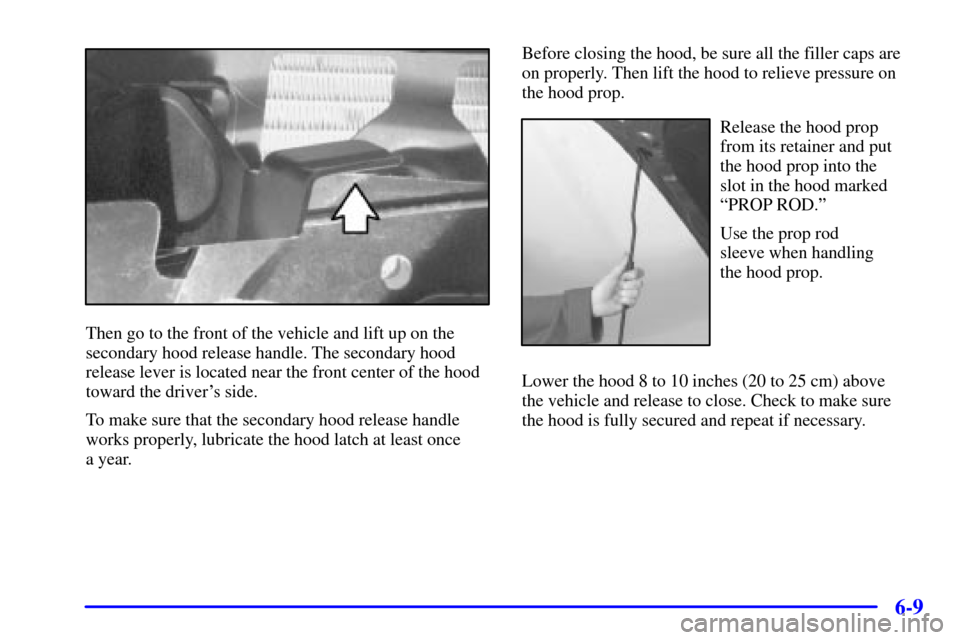
Then go to the front of the vehicle and lift up on the
secondary hood release handle. The secondary hood
release lever is located near the front center of the hood
toward the driver's side.
To make sure that the secondary hood release handle
works properly, lubricate the hood latch at least once
a year.Before closing the hood, be sure all the filler caps are
on properly. Then lift the hood to relieve pressure on
the hood prop.
Release the hood prop
from its retainer and put
the hood prop into the
slot in the hood marked
ªPROP ROD.º
Use the prop rod
sleeve when handling
the hood prop.
Lower the hood 8 to 10 inches (20 to 25 cm) above
the vehicle and release to close. Check to make sure
the hood is fully secured and repeat if necessary.