Page 53 of 364

1-42
A booster seat (F) is designed for children who
are about 40 to 60 lbs., or even up to 80 lbs.
(18 to 27 kg, or even up to 36 kg), and about
four to eight years of age. A booster seat is
designed to improve the fit of the vehicle's safety
belt system. Booster seats with shields use lap
-only
belts; however, booster seats without shields use
lap
-shoulder belts. Booster seats can also help
a child to see out the window.When choosing a child restraint, be sure the child
restraint is designed to be used in a vehicle. If it is,
it will have a label saying that it meets federal motor
vehicle safety standards.
Then follow the instructions for the restraint. You may
find these instructions on the restraint itself or in a
booklet, or both. These restraints use the belt system
in your vehicle, but the child also has to be secured
within the restraint to help reduce the chance of personal
injury. The instructions that come with the infant or
child restraint will show you how to do that. Both the
owner's manual and the child restraint instructions are
important, so if either one of these is not available,
obtain a replacement copy from the manufacturer.
Where to Put the Restraint
Accident statistics show that children are safer if they
are restrained in the rear rather than the front seat. We at
General Motors therefore recommend that you put your
child restraint in the rear seat. Never put a rear
-facing
child restraint in the front passenger seat. Here's why:
Page 59 of 364

1-48
To remove the child restraint, just unbuckle the vehicle's
safety belt. It will be ready to work for an adult or larger
child passenger.
Securing a Child Restraint in the Right
Front Seat Position
Your vehicle has a right front passenger air bag. Never
put a rear
-facing child restraint in this seat. Here's why:
CAUTION:
A child in a rear-facing child restraint can be
seriously injured or killed if the right front
passenger's air bag inflates. This is because the
back of the rear
-facing child restraint would be
very close to the inflating air bag. Always secure
a rear
-facing child restraint in the rear seat.
Although a rear seat is a safer place, you can secure a
forward
-facing child restraint in the right front seat.
You'll be using the lap
-shoulder belt. See the earlier
part about the top strap if the child restraint has one.
Be sure to follow the instructions that came with the
child restraint. Secure the child in the child restraint
when and as the instructions say.
1. Because your vehicle has a right front passenger
air bag, always move the seat as far back as it will
go before securing a forward
-facing child restraint.
(See ªSeatsº in the Index.)
2. Put the restraint on the seat.
3. Pick up the latch plate, and run the lap and shoulder
portions of the vehicle's safety belt through or around
the restraint. The child restraint instructions will show
you how.
Page 85 of 364

2-21
4. Before starting the engine, be sure to unplug and
store the cord as it was before to keep it away
from moving engine parts. If you don't, it could
be damaged.
How long should you keep the coolant heater plugged
in? The answer depends on the outside temperature, the
kind of oil you have, and some other things. Instead of
trying to list everything here, we ask that you contact
your dealer in the area where you'll be parking your
vehicle. The dealer can give you the best advice for that
particular area.
Automatic Transaxle Operation
Your vehicle may be equipped with a three-speed
automatic transaxle or a four
-speed automatic
transaxle. The shift lever is located on the console
between the seats.
There are six different positions for the shift lever on
the three
-speed automatic and seven positions for the
four
-speed automatic transaxles. While PARK (P),
REVERSE (R) and NEUTRAL (N) operate identically
for both transaxles, the forward gear positions represent
different gearing and operation. See ªForward Gears
(3
-Speed)º or ªForward-Gears (4-Speed)º later in
this section.PARK (P): This position locks your front wheels.
It's the best position to use when you start your
engine because your vehicle can't move easily.
CAUTION:
It is dangerous to get out of your vehicle if the
shift lever is not fully in PARK (P) with the
parking brake firmly set. Your vehicle can roll.
Don't leave your vehicle when the engine is
running unless you have to. If you have left the
engine running, the vehicle can move suddenly.
You or others could be injured. To be sure your
vehicle won't move, even when you're on fairly
level ground, always set your parking brake and
move the shift lever to PARK (P).
See ªShifting Into PARK (P)º in the Index.
If you're pulling a trailer, see ªTowing a Trailerº
in the Index.
Page 91 of 364
2-27
Parking Brake
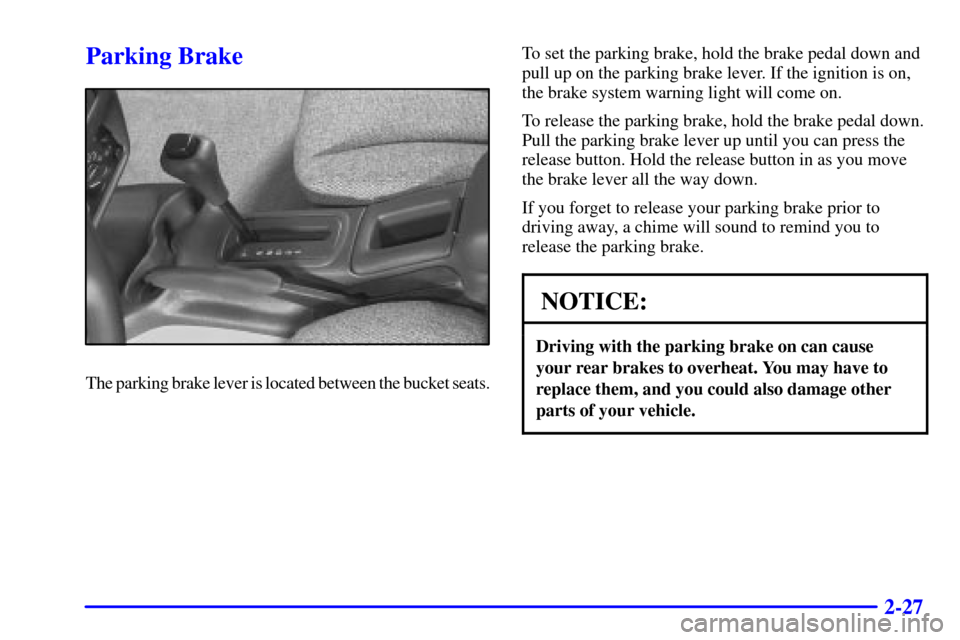
The parking brake lever is located between the bucket seats.To set the parking brake, hold the brake pedal down and
pull up on the parking brake lever. If the ignition is on,
the brake system warning light will come on.
To release the parking brake, hold the brake pedal down.
Pull the parking brake lever up until you can press the
release button. Hold the release button in as you move
the brake lever all the way down.
If you forget to release your parking brake prior to
driving away, a chime will sound to remind you to
release the parking brake.
NOTICE:
Driving with the parking brake on can cause
your rear brakes to overheat. You may have to
replace them, and you could also damage other
parts of your vehicle.
Page 118 of 364
2-54
6. Lift the side cover eyelet (C) at the rear of the side
boot cover from the snap ball stud (D). Raise the
back of the boot side cover to unhook the tab (A)
from the slot (B) in the quarter trim panel. Do the
same on the other side.7. Store both boot side covers in the trunk.
8. Close the trunk.
9. Raise the rear seatback to the up position. Push the
seat back to make sure it is latched. Ensure that the
rear safety belts do not become trapped behind the
rear seats.
Installing the One Piece Boot
1. From inside the vehicle, pull the tab on the rear seat
to fold down the seat. See ªFold
-Down Rear Seatº
in the Index.
2. Open the trunk and remove the boot. Leave the
trunk open.
The attachments for the one piece boot are the same
as the attachments for the three piece boot at the
quarter trim panel and the trunk lid opening.
The one piece boot attachment is unique at the rear
seat back.
Page 120 of 364

2-56 Removing the One Piece Boot
1. Set the parking brake and shift your automatic
transaxle to PARK (P) or your manual transaxle to
NEUTRAL (N).
2. Open the trunk and leave it open.
3. From inside the vehicle, fold down the rear seatback.
See ªFold
-Down Rear Seatº in the Index.
4. Gently pull the boot flap away from the rear
seat striker.
The one piece boot is detached the same as the
three piece boot at the quarter trim panel and the
trunk lid opening.
5. Store boot in the trunk.
6. Close the trunk.
7. Raise the rear seatback to the up position. Push the
seat back to make sure it is latched. Ensure that the
rear safety belts do not become trapped behind the
rear seats.
Raising the Convertible Top
1. Set the parking brake and shift your automatic
transaxle to PARK (P) or your manual transaxle to
NEUTRAL (N).
2. Turn the ignition to RUN.
3. Lower the door windows completely to avoid wear
to the weatherstrips.
4. Push the button in the latch handle and rotate the
handle down.
Page 146 of 364
3-5 Heating
On cold days, use FLOOR with the temperature knob all
the way in the red area. The system will bring in outside
air, heat it and send it to the floor ducts.
Your vehicle has heat ducts that are directed toward the
rear seat. Keep the area under the front seats clear of
obstructions so the heated air can reach the rear
seat passengers.
If your vehicle has an engine coolant heater, you can
use it to help your system provide warm air faster when
it's cold outside (0�F (
-18�C) or lower). An engine
coolant heater warms the coolant your engine and
heating system use to provide heat. See ªEngine
Coolant Heaterº in the Index.
Defogging and Defrosting
Your system has two settings for clearing the front and
side windows. To defrost the windows quickly, use
DEFROST with the temperature knob all the way in
the red area. To warm passengers while keeping the
windows clean, use DEFOG.
To defog the side windows, set the right control to
BI
-LEVEL and the fan control to the highest setting.To defog the side windows while using the air
conditioner, set the right control to BI
-LEVEL, the fan
control to the highest setting, and press the A/C button.
For both systems, aim the side vents toward the side
windows. For increased airflow to the side vents, close
the center vents.
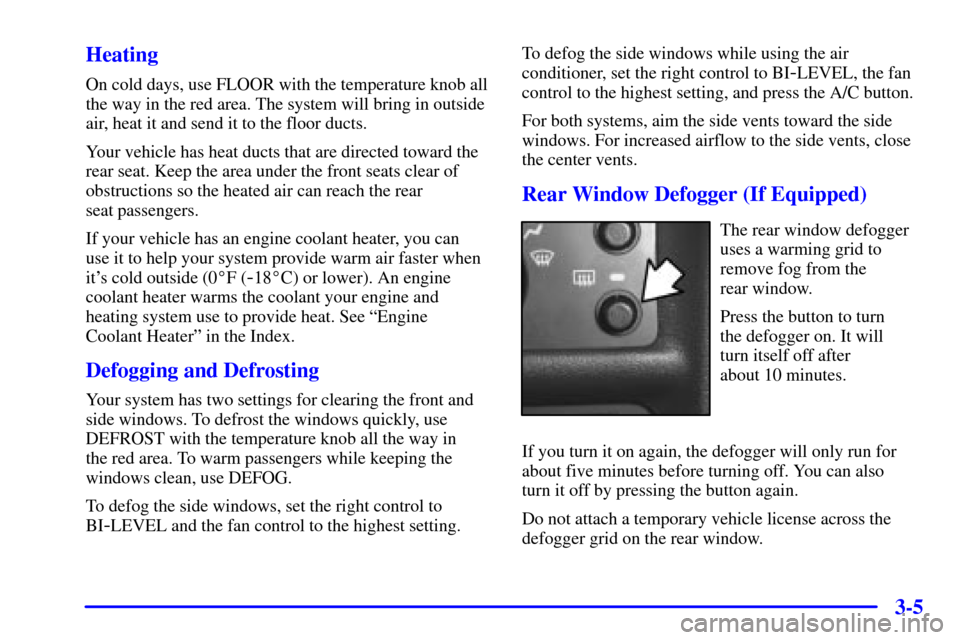
Rear Window Defogger (If Equipped)
The rear window defogger
uses a warming grid to
remove fog from the
rear window.
Press the button to turn
the defogger on. It will
turn itself off after
about 10 minutes.
If you turn it on again, the defogger will only run for
about five minutes before turning off. You can also
turn it off by pressing the button again.
Do not attach a temporary vehicle license across the
defogger grid on the rear window.
Page 147 of 364

3-6
NOTICE:
Don't use a razor blade or anything else sharp on
the inside of the rear window. If you do, you
could cut or damage the warming grid, and the
repairs wouldn't be covered by your warranty.
Ventilation System
For mild outside temperatures when little heating or
cooling is needed, use VENT to direct outside air
through your vehicle. Your vehicle also has the
flow
-through ventilation system.
Your vehicle's flow
-through ventilation system supplies
outside air into the vehicle when it is moving. Outside
air will also enter the vehicle when the air conditioning
fan is running.
Ventilation Tips
�Keep the hood and front air inlet free of ice, snow or
any other obstruction, such as leaves. The heater and
defroster will work far better, reducing the chance of
fogging the inside of your windows.
�When you enter a vehicle in cold weather, adjust the
mode knob to FLOOR and the fan to the highest speed
for a few moments before driving off. This helps clear
the intake ducts of snow and moisture and reduces the
chance of fogging the inside of your windows.
�Keep the air path under the front seats clear of objects.
This helps air circulate throughout your vehicle.