Page 2 of 357
Free lockout assistance
Free dead-battery assistance
Free out-of-fuel assistance
Free flat-tire change
Emergency towing
(For vehicles purchased in Canada,
call 1-800-268-6800)
that provides in an emergency:
(For vehicles purchased in Canada,
call 1-800-268-6800)
Bumper-to-Bumper
3-years/36,000 miles (60 000 km)
Limited Warranty
Courtesy
Transportation
Every
2000 Camaro
under warranty is
backed with the
following
services:
1-800-CHEV-USA 1-800-CHEV-USA
Page 5 of 357
Table of Contents (cont'd)
Braking/Anti-lock Brakes (If Equipped)
ASR System
Steering
Driving Tips for Various Road ConditionsRecreational Vehicle Towing
Loading Your Vehicle
Towing a Trailer Heating and Air Conditioning
Setting the Radio Clock
Radio/Cassette Player/CD PlayerRadio Theft-Deterrent Feature
Steering Wheel Controls (If Equipped)
Hazard Warning Flashers
Jump Starting
Towing Your VehicleEngine Overheating
Changing a Flat Tire
If You're Stuck
Problems on the Road
iii
Section
3
Section
4
Section
5
Comfort Controls and Audio Systems
Your Driving and the Road
Page 36 of 357

1-24
When should an air bag inflate?
An air bag is designed to inflate in a moderate to severe
frontal or near
-frontal crash. The air bag will inflate
only if the impact speed is above the system's designed
ªthreshold level.º If your vehicle goes straight into a
wall that doesn't move or deform, the threshold level is
about 12 to 18 mph (19 to 29 km/h). The threshold level
can vary, however, with specific vehicle design, so that
it can be somewhat above or below this range. If your
vehicle strikes something that will move or deform,
such as a parked car, the threshold level will be higher.
The air bag is not designed to inflate in rollovers, side
impacts or rear impacts, because inflation would not
help the occupant.
In any particular crash, no one can say whether an air
bag should have inflated simply because of the damage
to a vehicle or because of what the repair costs were.
Inflation is determined by the angle of the impact and
how quickly the vehicle slows down in frontal or
near
-frontal impacts.What makes an air bag inflate?
In an impact of sufficient severity, the air bag sensing
system detects that the vehicle is in a crash. The sensing
system triggers a release of gas from the inflator, which
inflates the air bag. The inflator, air bag and related
hardware are all part of the air bag modules inside the
steering wheel and in the instrument panel in front of
the right front passenger.
How does an air bag restrain?
In moderate to severe frontal or near
-frontal collisions,
even belted occupants can contact the steering wheel
or the instrument panel. Air bags supplement the
protection provided by safety belts. Air bags distribute
the force of the impact more evenly over the occupant's
upper body, stopping the occupant more gradually.
But air bags would not help you in many types of
collisions, including rollovers, rear impacts and side
impacts, primarily because an occupant's motion is not
toward those air bags. Air bags should never be regarded
as anything more than a supplement to safety belts,
and then only in moderate to severe frontal or
near
-frontal collisions.
Page 45 of 357
1-33
Child Restraints
Every time infants and young children ride in
vehicles, they should have protection provided by
appropriate restraints.
Q:What are the different types of add-on
child restraints?
A:Add-on child restraints are available in four basic
types. When selecting a child restraint, take into
consideration not only the child's weight and
size, but also whether or not the restraint will be
compatible with the motor vehicle in which it will
be used.
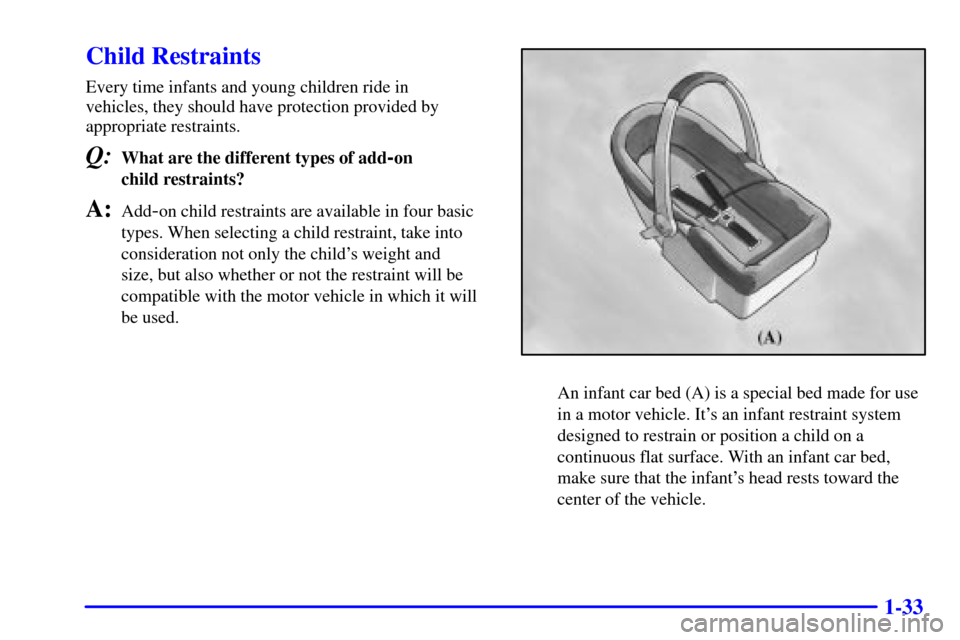
An infant car bed (A) is a special bed made for use
in a motor vehicle. It's an infant restraint system
designed to restrain or position a child on a
continuous flat surface. With an infant car bed,
make sure that the infant's head rests toward the
center of the vehicle.
Page 56 of 357
1-44
Q:What if a child is wearing a lap-shoulder belt,
but the child is so small that the shoulder belt is
very close to the child's face or neck?
A:Move the child toward the center of the vehicle, but
be sure that the shoulder belt still is on the child's
shoulder, so that in a crash the child's upper body
would have the restraint that belts provide.
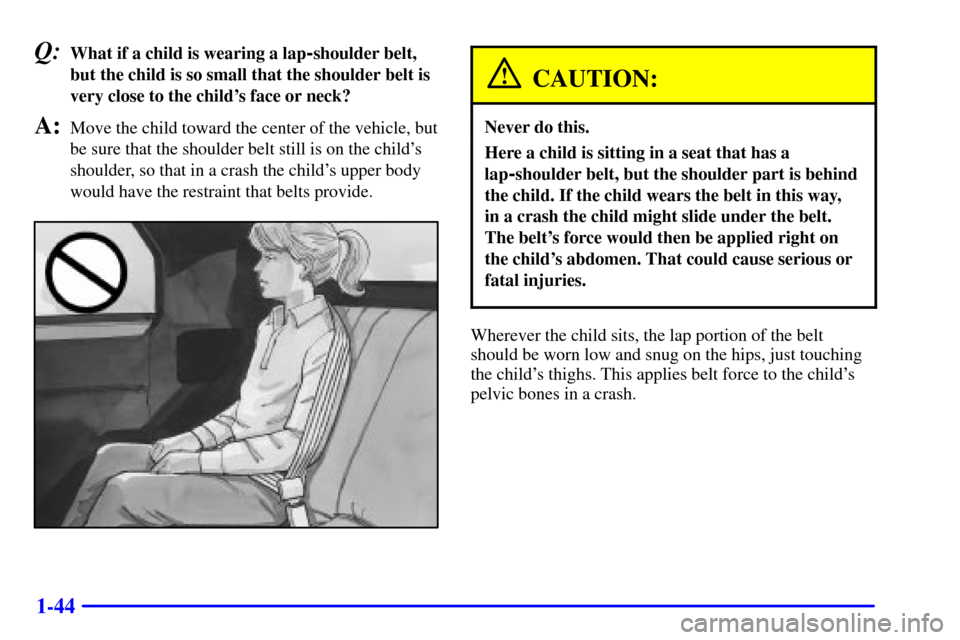
CAUTION:
Never do this.
Here a child is sitting in a seat that has a
lap
-shoulder belt, but the shoulder part is behind
the child. If the child wears the belt in this way,
in a crash the child might slide under the belt.
The belt's force would then be applied right on
the child's abdomen. That could cause serious or
fatal injuries.
Wherever the child sits, the lap portion of the belt
should be worn low and snug on the hips, just touching
the child's thighs. This applies belt force to the child's
pelvic bones in a crash.
Page 76 of 357

2-19 Entering Programming Mode
To program any feature, your vehicle must be in the
programming mode. Follow these steps:
1. Put your key in the ignition.
2. Turn the ignition to RUN to disarm the content
theft
-deterrent/alarm system.
3. Turn the ignition to OFF.
4. Remove the RADIO fuse. This fuse is in the
main fuse block, located on the left side of your
instrument panel. When the main fuse block is open,
the RADIO fuse is located in the lower right corner
side of the fuse panel. See ªFuses and Circuit
Breakersº in the Index.
5. Turn the ignition towards you to ACC.
6. Count the number of chimes you hear. You will
hear one to two chimes depending on the features
your vehicle is equipped with. Refer to the chart
shown previously.
You can now program your choices.
To exit the programming mode, follow the steps
listed under ªLeaving Programming Modeº later in
this section.
Exit Lighting and Delayed Illumination
With Exit Lighting, your interior lamps will come on
for up to 25 seconds when the key is removed from
the ignition.
With Delayed Illumination, your interior lamps will
come on and stay on for up to 25 seconds when
entering your vehicle and up to five seconds when
leaving your vehicle.
Programmable Modes
Your vehicle can be programmed to one of the
following modes:
Mode 1: Both Off
Mode 2: Delayed Illumination Only
Mode 3: Exit Lighting Only
Mode 4: Both On
Vehicles are delivered programmed in Mode 4.
Page 82 of 357

2-25
New Vehicle ªBreak-Inº
NOTICE:
Your vehicle doesn't need an elaborate ªbreak-in.º
But it will perform better in the long run if you
follow these guidelines:
�Keep your speed at 55 mph (88 km/h) or
less for the first 500 miles (805 km).
�Don't drive at any one speed
-- fast or
slow
-- for the first 500 miles (805 km).
Don't make full
-throttle starts.
�Avoid making hard stops for the first
200 miles (322 km) or so. During this time
your new brake linings aren't yet broken
in. Hard stops with new linings can mean
premature wear and earlier replacement.
Follow this breaking
-in guideline every
time you get new brake linings.
�Don't tow a trailer during break
-in.
See ªTowing a Trailerº in the Index for
more information.
Ignition Positions
With the ignition key in the ignition, you can turn the
switch to five positions.
ACC (A): The position in which you can operate your
electrical power accessories. Push in the ignition switch
as you turn the top of it toward you.
LOCK (B): The only position from which you can
remove the key. This locks your steering wheel, ignition
and automatic transmission.
If you have an automatic transmission, the ignition
switch can't be turned to LOCK unless the shift lever is
in PARK (P).
Page 83 of 357

2-26
CAUTION:
On manual transmission vehicles, turning the key
to LOCK will lock the steering column and result
in a loss of ability to steer the vehicle. This could
cause a collision. If you need to turn the engine
off while the vehicle is moving, turn the key only
to OFF. Don't press the key release button while
the vehicle is moving.
NOTICE:
If your key seems stuck in LOCK and you can't
turn it, be sure you are using the correct key;
if so, is it all the way in? If it is, then turn the
steering wheel left and right while you turn the
key hard. But turn the key only with your hand.
Using a tool to force it could break the key or the
ignition switch. If none of this works, then your
vehicle needs service.
OFF (C): This position unlocks the steering wheel,
ignition and automatic transmission, but does not send
electrical power to any accessories. Use this position if
your vehicle must be pushed or towed. A warning tone
will sound if you open the driver's door when the
ignition is in OFF and the key is in the ignition.
RUN (D): The position which the switch returns after
you start your engine and release the switch. The switch
stays in RUN when the engine is running. But even
when the engine is not running, you can use RUN to
operate your electrical power accessories and to display
some instrument panel warning and indicator lights.
START (E): Starts the engine. When the engine starts,
release the key. The ignition will return to RUN for
normal driving.
Even if the engine is not running, ACC and RUN or
when Retained Accessory Power (RAP) is active, allows
you to operate your electrical accessories, such as the
radio and ventilation fan. See ªRetained Accessory
Powerº in the Index.