Page 252 of 357

6-
6-1
Section 6 Service and Appearance Care
Here you will find information about the care of your vehicle. This section begins with service and fuel information,
and then it shows how to check important fluid and lubricant levels. There is also technical information about your
vehicle, and a part devoted to its appearance care.
6
-2 Service
6
-3 Fuel
6
-5 Fuels in Foreign Countries
6
-6 Filling Your Tank
6
-8 Filling a Portable Fuel Container
6
-8 Checking Things Under the Hood
6
-12 Engine Oil
6
-18 Engine Air Cleaner/Filter
6
-20 Automatic Transmission Fluid
6
-23 Manual Transmission Fluid
6
-24 Hydraulic Clutch
6
-25 Rear Axle
6
-26 Engine Coolant
6
-29 Power Steering Fluid
6
-30 Windshield Washer Fluid
6
-31 Brakes
6
-35 Battery
6
-36 Bulb Replacement6
-40 Tires
6
-50 Appearance Care
6
-50 Cleaning the Inside of Your Vehicle
6
-52 Care of Safety Belts
6
-53 Cleaning Glass Surfaces
6
-53 Cleaning a Removeable Roof Panel
6
-54 Cleaning the Outside of Your Vehicle
6
-55 Cleaning Your Convertible Top
6
-56 Cleaning Aluminum or Chrome-Plated
Wheels (If Equipped)
6
-57 Underbody Maintenance
6
-58 GM Vehicle Care/Appearance Materials
6
-59 Vehicle Identification Number (VIN)
6
-59 Service Parts Identification Label
6
-60 Electrical System
6
-66 Replacement Bulbs
6
-66 Capacities and Specifications
6
-67 Normal Maintenance Replacement Parts
Page 261 of 357
6-10
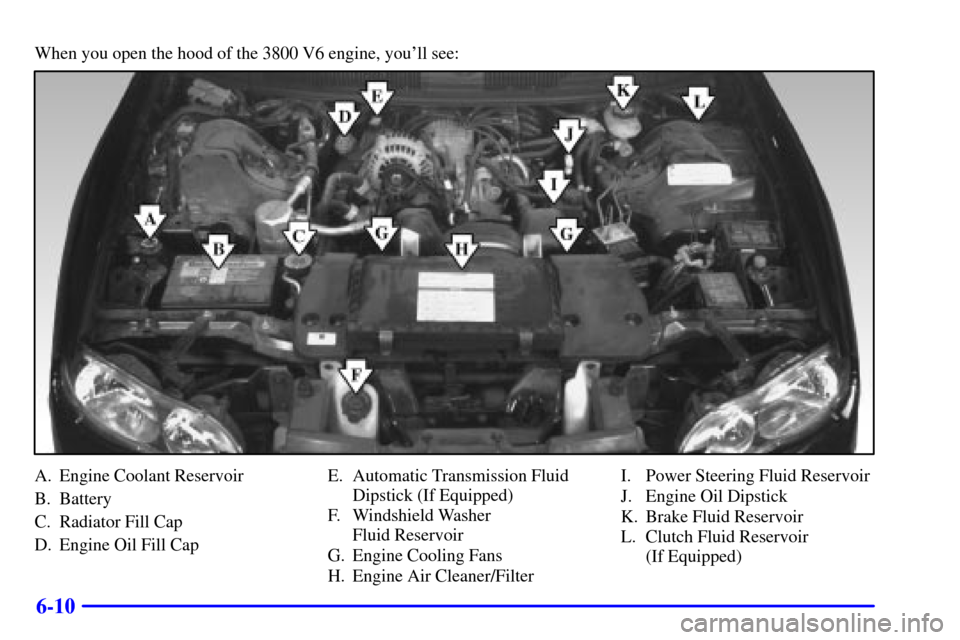
When you open the hood of the 3800 V6 engine, you'll see:
A. Engine Coolant Reservoir
B. Battery
C. Radiator Fill Cap
D. Engine Oil Fill CapE. Automatic Transmission Fluid
Dipstick (If Equipped)
F. Windshield Washer
Fluid Reservoir
G. Engine Cooling Fans
H. Engine Air Cleaner/FilterI. Power Steering Fluid Reservoir
J. Engine Oil Dipstick
K. Brake Fluid Reservoir
L. Clutch Fluid Reservoir
(If Equipped)
Page 262 of 357
6-11
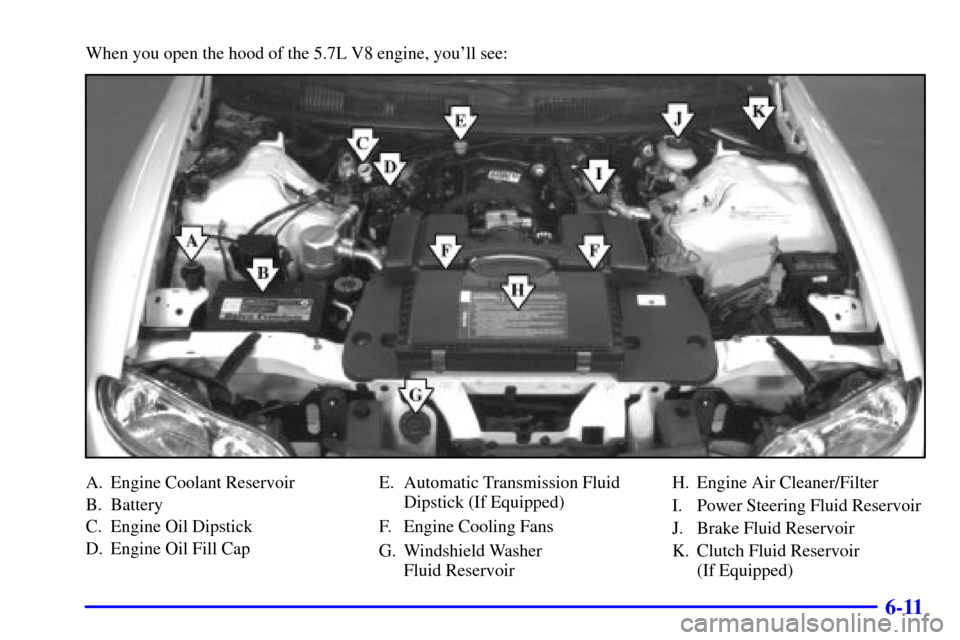
When you open the hood of the 5.7L V8 engine, you'll see:
A. Engine Coolant Reservoir
B. Battery
C. Engine Oil Dipstick
D. Engine Oil Fill CapE. Automatic Transmission Fluid
Dipstick (If Equipped)
F. Engine Cooling Fans
G. Windshield Washer
Fluid ReservoirH. Engine Air Cleaner/Filter
I. Power Steering Fluid Reservoir
J. Brake Fluid Reservoir
K. Clutch Fluid Reservoir
(If Equipped)
Page 275 of 357

6-24
Check the fluid level only when your engine is off, the
vehicle is parked on a level place and the transmission
is cool enough for you to rest your fingers on the
transmission case.
Then, follow these steps:
6-Speed (5-Speed Similar)
1. Remove the filler plug.
2. Check that the lubricant level is up to the bottom of
the filler plug hole.
3. If the fluid level is good, install the plug and be sure it
is fully seated. If the fluid level is low, add more fluid
as described in the next steps.
How to Add Fluid
Here's how to add fluid. Refer to the Maintenance
Schedule to determine what kind of fluid to use.
See ªRecommended Fluids and Lubricantsº in
the Index.
1. Remove the filler plug.
2. Add fluid at the filler plug hole. Add only enough
fluid to bring the fluid level up to the bottom of the
filler plug hole.
3. Install the filler plug. Be sure the plug is fully seated.
Hydraulic Clutch
The hydraulic clutch linkage in your vehicle is
self
-adjusting. The clutch master cylinder reservoir is
filled with hydraulic clutch fluid.
It is not necessary to regularly check clutch fluid unless
you suspect there is a leak in the system. Adding fluid
won't correct a leak.
A fluid loss in this system could indicate a problem.
Have the system inspected and repaired.
Page 276 of 357
6-25 When to Check and What to Use
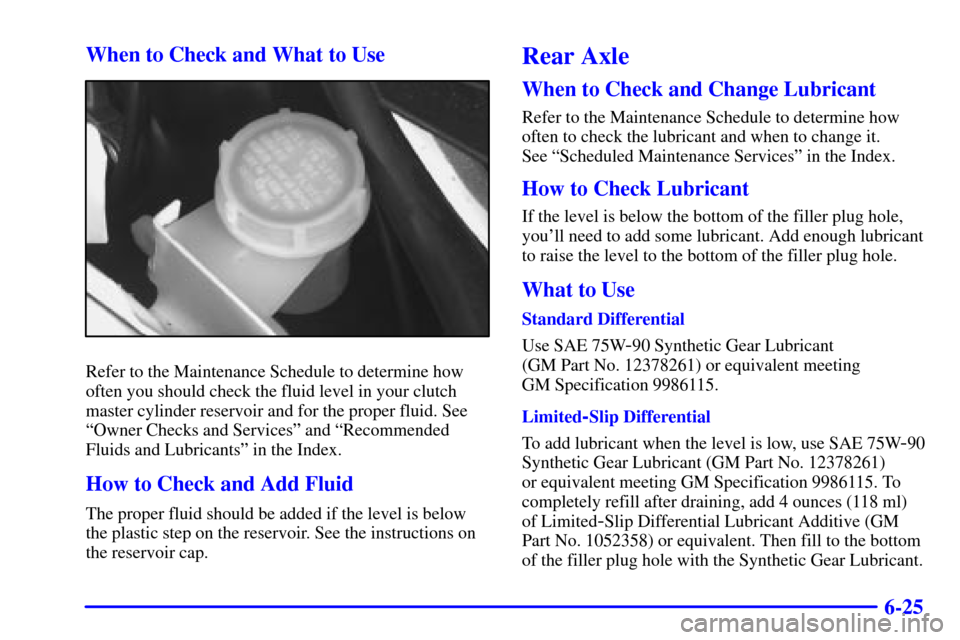
Refer to the Maintenance Schedule to determine how
often you should check the fluid level in your clutch
master cylinder reservoir and for the proper fluid. See
ªOwner Checks and Servicesº and ªRecommended
Fluids and Lubricantsº in the Index.
How to Check and Add Fluid
The proper fluid should be added if the level is below
the plastic step on the reservoir. See the instructions on
the reservoir cap.
Rear Axle
When to Check and Change Lubricant
Refer to the Maintenance Schedule to determine how
often to check the lubricant and when to change it.
See ªScheduled Maintenance Servicesº in the Index.
How to Check Lubricant
If the level is below the bottom of the filler plug hole,
you'll need to add some lubricant. Add enough lubricant
to raise the level to the bottom of the filler plug hole.
What to Use
Standard Differential
Use SAE 75W
-90 Synthetic Gear Lubricant
(GM Part No. 12378261) or equivalent meeting
GM Specification 9986115.
Limited
-Slip Differential
To add lubricant when the level is low, use SAE 75W
-90
Synthetic Gear Lubricant (GM Part No. 12378261)
or equivalent meeting GM Specification 9986115. To
completely refill after draining, add 4 ounces (118 ml)
of Limited
-Slip Differential Lubricant Additive (GM
Part No. 1052358) or equivalent. Then fill to the bottom
of the filler plug hole with the Synthetic Gear Lubricant.
Page 316 of 357
6-65
Fuse Usage
ENG SEN Mass Air Flow, Heated Oxygen
Sensor, Skip Shift Solenoid
(V8 Only), Reverse Lockout
Solenoid, Brake Switch
STRTR Powertrain Control Module (PCM)
and Clutch Pedal Switch
ABS IGN Anti
-Lock Brake System Module
PCM IGN Powertrain Control Module (PCM)
ETC Electronic Throttle Control
(V6 Only)
ENG CTRL Ignition Module (V6 Only),
Automatic Transmission and
Charcoal Canister Purge Solenoid
A/C CRUISE Air Conditioning Compressor
Relay, Cruise Control Switches
and ModuleFuse Usage
ENG CTRL Engine Controls, Fuel Pump,
Powertrain Control Module (PCM),
A.I.R. and Cooling Fans
I/P
-1 HVAC Blower Control and Relay
IGN Ignition Switch, Relay and Starter
Enable Relay
I/P
-2 Instrument Panel Fuse Center
Relay Description
Blank Not Used
AIR PUMP Air Pump
A/C COMP Air Conditioning Compressor
FUEL PUMP Fuel Pump
STARTER Starter
IGN Engine Controls, Cruise Control,
Air Conditioning
Page 336 of 357

7-18
Also look for any opened or broken air bag coverings,
and have them repaired or replaced. (The air bag system
does not need regular maintenance.)
Wiper Blade Check
Inspect wiper blades for wear or cracking. Replace blade
inserts that appear worn or damaged or that streak or
miss areas of the windshield. Also see ªWiper Blades,
Cleaningº in the Index.
Weatherstrip Lubrication
Silicone grease on weatherstrips will make them last
longer, seal better, and not stick or squeak. Apply
silicone grease with a clean cloth. During very cold,
damp weather more frequent application may be
required. (See ªRecommended Fluids and
Lubricantsº in the Index.)
Manual Transmission Check
Check the transmission fluid level; add if needed.
See ªManual Transmission Fluidº in the Index.
Check for leaks. A fluid leak is the only reason for fluid
loss. Have the system inspected and repaired if needed.Automatic Transmission Check
Check the transmission fluid level; add if needed.
See ªAutomatic Transmission Fluidº in the Index.
A fluid loss may indicate a problem. Check the system
and repair if needed.
Hydraulic Clutch System Check
Check the fluid level in the clutch reservoir. See
ªHydraulic Clutch Fluidº in the Index. A fluid loss in
this system could indicate a problem. Have the system
inspected and repaired at once.
At Least Once a Year
Key Lock Cylinders Service
Lubricate the key lock cylinders with the lubricant
specified in Part D.
Body Lubrication Service
Lubricate all hinges and latches, including those for the
hood, rear compartment, console doors and any folding
seat hardware. Part D tells you what to use. More
frequent lubrication may be required when exposed to
a corrosive environment.
Page 337 of 357

7-19
Starter Switch Check
CAUTION:
When you are doing this check, the vehicle could
move suddenly. If it does, you or others could be
injured. Follow the steps below.
1. Before you start, be sure you have enough room
around the vehicle.
2. Firmly apply both the parking brake (see ªParking
Brakeº in the Index if necessary) and the regular brake.
NOTE: Do not use the accelerator pedal, and be
ready to turn off the engine immediately if it starts.
3. On automatic transmission vehicles, try to start the
engine in each gear. The starter should work only in
PARK (P) or NEUTRAL (N). If the starter works
in any other position, your vehicle needs service.
On manual transmission vehicles, put the shift lever
in NEUTRAL (N), push the clutch down halfway
and try to start the engine. The starter should work
only when the clutch is pushed down all the way to
the floor. If the starter works when the clutch isn't
pushed all the way down, your vehicle needs service.Automatic Transmission Shift Lock Control
System Check
CAUTION:
When you are doing this check, the vehicle could
move suddenly. If it does, you or others could be
injured. Follow the steps below.
1. Before you start, be sure you have enough room
around the vehicle. It should be parked on a
level surface.
2. Firmly apply the parking brake (see ªParking Brakeº
in the Index if necessary).
NOTE: Be ready to apply the regular brake
immediately if the vehicle begins to move.
3. With the engine off, turn the key to the RUN
position, but don't start the engine. Without
applying the regular brake, try to move the shift
lever out of PARK (P) with normal effort. If the
shift lever moves out of PARK (P), your vehicle
needs service.