Page 301 of 430
6-7
CAUTION:
If you get gasoline on yourself and then
something ignites it, you could be badly burned.
Gasoline can spray out on you if you open the
fuel filler cap too quickly. This spray can happen
if your tank is nearly full, and is more likely in
hot weather. Open the fuel filler cap slowly and
wait for any ªhissº noise to stop. Then unscrew
the cap all the way.
Be careful not to spill gasoline. Clean gasoline from
painted surfaces as soon as possible. See ªCleaning the
Outside of Your Vehicleº in the Index.
When you put the cap back on, turn it to the right
(clockwise) until you hear a clicking sound. Make sure
you fully install the cap. The diagnostic system can
determine if the fuel cap has been left off or improperly
installed. This would allow fuel to evaporate into the
atmosphere. See ªMalfunction Indicator Lampº in
the Index.
NOTICE:
If you need a new cap, be sure to get the right
type. Your dealer can get one for you. If you get
the wrong type, it may not fit properly. This may
cause your malfunction indicator lamp to light
and your fuel tank and emissions system may be
damaged. See ªMalfunction Indicator Lampº in
the Index.
Page 302 of 430
6-8
Filling a Portable Fuel Container
CAUTION:
Never fill a portable fuel container while it is in
your vehicle. Static electricity discharge from the
container can ignite the gasoline vapor. You can
be badly burned and your vehicle damaged if this
occurs. To help avoid injury to you and others:
�Dispense gasoline only into
approved containers.
�Do not fill a container while it is inside a
vehicle, in a vehicle's trunk, pickup bed or
on any surface other than the ground.
�Bring the fill nozzle in contact with the
inside of the fill opening before operating
the nozzle. Contact should be maintained
until the filling is complete.
�Don't smoke while pumping gasoline.
Checking Things Under the Hood
CAUTION:
Things that burn can get on hot engine parts and
start a fire. These include liquids like fuel, oil,
coolant, brake fluid, windshield washer and other
fluids, and plastic or rubber. You or others could
be burned. Be careful not to drop or spill things
that will burn onto a hot engine.
Page 305 of 430
6-11
Before closing the hood, be sure all the filler caps are on
properly. Then lift the hood to relieve pressure on the
hood prop.
Remove the hood prop from the slot in the hood and
return the prop to its retainer.
Then just pull the hood down firmly to close. It will
latch when dropped from 10 to 12 inches (25 to 30 cm)
without pressing on the hood.
Engine Oil
Checking Engine Oil
It's a good idea to check your engine oil every time you
get fuel. In order to get an accurate reading, the oil must
be warm and the vehicle must be on level ground.
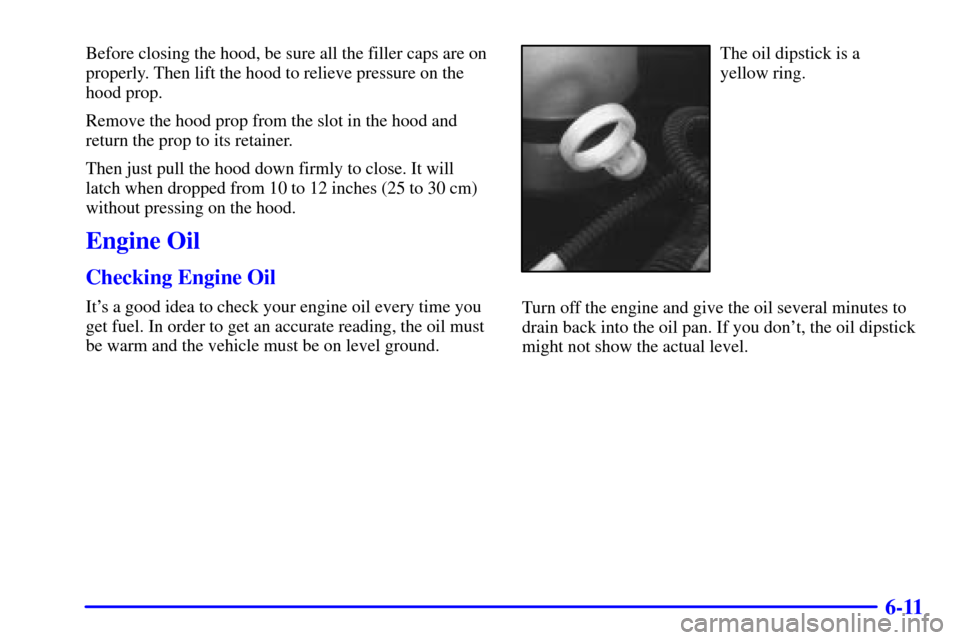
The oil dipstick is a
yellow ring.
Turn off the engine and give the oil several minutes to
drain back into the oil pan. If you don't, the oil dipstick
might not show the actual level.
Page 336 of 430
6-42
CAUTION:
Poorly maintained and improperly used tires
are dangerous.
�Overloading your tires can cause
overheating as a result of too much friction.
You could have an air
-out and a serious
accident. See ªLoading Your Vehicleº in
the Index.
�Underinflated tires pose the same danger as
overloaded tires. The resulting accident
could cause serious injury. Check all tires
frequently to maintain the recommended
pressure. Tire pressure should be checked
when your tires are cold.
�Overinflated tires are more likely to be
cut, punctured or broken by a sudden
impact
-- such as when you hit a pothole.
Keep tires at the recommended pressure.
�Worn, old tires can cause accidents. If your
tread is badly worn, or if your tires have
been damaged, replace them.
Inflation -- Tire Pressure
The Certification/Tire label, which is on the driver's
door edge, above the door latch, shows the correct
inflation pressures for your tires when they're cold.
ªColdº means your vehicle has been sitting for at least
three hours or driven no more than 1 mile (1.6 km).
NOTICE:
Don't let anyone tell you that underinflation or
overinflation is all right. It's not. If your tires
don't have enough air (underinflation), you can
get the following:
�Too much flexing
�Too much heat
�Tire overloading
�Bad wear
�Bad handling
�Bad fuel economy.
NOTICE: (Continued)
Page 350 of 430
6-56
Sheet Metal Damage
If your vehicle is damaged and requires sheet metal
repair or replacement, make sure the body repair shop
applies anti
-corrosion material to the parts repaired or
replaced to restore corrosion protection.
Original manufacturer replacement parts will provide
the corrosion protection while maintaining the warranty.
Finish Damage
Any stone chips, fractures or deep scratches in the finish
should be repaired right away. Bare metal will corrode
quickly and may develop into a major repair expense.
Minor chips and scratches can be repaired with touch
-up
materials available from your dealer or other service
outlets. Larger areas of finish damage can be corrected
in your dealer's body and paint shop.
Underbody Maintenance
Chemicals used for ice and snow removal and dust
control can collect on the underbody. If these are not
removed, accelerated corrosion (rust) can occur on the
underbody parts such as fuel lines, frame, floor pan
and exhaust system even though they have
corrosion protection.At least every spring, flush these materials from the
underbody with plain water. Clean any areas where mud
and other debris can collect. Dirt packed in closed areas
of the frame should be loosened before being flushed.
Your dealer or an underbody car washing system can do
this for you.
Chemical Paint Spotting
Some weather and atmospheric conditions can create a
chemical fallout. Airborne pollutants can fall upon and
attack painted surfaces on your vehicle. This damage
can take two forms: blotchy, ringlet
-shaped
discolorations, and small irregular dark spots etched into
the paint surface.
Although no defect in the paint job causes this, GM
will repair, at no charge to the owner, the surfaces of
new vehicles damaged by this fallout condition within
12 months or 12,000 miles (20 000 km) of purchase,
whichever occurs first.
Page 357 of 430
6-63
Name Usage
TRL TRN Trailer Left Turn
TRR TRN Trailer Right Turn
TRL B/U Trailer Back Up Lamps
VEH B/U Vehicle Back Up Lamps
RT TURN Right Turn Signal Front
LT TURN Left Turn Signal Front
HDLP W/W Not Used
LT TRN Left Turn Signal Rear
RT TRN Right Turn Signal Rear
RR PRK Right Rear Parking Lamps
TRL PRK Trailer Park Lamps
LTHDLP Left Headlamp
RTHDLP Right Headlamp
FRPRK Front Parking LampsName Usage
INT BAT I/P Fuse Block Feed
ENG I Engine Sensors/Solenoids, MAF,
CAM, PURGE, VENT
ECM B Engine Control Module, Fuel
Pump Module, Oil Pressure
ABS Anti
-Lock Brake System
ECM I Engine Control Module Injectors
A/C Air Conditioning
W/W PMP Not Used
HORN Horn
BTSI Automatic Transmission Shift
Lock Control System
B/U LP Back Up Lamps
IGN B Column Feed, IGN 2, 3, 4
RAP Retained Accessory Power
Page 358 of 430
6-64
Name Usage
LD LEV Not Used
OXYSEN Oxygen Sensor
IGN E Engine
MIR/LKS Mirrors, Door Locks
FOG LP Fog Lamps
IGN A Starting and Charging IGN 1
STUD #2 Accessory Feeds, Electric Brake
PARKLP Parking Lamps
LR PRK Left Rear Parking Lamps
IGN C Starter Solenoid, Fuel
Pump, PRNDL
HTDSEAT Heated Seat
HVAC HVAC SystemName Usage
TRCHMSL Trailer Center High Mount
Stop Light
RRDFOG Rear Defogger
TBC Truck Body Computer
CRANK Clutch Switch, NSBU Switch
HAZLP Hazard Lamps
VECHMSL Vehicle Center High
-Mounted
Stop Lamp
HTDMIR Heated Mirror
ATC Transfer Case (Four
-Wheel Drive)
STOPLP Stop Lamps
RR W/W Rear Window Wiper
Page 360 of 430
6-66 Capacities (Approximate)
Please refer to ªRecommended Fluids and Lubricantsº
in the Index for more information.
Cooling System*
Automatic Trans. 11.7 quarts (11.1 L). . . . . . . . . . . .
Manual Trans. 11.9 quarts (11.3 L). . . . . . . . . . . . . .
Crankcase* 4.5 quarts (4.3 L). . . . . . . . . . . . . . . . .
Automatic Transmission
(Drain and Refill)* 5.0 quarts (4.7 L). . . . . . . . .
Differential Fluid
Rear 4.0 pints (1.9 L). . . . . . . . . . . . . . . . . . . . . . . .
Front 2.6 pints (1.2 L). . . . . . . . . . . . . . . . . . . . . . .
Fuel Tank (2
-Door Models) 19.0 gallons (72.0 L). .
Fuel Tank (4
-Door Models) 18.0 gallons (68.0 L). .
A/C Refrigerant See refrigerant charge. . . . . . . . . . .
label under the hood.
*After refill, the level must be checked.
Normal Maintenance
Replacement Parts
Replacement part numbers listed in this section are
based on the latest information available at the time of
printing, and are subject to change. If a part listed in this
manual is not the same as the part used in your vehicle
when it was built, or if you have any questions, please
contact your GM dealer.
Thermostat 12559051. . . . . . . . . . . . . . . . . . . . . . . . .
Oil Filter PF52. . . . . . . . . . . . . . . . . . . . . . . . . . . . . . .
Air Cleaner Filter A1163C. . . . . . . . . . . . . . . . . . . . . .
PCV Valve CV769C. . . . . . . . . . . . . . . . . . . . . . . . . .
Automatic Transmission Filter Kit 24200796. . . . . .
Spark Plugs 41
-932 . . . . . . . . . . . . . . . . . . . . . . . . . . .
Fuel Filter GF481. . . . . . . . . . . . . . . . . . . . . . . . . . . . .
Front Windshield
Wiper Blade Trico (20 inches/50.8 cm). . . . . . . . . .
Backglass Wiper Blade Trico (14 inches/35.6 cm). . .