Page 152 of 359
2-92 Mirror To Curb In Reverse (If Equipped)
Press the down arrow on the INFO button one or
more times until the MIRROR TO CURB IN REV
prompts appears on the DIC display. This feature will
move the passenger's outside rearview mirror to a curb
view position when the console shifter is placed in
REVERSE (R) and it will return the mirror to the last
known driving position when the console shifter is
moved out of REVERSE (R). To turn this feature on,
press the ON/OFF button until ON is displayed on the
DIC. To turn the feature off, press the ON/OFF button
until OFF is displayed. For more information, see
ªCurb View Assist Mirrorº in the Index.
Driver's Names Set/Recall (If Equipped)
After the FEATURE PROGRAMMING prompt is
displayed on the DIC and the ON/OFF button is pressed,
the prompts DRIVER NO 1 or DRIVER NO 2 will
appear. These prompts correspond to which RKE
transmitter button or memory recall button has been
pressed on the driver's door armrest. You may have
your name and a second driver's name displayed here, replacing the prompts DRIVER NO 1 and DRIVER
NO 2. A dealership can program your vehicle to display
the names you want. The names will appear whenever
the key is turned to ON only if RKE transmitters 1 or 2
are used to enter the vehicle or buttons 1 or 2 on the
driver's door are pressed.
Comfort Controls and Radio System
Personalization
These features allow both drivers to personalize their own
climate control settings as well as their radio settings. For
more information, see ªClimate Control Personalizationº
and ªRadio Personalizationº in the Index.
The outside temperature is always available for display
if it has been selected for a DIC display when your
vehicle is running unless an overriding DIC message
appears. You can change the temperature from
Fahrenheit to Celsius by pressing the ENG/MET
(English/metric) button on the instrument panel. For
more information on the DIC, see ªDIC Messagesº
in the Index.
Page 156 of 359
3-2
Comfort Controls
This section tells you how to make your air system
work for you.
Climate Control Panel
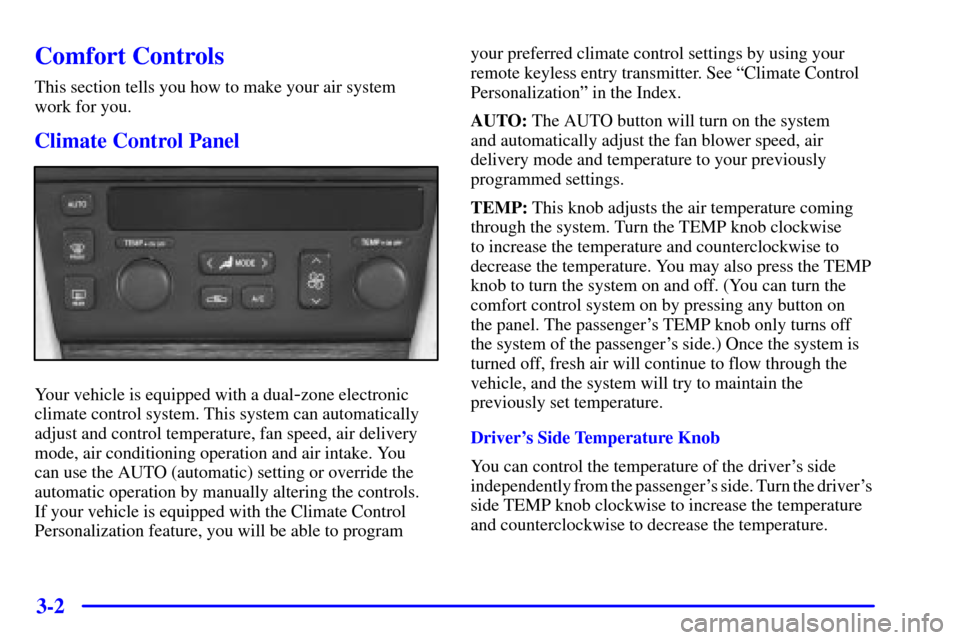
Your vehicle is equipped with a dual-zone electronic
climate control system. This system can automatically
adjust and control temperature, fan speed, air delivery
mode, air conditioning operation and air intake. You
can use the AUTO (automatic) setting or override the
automatic operation by manually altering the controls.
If your vehicle is equipped with the Climate Control
Personalization feature, you will be able to program
your preferred climate control settings by using your
remote keyless entry transmitter. See ªClimate Control
Personalizationº in the Index.
AUTO: The AUTO button will turn on the system
and automatically adjust the fan blower speed, air
delivery mode and temperature to your previously
programmed settings.
TEMP: This knob adjusts the air temperature coming
through the system. Turn the TEMP knob clockwise
to increase the temperature and counterclockwise to
decrease the temperature. You may also press the TEMP
knob to turn the system on and off. (You can turn the
comfort control system on by pressing any button on
the panel. The passenger's TEMP knob only turns off
the system of the passenger's side.) Once the system is
turned off, fresh air will continue to flow through the
vehicle, and the system will try to maintain the
previously set temperature.
Driver's Side Temperature Knob
You can control the temperature of the driver's side
independently from the passenger's side. Turn the driver's
side TEMP knob clockwise to increase the temperature
and counterclockwise to decrease the temperature.
Page 164 of 359
3-10 HVAC Steering Wheel Controls
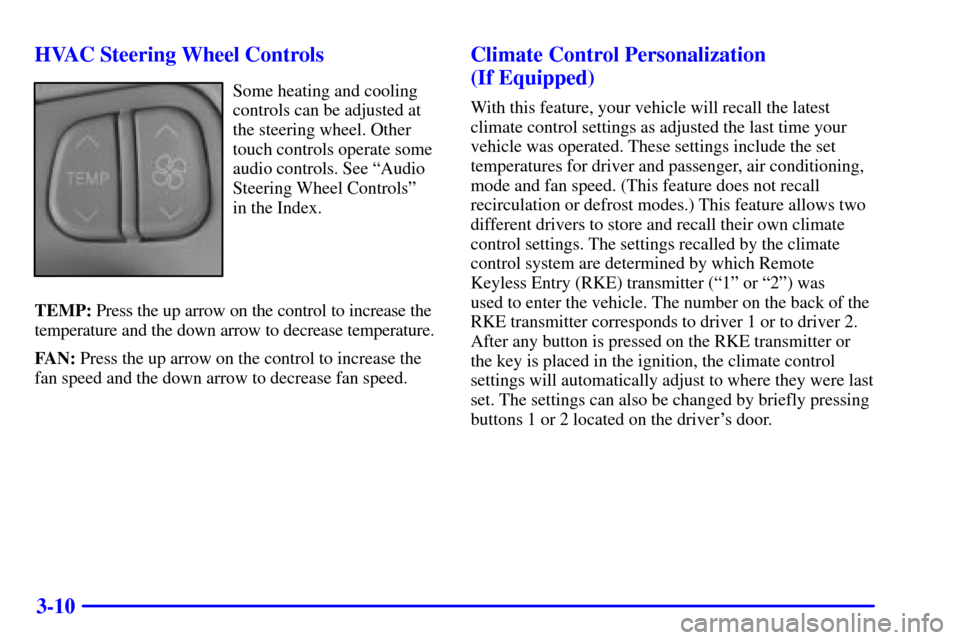
Some heating and cooling
controls can be adjusted at
the steering wheel. Other
touch controls operate some
audio controls. See ªAudio
Steering Wheel Controlsº
in the Index.
TEMP: Press the up arrow on the control to increase the
temperature and the down arrow to decrease temperature.
FAN: Press the up arrow on the control to increase the
fan speed and the down arrow to decrease fan speed.
Climate Control Personalization
(If Equipped)
With this feature, your vehicle will recall the latest
climate control settings as adjusted the last time your
vehicle was operated. These settings include the set
temperatures for driver and passenger, air conditioning,
mode and fan speed. (This feature does not recall
recirculation or defrost modes.) This feature allows two
different drivers to store and recall their own climate
control settings. The settings recalled by the climate
control system are determined by which Remote
Keyless Entry (RKE) transmitter (ª1º or ª2º) was
used to enter the vehicle. The number on the back of the
RKE transmitter corresponds to driver 1 or to driver 2.
After any button is pressed on the RKE transmitter or
the key is placed in the ignition, the climate control
settings will automatically adjust to where they were last
set. The settings can also be changed by briefly pressing
buttons 1 or 2 located on the driver's door.
Page 213 of 359

4-3
Drunken Driving
Death and injury associated with drinking and driving
is a national tragedy. It's the number one contributor to
the highway death toll, claiming thousands of victims
every year.
Alcohol affects four things that anyone needs to
drive a vehicle:
�Judgment
�Muscular Coordination
�Vision
�Attentiveness.
Police records show that almost half of all motor
vehicle
-related deaths involve alcohol. In most cases,
these deaths are the result of someone who was drinking
and driving. In recent years, over 17,000 annual motor
vehicle
-related deaths have been associated with the use
of alcohol, with more than 300,000 people injured.
Many adults
-- by some estimates, nearly half the
adult population
-- choose never to drink alcohol, so
they never drive after drinking. For persons under 21,
it's against the law in every U.S. state to drink alcohol.
There are good medical, psychological and
developmental reasons for these laws.The obvious way to solve the leading highway safety
problem is for people never to drink alcohol and then
drive. But what if people do? How much is ªtoo muchº
if the driver plans to drive? It's a lot less than many
might think. Although it depends on each person
and situation, here is some general information on
the problem.
The Blood Alcohol Concentration (BAC) of someone
who is drinking depends upon four things:
�The amount of alcohol consumed
�The drinker's body weight
�The amount of food that is consumed before and
during drinking
�The length of time it has taken the drinker to
consume the alcohol.
According to the American Medical Association, a
180
-lb. (82 kg) person who drinks three 12-ounce
(355 ml) bottles of beer in an hour will end up with a
BAC of about 0.06 percent. The person would reach the
same BAC by drinking three 4
-ounce (120 ml) glasses
of wine or three mixed drinks if each had 1
-1/2 ounces
(45 ml) of a liquor like whiskey, gin or vodka.
Page 250 of 359
5-2
Hazard Warning Flashers
Your hazard warning flashers let you warn others. They
also let police know you have a problem. Your front and
rear turn signal lamps will flash on and off.
The hazard warning button
is located in the center of
the instrument panel,
between the two air vents.
Press the button in to make
the front and rear turn signal
lamps flash on and off.
This light located on the
instrument panel cluster
will flash, indicating that
the hazard warning
flashers are on.
Your hazard warning flashers work no matter what
position the key is in, and even if the key isn't in.
Press the button again to turn your hazard warning
flashers off. When the hazard warning flashers are on,
the turn signals won't work.
Page 302 of 359

6-26
Power Steering Fluid
The power steering fluid
reservoir is located next
to the fuse relay center
on the passenger's side
of the engine.
When to Check Power Steering Fluid
It is not necessary to regularly check power steering
fluid unless you suspect there is a leak in the system or
you hear an unusual noise. A fluid loss in this system
could indicate a problem. Have the system inspected
and repaired.
How to Check Power Steering Fluid
Turn the key off, let the engine compartment cool down,
wipe the cap and the top of the reservoir clean, then
unscrew the cap and wipe the dipstick with a clean rag.
Replace the cap and completely tighten it. Then remove
the cap again and look at the fluid level on the dipstick.
The level should be at the FULL COLD mark. If necessary,
add only enough fluid to bring the level up to the mark.
What to Use
To determine what kind of fluid to use, see
ªRecommended Fluids and Lubricantsº in the
Maintenance Schedule booklet. Always use the proper
fluid. Failure to use the proper fluid can cause leaks
and damage hoses and seals.
