Page 301 of 339

6-39 Inflation -- Tire Pressure
The Certification/Tire label, which is on the rear edge of
the driver's door, shows the correct inflation pressures
for your tires when they're cold. ªColdº means your
vehicle has been sitting for at least three hours or driven
no more than 1 mile (1.6 km).
You can operate some vehicles at reduced inflation
pressures only when you'll be carrying reduced loads.
On those vehicles, the minimum cold inflation pressures
for a typical reduced load are printed on the Improved
Ride Tire Pressure label located on the driver's door.
Weigh the vehicle to find the load on each tire and see
the label for the minimum cold inflation pressures for
that load.NOTICE:
Don't let anyone tell you that underinflation or
overinflation is all right. It's not. If your tires
don't have enough air (underinflation), you can
get the following:
�Too much flexing
�Too much heat
�Tire overloading
�Bad wear
�Bad handling
�Bad fuel economy.
If your tires have too much air (overinflation),
you can get the following:
�Unusual wear
�Bad handling
�Rough ride
�Needless damage from road hazards.
Page 302 of 339

6-40
When to Check
Check your tires once a month or more. Also, check the
tire pressure of the spare tire.
How to Check
Use a good quality pocket
-type gage to check tire
pressure. You can't tell if your tires are properly inflated
simply by looking at them. Radial tires may look
properly inflated even when they're underinflated.
Be sure to put the valve caps back on the valve
stems. They help prevent leaks by keeping out
dirt and moisture.
Tire Inspection and Rotation
Tires should be rotated every 6,000 to 8,000 miles
(10 000 to 13 000 km). Any time you notice unusual
wear, rotate your tires as soon as possible and check
wheel alignment. Also check for damaged tires or
wheels. See ªWhen It's Time for New Tiresº and
ªWheel Replacementº later in this section for
more information.
Make sure the spare tire is secured properly. Push, pull
and then try to rotate or turn the tire. If it moves, use the
ratchet to tighten the cable. See ªStoring a Flat or Spare
Tire and Toolsº in the Index.The purpose of regular rotation is to achieve more
uniform wear for all tires on the vehicle. The first
rotation is the most important. See ªScheduled
Maintenance Servicesº in the Maintenance Schedule
booklet for scheduled rotation intervals.
When rotating your tires, always use one of the correct
rotation patterns shown here.
After the tires have been rotated, adjust the front and
rear inflation pressures as shown on the
Certification/Tire label. Make certain that all wheel nuts
are properly tightened. See ªWheel Nut Torqueº in
the Index.
Page 325 of 339
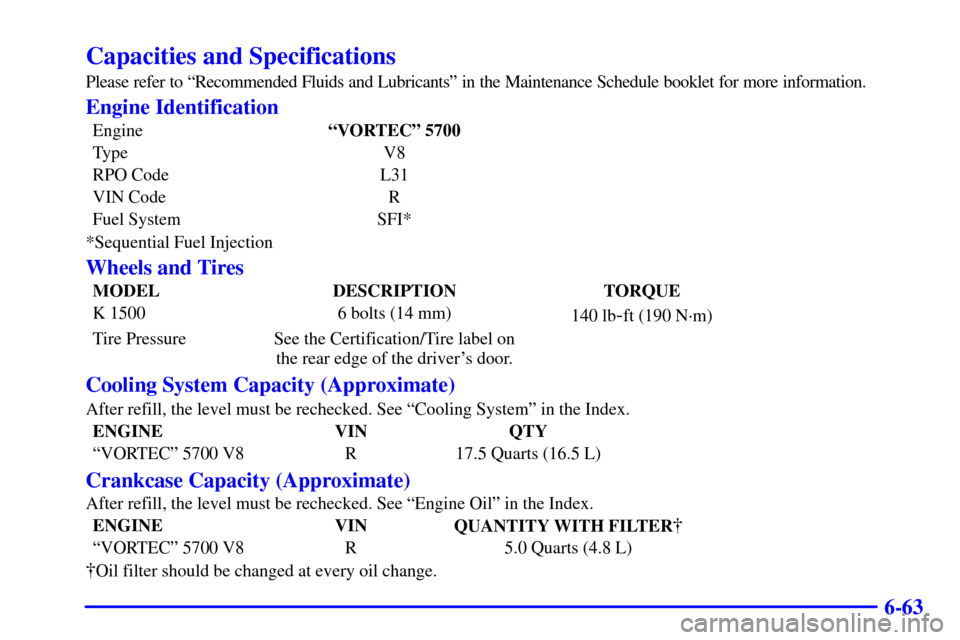
6-63
Capacities and Specifications
Please refer to ªRecommended Fluids and Lubricantsº in the Maintenance Schedule booklet for more information.
Engine Identification
EngineªVORTECº 5700
Type V8
RPO Code L31
VIN Code R
Fuel System SFI*
*Sequential Fuel Injection
Wheels and Tires
MODEL DESCRIPTION TORQUE
K 1500 6 bolts (14 mm)
140 lb
-ft (190 N´m)
Tire Pressure See the Certification/Tire label on
the rear edge of the driver's door.
Cooling System Capacity (Approximate)
After refill, the level must be rechecked. See ªCooling Systemº in the Index.
ENGINE VIN QTY
ªVORTECº 5700 V8 R 17.5 Quarts (16.5 L)
Crankcase Capacity (Approximate)
After refill, the level must be rechecked. See ªEngine Oilº in the Index.
ENGINE VIN
QUANTITY WITH FILTER�
ªVORTECº 5700 V8 R 5.0 Quarts (4.8 L)
�Oil filter should be changed at every oil change.