Page 239 of 339
5-11
Cooling System
When you decide it's safe to lift the hood, here's what
you'll see:
A. Coolant Recovery Tank
B. Radiator Pressure Cap
C. Engine FanIf the coolant inside the coolant recovery tank is boiling,
don't do anything else until it cools down.
When the engine is cold, the coolant level should be at
or above the COLD mark. If it isn't, you may have a
leak in the radiator hoses, heater hoses, radiator, water
pump or somewhere else in the cooling system.
Page 241 of 339
5-13 How to Add Coolant to the Coolant
Recovery Tank
If you haven't found a problem yet, but the coolant level
isn't at or above the COLD mark, add a 50/50 mixture
of clean, drinkable water and DEX
-COOL� engine
coolant at the coolant recovery tank. (See ªEngine
Coolantº in the Index for more information.)
CAUTION:
Adding only plain water to your cooling system
can be dangerous. Plain water, or some other
liquid like alcohol, can boil before the proper
coolant mixture will. Your vehicle's coolant
warning system is set for the proper coolant
mixture. With plain water or the wrong mixture,
your engine could get too hot but you wouldn't
get the overheat warning. Your engine could
catch fire and you or others could be burned.
Use a 50/50 mixture of clean, drinkable water
and DEX
-COOL� coolant.
NOTICE:
In cold weather, water can freeze and crack the
engine, radiator, heater core and other parts.
Use the recommended coolant and the proper
coolant mixture.
Page 263 of 339

6-
6-1
Section 6 Service and Appearance Care
Here you will find information about the care of your vehicle. This section begins with service and fuel information,
and then it shows how to check important fluid and lubricant levels. There is also technical information about your
vehicle, and a part devoted to its appearance care.
6
-2 Service
6
-3 Fuel
6
-5 Fuels in Foreign Countries
6
-6 Filling Your Tank
6
-8 Filling a Portable Fuel Container
6
-8 Checking Things Under the Hood
6
-11 Engine Oil
6
-15 Engine Air Cleaner/Filter
6
-17 Automatic Transmission Fluid
6
-21 Rear Axle
6
-21 Four-Wheel Drive
6
-23 Engine Coolant
6
-26 Radiator Pressure Cap
6
-26 Power Steering Fluid
6
-27 Windshield Washer Fluid
6
-28 Brakes6
-32 Battery
6
-33 Bulb Replacement
6
-37 Windshield Wiper Blade Replacement
6
-38 Tires
6
-46 Appearance Care
6
-47 Cleaning the Inside of Your Vehicle
6
-49 Care of Safety Belts
6
-50 Cleaning the Outside of Your Vehicle
6
-54 GM Vehicle Care/Appearance Materials
6
-55 Vehicle Identification Number (VIN)
6
-55 Service Parts Identification Number Label
6
-56 Electrical System
6
-62 Replacement Bulbs
6
-63 Capacities and Specifications
6
-64 Normal Maintenance Replacement Parts
Page 267 of 339

6-5
To provide cleaner air, all gasolines in the United States
are now required to contain additives that will help
prevent deposits from forming in your engine and fuel
system, allowing your emission control system to
function properly. Therefore, you should not have to add
anything to the fuel. In addition, gasolines containing
oxygenates, such as ethers and ethanol, and
reformulated gasolines may be available in your area to
contribute to clean air. General Motors recommends that
you use these gasolines, particularly if they comply with
the specifications described earlier.
NOTICE:
Your vehicle was not designed for fuel that
contains methanol. Don't use it. It can corrode
metal parts in your fuel system and also damage
plastic and rubber parts. That damage wouldn't
be covered under your warranty.
Fuels in Foreign Countries
If you plan on driving in another country outside the
United States or Canada, the proper fuel may be hard to
find. Never use leaded gasoline or any other fuel not
recommended in the previous text on fuel. Costly repairs
caused by use of improper fuel wouldn't be covered by
your warranty.
To check on fuel availability, ask an auto club, or
contact a major oil company that does business in the
country where you'll be driving.
You can also write us at the following address for
advice. Just tell us where you're going and give your
Vehicle Identification Number (VIN).
General Motors Overseas Distribution Corporation
1908 Colonel Sam Drive
Oshawa, Ontario L1H 8P7
Page 270 of 339

6-8
Filling a Portable Fuel Container
CAUTION:
Never fill a portable fuel container while it is in
your vehicle. Static electricity discharge from the
container can ignite the gasoline vapor. You can
be badly burned and your vehicle damaged if this
occurs. To help avoid injury to you and others:
�Dispense gasoline only into
approved containers.
�Do not fill a container while it is inside a
vehicle, in a vehicle's trunk, pickup bed or
on any surface other than the ground.
�Bring the fill nozzle in contact with the
inside of the fill opening before operating
the nozzle. Contact should be maintained
until the filling is complete.
�Don't smoke while pumping gasoline.
Checking Things Under the Hood
CAUTION:
Things that burn can get on hot engine parts and
start a fire. These include liquids like gasoline,
oil, coolant, brake fluid, windshield washer and
other fluids, and plastic or rubber. You or others
could be burned. Be careful not to drop or spill
things that will burn onto a hot engine.
Page 272 of 339
6-10
ªVORTECº 5700 V8 Engine
When you lift up the hood you'll see:
A. Battery
B. Coolant Recovery Tank
C. Radiator Pressure Cap
D. Engine Air Cleaner/Filter
E. Air Filter Restriction IndicatorF. Engine Oil Dipstick
G. Automatic Transmission
Dipstick
H. Engine Cooling Fan
I. Engine Oil FillJ. Power Steering Fluid Reservoir
K. Brake Fluid Reservoir
L. Windshield Washer
Fluid Reservoir
M. Underhood Fuse/Relay Center
Page 273 of 339
6-11
Engine Oil
Checking Engine Oil
It's a good idea to check your engine oil every time you
get fuel. In order to get an accurate reading, the oil must
be warm and the vehicle must be on level ground.
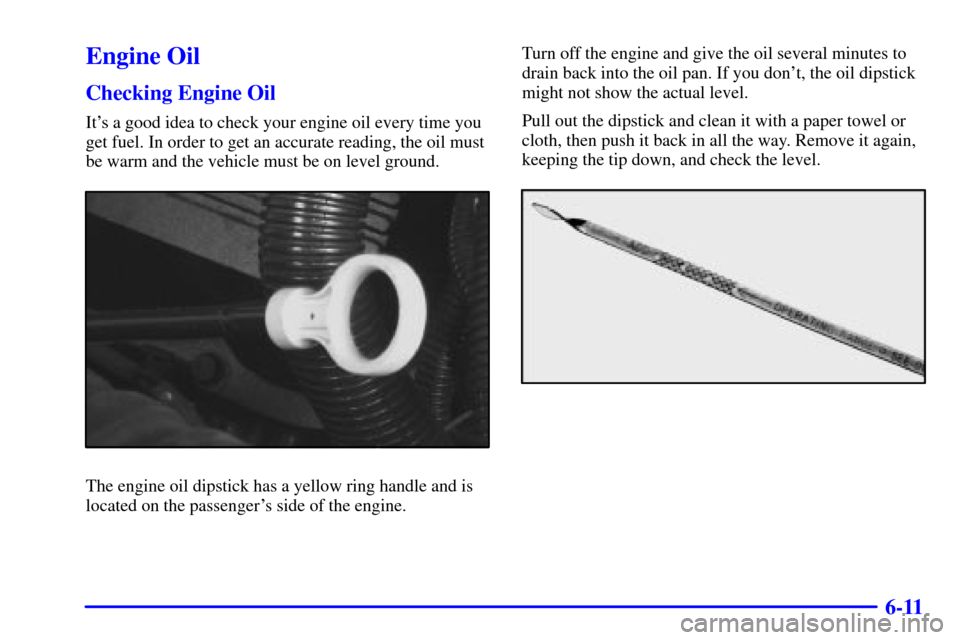
The engine oil dipstick has a yellow ring handle and is
located on the passenger's side of the engine.Turn off the engine and give the oil several minutes to
drain back into the oil pan. If you don't, the oil dipstick
might not show the actual level.
Pull out the dipstick and clean it with a paper towel or
cloth, then push it back in all the way. Remove it again,
keeping the tip down, and check the level.
Page 274 of 339

6-12 When to Add Engine Oil
If the oil is at or below the ADD mark, then you'll need
to add at least one quart of oil. But you must use the
right kind. This part explains what kind of oil to use. For
crankcase capacity, see ªCapacities and Specificationsº
in the Index.
NOTICE:
Don't add too much oil. If your engine has so
much oil that the oil level gets above the
cross
-hatched area that shows the proper
operating range, your engine could be damaged.
The engine oil fill cap is located on the driver's side
engine valve cover.
Be sure to fill it enough to put the level somewhere in
the proper operating range. Push the dipstick all the way
back in when you're through.
What Kind of Engine Oil to Use
Oils recommended for your vehicle can be identified by
looking for the starburst symbol.
This symbol indicates that the oil has been certified by
the American Petroleum Institute (API). Do not use any
oil which does not carry this starburst symbol.
If you change your own oil,
be sure you use oil that has
the starburst symbol on the
front of the oil container.
If you have your oil changed for you, be sure the oil put
into your engine is American Petroleum Institute
certified for gasoline engines.
You should also use the proper viscosity oil for your
vehicle, as shown in the following chart: