Page 193 of 323
4-20
City DrivingOne of the biggest problems with city streets is the
amount of traffic on them. You'll want to watch out for
what the other drivers are doing and pay attention to
traffic signals.
Here are ways to increase your safety in city driving:
�Know the best way to get to where you are going.
Get a city map and plan your trip into an unknown
part of the city just as you would for a
cross
-country trip.
�Try to use the freeways that rim and crisscross most
large cities. You'll save time and energy. (See the
next part, ªFreeway Driving.º)
�Treat a green light as a warning signal. A traffic light
is there because the corner is busy enough to need it.
When a light turns green, and just before you start
to move, check both ways for vehicles that have
not cleared the intersection or may be running the
red light.
Page 204 of 323

4-31
CAUTION:
Things you put inside your vehicle can strike and
injure people in a sudden stop or turn, or in
a crash.
�Put things in the trunk of your vehicle. In a
trunk, put them as far forward as you can.
Try to spread the weight evenly.
�Never stack heavier things, like suitcases,
inside the vehicle so that some of them are
above the tops of the seats.
�Don't leave an unsecured child restraint in
your vehicle.
�When you carry something inside the
vehicle, secure it whenever you can.
Electronic Level Control
This feature keeps the rear of your vehicle level as the
load changes. It's automatic
-- you don't need to
adjust anything.
Towing a Trailer
CAUTION:
If you don't use the correct equipment and drive
properly, you can lose control when you pull a
trailer. For example, if the trailer is too heavy,
the brakes may not work well
-- or even at all.
You and your passengers could be seriously
injured. You may also damage your vehicle; the
resulting repairs would not be covered by your
warranty. Pull a trailer only if you have followed
all the steps in this section. Ask your dealer for
advice and information about towing a trailer
with your vehicle.
Page 205 of 323

4-32
Your vehicle can tow a trailer if it is equipped with the
proper trailer towing equipment. To identify what the
vehicle trailering capacity is for your vehicle, you
should read the information in ªWeight of the Trailerº
that appears later in this section. But trailering is
different than just driving your vehicle by itself.
Trailering means changes in handling, durability and
fuel economy. Successful, safe trailering takes correct
equipment, and it has to be used properly.
That's the reason for this part. In it are many
time
-tested, important trailering tips and safety rules.
Many of these are important for your safety and that of
your passengers. So please read this section carefully
before you pull a trailer.
Load
-pulling components such as the engine, transaxle,
wheel assemblies and tires are forced to work harder
against the drag of the added weight. The engine is
required to operate at relatively higher speeds and under
greater loads, generating extra heat. What's more, the
trailer adds considerably to wind resistance, increasing
the pulling requirements.
If You Do Decide To Pull A Trailer
If you do, here are some important points:
�There are many different laws, including speed limit
restrictions, having to do with trailering. Make sure
your rig will be legal, not only where you live but
also where you'll be driving. A good source for this
information can be state or provincial police.
�Consider using a sway control. You can ask a hitch
dealer about sway controls.
�Don't tow a trailer at all during the first 1,000 miles
(1 600 km) your new vehicle is driven. Your engine,
axle or other parts could be damaged.
�Then, during the first 500 miles (800 km) that you
tow a trailer, don't drive over 50 mph (80 km/h) and
don't make starts at full throttle. This helps your
engine and other parts of your vehicle wear in at the
heavier loads.
�Obey speed limit restrictions when towing a trailer.
Don't drive faster than the maximum posted speed
for trailers (or no more than 55 mph (90 km/h)) to
save wear on your vehicle's parts.
Three important considerations have to do with weight:
�the weight of the trailer,
�the weight of the trailer tongue
�and the total weight on your vehicle's tires.
Page 212 of 323
5-
5-1
Section 5 Problems on the Road
Here you'll find what to do about some problems that can occur on the road.
5
-2 Hazard Warning Flashers
5
-3 Other Warning Devices
5
-3 Jump Starting
5
-9 Towing Your Vehicle
5
-9 Engine Overheating5
-12 Cooling System
5
-18 If a Tire Goes Flat
5
-19 Changing a Flat Tire
5
-29 Compact Spare Tire
5
-31 If You're Stuck: In Sand, Mud, Ice or Snow
Page 223 of 323
5-12
If you no longer have the overheat warning, you can
drive. Just to be safe, drive slower for about 10 minutes.
If the warning doesn't come back on, you can
drive normally.
If the warning continues, pull over, stop, and park your
vehicle right away.
If there's still no sign of steam, idle the engine for
three minutes while you're parked. If you still have the
warning, turn off the engine and get everyone out of
the vehicle until it cools down. Also, see ªOverheated
Engine Protection Operating Modeº listed previously in
this section.
You may decide not to lift the hood but to get service
help right away.Cooling System
When you decide it's safe to lift the hood, here's what
you'll see:
A. Coolant Surge Tank with Pressure Cap
B. Electric Engine Fans
Page 243 of 323

6-
6-1
Section 6 Service and Appearance Care
Here you will find information about the care of your vehicle. This section begins with service and fuel information,
and then it shows how to check important fluid and lubricant levels. There is also technical information about your
vehicle, and a part devoted to its appearance care.
6
-2 Service
6
-3 Fuel
6
-5 Fuels in Foreign Countries
6
-5 Filling Your Tank
6
-8 Filling a Portable Fuel Container
6
-8 Checking Things Under the Hood
6
-11 Engine Oil
6
-16 Engine Air Cleaner/Filter
6
-19 Automatic Transaxle Fluid
6
-22 Engine Coolant
6
-27 Windshield Washer Fluid
6
-29 Brakes
6
-33 Battery
6
-33 Bulb Replacement
6
-39 Windshield Wiper Blade Replacement
6
-40 Tires
6
-49 Appearance Care
6
-49 Cleaning the Inside of Your Vehicle6
-51 Care of Safety Belts
6
-51 Cleaning Glass Surfaces
6
-52 Cleaning the Outside of the Windshield
and Wiper Blades
6
-52 Weatherstrips
6
-52 Cleaning the Outside of Your Vehicle
6
-54 Cleaning Aluminum or Chrome-Plated
Wheels (If Equipped)
6
-54 Cleaning Tires
6
-54 Sheet Metal Damage
6
-55 Underbody Maintenance
6
-55 Chemical Paint Spotting
6
-56 GM Vehicle Care/Appearance Materials
6
-57 Vehicle Identification Number (VIN)
6
-58 Electrical System
6
-67 Replacement Bulbs
6
-67 Capacities and Specifications
6
-68 Normal Maintenance Replacement Parts
Page 275 of 323

6-33
Battery
Your new vehicle comes with a maintenance free
ACDelco� battery. When it's time for a new battery, get
one that has the replacement number shown on the original
battery's label. We recommend an ACDelco battery.
Vehicle Storage
If you're not going to drive your vehicle for 25 days or
more, remove the black, negative (
-) cable from the
battery. This will help keep your battery from
running down.
CAUTION:
Batteries have acid that can burn you and gas
that can explode. You can be badly hurt if you
aren't careful. See ªJump Startingº in the Index
for tips on working around a battery without
getting hurt.
Contact your dealer to learn how to prepare your vehicle
for longer storage periods.
Also, for your audio system, see ªTheft
-Deterrent
Featureº in the Index.
Bulb Replacement
For the proper type of replacement bulb, see
ªReplacement Bulbsº in the Index.
For any bulb changing procedure not listed in this
section, contact your dealer's service department.
Halogen Bulbs
CAUTION:
Halogen bulbs have pressurized gas inside and
can burst if you drop or scratch the bulb. You or
others could be injured. Be sure to read and
follow the instructions on the bulb package.
Page 282 of 323
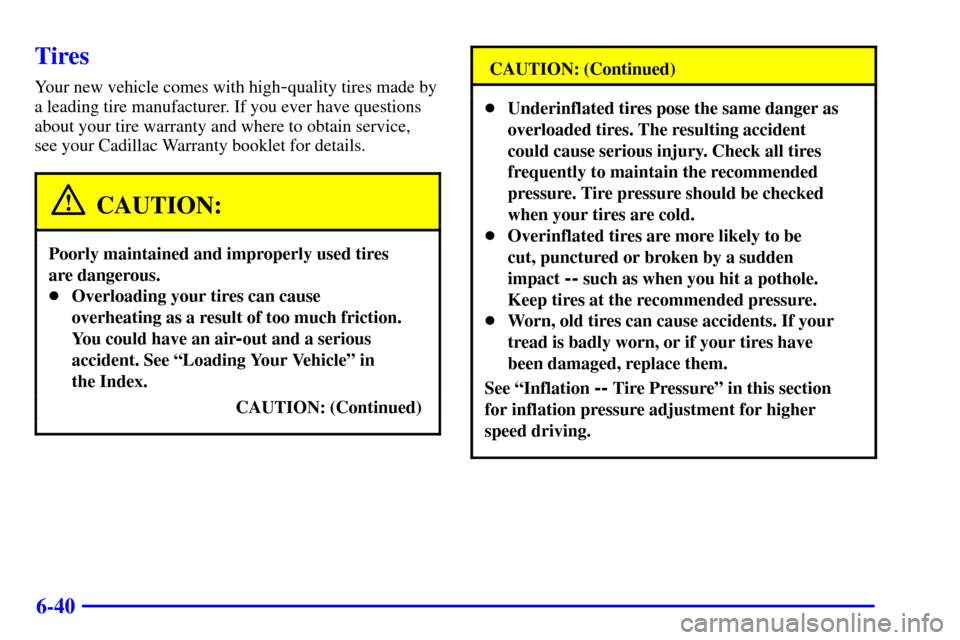
6-40
Tires
Your new vehicle comes with high-quality tires made by
a leading tire manufacturer. If you ever have questions
about your tire warranty and where to obtain service,
see your Cadillac Warranty booklet for details.
CAUTION:
Poorly maintained and improperly used tires
are dangerous.
�Overloading your tires can cause
overheating as a result of too much friction.
You could have an air
-out and a serious
accident. See ªLoading Your Vehicleº in
the Index.
CAUTION: (Continued)
CAUTION: (Continued)
�Underinflated tires pose the same danger as
overloaded tires. The resulting accident
could cause serious injury. Check all tires
frequently to maintain the recommended
pressure. Tire pressure should be checked
when your tires are cold.
�Overinflated tires are more likely to be
cut, punctured or broken by a sudden
impact
-- such as when you hit a pothole.
Keep tires at the recommended pressure.
�Worn, old tires can cause accidents. If your
tread is badly worn, or if your tires have
been damaged, replace them.
See ªInflation -- Tire Pressureº in this section
for inflation pressure adjustment for higher
speed driving.