Page 243 of 321
5-30
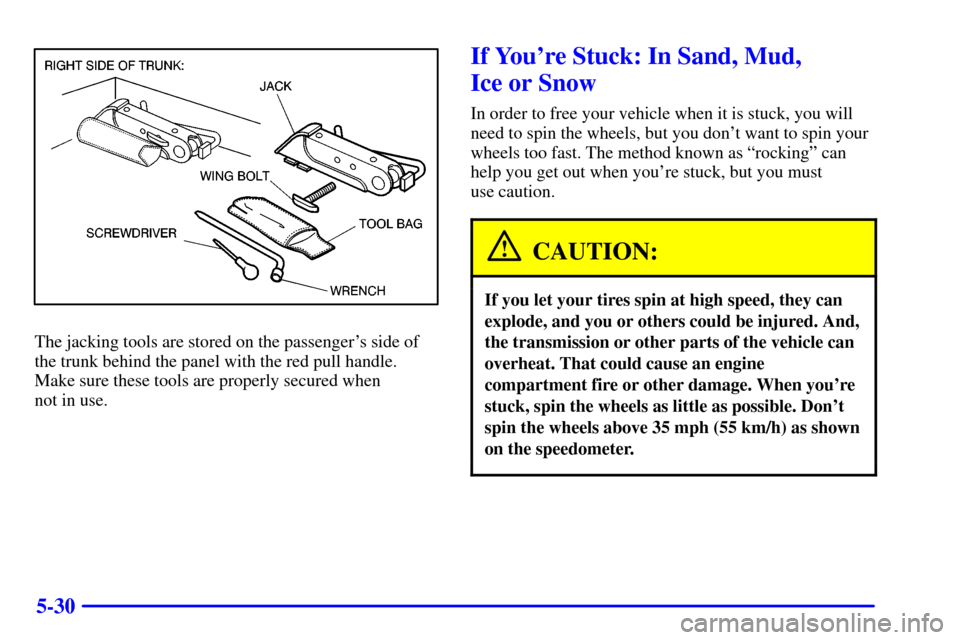
The jacking tools are stored on the passenger's side of
the trunk behind the panel with the red pull handle.
Make sure these tools are properly secured when
not in use.
If You're Stuck: In Sand, Mud,
Ice or Snow
In order to free your vehicle when it is stuck, you will
need to spin the wheels, but you don't want to spin your
wheels too fast. The method known as ªrockingº can
help you get out when you're stuck, but you must
use caution.
CAUTION:
If you let your tires spin at high speed, they can
explode, and you or others could be injured. And,
the transmission or other parts of the vehicle can
overheat. That could cause an engine
compartment fire or other damage. When you're
stuck, spin the wheels as little as possible. Don't
spin the wheels above 35 mph (55 km/h) as shown
on the speedometer.
Page 248 of 321
6-4
If your vehicle is certified to meet California Emission
Standards (indicated on the underhood emission
control label), it is designed to operate on fuels that meet
California specifications. If such fuels are not available
in states adopting California emissions standards,
your vehicle will operate satisfactorily on fuels meeting
federal specifications, but emission control system
performance may be affected. The malfunction indicator
lamp on your instrument panel may turn on and/or your
vehicle may fail a smog
-check test. (See ªMalfunction
Indicator Lampº in the Index.) If this occurs, return to
your authorized Catera dealer for diagnosis to determine
the cause of failure. In the event it is determined that the
cause of the condition is the type of fuels used, repairs
may not be covered by your warranty.
Some gasolines that are not reformulated for low
emissions may contain an octane
-enhancing additive
called methylcyclopentadienyl manganese tricarbonyl
(MMT); ask your service station operator whether or
not the fuel contains MMT. General Motors does not
recommend the use of such gasolines. If fuels containing
MMT are used, spark plug life may be reduced and your
emission control system performance may be affected.
The malfunction indicator lamp on your instrument
panel may turn on. If this occurs, return to your
authorized Catera dealer for service.To provide cleaner air, all gasolines in the United States
are now required to contain additives that will help
prevent deposits from forming in your engine and
fuel system, allowing your emission control system
to function properly. Therefore, you should not have
to add anything to the fuel. In addition, gasolines
containing oxygenates, such as ethers and ethanol, and
reformulated gasolines may be available in your area to
contribute to clean air. General Motors recommends that
you use these gasolines, particularly if they comply with
the specifications described earlier.
NOTICE:
Your vehicle was not designed for fuel that
contains methanol. Don't use it. It can corrode
metal parts in your fuel system and also damage
plastic and rubber parts. That damage wouldn't
be covered under your warranty.
Page 253 of 321
6-9
Checking Things Under the Hood
CAUTION:
An electric fan under the hood can start up and
injure you even when the engine is not running.
Keep hands, clothing and tools away from any
underhood electric fan.
CAUTION:
Things that burn can get on hot engine parts and
start a fire. These include liquids like gasoline,
oil, coolant, brake fluid, windshield washer and
other fluids, and plastic or rubber. You or others
could be burned. Be careful not to drop or spill
things that will burn onto a hot engine.
Hood Release
Pull the lever inside the
vehicle to open the hood.
It is located on the
lower left side of the
instrument panel.
Then go to the front of the vehicle and find the
secondary hood release which is located above the front
grille. Lift up on the release lever as you raise the hood.
Page 255 of 321
6-11
Engine Oil
If the low oil level appears
on the instrument panel,
it means you need to
check your engine oil
level right away. For more
information, see ªCHECK
OIL lightº in the Index.
You should check your engine oil level regularly; this is
an added reminder.
Checking Engine Oil
It's a good idea to check your engine oil every time you
get fuel. In order to get an accurate reading, the oil must
be warm and the vehicle must be on level ground.
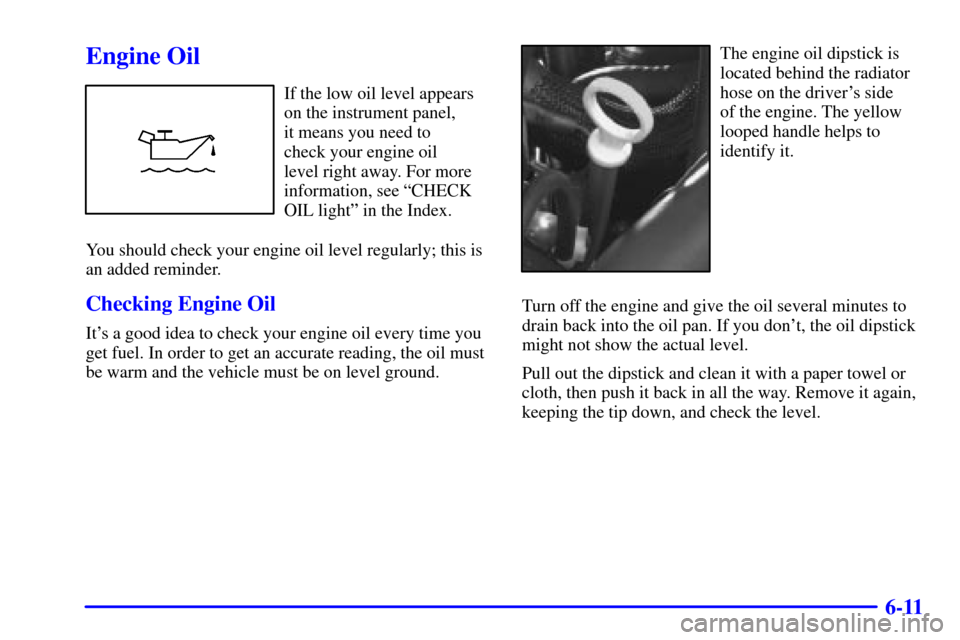
The engine oil dipstick is
located behind the radiator
hose on the driver's side
of the engine. The yellow
looped handle helps to
identify it.
Turn off the engine and give the oil several minutes to
drain back into the oil pan. If you don't, the oil dipstick
might not show the actual level.
Pull out the dipstick and clean it with a paper towel or
cloth, then push it back in all the way. Remove it again,
keeping the tip down, and check the level.
Page 262 of 321
6-18
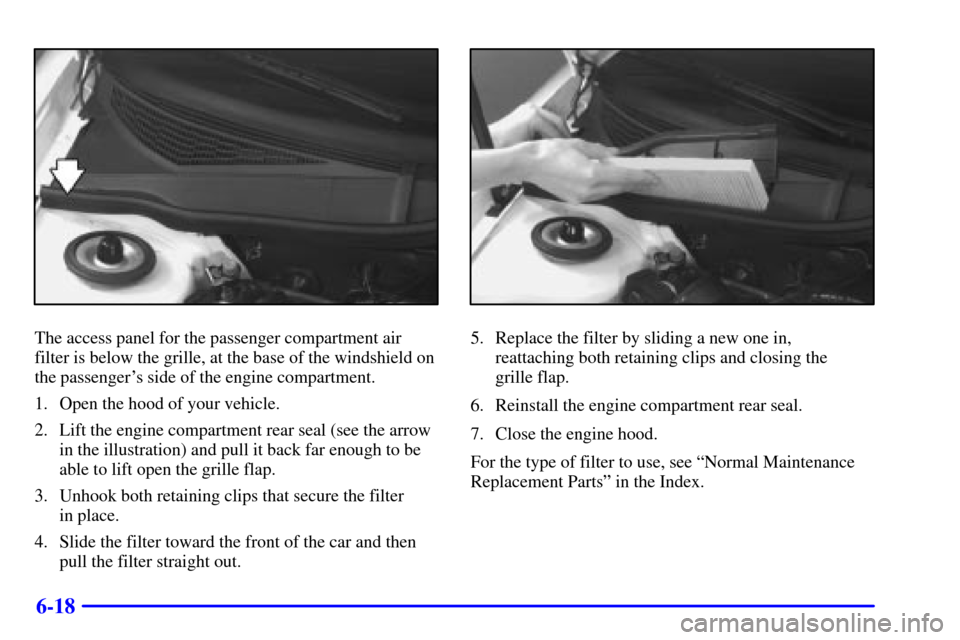
The access panel for the passenger compartment air
filter is below the grille, at the base of the windshield on
the passenger's side of the engine compartment.
1. Open the hood of your vehicle.
2. Lift the engine compartment rear seal (see the arrow
in the illustration) and pull it back far enough to be
able to lift open the grille flap.
3. Unhook both retaining clips that secure the filter
in place.
4. Slide the filter toward the front of the car and then
pull the filter straight out.5. Replace the filter by sliding a new one in,
reattaching both retaining clips and closing the
grille flap.
6. Reinstall the engine compartment rear seal.
7. Close the engine hood.
For the type of filter to use, see ªNormal Maintenance
Replacement Partsº in the Index.
Page 266 of 321
6-22
NOTICE:
If you use an improper coolant mixture, your
engine could overheat and be badly damaged.
The repair cost wouldn't be covered by your
warranty. Too much water in the mixture can
freeze and crack the engine, radiator, heater core
and other parts.
If you have to add coolant more than four times a year,
have your dealer check your cooling system.
NOTICE:
If you use the proper coolant, you don't have to
add extra inhibitors or additives which claim to
improve the system. These can be harmful.
Checking Coolant
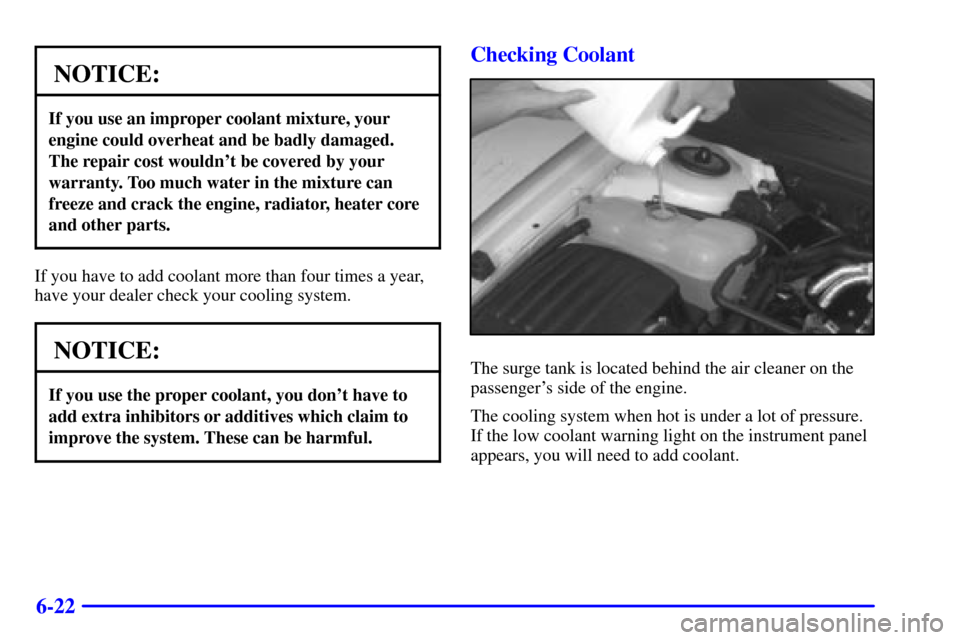
The surge tank is located behind the air cleaner on the
passenger's side of the engine.
The cooling system when hot is under a lot of pressure.
If the low coolant warning light on the instrument panel
appears, you will need to add coolant.
Page 299 of 321
6-55
Vehicle Identification Number (VIN)
This is the legal identifier for your vehicle. It appears
on a plate in the front corner of the instrument panel,
on the driver's side. You can see it if you look through
the windshield from outside your vehicle. The VIN also
appears on the Vehicle Certification and Service Parts
labels and the certificates of title and registration.
Engine Identification
The 8th character in your VIN is the engine code. This
code will help you identify your engine, specifications
and replacement parts.
Service Parts Identification Label
You'll find this label behind the passenger's side
access panel in the trunk (the panel that covers the
trunk
-mounted CD changer). It's very helpful if
you ever need to order parts. On this label is:
�your VIN,
�the model designation,
�paint information and
�a list of all production options and
special equipment.
Be sure that this label is not removed from the vehicle.
Page 301 of 321

6-57 Power Distribution Fuse Block
This fuse block is attached to the engine compartment
relay center located on top of the battery. Simply lift the
lid to open. If you have any questions about the power
distribution fuse block, consult your dealer.
Please note that if a power loss has occurred, such as
disconnecting the battery or removing the Maxi Fuses
in the power distribution fuse block, there are steps that
must be followed to calibrate the Electronic ThrottleControl (ETC). If these steps are not done, the engine
will not run properly. For information regarding these
steps, see ªBatteryº earlier in this section.
Fuses and Circuit Breakers
The wiring circuits in your vehicle are protected from
short circuits by a combination of fuses and circuit
breakers. This greatly reduces the chance of fires
caused by electrical problems.
Look at the silver
-colored band inside the fuse. If the
band is broken or melted, replace the fuse. Be sure you
replace a bad fuse with a new one of the identical size
and rating.
If you ever have a problem on the road and don't have
a spare fuse, you can borrow one that has the same
amperage. Pick some feature of your vehicle that you
can get along without
-- like the radio or cigarette
lighter
-- and use its fuse, if it is the correct amperage.
Replace it as soon as you can.
There are two fuse blocks in your vehicle: the
instrument panel fuse block and the engine
compartment relay center.