Page 232 of 349
5-22 Removing the Spare Tire and Tools
The equipment you'll need is in the trunk.
1. Turn the center nut on
the compact spare cover
counterclockwise to
remove it. Then lift and
remove the cover.
(See ªCompact Spare
Tireº in the Index for
more information about
the compact spare.)
2. Remove the spare tire.
Page 239 of 349
5-29
10. Tighten the wheel
nuts firmly in a
crisscross sequence
as shown.
CAUTION:
Incorrect wheel nuts or improperly tightened
wheel nuts can cause the wheel to become loose
and even come off. This could lead to an accident.
Be sure to use the correct wheel nuts. If you have
to replace them, be sure to get new GM original
equipment wheel nuts.
Stop somewhere as soon as you can and have
the nuts tightened with a torque wrench to
100 lb
-ft (140 N´m).
NOTICE:
Improperly tightened wheel nuts can lead to
brake pulsation and rotor damage. To avoid
expensive brake repairs, evenly tighten the wheel
nuts in the proper sequence and to the proper
torque specification.
Don't try to put the wheel cover on your compact
spare tire. It won't fit. Store the wheel cover in the
trunk until you have the flat tire repaired or replaced.
NOTICE:
Wheel covers won't fit on your compact spare.
If you try to put a wheel cover on your compact
spare, you could damage the cover or the spare.
Page 240 of 349
5-30 Storing the Flat Tire and Tools
CAUTION:
Storing a jack, a tire or other equipment in the
passenger compartment of the vehicle could
cause injury. In a sudden stop or collision, loose
equipment could strike someone. Store all these
in the proper place.
After you've put the compact tire on your vehicle, you'll
put the compact spare tire on your vehicle, you'll need
to store the flat tire in your trunk. Use the following
procedure to secure the flat tire in the trunk.
When storing a full
-size tire you must use the extension
with the protector/guide to help avoid wheel surface
damage. Use the extension and protector/guide located
in the foam holder. To store a full
-size tire, place the
tire valve stem facing down, and then remove the
protector/guide and attach the retainer securely.
Store the cover as far forward as possible.
When reinstalling a compact spare tire, put the
protector/guide back in the foam holder.
Page 241 of 349
5-31 Storing the Spare Tire and Tools
CAUTION:
Storing a jack, a tire or other equipment in the
passenger compartment of the vehicle could
cause injury. In a sudden stop or collision, loose
equipment could strike someone. Store all these
in the proper place.
The compact spare is for temporary use only. Replace
the compact spare tire with a full
-size tire as soon as you
can. See ªCompact Spare Tireº in the Index. See the
storage instructions label to replace your compact spare
into your trunk properly.
Be sure to calibrate your low tire pressure system after
you replace your compact spare tire with a full
-sized
one. See ªLow Tire Inflation Monitorº in the Index.
A. Retainer
B. Cover
C. Compact Spare Tire
D. Nut
E. Jack
F. Wrench
G. Lock Nut Tool
H. Foam Holder
I. Extension and
Protector/Guide
J. Bolt Screw
Page 251 of 349

6-8
Filling a Portable Fuel Container
CAUTION:
Never fill a portable fuel container while it is in
your vehicle. Static electricity discharge from the
container can ignite the gasoline vapor. You can
be badly burned and your vehicle damaged if this
occurs. To help avoid injury to you and others:
�Dispense gasoline only into
approved containers.
�Do not fill a container while it is inside a
vehicle, in a vehicle's trunk, pickup bed or
on any surface other than the ground.
�Bring the fill nozzle in contact with the
inside of the fill opening before operating
the nozzle. Contact should be maintained
until the filling is complete.
�Don't smoke while pumping gasoline.
Checking Things Under the Hood
CAUTION:
An electric fan under the hood can start up and
injure you even when the engine is not running.
Keep hands, clothing and tools away from any
underhood electric fan.
CAUTION:
Things that burn can get on hot engine parts and
start a fire. These include liquids like gasoline,
oil, coolant, brake fluid, windshield washer and
other fluids, and plastic or rubber. You or others
could be burned. Be careful not to drop or spill
things that will burn onto a hot engine.
Page 280 of 349
6-37
Once the horizontal aim is adjusted, then adjust the
vertical aim.
1. Turn the horizontal aiming screw until the indicator
is lined up with zero.
2. Turn the vertical aiming screw until the level bubble
is lined up with zero.
Front Parking and Turn Signal Lamp
1. Remove the headlamp assembly. Refer to the
removal procedure earlier in this section.
2. Remove the rubber bulb access cover.
3. Twist the sidemarker lamp socket counterclockwise
and pull from the headlamp assembly.
4. Holding the base of the bulb, pull the bulb from
the socket.
5. Push the new bulb into the socket.
6. Reverse these steps to reinstall the lamp assembly.
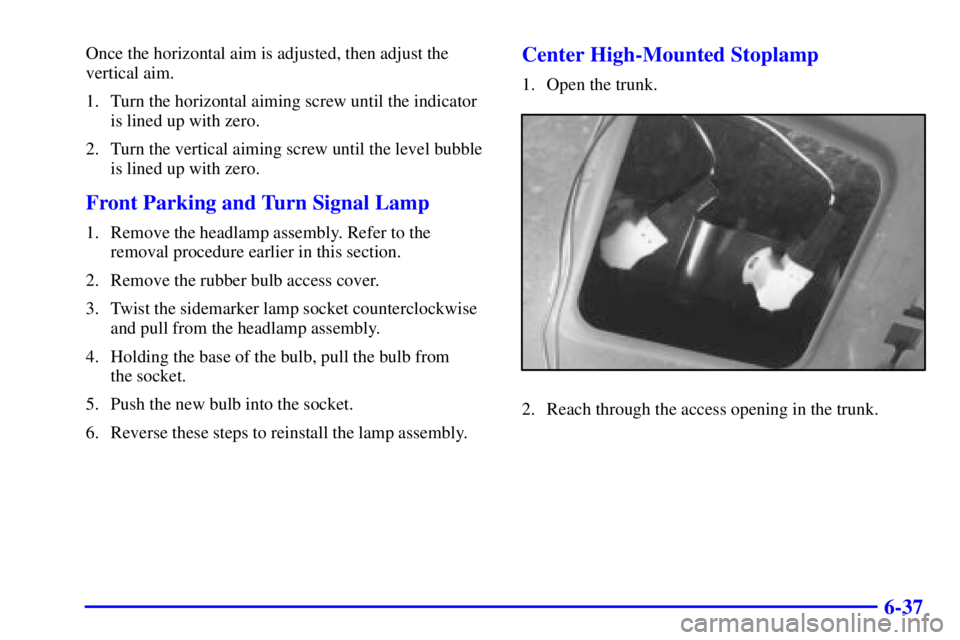
Center High-Mounted Stoplamp
1. Open the trunk.
2. Reach through the access opening in the trunk.
Page 281 of 349
6-38
3. Remove the bulb by turning it one-quarter
turn counterclockwise.
4. Place the new bulb into the bulb socket.
5. Turn the bulb one
-quarter turn clockwise to replace.
6. Close the trunk.
Tail/Stop/Turn Signal Lamp
1. Remove the three plastic wing nuts (A). (Pliers may
be required to remove the wing nuts.)
There is one wing nut located on the outside of the
carpet. The other two are located underneath
the carpet.
Page 282 of 349
6-39
2. Pull the taillamp housing (B) away from the body of
the vehicle.
3. Squeeze the tab on the socket and turn the
socket counterclockwise.
4. Pull out the socket.
5. Pull the bulb out of the socket. (There are two bulbs
on each taillamp.)
6. Push in a new bulb.
7. Reverse these steps to reinstall the lamp assembly.Trunk Lid Applique
1. Open the trunk lid halfway.
2. Remove the wing nuts (A) from the studs on the
applique. (There are eight wing nuts. Pliers may be
required to remove them.)
3. Remove the applique from the trunk lid.
4. Turn the sockets (B) counterclockwise.