Page 75 of 349

2-8
At times you may notice a decrease in range. This is
normal for any remote keyless entry system. If the
transmitter does not work or if you have to stand closer
to your vehicle for the transmitter to work, try this:
�Check the distance. You may be too far from your
vehicle. You may need to stand closer during rainy
or snowy weather.
�Check the location. Other vehicles or objects may be
blocking the signal. Take a few steps to the left or
right, hold the transmitter higher, and try again.
�Check to determine if battery replacement is
necessary. See the instructions that follow.
�If you're still having trouble, see your dealer or a
qualified technician for service.Operation
Press UNLOCK once to
unlock the driver's door and
to turn on the interior lamps
(see ªIllumination on
Remote Activationº in the
Index for more details).
The perimeter lighting feature will also be activated at
night, turning on your headlamps and back
-up lamps for
approximately 25 seconds when the UNLOCK button is
pressed. (This will light the area around the vehicle.)
See ªPerimeter Lightingº in the Index.
Press UNLOCK again within five seconds to unlock all
the doors. To lock all doors, press LOCK. To unlock the
trunk, press the button with the trunk symbol on the
remote keyless entry transmitter. The trunk will only
unlock if your transaxle is in PARK (P).
Page 80 of 349
2-13
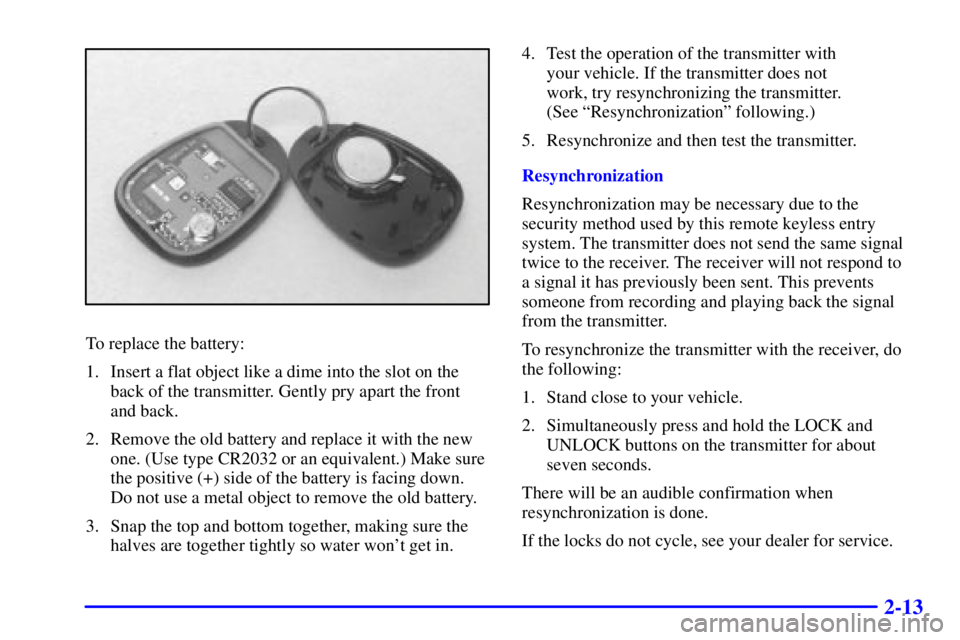
To replace the battery:
1. Insert a flat object like a dime into the slot on the
back of the transmitter. Gently pry apart the front
and back.
2. Remove the old battery and replace it with the new
one. (Use type CR2032 or an equivalent.) Make sure
the positive (+) side of the battery is facing down.
Do not use a metal object to remove the old battery.
3. Snap the top and bottom together, making sure the
halves are together tightly so water won't get in.4. Test the operation of the transmitter with
your vehicle. If the transmitter does not
work, try resynchronizing the transmitter.
(See ªResynchronizationº following.)
5. Resynchronize and then test the transmitter.
Resynchronization
Resynchronization may be necessary due to the
security method used by this remote keyless entry
system. The transmitter does not send the same signal
twice to the receiver. The receiver will not respond to
a signal it has previously been sent. This prevents
someone from recording and playing back the signal
from the transmitter.
To resynchronize the transmitter with the receiver, do
the following:
1. Stand close to your vehicle.
2. Simultaneously press and hold the LOCK and
UNLOCK buttons on the transmitter for about
seven seconds.
There will be an audible confirmation when
resynchronization is done.
If the locks do not cycle, see your dealer for service.
Page 83 of 349

2-16
PASS-Key� II
Your vehicle is equipped
with the PASS
-Key II
(Personalized Automotive
Security System)
theft
-deterrent system.
PASS
-Key II is a passive
theft
-deterrent system. It
works when you insert
or remove the key from
the ignition.
PASS
-Key II uses a resistor pellet in the ignition key
that matches a decoder in your vehicle.When the PASS
-Key II system senses that someone is
using the wrong key, it shuts down the vehicle's starter
and fuel systems. For about three minutes, the starter
won't work and fuel won't go to the engine. If someone
tries to start your vehicle again or uses another key
during this time, the vehicle will not start. This
discourages someone from randomly trying different
keys with different resistor pellets in an attempt to make
a match.
The ignition key must be clean and dry before it's inserted
in the ignition or the engine may not start. If the engine
does not start and the SECURITY light is flashing, the key
may be dirty or wet. Turn the ignition off.
Clean and dry the key. Wait about three minutes and try
again. If the starter still won't work, and the key appears
to be clean and dry, wait about three minutes and try
another ignition key. At this time, you may also want to
check the fuse (see ªFuses and Circuit Breakersº in the
Index). If the starter won't work with the other key, your
vehicle needs service. If your vehicle does start, the first
ignition key may be faulty. See your dealer or a
locksmith who can service the PASS
-Key II.
Page 84 of 349

2-17
If you accidentally use a key that has a damaged or
missing resistor pellet, the starter won't work. The
SECURITY light will then come on. But you don't have
to wait three minutes before trying another ignition key.
See your dealer or a locksmith who can service the
PASS
-Key II to have a new key made.
If you're ever driving and the SECURITY light comes
on, you will be able to restart your engine if you turn it
off. Your PASS
-Key II system, however, is not working
properly and must be serviced by your dealer. Your
vehicle is not protected by the PASS
-Key II system.
If you lose or damage a PASS
-Key II ignition key, see
your dealer or a locksmith who can service PASS
-Key II
to have a new key made. In an emergency, call the
Buick Premium Roadside Assistance Center at
1
-800-252-1112. In Canada, call 1-800-268-6800.
New Vehicle ªBreak-Inº
NOTICE:
Your vehicle doesn't need an elaborate
ªbreak
-in.º But it will perform better in the
long run if you follow these guidelines:
�Don't drive at any one speed -- fast or
slow
-- for the first 500 miles (805 km).
Don't make full
-throttle starts.
�Avoid making hard stops for the first
200 miles (322 km) or so. During this time
your new brake linings aren't yet broken
in. Hard stops with new linings can mean
premature wear and earlier replacement.
Follow this breaking
-in guideline every
time you get new brake linings.
�Don't tow a trailer during break
-in.
See ªTowing a Trailerº in the Index for
more information.
Page 86 of 349

2-19
START (E): This position starts your engine.
A warning chime will sound if you open the driver's
door when the ignition is in OFF, LOCK or
ACCESSORY and the key is in the ignition.
NOTICE:
If your key seems stuck in LOCK and you can't
turn it, be sure you are using the correct key;
if so, is it all the way in? If it is, then turn the
steering wheel left and right while you turn the
key hard. But turn the key only with your hand.
Using a tool to force it could break the key or the
ignition switch. If none of this works, then your
vehicle needs service.
Starting Your Engine
Move your shift lever to PARK (P) or NEUTRAL (N).
Your engine won't start in any other position
-- that's a
safety feature. To restart when you're already moving,
use NEUTRAL (N) only.
NOTICE:
Don't try to shift to PARK (P) if your vehicle
is moving. If you do, you could damage the
transaxle. Shift to PARK (P) only when your
vehicle is stopped.
NOTICE:
If you cannot remove your key from the ignition
and the gear shift is in PARK (P) (with the shift
knob button fully released), see ªShift Lock
Releaseº in the index.
Page 91 of 349

2-24
NEUTRAL (N): In this position, your engine
doesn't connect with the wheels. To restart when you're
already moving, use NEUTRAL (N) only. Also, use
NEUTRAL (N) when your vehicle is being towed.
CAUTION:
Shifting out of PARK (P) or NEUTRAL (N) while
your engine is ªracingº (running at high speed)
is dangerous. Unless your foot is firmly on the
brake pedal, your vehicle could move very
rapidly. You could lose control and hit people
or objects. Don't shift out of PARK (P) or
NEUTRAL (N) while your engine is racing.
NOTICE:
Damage to your transaxle caused by shifting out
of PARK (P) or NEUTRAL (N) with the engine
racing isn't covered by your warranty.
AUTOMATIC OVERDRIVE (�): This position is
for normal driving. If you need more power for passing,
and you're:
�Going less than 35 mph (55 km/h), push your
accelerator pedal about halfway down.
�Going about 35 mph (55 km/h) or more, push the
accelerator pedal all the way down.
You'll shift down to the next gear and have more power.
NOTICE:
If your vehicle seems to start up rather slowly,
or if it seems not to shift gears as you go faster,
something may be wrong with a transaxle system
sensor. If you drive very far that way, your
vehicle can be damaged. So, if this happens,
have your vehicle serviced right away. Until then,
you can use SECOND (2) when you are driving
less than 35 mph (55 km/h) and AUTOMATIC
OVERDRIVE (�) for higher speeds.
Page 120 of 349

2-53
It is located on the passenger's side of the vehicle,
under the glove box, and is labeled with a wire function
and fuse rating. This feature provides power, ground
and accessory wires which can be accessed to add
aftermarket electrical equipment to your vehicle. For
information on accessing the connection and electrical
hookup, please refer to your service manual. To order a
service manual, see ªService Publications, Orderingº in
the Index.
NOTICE:
Adding some electrical equipment to your vehicle
can damage it or keep other things from working
as they should. This wouldn't be covered by your
warranty. Check with your dealer before adding
electrical equipment, and never use anything that
exceeds the fuse rating.
OnStar� System (If Equipped)
OnStar is a vehicle communications service. The
following services are available through a subscription
with OnStar and are available 24 hours a day:
Emergency Services
�Automatic Notification of Air Bag Deployment
�Theft Notification and Stolen
-Vehicle Tracking
�Roadside Assistance with Location
�Remote Diagnostics
�OnStar MED
-NET
�Accident Assist
Convenience Services
�Remote Door Unlock
�Route Support
�Concierge Services
�Ride Assist
A complete user's guide is provided with the OnStar
System. For more information contact OnStar at
1
-888-ONSTAR7.
Page 127 of 349

2-60 Air Bag Readiness Light
There is an air bag readiness light on the instrument
panel, which shows the air bag symbol. The system
checks the air bag's electrical system for malfunctions.
The light tells you if there is an electrical problem. The
system check includes the air bag modules, the wiring
and the crash sensing and diagnostic module. For more
information on the air bag system, see ªAir Bagº in
the Index.
This light will come on
when you start your vehicle,
and it will flash for a few
seconds. Then the light
should go out. This means
the system is ready.
If the air bag readiness light stays on after you start the
vehicle or comes on when you are driving, your air bag
system may not work properly. Have your vehicle
serviced right away.
CAUTION:
If the air bag readiness light stays on after you
start your vehicle, it means the air bag system
may not be working properly. The air bags in
your vehicle may not inflate in a crash, or they
could even inflate without a crash. To help avoid
injury to yourself or others, have your vehicle
serviced right away if the air bag readiness light
stays on after you start your vehicle.
The air bag readiness light should flash for a few
seconds when you turn the ignition key to RUN. If the
light doesn't come on then, have it fixed so it will be
ready to warn you if there is a problem.