Page 249 of 349
6-6
Filling Your Tank
CAUTION:
Gasoline vapor is highly flammable. It burns
violently, and that can cause very bad injuries.
Don't smoke if you're near gasoline or refueling
your vehicle. Keep sparks, flames and smoking
materials away from gasoline.
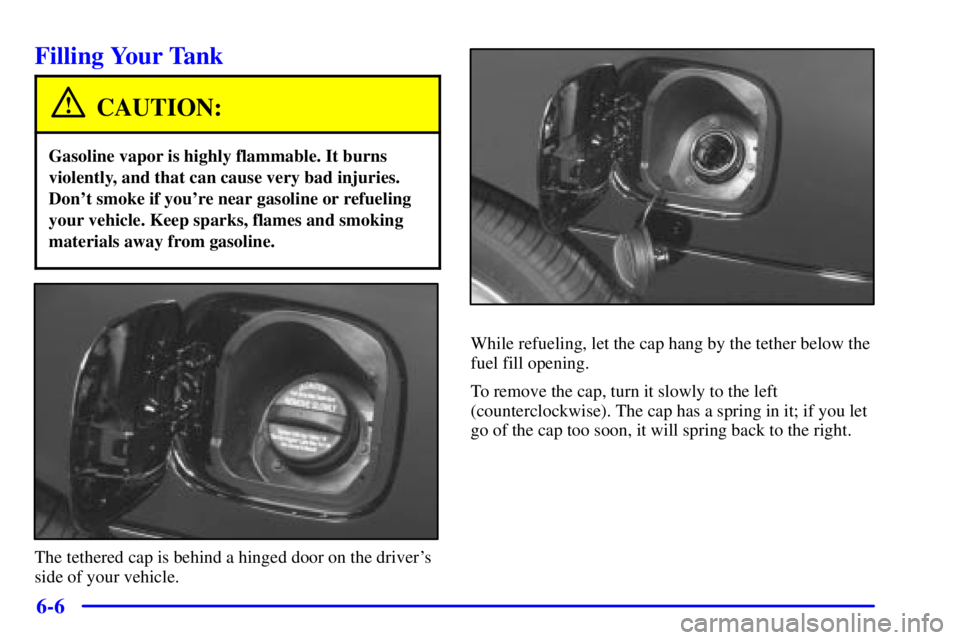
The tethered cap is behind a hinged door on the driver's
side of your vehicle.
While refueling, let the cap hang by the tether below the
fuel fill opening.
To remove the cap, turn it slowly to the left
(counterclockwise). The cap has a spring in it; if you let
go of the cap too soon, it will spring back to the right.
Page 250 of 349

6-7
CAUTION:
If you get gasoline on yourself and then
something ignites it, you could be badly burned.
Gasoline can spray out on you if you open the
fuel filler cap too quickly. This spray can happen
if your tank is nearly full, and is more likely in
hot weather. Open the fuel filler cap slowly and
wait for any ªhissº noise to stop. Then unscrew
the cap all the way.
Be careful not to spill gasoline. Clean gasoline from
painted surfaces as soon as possible. See ªCleaning the
Outside of Your Vehicleº in the Index.
When you put the cap back on, turn it to the right
(clockwise) until you hear a clicking sound. Make sure
you fully install the cap. The diagnostic system can
determine if the fuel cap has been left off or improperly
installed. This would allow fuel to evaporate into the
atmosphere. See ªMalfunction Indicator Lampº in
the Index.The SERVICE ENGINE SOON light will come on if the
fuel cap is not properly reinstalled.
NOTICE:
If you need a new cap, be sure to get the right
type. Your dealer can get one for you. If you get
the wrong type, it may not fit properly. This may
cause your malfunction indicator lamp to light
and your fuel tank and emissions system may be
damaged. See ªMalfunction Indicator Lampº in
the Index.
Page 255 of 349

6-12
Before closing the hood, be sure all the filler caps are
on properly. Then just pull the hood down and close
it firmly.
3800 Supercharged V6 Engine
(If Equipped)
Your vehicle may have a 3800 Supercharged V6 engine.
The supercharger is a device which is designed to pump
more air into the engine than it would normally use.
This air is mixed with fuel, which creates increased
engine power. Since the supercharger is a pump and is
driven from an engine accessory drive belt, increased
pressure is available at all driving conditions.
The Powertrain Control Module (PCM), works with a
vacuum control to regulate the increased pressure
required during specific driving conditions. When this
increased pressure or boost is not desired, such as during
idling and light throttle cruising, the excess air that the
supercharger is pumping is routed through a bypass.
All of these controls working together provide high
performance character and fuel efficiency in the
3800 Supercharged V6 engine.
Engine Oil
If the LOW OIL light
appears on the instrument
panel, it means you need to
check your engine oil level
right away. For more
information, see ªLow Oil
Level Lightº in the Index.
You should check your engine oil level regularly; this is
an added reminder.
Checking Engine Oil
It's a good idea to check your engine oil every time you
get fuel. In order to get an accurate reading, the oil must
be warm and the vehicle must be on level ground.
Page 286 of 349

6-43 Inflation -- Tire Pressure
The Tire-Loading Information label, which is on the
inside of the trunk lid, shows the correct inflation
pressures for your tires when they're cold. ªColdº
means your vehicle has been sitting for at least three
hours or driven no more than 1 mile (1.6 km).
NOTICE:
Don't let anyone tell you that underinflation or
overinflation is all right. It's not. If your tires
don't have enough air (underinflation), you can
get the following:
�Too much flexing
�Too much heat
�Tire overloading
�Bad wear
�Bad handling
�Bad fuel economy.
NOTICE: (Continued)
NOTICE: (Continued)
If your tires have too much air (overinflation),
you can get the following:
�Unusual wear
�Bad handling
�Rough ride
�Needless damage from road hazards.
When to Check
Check your tires once a month or more.
Don't forget your compact spare tire. It should be at
60 psi (420 kPa).
How to Check
Use a good quality pocket
-type gage to check tire
pressure. You can't tell if your tires are properly inflated
simply by looking at them. Radial tires may look
properly inflated even when they're underinflated.
Be sure to put the valve caps back on the valve
stems. They help prevent leaks by keeping out dirt
and moisture.
Page 310 of 349

6-67
Capacities and Specifications
Automatic Transaxle
Pan Removal and Replacement 7.4 quarts (7.0 L). .
After Complete Overhaul 10.0 quarts (9.5 L). . . . .
*When draining/replacing converter, more fluid will
be needed.
Cooling System Including Reservoir
3800 V6 12.3 quarts (11.6 L). . . . . . . . . . . . . . . . . . .
3800 Supercharged V6 12.3 quarts (11.6 L). . . . . . .
Refrigerant,
Air Conditioning*1.88 lbs. (0.85 kg) . . . . . . . . . . . .
Engine Crankcase
Oil and Filter Change 4.5 quarts (4.3 L). . . . . . . . .
Wheel Nut Torque100 lb
-ft (140 N´m) . . . . . . . . . .
Fuel Tank17.0 U.S. gallons (64.3 L) . . . . . . . . . . . .
*Note: All capacities are approximate. When adding, be
sure to fill to the approximate level, as recommended in
this manual. See ªFluids and Lubricantsº in the Index.
Engine Specifications
Type 3800 V6 (VIN Engine Code K). . . . . . . . . . . . .
3800 Supercharged V6 (VIN Engine Code 1)
Displacement 231 CID. . . . . . . . . . . . . . . . . . . . . . . .
Firing Order 1
-6-5-4-3-2 . . . . . . . . . . . . . . . . . . . . . .
Thermostat Temperature 195�F (91�C) . . . . . . . . . . .
Horsepower, 3800 V6 200 @ 5200. . . . . . . . . . . . . . .
Horsepower, 3800 Supercharged V6 240 @ 5200. . . .