Page 288 of 392
6-26 What to Use
Use a mixture of one-half clean, drinkable water and
one
-half DEX-COOL� coolant which won't damage
aluminum parts. If you use this coolant mixture, you
don't need to add anything else.
CAUTION:
Adding only plain water to your cooling system
can be dangerous. Plain water, or some other
liquid like alcohol, can boil before the proper
coolant mixture will. Your vehicle's coolant
warning system is set for the proper coolant
mixture. With plain water or the wrong mixture,
your engine could get too hot but you wouldn't
get the overheat warning. Your engine could
catch fire and you or others could be burned.
Use a 50/50 mixture of clean, drinkable water
and DEX
-COOL� coolant.
NOTICE:
If you use an improper coolant mixture, your
engine could overheat and be badly damaged.
The repair cost wouldn't be covered by your
warranty. Too much water in the mixture can
freeze and crack the engine, radiator, heater core
and other parts.
If you have to add coolant more than four times a year,
have your dealer check your cooling system.
NOTICE:
If you use the proper coolant, you don't have to
add extra inhibitors or additives which claim to
improve the system. These can be harmful.
Page 289 of 392
6-27 Checking Coolant
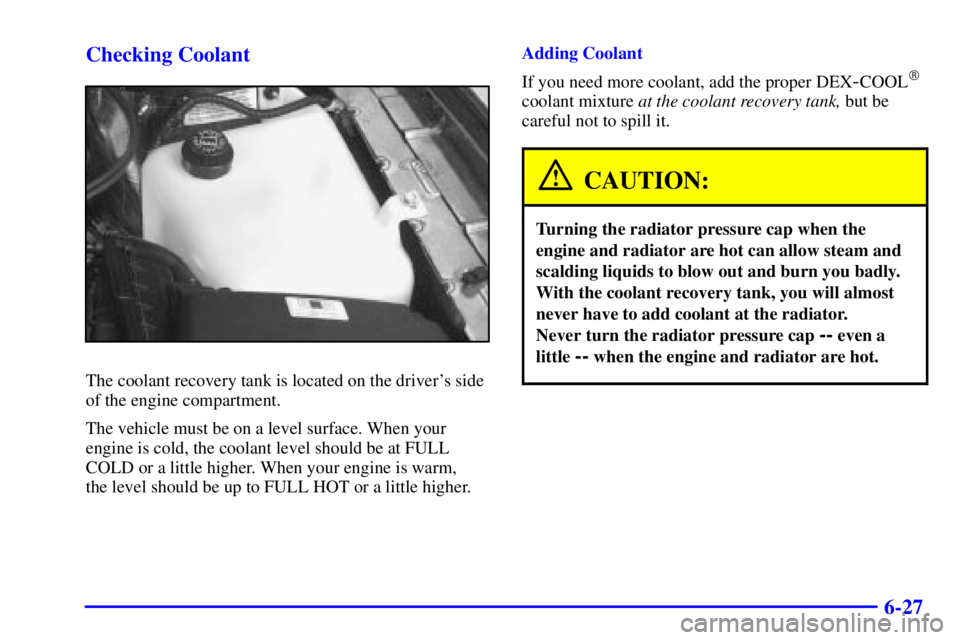
The coolant recovery tank is located on the driver's side
of the engine compartment.
The vehicle must be on a level surface. When your
engine is cold, the coolant level should be at FULL
COLD or a little higher. When your engine is warm,
the level should be up to FULL HOT or a little higher.Adding Coolant
If you need more coolant, add the proper DEX
-COOL�
coolant mixture at the coolant recovery tank, but be
careful not to spill it.
CAUTION:
Turning the radiator pressure cap when the
engine and radiator are hot can allow steam and
scalding liquids to blow out and burn you badly.
With the coolant recovery tank, you will almost
never have to add coolant at the radiator.
Never turn the radiator pressure cap
-- even a
little
-- when the engine and radiator are hot.
Page 290 of 392
6-28
CAUTION:
You can be burned if you spill coolant on hot
engine parts. Coolant contains ethylene glycol,
and it will burn if the engine parts are hot
enough. Don't spill coolant on a hot engine.
Occasionally check the coolant level in the radiator.
For information on how to add coolant to the radiator,
see ªCooling Systemº in the Index.
Radiator Pressure Cap
NOTICE:
Your radiator pressure cap is a 15 psi (105 kPa)
pressure
-type cap and must be tightly installed to
prevent coolant loss and possible engine damage
from overheating. Be sure the arrows on the cap
line up with the overflow tube on the radiator
filler neck.
Power Steering Fluid
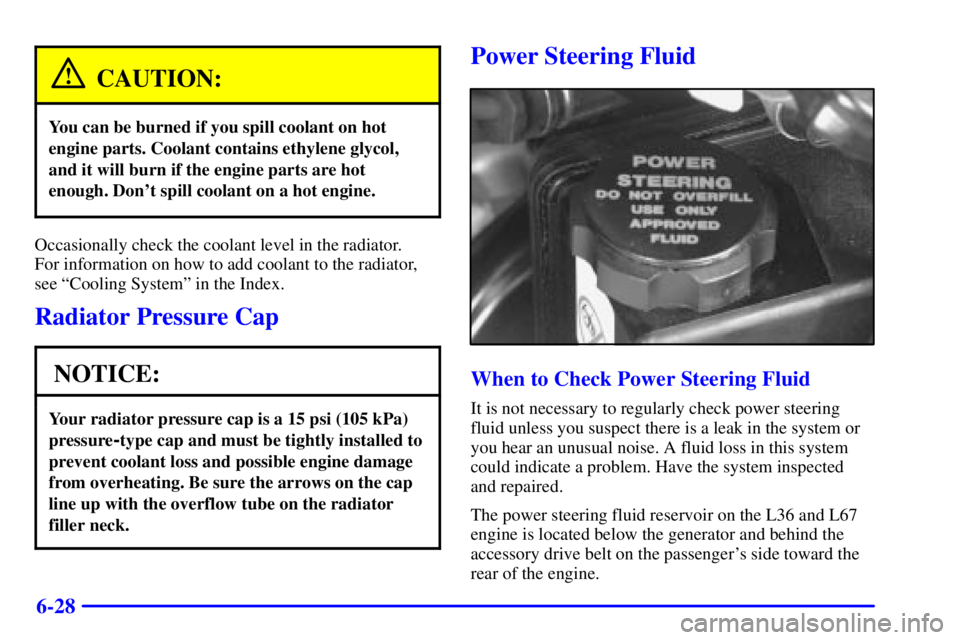
When to Check Power Steering Fluid
It is not necessary to regularly check power steering
fluid unless you suspect there is a leak in the system or
you hear an unusual noise. A fluid loss in this system
could indicate a problem. Have the system inspected
and repaired.
The power steering fluid reservoir on the L36 and L67
engine is located below the generator and behind the
accessory drive belt on the passenger's side toward the
rear of the engine.
Page 291 of 392
6-29 How to Check Power Steering Fluid
Turn the key off, let the engine compartment cool down,
wipe the cap and the top of the reservoir clean, then
unscrew the cap and wipe the dipstick with a clean rag.
Replace the cap and completely tighten it. Then remove
the cap again and look at the fluid level on the dipstick.
The level should be at the FULL COLD mark.
If necessary, add only enough fluid to bring the level
up to the mark.
What to Use
To determine what kind of fluid to use, see
ªRecommended Fluids and Lubricantsº in the Index.
Always use the proper fluid. Failure to use the proper
fluid can cause leaks and damage hoses and seals.
Windshield Washer Fluid
What to Use
When you need windshield washer fluid, be sure to read
the manufacturer's instructions before use. If you will be
operating your vehicle in an area where the temperature
may fall below freezing, use a fluid that has sufficient
protection against freezing.
Adding Washer Fluid
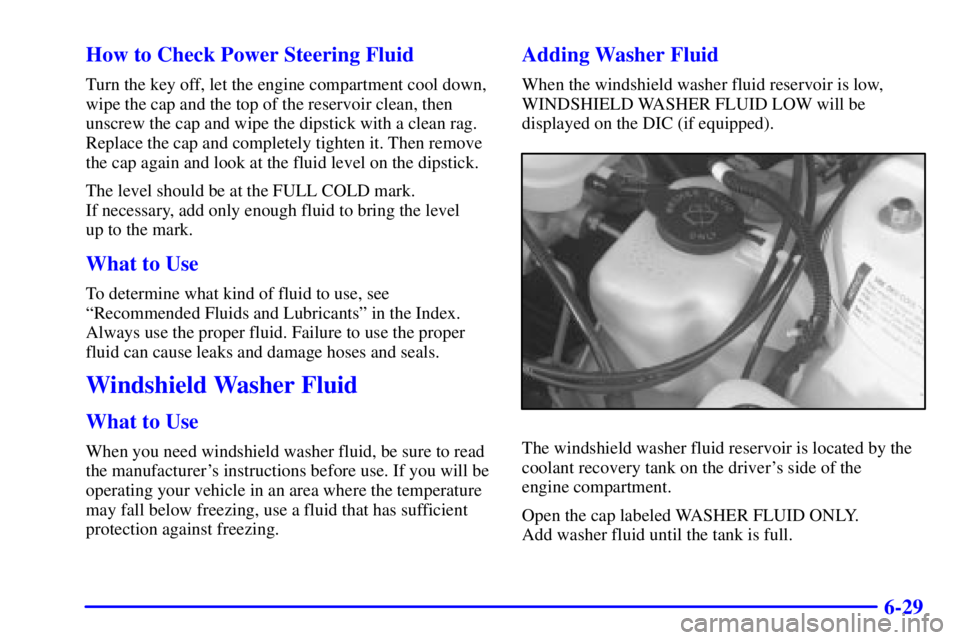
When the windshield washer fluid reservoir is low,
WINDSHIELD WASHER FLUID LOW will be
displayed on the DIC (if equipped).
The windshield washer fluid reservoir is located by the
coolant recovery tank on the driver's side of the
engine compartment.
Open the cap labeled WASHER FLUID ONLY.
Add washer fluid until the tank is full.
Page 337 of 392
6-75
Capacities and Specifications
The following approximate capacities are given in English and metric conversions. Please refer to ªRecommended
Fluids and Lubricantsº in the Index for more information.
Automatic Transaxle AT (Overdrive)
Pan Removal and Replacement 6.0 quarts (5.6 L). . . . . . . . . . . . . . . . . . . . . . . . . . . . . . . . . . . . . . . . . . . . . . . .
After Complete Overhaul 11.0 quarts (10.4 L). . . . . . . . . . . . . . . . . . . . . . . . . . . . . . . . . . . . . . . . . . . . . . . . . . .
After performing either transaxle procedure, check fluid level when done. More fluid may be needed.
Belt Tensions
Automatically controlled by a self
-tension idler pulley. Tension adjustment should never be necessary.
Cooling System13.0 quarts (12.3 L) . . . . . . . . . . . . . . . . . . . . . . . . . . . . . . . . . . . . . . . . . . . . . . . . . . . . . . . . . . .
Engine Crankcase
Oil change with filter change 4.5 quarts (4.3 L). . . . . . . . . . . . . . . . . . . . . . . . . . . . . . . . . . . . . . . . . . . . . . . . .
Fuel Tank18.5 gallons (70.0 L) . . . . . . . . . . . . . . . . . . . . . . . . . . . . . . . . . . . . . . . . . . . . . . . . . . . . . . . . . . . . . . .
Power Steering
Pump Only1.0 pint (0.5 L) . . . . . . . . . . . . . . . . . . . . . . . . . . . . . . . . . . . . . . . . . . . . . . . . . . . . . . . . . . . . . . . . .
Complete System 1.5 pints (0.7 L). . . . . . . . . . . . . . . . . . . . . . . . . . . . . . . . . . . . . . . . . . . . . . . . . . . . . . . . . . .
Wheel Nut Torque100 lb
-ft (140 N´m) . . . . . . . . . . . . . . . . . . . . . . . . . . . . . . . . . . . . . . . . . . . . . . . . . . . . . . . .
Tire Pressure
See Tire
-Loading Information label on the rear edge of the driver's door.
Air Conditioning Refrigerant
See refrigerant charge label under the hood.
All capacities are approximate. When adding, be sure to fill to the appropriate level as recommended in this manual.
Page 339 of 392

6-77
Normal Maintenance
Replacement Parts
Air Cleaner Filter AC Type A-1096C . . . . . . . . . . . . .
Engine Oil Filter AC Type PF
-47 . . . . . . . . . . . . . . . .
Fuel Filter AC Type GF
-627 . . . . . . . . . . . . . . . . . . . .
Spark Plugs AC Type 41
-921* . . . . . . . . . . . . . . . . . .
Gap 0.060 inch (.152 cm)
Windshield Wiper Blades
Type Hook Style. . . . . . . . . . . . . . . . . . . . . . . . . . . .
Length 22 inches (56 cm). . . . . . . . . . . . . . . . . . . . .
Passenger Compartment Air Filter
(HVAC air filter) GM Part No. 52472175. . . . . . . . .
*On 3800 Supercharged Engine (Code 1) only, this
replaces original spark plug NGK Type PTR4B
-15.
Vehicle Dimensions
Length 206.8 inches (525.3 cm). . . . . . . . . . . . . . . . .
Width 74.7 inches (189.7 cm). . . . . . . . . . . . . . . . . . .
Height 57.4 inches (145.8 cm). . . . . . . . . . . . . . . . . . .
Wheelbase 113.8 inches (289.1 cm). . . . . . . . . . . . . .
Front Tire Tread 62.7 inches (159.3 cm). . . . . . . . . . .
Rear Tire Tread 62.3 inches (158.2 cm). . . . . . . . . . .
Engine Accessory Belt (L36)
The L36 engine uses an engine accessory belt. This
diagram shows the features connected and the routing.
See ªMaintenance Scheduleº in the Index for when to
check the belt.
A. Power Steering
B. Generator
C. Air ConditioningD. Crank
E. Water Pump
F. Tensioner
Page 345 of 392
Scheduled Maintenance
7-5
Short Trip/City Definition
Follow the Short Trip/City Scheduled Maintenance if
any one of these conditions is true for your vehicle:
�Most trips are less than 5 to 10 miles (8 to 16 km).
This is particularly important when outside
temperatures are below freezing.
�Most trips include extensive idling (such as frequent
driving in stop
-and-go traffic).
�Most trips are through dusty areas.
�You frequently tow a trailer or use a carrier on top of
your vehicle.
�If the vehicle is used for delivery service, police, taxi
or other commercial application.
One of the reasons you should follow this schedule if
you operate your vehicle under any of these conditions
is that these conditions cause engine oil to break
down sooner.
Short Trip/City Intervals
Every 3,000 Miles (5 000 km): Engine Oil and Filter
Change (or 3 months, whichever occurs first).
Every 6,000 Miles (10 000 km): Tire Rotation.
Every 12,000 Miles (20 000 km): Passenger
Compartment Air Filter Replacement.
Every 15,000 Miles (25 000 km): Engine Air Cleaner
Filter Inspection, if driving in dusty conditions.
Every 30,000 Miles (50 000 km): Engine Air Cleaner
Filter Replacement. Supercharger Oil Check
(or every 36 months, whichever occurs first)
(3800 Code 1 V6 engine only).
Every 50,000 Miles (83 000 km): Automatic Transaxle
Service (severe conditions only).
(Continued)
Page 347 of 392
Scheduled Maintenance
7-7
Long Trip/Highway Intervals
Every 7,500 Miles (12 500 km): Engine Oil and Filter
Change (or every 12 months, whichever occurs first).
Tire Rotation.
Every 15,000 Miles (25 000 km): Passenger
Compartment Air Filter Replacement.
Every 30,000 Miles (50 000 km): Supercharger Oil
Check (or every 36 months, whichever occurs first)
(3800 Code 1 V6 engine only). Engine Air Cleaner
Filter Replacement.
Every 50,000 Miles (83 000 km): Automatic Transaxle
Service (severe conditions only).
Every 60,000 Miles (100 000 km): Engine Accessory
Drive Belt Inspection.
Long Trip/Highway Intervals
Every 100,000 Miles (166 000 km): Spark Plug Wire
Inspection. Spark Plug Replacement. Automatic
Transaxle Service (normal conditions).
Every 150,000 Miles (240 000 km): Cooling System
Service (or every 60 months, whichever occurs first).
These intervals only summarize maintenance services.
Be sure to follow the complete scheduled maintenance
on the following pages.