Page 290 of 392
6-28
CAUTION:
You can be burned if you spill coolant on hot
engine parts. Coolant contains ethylene glycol,
and it will burn if the engine parts are hot
enough. Don't spill coolant on a hot engine.
Occasionally check the coolant level in the radiator.
For information on how to add coolant to the radiator,
see ªCooling Systemº in the Index.
Radiator Pressure Cap
NOTICE:
Your radiator pressure cap is a 15 psi (105 kPa)
pressure
-type cap and must be tightly installed to
prevent coolant loss and possible engine damage
from overheating. Be sure the arrows on the cap
line up with the overflow tube on the radiator
filler neck.
Power Steering Fluid
When to Check Power Steering Fluid
It is not necessary to regularly check power steering
fluid unless you suspect there is a leak in the system or
you hear an unusual noise. A fluid loss in this system
could indicate a problem. Have the system inspected
and repaired.
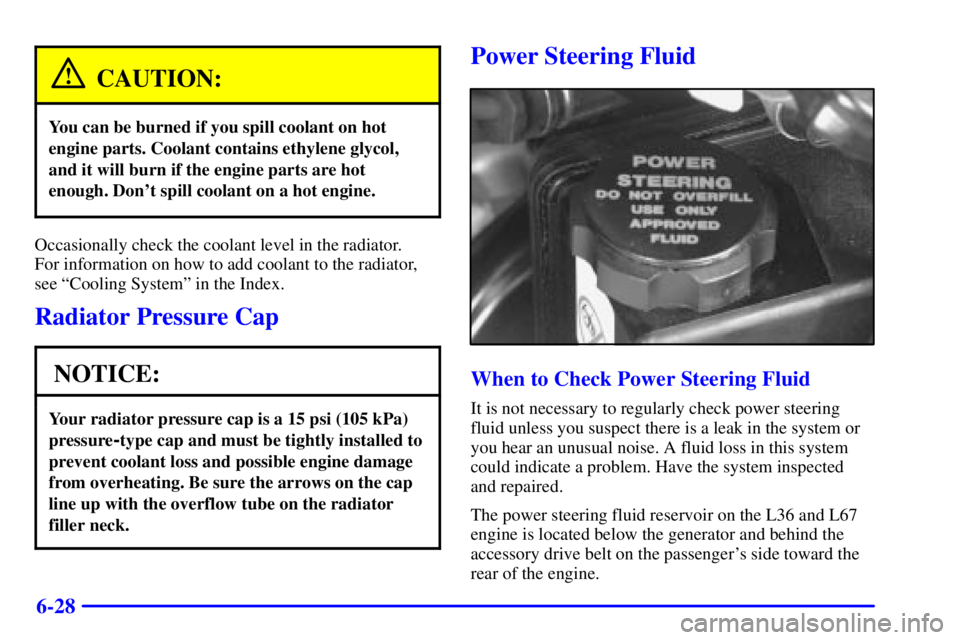
The power steering fluid reservoir on the L36 and L67
engine is located below the generator and behind the
accessory drive belt on the passenger's side toward the
rear of the engine.
Page 291 of 392
6-29 How to Check Power Steering Fluid
Turn the key off, let the engine compartment cool down,
wipe the cap and the top of the reservoir clean, then
unscrew the cap and wipe the dipstick with a clean rag.
Replace the cap and completely tighten it. Then remove
the cap again and look at the fluid level on the dipstick.
The level should be at the FULL COLD mark.
If necessary, add only enough fluid to bring the level
up to the mark.
What to Use
To determine what kind of fluid to use, see
ªRecommended Fluids and Lubricantsº in the Index.
Always use the proper fluid. Failure to use the proper
fluid can cause leaks and damage hoses and seals.
Windshield Washer Fluid
What to Use
When you need windshield washer fluid, be sure to read
the manufacturer's instructions before use. If you will be
operating your vehicle in an area where the temperature
may fall below freezing, use a fluid that has sufficient
protection against freezing.
Adding Washer Fluid
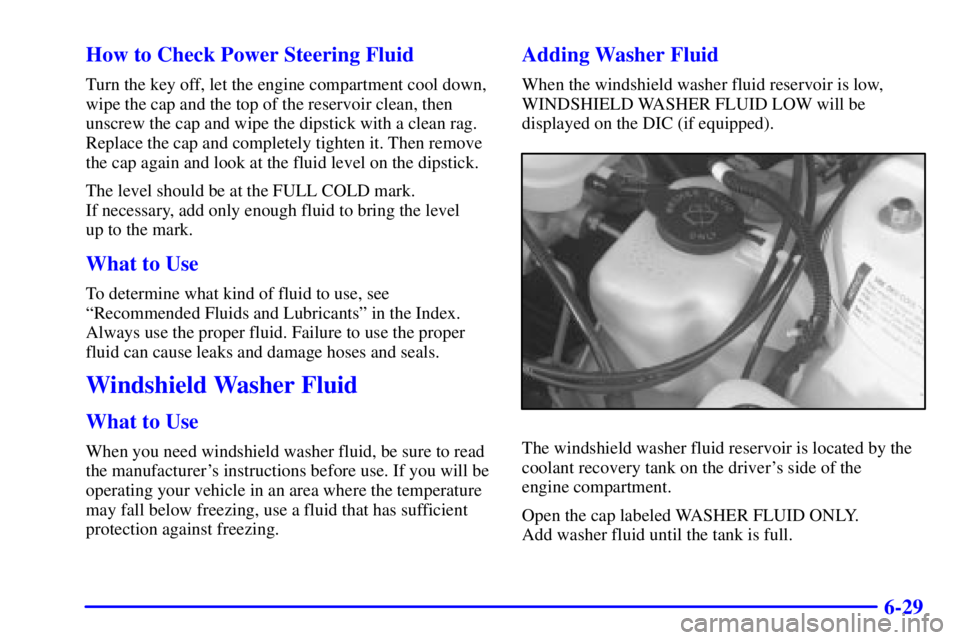
When the windshield washer fluid reservoir is low,
WINDSHIELD WASHER FLUID LOW will be
displayed on the DIC (if equipped).
The windshield washer fluid reservoir is located by the
coolant recovery tank on the driver's side of the
engine compartment.
Open the cap labeled WASHER FLUID ONLY.
Add washer fluid until the tank is full.
Page 292 of 392
6-30
NOTICE:
�When using concentrated washer fluid,
follow the manufacturer's instructions for
adding water.
�Don't mix water with ready
-to-use washer
fluid. Water can cause the solution to freeze
and damage your washer fluid tank and
other parts of the washer system. Also,
water doesn't clean as well as washer fluid.
�Fill your washer fluid tank only
three
-quarters full when it's very cold.
This allows for expansion if freezing occurs,
which could damage the tank if it is
completely full.
�Don't use engine coolant (antifreeze) in
your windshield washer. It can damage
your washer system and paint.
Brakes
Brake Fluid
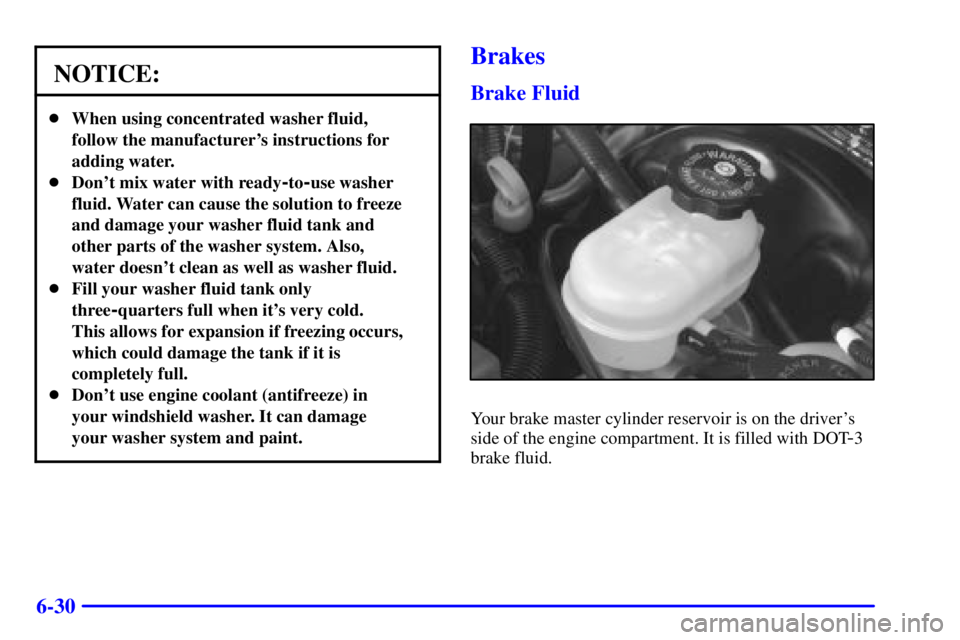
Your brake master cylinder reservoir is on the driver's
side of the engine compartment. It is filled with DOT
-3
brake fluid.
Page 293 of 392
6-31
There are only two reasons why the brake fluid level in
the reservoir might go down. The first is that the brake
fluid goes down to an acceptable level during normal
brake lining wear. When new linings are put in, the fluid
level goes back up. The other reason is that fluid is
leaking out of the brake system. If it is, you should have
your brake system fixed, since a leak means that sooner
or later your brakes won't work well, or won't work
at all.
So, it isn't a good idea to ªtop offº your brake fluid.
Adding brake fluid won't correct a leak. If you add fluid
when your linings are worn, then you'll have too much
fluid when you get new brake linings. You should add
(or remove) brake fluid, as necessary, only when work is
done on the brake hydraulic system.
CAUTION:
If you have too much brake fluid, it can spill on
the engine. The fluid will burn if the engine is hot
enough. You or others could be burned, and your
vehicle could be damaged. Add brake fluid only
when work is done on the brake hydraulic system.
When your brake fluid falls to a low level, your brake
warning light will come on. A chime will sound if you
try to drive with this warning light on. See ªBrake
System Warning Lightº in the Index.
What to Add
When you do need brake fluid, use only DOT
-3 brake
fluid. Use new brake fluid from a sealed container only.
Refer to ªRecommended Fluids and Lubricantsº in the
Maintenance Schedule.
Always clean the brake fluid reservoir cap and the area
around the cap before removing it. This will help keep
dirt from entering the reservoir.
CAUTION:
With the wrong kind of fluid in your brake
system, your brakes may not work well, or they
may not even work at all. This could cause a
crash. Always use the proper brake fluid.
Page 294 of 392
6-32
NOTICE:
�Using the wrong fluid can badly damage
brake system parts. For example, just a few
drops of mineral
-based oil, such as engine
oil, in your brake system can damage brake
system parts so badly that they'll have to be
replaced. Don't let someone put in the
wrong kind of fluid.
�If you spill brake fluid on your vehicle's
painted surfaces, the paint finish can be
damaged. Be careful not to spill brake fluid
on your vehicle. If you do, wash it off
immediately. See ªAppearance Careº in
the Index.
Brake Wear
Your vehicle has four-wheel disc brakes.
Disc brake pads have built
-in wear indicators that make a
high
-pitched warning sound when the brake pads are
worn and new pads are needed. The sound may come
and go or be heard all the time your vehicle is moving
(except when you are pushing on the brake pedal firmly).
CAUTION:
The brake wear warning sound means that soon
your brakes won't work well. That could lead to
an accident. When you hear the brake wear
warning sound, have your vehicle serviced.
NOTICE:
Continuing to drive with worn-out brake pads
could result in costly brake repair.
Page 327 of 392
6-65
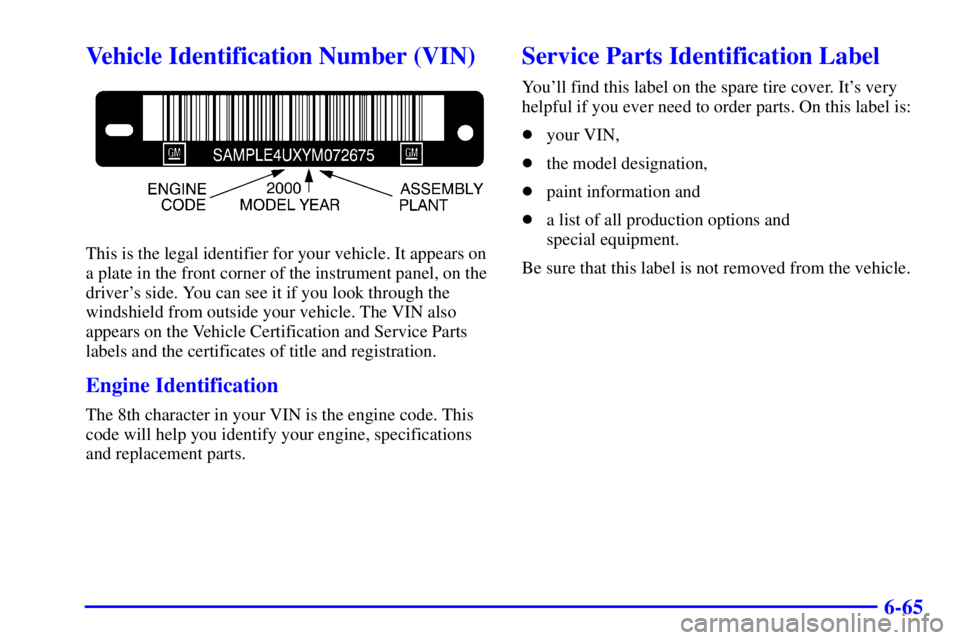
Vehicle Identification Number (VIN)
This is the legal identifier for your vehicle. It appears on
a plate in the front corner of the instrument panel, on the
driver's side. You can see it if you look through the
windshield from outside your vehicle. The VIN also
appears on the Vehicle Certification and Service Parts
labels and the certificates of title and registration.
Engine Identification
The 8th character in your VIN is the engine code. This
code will help you identify your engine, specifications
and replacement parts.
Service Parts Identification Label
You'll find this label on the spare tire cover. It's very
helpful if you ever need to order parts. On this label is:
�your VIN,
�the model designation,
�paint information and
�a list of all production options and
special equipment.
Be sure that this label is not removed from the vehicle.
Page 329 of 392

6-67 Fuses and Circuit Breakers
The wiring circuits in your vehicle are protected from
short circuits by a combination of fuses and circuit
breakers. This greatly reduces the chance of damage
caused by electrical problems.
Look at the silver
-colored band inside the fuse. If the
band is broken or melted, replace the fuse. Be sure you
replace a bad fuse with a new one of the identical size
and rating.
There are three fuse blocks in your vehicle: the
instrument panel fuse block located under the instrument
panel, the underhood fuse block located on the
passenger's side engine compartment and the rear fuse
block, located under the rear seat.Instrument Panel Fuse Block
The instrument panel fuse block is located to the far
right side under the instrument panel.
Remove the hush panel on the passenger's side to reveal
the fuses. To remove the panel, do the following:
1. Remove the two 7 mm screws located along the front
edge of the panel.
2. Lower the hush panel. The fuse block is a
rectangular covered box located on the far right side
under the instrument panel.
3. Remove the cover. Now you can see the fuses and
replace them.
4. Place the wide end of the fuse puller over the plastic
end of the fuse.
5. Squeeze the ends over the fuse and pull it out.
Spare fuses are located in the empty slots shown on the
following chart.
When finished, reinstall the hush panel. Reinstall lamps,
connectors, and HVAC duct temperature sensors if they
were removed.
Page 331 of 392
6-69
Fuse Usage
LP PK L Underhood Lamp, L PK/
Sidemarker, L Park/Turn Lamp,
SBM, L Tail Signal Lamp,
L Tail/Stop Lamp,
L Rear Sidemarker
LP PK R Rt Pk/Sidemarker Lamp,
Rt PK/Turn Lamp, Rt Tail/Sign
Lamp, Rt Tail/Stoplamp, Rt Rear
Sidemarker, Stop/Tail Lamp,
Tail/Signal Lamp, License
Lamp, RFA
RUN Run/Accessory
WSW Wiper Motor
EMPTY Not Used
WSW/RFA Wiper Switch, RFA, Rain Sense
B/U LP
EC Mirror, Back
-Up LampsUnderhood Fuse Block
There are additional fuses located on the passenger's
side of the engine compartment.
Minifuses Usage
1 Air Sol
2 SBM, LCM
3 Turn Signal