Page 145 of 381

yellowblue
2-88
Delayed Locking
The delayed locking feature, which delays the actual locking
of the vehicle, can be made active or inactive through
the DIC. When DELAYED LOCKING
- OFF - ON appears
on the display, use the ENG/MET button to toggle the arrow
between OFF and ON. When you have made your choice,
press the RESET button to record your selection.
For more information on this feature, see ªDelayed
Lockingº in the Index.
Perimeter Lighting
When the button with the unlock symbol on the
transmitter is pressed, the Daytime Running Lamps
(high
-beams at reduced intensity), parking lamps and
back
-up lamps will turn on if it is dark enough
according to the Twilight Sentinel�.
You can control activation of this feature by choosing
OFF or ON when the PERIMETER LIGHTS choice is
displayed on the DIC. Make your choice by pressing the
ENG/MET button and record your choice by pressing
the RESET button. You will then be prompted to choose
a TIMEOUT period. See ªExterior Lightsº later in this
section for more information.
For more information on this feature, see ªPerimeter
Lightingº in the Index.Exterior Lights
The EXTERIOR LIGHTS/TIMEOUT feature can be
changed to desired setting by using the ENG/MET to
toggle from 5 to 30 seconds. Each toggle will increase
the time by 5 seconds. Once the desired timeout is
displayed, press RESET to record your choice and move
on to the next personal choice feature.
Memory Seat Recall
This feature recalls the position of your seat. When this
feature is active, the memory seat and mirror positions
will be recalled for the identified driver when the remote
keyless entry transmitter is used to enter the vehicle.
You can program this feature to be active by choosing
ON when the SEAT RECALL choice appears, or
inactive by choosing OFF when the SEAT RECALL
choice appears on the DIC. Make your choices by
pressing the ENG/MET button and store them to
memory by pressing the RESET button.
Page 146 of 381

yellowblue
2-89
You can also program this feature to recall your
memory seat position or the exit seat position.
�Memory Position: Choose ON when the SEAT
RECALL choice appears, and then choose MEMORY
when the RECALL POSITION choice appears.
�Exit Position: Choose ON when the SEAT RECALL
choice appears, and then choose EXIT when the
RECALL POSITION choice appears. The seat will
move when you enter the vehicle after unlocking it
with a remote keyless entry transmitter. This will
allow for easy entry.
For more information on this feature, see
ªMemory Seatsº in the Index.Parallel Park Assist (If Equipped)
The parallel park assist mirror, which tips the passenger
mirror down while the vehicle is in REVERSE (R), can
be made active or inactive through the DIC. When TILT
MIRRORS
-OFF/ON appears on the display, use the
ENG/MET button to toggle the arrow between OFF and
ON. When you have made your choice, press the
RESET button to record your selection. For more
information on this feature, see ªParallel Park Assist
Mirrorº in the Index.
Driver ID
This feature displays the DRIVER ID, as identified by
the DIC. If this feature is ON, the DRIVER ID will be
displayed every time the ignition is turned on. If the
DRIVER ID is OFF, the DRIVER ID can be displayed
by pressing either a button on the remote keyless entry
transmitter or a memory seat button. Vehicles are
delivered with this feature ON.
Page 203 of 381
yellowblue
4-16
Driving at Night
Night driving is more dangerous than day driving. One
reason is that some drivers are likely to be impaired
-- by
alcohol or drugs, with night vision problems, or by fatigue.Here are some tips on night driving.
�Drive defensively.
�Don't drink and drive.
�Adjust your inside rearview mirror to reduce the
glare from headlamps behind you.
�Since you can't see as well, you may need to
slow down and keep more space between you and
other vehicles.
�Slow down, especially on higher speed roads. Your
headlamps can light up only so much road ahead.
�In remote areas, watch for animals.
�If you're tired, pull off the road in a safe place
and rest.
Page 231 of 381

yellowblue
5-4
2. Get the vehicles close enough so the jumper cables
can reach, but be sure the vehicles aren't touching
each other. If they are, it could cause a ground
connection you don't want. You wouldn't be able to
start your vehicle, and the bad grounding could
damage the electrical systems.
To avoid the possibility of the vehicles rolling, set
the parking brake firmly on both vehicles involved in
the jump start procedure. Put your automatic
transaxle in PARK (P).
3. Turn off the ignition on both vehicles. Unplug
unnecessary accessories plugged into the cigarette
lighter. Turn off all lamps that aren't needed as well
as radios. This will avoid sparks and help save both
batteries. In addition, it could save your radio!4. Open the hoods and locate the battery on the other
vehicle and the remote positive (+) terminal, located
on the passenger's side of the engine, on your
vehicle. Find the positive (+) and negative (
-)
terminals on the battery in the other vehicle.
You do not need to access your vehicle's battery
(which is under the rear seat) for jump starting.
The remote positive (+) terminal is for this purpose.
CAUTION:
An electric fan can start up even when the engine
is not running and can injure you. Keep hands,
clothing and tools away from any underhood
electric fan.
Page 232 of 381
yellowblue
5-5
Start by lifting and moving the red positive (+)
remote terminal cover away from the relay center.
CAUTION:
Using a match near a battery can cause battery
gas to explode. People have been hurt doing this,
and some have been blinded. Use a flashlight if
you need more light.
Be sure the battery has enough water. You don't
need to add water to the ACDelco� battery
installed in every new GM vehicle. But if a battery
has filler caps, be sure the right amount of fluid is
there. If it is low, add water to take care of that
first. If you don't, explosive gas could be present.
Battery fluid contains acid that can burn you.
Don't get it on you. If you accidentally get it in
your eyes or on your skin, flush the place with
water and get medical help immediately.
Page 233 of 381

yellowblue
5-6
5. Check that the jumper cables don't have loose or
missing insulation. If they do, you could get a shock.
The vehicles could also be damaged.
Before you connect the cables, here are some basic
things you should know. Positive (+) will go to
positive (+) and negative (
-) will go to a heavy,
unpainted metal engine part or a body metal surface.
Don't connect positive (+) to negative (
-) or you'll
get a short that would damage the battery and maybe
other parts, too. Also, don't connect the negative (
-)
cable to the negative (
-) terminal on the dead battery.
CAUTION:
Fans or other moving engine parts can injure you
badly. Keep your hands away from moving parts
once the engine is running.
6. Connect the red
positive (+) cable to
the remote positive (+)
terminal of the vehicle
with the dead battery.
7. Don't let the other
end of the cable touch
metal. Connect it to the
positive (+) terminal of
the good battery. Use a
remote positive (+)
terminal if the vehicle
has one.
Page 234 of 381
yellowblue
5-7
8. Now connect the black
negative (
-) cable to
the good battery's
negative (
-) terminal.
Don't let the other end touch anything until the next
step. The other end of the negative (
-) cable doesn't go
to the dead battery.
It goes to a heavy,
unpainted metal part on
the engine of the vehicle
with the dead battery.
9. Now start the vehicle with the good battery and run
the engine for a while.
10. Try to start the vehicle with the dead battery. If it
won't start after a few tries, it probably needs service.
11. Remove the cables in reverse order to prevent
electrical shorting. Take care that they don't touch each
other or any other metal. Replace the red positive (+)
remote terminal cover to its original position.
Page 235 of 381
yellowblue
5-8
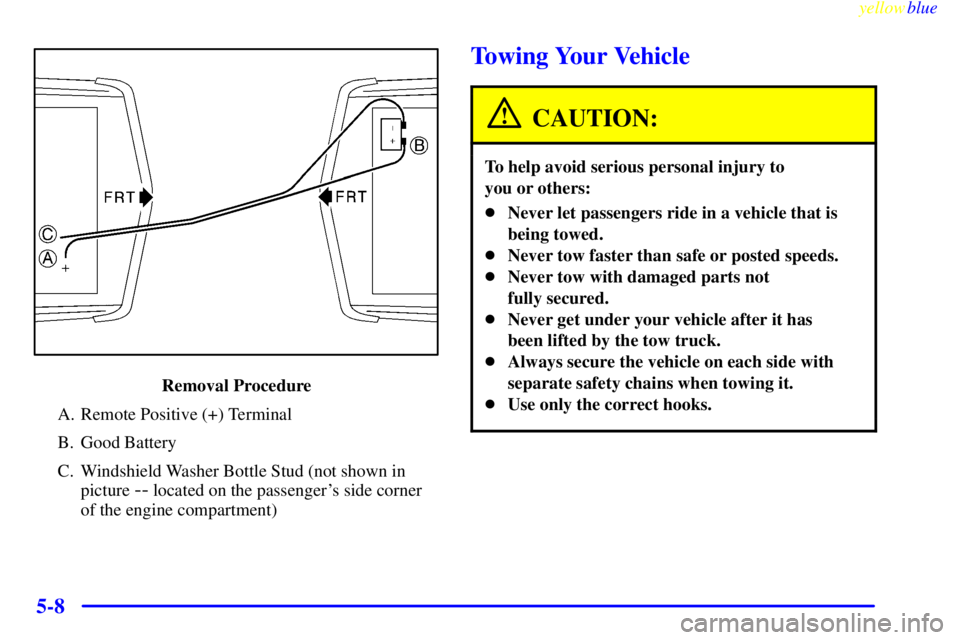
Removal Procedure
A. Remote Positive (+) Terminal
B. Good Battery
C. Windshield Washer Bottle Stud (not shown in
picture
-- located on the passenger's side corner
of the engine compartment)
Towing Your Vehicle
CAUTION:
To help avoid serious personal injury to
you or others:
�Never let passengers ride in a vehicle that is
being towed.
�Never tow faster than safe or posted speeds.
�Never tow with damaged parts not
fully secured.
�Never get under your vehicle after it has
been lifted by the tow truck.
�Always secure the vehicle on each side with
separate safety chains when towing it.
�Use only the correct hooks.