Page 182 of 381

yellowblue
3-35 Personal Choice Radio Controls
(If Equipped)
With this feature, your vehicle will recall the latest radio
settings as adjusted the last time your vehicle was
operated. This feature allows two different drivers to
store and recall their own radio settings for AM and FM
presets, last tuned station, volume, tone and audio
source (radio, cassette or CD). The settings recalled by
the radio are determined by which transmitter (ª1º or
ª2º) was used to enter the vehicle. The number on the
back of the transmitter corresponds to driver 1 or to
driver 2. After the button with the unlock symbol is
pressed on the transmitter and the ignition is in RUN,
the radio settings will automatically adjust to where they
were last set by the identified driver. The settings can
also be changed by pressing one of the MEMORY
buttons (1 or 2) located on the driver's door until you
hear two beeps. When changes are made, the new
settings will be saved for the driver.
Theft-Deterrent Feature (If Equipped)
THEFTLOCK� is designed to discourage theft of your
radio. It works by using a secret code to disable all radio
functions whenever battery power is removed and the
radio is placed in a different vehicle. This feature
requires no user unput to be activated. It is automatically
armed when it is put into the vehicle for the first time.
When the radio is turned off, the blinking red light
indicates that THEFTLOCK is armed.
If THEFTLOCK is activated, your radio will not operate
if stolen. The radio will display LOC and a red LED
indicator light will come on above the THEFTLOCK
logo to indicate a locked condition. If this occurs, the
radio will have to be returned to the dealer.
Page 216 of 381

yellowblue
4-29
�Tie a red cloth to your vehicle to alert police that
you've been stopped by the snow.
�Put on extra clothing or wrap a blanket around you.
If you have no blankets or extra clothing, make body
insulators from newspapers, burlap bags, rags, floor
mats
-- anything you can wrap around yourself or
tuck under your clothing to keep warm.
You can run the engine to keep warm, but be careful.
CAUTION:
Snow can trap exhaust gases under your vehicle.
This can cause deadly CO (carbon monoxide) gas
to get inside. CO could overcome you and kill
you. You can't see it or smell it, so you might not
know it is in your vehicle. Clear away snow from
around the base of your vehicle, especially any
that is blocking your exhaust pipe. And check
around again from time to time to be sure snow
doesn't collect there.
Open a window just a little on the side of the
vehicle that's away from the wind. This will help
keep CO out.
Run your engine only as long as you must. This saves
fuel. When you run the engine, make it go a little faster
than just idle. That is, push the accelerator slightly. This
uses less fuel for the heat that you get and it keeps the
battery charged. You will need a well
-charged battery to
restart the vehicle, and possibly for signaling later on
with your headlamps. Let the heater run for a while.
Page 230 of 381

yellowblue
5-3
Jump Starting
If your vehicle's battery has run down, you may want to
use another vehicle and some jumper cables to start your
vehicle. But please use the following steps to do it safely.
Note: You will not see the battery under the hood of
your vehicle, since it is located under the rear seat on the
passenger's side.
CAUTION:
Batteries can hurt you. They can be
dangerous because:
�They contain acid that can burn you.
�They contain gas that can explode or ignite.
�They contain enough electricity to
burn you.
If you don't follow these steps exactly, some
or all of these things can hurt you.
NOTICE:
Ignoring these steps could result in costly damage
to your vehicle that wouldn't be covered by
your warranty.
The ACDelco� battery in your vehicle has a
built
-in hydrometer. Do not charge, test or jump
start the battery if the hydrometer looks clear or
light yellow. Replace the battery when there is
a clear or light yellow hydrometer and a
cranking complaint.
Trying to start your vehicle by pushing or pulling
it won't work, and it could damage your vehicle.
1. Check the other vehicle. It must have a 12-volt
battery with a negative ground system.
NOTICE:
If the other system isn't a 12-volt system with a
negative ground, both vehicles can be damaged.
Page 231 of 381

yellowblue
5-4
2. Get the vehicles close enough so the jumper cables
can reach, but be sure the vehicles aren't touching
each other. If they are, it could cause a ground
connection you don't want. You wouldn't be able to
start your vehicle, and the bad grounding could
damage the electrical systems.
To avoid the possibility of the vehicles rolling, set
the parking brake firmly on both vehicles involved in
the jump start procedure. Put your automatic
transaxle in PARK (P).
3. Turn off the ignition on both vehicles. Unplug
unnecessary accessories plugged into the cigarette
lighter. Turn off all lamps that aren't needed as well
as radios. This will avoid sparks and help save both
batteries. In addition, it could save your radio!4. Open the hoods and locate the battery on the other
vehicle and the remote positive (+) terminal, located
on the passenger's side of the engine, on your
vehicle. Find the positive (+) and negative (
-)
terminals on the battery in the other vehicle.
You do not need to access your vehicle's battery
(which is under the rear seat) for jump starting.
The remote positive (+) terminal is for this purpose.
CAUTION:
An electric fan can start up even when the engine
is not running and can injure you. Keep hands,
clothing and tools away from any underhood
electric fan.
Page 232 of 381
yellowblue
5-5
Start by lifting and moving the red positive (+)
remote terminal cover away from the relay center.
CAUTION:
Using a match near a battery can cause battery
gas to explode. People have been hurt doing this,
and some have been blinded. Use a flashlight if
you need more light.
Be sure the battery has enough water. You don't
need to add water to the ACDelco� battery
installed in every new GM vehicle. But if a battery
has filler caps, be sure the right amount of fluid is
there. If it is low, add water to take care of that
first. If you don't, explosive gas could be present.
Battery fluid contains acid that can burn you.
Don't get it on you. If you accidentally get it in
your eyes or on your skin, flush the place with
water and get medical help immediately.
Page 233 of 381

yellowblue
5-6
5. Check that the jumper cables don't have loose or
missing insulation. If they do, you could get a shock.
The vehicles could also be damaged.
Before you connect the cables, here are some basic
things you should know. Positive (+) will go to
positive (+) and negative (
-) will go to a heavy,
unpainted metal engine part or a body metal surface.
Don't connect positive (+) to negative (
-) or you'll
get a short that would damage the battery and maybe
other parts, too. Also, don't connect the negative (
-)
cable to the negative (
-) terminal on the dead battery.
CAUTION:
Fans or other moving engine parts can injure you
badly. Keep your hands away from moving parts
once the engine is running.
6. Connect the red
positive (+) cable to
the remote positive (+)
terminal of the vehicle
with the dead battery.
7. Don't let the other
end of the cable touch
metal. Connect it to the
positive (+) terminal of
the good battery. Use a
remote positive (+)
terminal if the vehicle
has one.
Page 234 of 381
yellowblue
5-7
8. Now connect the black
negative (
-) cable to
the good battery's
negative (
-) terminal.
Don't let the other end touch anything until the next
step. The other end of the negative (
-) cable doesn't go
to the dead battery.
It goes to a heavy,
unpainted metal part on
the engine of the vehicle
with the dead battery.
9. Now start the vehicle with the good battery and run
the engine for a while.
10. Try to start the vehicle with the dead battery. If it
won't start after a few tries, it probably needs service.
11. Remove the cables in reverse order to prevent
electrical shorting. Take care that they don't touch each
other or any other metal. Replace the red positive (+)
remote terminal cover to its original position.
Page 235 of 381
yellowblue
5-8
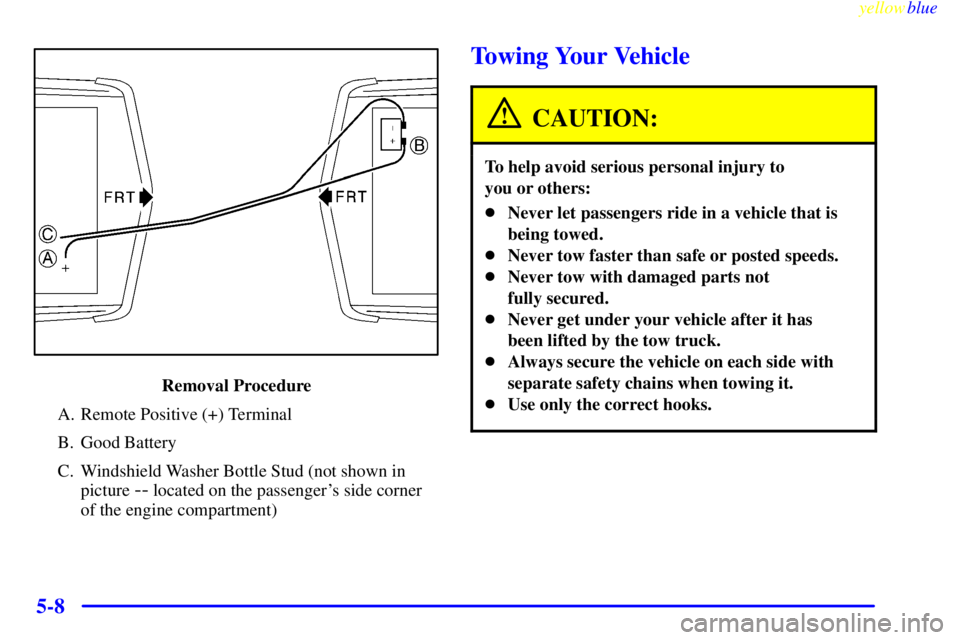
Removal Procedure
A. Remote Positive (+) Terminal
B. Good Battery
C. Windshield Washer Bottle Stud (not shown in
picture
-- located on the passenger's side corner
of the engine compartment)
Towing Your Vehicle
CAUTION:
To help avoid serious personal injury to
you or others:
�Never let passengers ride in a vehicle that is
being towed.
�Never tow faster than safe or posted speeds.
�Never tow with damaged parts not
fully secured.
�Never get under your vehicle after it has
been lifted by the tow truck.
�Always secure the vehicle on each side with
separate safety chains when towing it.
�Use only the correct hooks.