2000 BMW M5 second
[x] Cancel search: secondPage 51 of 80

Interior Lighting
Purpose of the System
The GM controls the interior lighting automatical-
ly with the status change of several monitored
inputs. The lighting can also be manually con-
trolled using the interior light switch.
In addition to the various time controls, the inte-
rior lights are also subject to the 16 minute shut
down of the GM (consumer protection).
Principle of Operation
The interior light switch is a push button switch that will carry out the opposite command
of the current status of the lights. (ie: if the interior lights are currently on, pushing the but-
ton will switch the lights off.)
• If the interior lights are switched “ON” by the button with the ignition switched ON, the
interior lights will remain on until they are switched off by the button.
• If the interior lights are switched “ON” when the ignition is switched OFF, the lights will
remain on for 16 minutes (consumer cutout).
• Pressing the interior light button for longer than three seconds will switch the lights to
continuous off. This feature is intended for workshop use.
Pressing the button again will
return the lights to the normal operational status.
• Locking the vehicle from the outside will immediately switch off the interior lights.
The ON/OFF conditions for the interior lights in the automatic mode are as follows:
ON Conditions
• Door Open.
• Switching off ignition after exterior
lights have been switched off.
• MRS Control Module crash input.
• Unlocking with FZV or pressing FZV
lock button when the vehicle is
already locked (interior search fution).
51
Central Body Electronics ZKE III
OFF Conditions
• All doors closed with ignition on.
• All doors closed with ignition off after 20
seconds.
• 20 seconds after switching off ignition with
lights off.
• 8 seconds after remote control activation.
• 16 minutes with door(s) open.
• When doors are locked.
Page 53 of 80
System Components
Door Contacts: As mentioned in the Central Locking Section, the existing door contacts
opened/closed are also an input for the interior lighting function. The E53 uses the Hall
effect sensors for the purpose of monitoring door open/closed status (located directly
behind the rotary latch plate encased in the actuator). The sensor is activated by the rotary
latch plate's position.
• Door closed, the rotary latch plate is in the latched position. Current flow through the
hall sensor is < 5 mA.
• Door open, the rotary latch plate is in the open position. Current flow through the hall
sensor is > 12 mA.
A change in current flow informs the General module when a door is opened or closed.
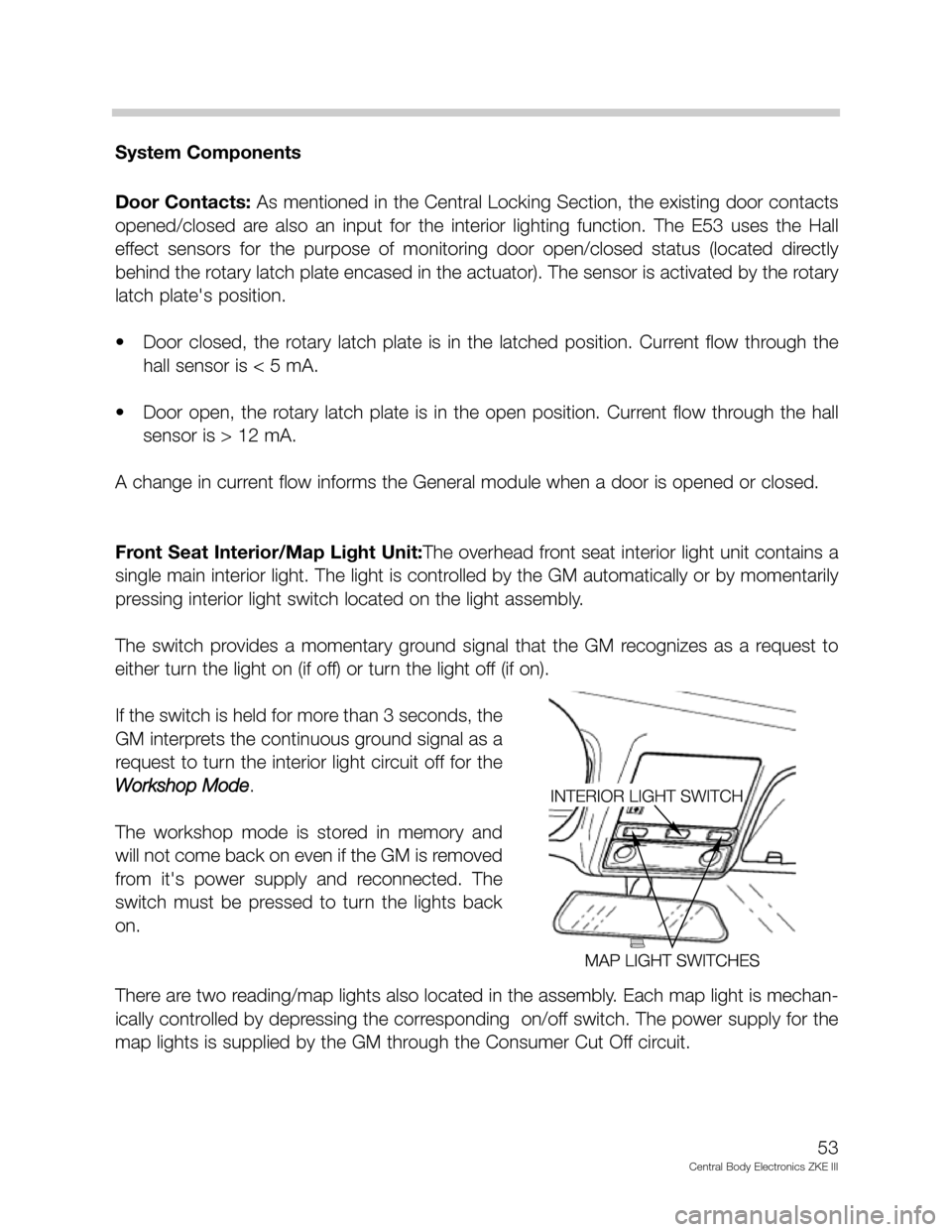
Front Seat Interior/Map Light Unit:The overhead front seat interior light unit contains a
single main interior light. The light is controlled by the GM automatically or by momentarily
pressing interior light switch located on the light assembly.
The switch provides a momentary ground signal that the GM recognizes as a request to
either turn the light on (if off) or turn the light off (if on).
If the switch is held for more than 3 seconds, the
GM interprets the continuous ground signal as a
request to turn the interior light circuit off for the
Workshop Mode
.
The workshop mode is stored in memory and
will not come back on even if the GM is removed
from it's power supply and reconnected. The
switch must be pressed to turn the lights back
on.
There are two reading/map lights also located in the assembly. Each map light is mechan-
ically controlled by depressing the corresponding on/off switch. The power supply for the
map lights is supplied by the GM through the Consumer Cut Off circuit.
53
Central Body Electronics ZKE III
Page 57 of 80

Fiber Optic Light Conductor Cable:The fiber optic cables carry the light to their respec-
tive light output modules at each exterior door handle.
Installation Note:The bending radius of the fiber optic cable should be less than 20mm
when installing.
Light Output Modules: The exterior door handle frames have an additional mount to
accept the light output module.
The light output modules carry the light from the conductor cables to the exterior door han-
dle recess as well as casting a soft exterior light on the outside floor area.
Principle of Operation
Lights ON:
The exterior visual entry aid lighting is activated “on” when the vehicle interior
lights are activated “on” automatically by the GM.
Lights OFF:
Immediately after KL 15 recognition (immediate off - no soft off function). Soft
off after a short delay once all doors are closed.
After a maximum of 20 seconds “on” time, the control module switches exterior visual entry
aid lighting off regardless of interior light status.
57
Central Body Electronics ZKE III
615200131.eps
Page 59 of 80

59
Central Body Electronics ZKE III
System Components
- with Principle of Operation
Manual Operation:The manual adjustments of the seat, mirrors and steering column are
carried out with the respective switches as with the previous systems.
The mirror adjustment switch is located in the driver’s switch block. The mirror operation
input is a digital signal that is processed by each respective module for mirror positioning.
Memory Storage: The parameters for storing memory positions are are as follows:
• With the transmission range
selector in “P” and the mirror
change over switched to the left,
switch the ignition on and press
the “M” on the memory switch.
• The memory indicator lamp swi-
tches on for 7 seconds.
• Press one of the three position
switches (1, 2 or 3) within the 7
second memory period.
• The current positions of the mir-
rors, seat and steering column
are stored for recall.
The positions of the mirrors are stored in the respective door
modules based on the position of the feedback potentiome-
ters. The positions of the seat and steering column are stored
in the seat module, based on the ripple count.
Recalling a memory position setting is possible by either
pressing and holding the recall switch (1, 2 or 3) with KL 15
“ON” or tapping the recall button (1, 2 or 3) with:
• The driver’s door open and KL 15 “OFF”.
• KL R ON and KL 15 “OFF”.
The recall movement can be interrupted at any time by touching any of the adjusting
switches.
E38/E39
E53
615200133.tiff
Page 67 of 80
67
Central Body Electronics ZKE III
Seat Heating Operation (from 99 MY)
Principle of Operation
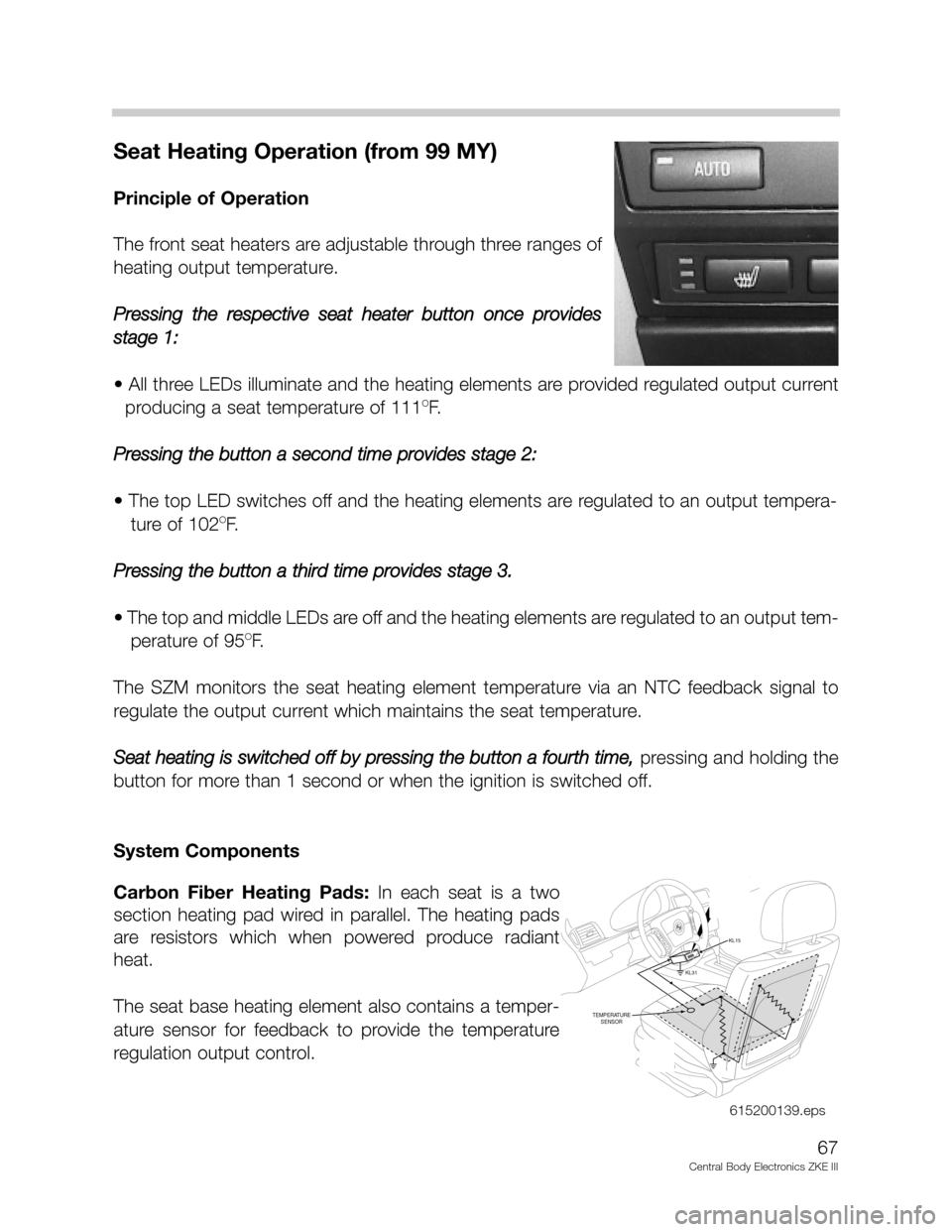
The front seat heaters are adjustable through three ranges of
heating output temperature.
Pressing the respective seat heater button once provides
stage 1:
• All three LEDs illuminate and the heating elements are provided regulated output current
producing a seat temperature of 111
OF.
Pressing the button a second time provides stage 2:
• The top LED switches off and the heating elements are regulated to an output tempera-
ture of 102
OF.
Pressing the button a third time provides stage 3.
• The top and middle LEDs are off and the heating elements are regulated to an output tem-
perature of 95
OF.
The SZM monitors the seat heating element temperature via an NTC feedback signal to
regulate the output current which maintains the seat temperature.
Seat heating is switched off by pressing the button a fourth time,
pressing and holding the
button for more than 1 second or when the ignition is switched off.
System Components
Carbon Fiber Heating Pads:In each seat is a two
section heating pad wired in parallel. The heating pads
are resistors which when powered produce radiant
heat.
The seat base heating element also contains a temper-
ature sensor for feedback to provide the temperature
regulation output control.
KL31
KL15
TEMPERATURE
SENSOR
615200139.eps
Page 68 of 80
68
Central Body Electronics ZKE III
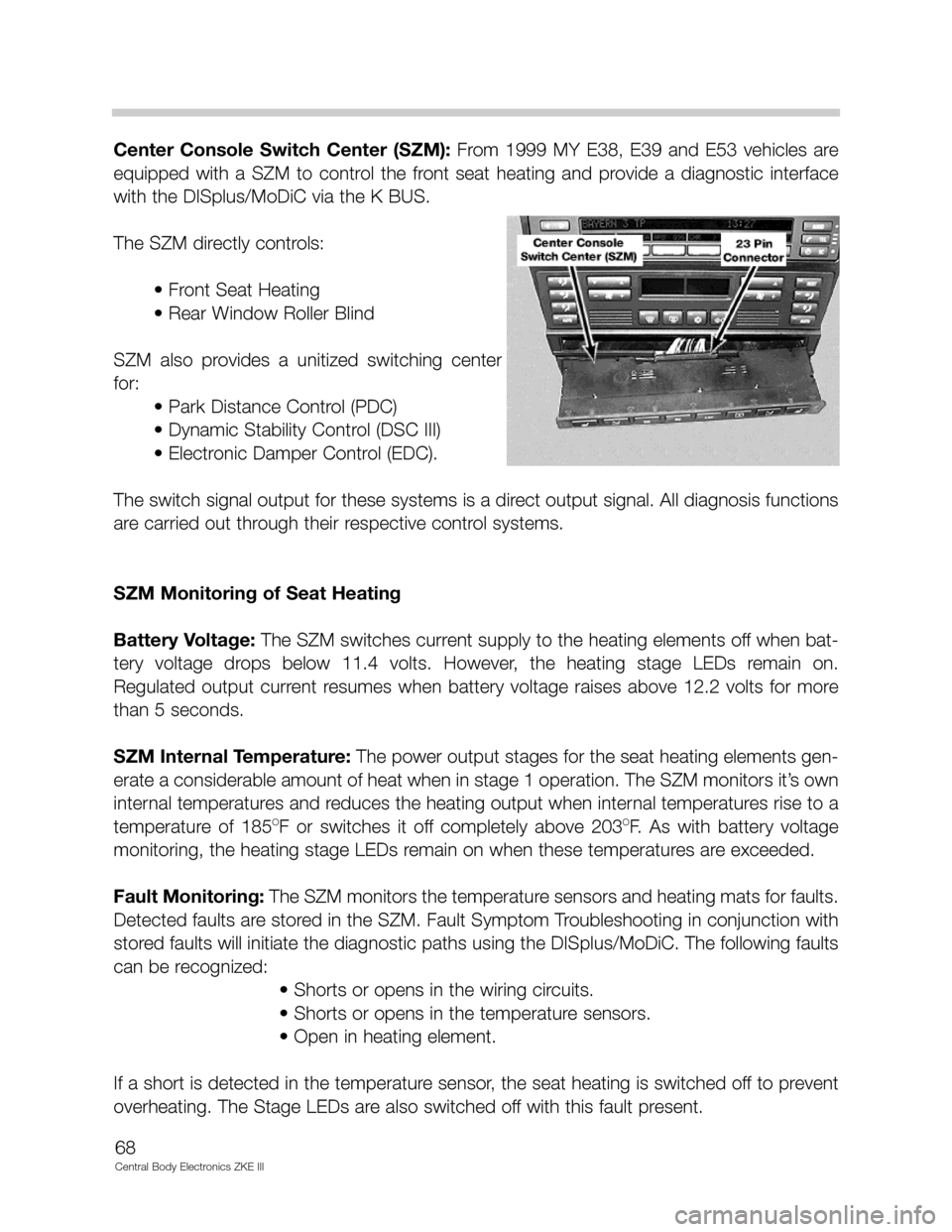
Center Console Switch Center (SZM): From 1999 MY E38, E39 and E53 vehicles are
equipped with a SZM to control the front seat heating and provide a diagnostic interface
with the DISplus/MoDiC via the K BUS.
The SZM directly controls:
• Front Seat Heating
• Rear Window Roller Blind
SZM also provides a unitized switching center
for:
• Park Distance Control (PDC)
• Dynamic Stability Control (DSC III)
• Electronic Damper Control (EDC).
The switch signal output for these systems is a direct output signal. All diagnosis functions
are carried out through their respective control systems.
SZM Monitoring of Seat Heating
Battery Voltage:The SZM switches current supply to the heating elements off when bat-
tery voltage drops below 11.4 volts. However, the heating stage LEDs remain on.
Regulated output current resumes when battery voltage raises above 12.2 volts for more
than 5 seconds.
SZM Internal Temperature: The power output stages for the seat heating elements gen-
erate a considerable amount of heat when in stage 1 operation. The SZM monitors it’s own
internal temperatures and reduces the heating output when internal temperatures rise to a
temperature of 185
OF or switches it off completely above 203OF. As with battery voltage
monitoring, the heating stage LEDs remain on when these temperatures are exceeded.
Fault Monitoring:The SZM monitors the temperature sensors and heating mats for faults.
Detected faults are stored in the SZM. Fault Symptom Troubleshooting in conjunction with
stored faults will initiate the diagnostic paths using the DISplus/MoDiC. The following faults
can be recognized:
• Shorts or opens in the wiring circuits.
• Shorts or opens in the temperature sensors.
• Open in heating element.
If a short is detected in the temperature sensor, the seat heating is switched off to prevent
overheating. The Stage LEDs are also switched off with this fault present.
Page 74 of 80

Principle of Operation
Control logic (example E38) includes:
• Servotronic control electronics active with KL R being switched "ON" - ensure no delay
in operation if engine is started and vehicle is immediately driven.
• Plausibility check for speed signal - the control electronics monitor both the Speed sig-
nal "A" from the IKE and the vehicle speed signal on the K-Bus.
• The ability to detect both acceleration and deceleration from the two speed signals - the
speed signal from the IKE is updated every two seconds.
• The servotronic assist is reduced gradually when the vehicle is under acceleration.
• The servotronic assist is adopted to the lower direct reading during decel or braking.
Electric/electronic failures with the servotronic system will result in the following:
• Power/electronic failure of the control module or solenoid - steering assist the same as
high speed driving (increased effort).
• Vehicle speed signal missing - control module retains the assist mode in effect when the
speed signal was lost.
• Speed signal implausible - steering assist the same as high speed driving (increased
effort).
The GM also provides the diagnostic “gateway” to the Servotronic status and Component
Activation via the DISplus/MoDiC.
74
Central Body Electronics ZKE III
Page 77 of 80

Battery Status
The GM monitors KL R on a dedicated circuit. If the ignition is switched on and detected
via the KL R circuit but the GM does not receive KL R status via the K Bus, the GM mon-
itors the KL R voltage level. If after an additional 0.3 seconds there is no K Bus activity, the
GM initiates an emergency running program.
A substitute value for vehicle speed is used to allow the GM to operate certain functions.
The emergency running program will terminate if the GM detects a vehicle speed or KL R
status via the K bus.
Diagnosis/Troubleshooting
The GM contains an EEPROM fault memory. Diagnosis and troubleshooting is carried out
with the DISplus or MoDiC. The diagnostic link is through the Instrument cluster over the K
bus to the GM.
Notes: _______________________________________________________________________
_____________________________________________________________________________
_____________________________________________________________________________
_____________________________________________________________________________
_____________________________________________________________________________
_____________________________________________________________________________
_____________________________________________________________________________
_____________________________________________________________________________
_____________________________________________________________________________
_____________________________________________________________________________
_____________________________________________________________________________
_____________________________________________________________________________
_____________________________________________________________________________
_____________________________________________________________________________
_____________________________________________________________________________
_____________________________________________________________________________
77
Central Body Electronics ZKE III