2000 BMW 323i SEDAN Dsc
[x] Cancel search: DscPage 10 of 189

Contents
Overview
Controls and features
Cockpit16
Instrument cluster18
Indicator and warning lamps20
Multifunction steering wheel
(MFL)24
Hazard warning flashers25
Warning triangle25
First-aid kit25
Refueling26
Fuel specifications26
Tire inflation pressure27
Locks and security systems:
Keys32
Electronic vehicle
immobilizer33
Central locking system34
Opening and closing Ð from
outside34
Opening and closing Ð from
inside38
Luggage compartment lid39
Luggage compartment41
Alarm system42
Electric power windows44
Sliding/Tilt sunroof45
Adjustments:
Seats47
Seat and mirror memory50
Steering wheel51
Mirrors52
Car Memory, Key Memory53
Passenger safety systems:
Safety belts54
Child restraint systems55
Child-safety locks56
Airbags56
Child restraints59
Installing a child restraint
system60
Driving:
Steering/Ignition lock61
Starting the engine61
Switching off the engine62
Parking brake63
Manual transmission64
Automatic transmission with
Steptronic65
Turn signal indicator/Headlamp
flasher68
Wiper/Washer system/Rain
sensor68
Rear window defroster70
Cruise control71
Everything under control:
Odometer73
Tachometer73
Energy Control73
Fuel gauge74
Temperature gauge74
Service Interval Display74
Check Control75
Clock75
Onboard computer76
Technology for safety and
convenience:
Park Distance Control (PDC)78
Dynamic Stability Control
(DSC)79
Tire Pressure Control (RDC)80
Contents
Page 12 of 189

Contents
Owner service procedures
Advanced technology
Technical data
Replacement procedures:
Onboard tool kit142
Windshield wiper blades142
Lamps and bulbs142
Changing a wheel149
Battery152
Fuses154
Microfilter155
In case of electrical
malfunction:
Fuel filler door156
Sliding/Tilt sunroof156
Assistance, giving and
receiving:
Jump-starting157
Towing the vehicle158Adaptive Transmission Control
(ATC)162
Airbags163
Dynamic Stability Control
(DSC)163
Radio reception164
Safety belt tensioner164
Interior rearview mirror with
automatic dimming
feature165
Rain sensor166
Tire Pressure Control (RDC)167
Self-diagnostics168
Xenon lamps169Engine data172
Dimensions173
Weights174
Capacities175
Electrical system176
Ribbed V-belt176
Page 19 of 189

19n
IndexDataTechnologyRepairsCar careControlsOverview
Instrument cluster
1 Fuel gauge with indicator lamp
for fuel reserve74
2 Turn signal indicator23
3 Speedometer
4 Indicator lamp for
>
Battery charge current20
>
High beams23
>
Engine oil pressure/Engine oil
level20, 22
5 Tachometer and Energy Control73
6 Engine coolant temperature gauge
with "Coolant temperature too high"
indicator74
7 Indicator and warning lamps
(clockwise) for
>
Parking brake/Brake hydraulic
system/Cornering Brake Control
(CBC)20
>
ABS22
>
Brake pads22
>
Tire Pressure Control
(RDC)
*
20, 22
>
Airbags21
>
Please fasten safety belts21
>
Cruise control
*
23
8 Clock reset
>
Clock75
>
Service Interval749 Program display for automatic
transmission
*
65, 67
Indicator lamp for automatic
transmission
*
22, 65
10 Indicator lamp for Dynamic Stability
Control (DSC)22
11 Indicator for
>
Odometer73
>
Trip odometer73
>
Clock75
>
Service Interval74
Display for onboard computer
*
,
operation via the turn signal lever:
Refer to page 76.
>
Clock
>
Outside temperature
>
Average fuel consumption
>
Range
>
Average speed
12 Indicator for Check Control75
13 Trip odometer, reset to zero7314 Indicator and warning lamps
(clockwise) for
>
Front fog lamps
*
23
>
Add washer fluid22
>
Coolant level23
>
Electronic Engine Power Control
(EML)
*
23
>
Engine22
You can display the outside tem-
perature and distance driven in
different units of measurement.
<
Page 21 of 189

21n
IndexDataTechnologyRepairsCar careControlsOverview
Indicator and warning lampsYellow: Stop immediately
Engine oil level
Comes on while driving: Stop
the vehicle and switch off the
engine immediately. The oil level is at
the absolute minimum.
For additional information: Refer to
page 125.
Do not continue driving until you
have topped up the engine oil. If
you continue to drive, the engine could
be damaged because of inadequate
lubrication.<
Red and yellow: Continue driving
cautiously
Cornering Brake Control (CBC) l
If the brake warning lamp comes
on together with the yellow indi-
cator lamps for ABS and DSC:
The entire ABS, CBC and DSC
control system has failed. Con-
tinue driving cautiously and
defensively. Avoid hard brake
applications. Please have the system
checked by your BMW center as soon as
possible.
For additional information: Refer to
pages 79 and 107.
CBC, ABS and DSC indicator
and warning lamps for Canadian
models.
Red: An important reminder
Parking brake
Comes on when the parking
brake is applied Ð an additional
acoustic signal sounds when starting
off.
For additional information: Refer to
page 63.
Brake warning lamp for Cana-
dian models.
Please fasten safety belts l
An acoustic warning signal
sounds simultaneously. Lights
up for a few seconds or until the safety
belt is fastened.
For additional information on safety
belts: Refer to page 54.
Airbags l
Please have the system in-
spected by your BMW center.
For additional information: Refer to
pages 56 and 163.
Page 22 of 189
22n
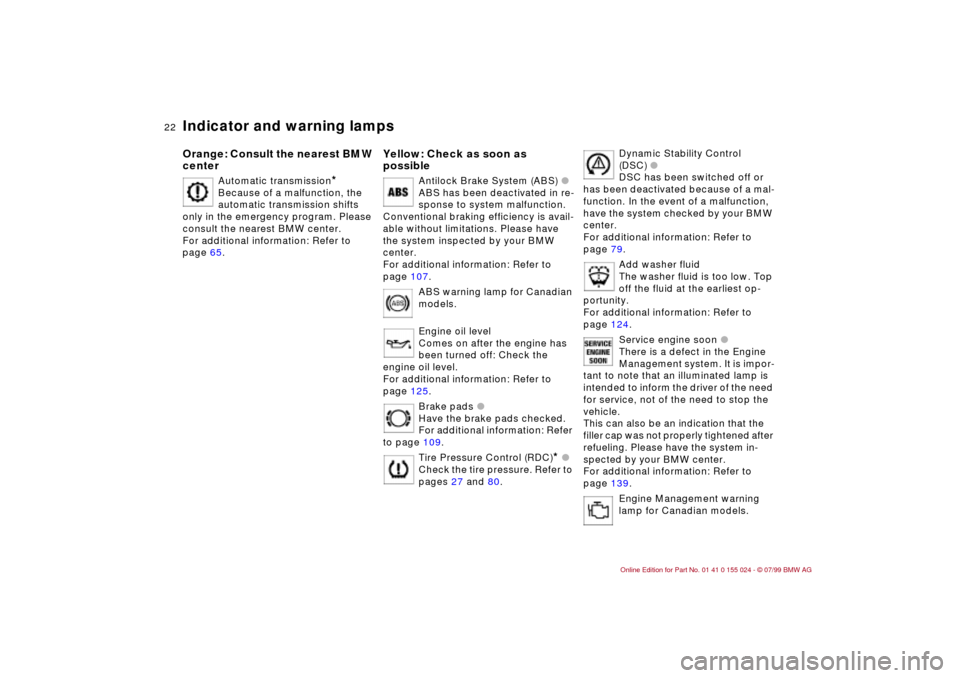
Indicator and warning lampsOrange: Consult the nearest BMW
center
Automatic transmission
*
Because of a malfunction, the
automatic transmission shifts
only in the emergency program. Please
consult the nearest BMW center.
For additional information: Refer to
page 65.
Yellow: Check as soon as
possible
Antilock Brake System (ABS) l
ABS has been deactivated in re-
sponse to system malfunction.
Conventional braking efficiency is avail-
able without limitations. Please have
the system inspected by your BMW
center.
For additional information: Refer to
page 107.
ABS warning lamp for Canadian
models.
Engine oil level
Comes on after the engine has
been turned off: Check the
engine oil level.
For additional information: Refer to
page 125.
Brake pads l
Have the brake pads checked.
For additional information: Refer
to page 109.
Tire Pressure Control (RDC)
* l
Check the tire pressure. Refer to
pages 27 and 80.
Dynamic Stability Control
(DSC) l
DSC has been switched off or
has been deactivated because of a mal-
function. In the event of a malfunction,
have the system checked by your BMW
center.
For additional information: Refer to
page 79.
Add washer fluid
The washer fluid is too low. Top
off the fluid at the earliest op-
portunity.
For additional information: Refer to
page 124.
Service engine soon l
There is a defect in the Engine
Management system. It is impor-
tant to note that an illuminated lamp is
intended to inform the driver of the need
for service, not of the need to stop the
vehicle.
This can also be an indication that the
filler cap was not properly tightened after
refueling. Please have the system in-
spected by your BMW center.
For additional information: Refer to
page 139.
Engine Management warning
lamp for Canadian models.
Page 31 of 189

Overview
Controls and features
Operation, care
and maintenance
Owner service procedures
Technical data
Index Advanced technology
31n
IndexDataTechnologyRepairsCar careControlsOverview
Driving:
Steering/Ignition lock61
Starting the engine61
Switching off the engine62
Parking brake63
Manual transmission64
Automatic transmission with
Steptronic65
Turn signal indicator/Headlamp
flasher68
Wiper/Washer system/Rain
sensor68
Rear window defroster70
Cruise control71
Everything under control:
Odometer73
Tachometer73
Energy Control73
Fuel gauge74
Temperature gauge74
Service Interval Display74
Check Control75
Clock75
Onboard computer76
Technology for safety and
convenience:
Park Distance Control (PDC)78
Dynamic Stability Control
(DSC)79
Tire Pressure Control (RDC)80Lamps:
Parking lamps/Headlamps82
Dash lighting82
High beams/Parking lamps83
Fog lamps83
Interior lamps83
Reading lamps84
Controlling the climate for
pleasant driving:
Automatic climate control86
Seat heating91
Roller sun blind91
Interior conveniences:
HiFi system92
Glove compartment92
Storage compartments93
Cellular phones95
Ashtray, front95
Cigarette lighter96
Ashtray, rear96
Loading and transporting:
Through-loading system97
Ski bag98
Cargo loading99
Roof-mounted luggage rack100
Page 79 of 189

79n
IndexDataTechnologyRepairsCar careControlsOverview
Dynamic Stability Control (DSC) The conceptDSC maintains vehicle stability, even in
critical driving situations.
The system optimizes vehicle stability
during acceleration and when starting
from a full stop, as well as optimizing
traction. In addition, the system recog-
nizes unstable vehicle conditions (un-
dersteering or oversteering, for example)
and holds the vehicle on a sure course
by intervening via the engine and by
braking intervention at the individual
wheels.
The system activates automatically each
time you start the engine.462us284
Indicator lamp
The indicator lamp in the instru-
ment cluster goes out shortly
after you switch on the ignition.
Refer to pages 21 and 22.
Indicator lamp flashes:
The system is actively regulating drive
torque in response to monitored vehicle
operating conditions.
If the indicator lamp fails to go out after
the engine is started, or comes on dur-
ing the course of normal vehicle opera-
tion:
If the system was not switched off,
there is a system malfunction. The vehi-
cle remains operational, but without
DSC. Please consult your BMW center
for repairs.
To deactivate the systemPress the button. The indicator lamp
flashes.
The illustration depicts the arrangement
of the buttons if the vehicle is fully
equipped. This may vary, depending on
the equipment actually installed.
When the DSC is deactivated, you are
operating the vehicle in the conven-
tional drive mode.
In exceptional instances, it is effective
to deactivate the system:
>when rocking the vehicle or starting
off in deep snow or on loose surfaces
>or when driving with snow chains.
Refer also to page 110.To reactivate the systemPress the button again; the indicator
lamp goes out.
The laws of physics cannot be re-
pealed, even with DSC. Any con-
sequences arising from traction loss
due to excessive vehicle speed remain
the responsibility of the driver. For this
reason, do not take risks by using the
additional safety margin provided by
the system as an excuse.<
For additional details concerning DSC,
please refer to the chapter describing
"Advanced technology" on page 163.
Page 107 of 189

107n
IndexDataTechnologyRepairsCar careControlsOverview
Antilock Brake System (ABS)Antilock Brake System (ABS)/
Cornering Brake Control (CBC) CBC is an advanced engineering devel-
opment of ABS. When braking during
cornering with high lateral accelera-
tion, or when braking during a lane
change, vehicle stability is improved
and the steering response is enhanced.
In the event of a fault
If the ABS in the instrument
cluster lights up, refer to
page 22. The brake system then
reverts to conventional operation as on
vehicles without ABS. However, have
the brake system checked by your
BMW center as soon as possible. To
prevent undetected defects and cumu-
lative faults from adversely affecting the
brake system, refer any problems to
your BMW center at the earliest oppor-
tunity.
ABS warning lamp for Canadian
models.
If the brake warning lamp
comes on together with the indi-
cator lamps for ABS and DSC
(refer to page 21), the entire
ABS, CBC and DSC control sys-
tem has failed. Continue driving
cautiously and defensively.
Avoid full brake applications.
This could cause the vehicle to lose
stability and you might no longer be
able to control it.
Have the system checked as soon as
possible by your BMW center.
CBC, ABS and DSC indicator
and warning lamps for Canadian
models.