2000 BMW 323i 109
[x] Cancel search: 109Page 11 of 189

11n
Controls and features
Operation, care and maintenance
Lamps:
Parking lamps/Headlamps82
Dash lighting82
High beams/Parking lamps83
Fog lamps83
Interior lamps83
Reading lamps84
Controlling the climate
for pleasant driving:
Automatic climate control86
Seat heating91
Roller sun blind91
Interior conveniences:
HiFi system92
Glove compartment92
Storage compartments93
Cellular phones95
Ashtray, front95
Cigarette lighter96
Ashtray, rear96
Loading and transporting:
Through-loading system97
Ski bag98
Cargo loading99
Roof-mounted luggage rack100
Special operating instructions:
Break-in procedures104
Driving notes104
Catalytic converter105
Antilock Brake System
(ABS)106
Disc brakes108
Brake system109
Winter operation110
Power steering111
Cellular phones112
Radio reception112
Wheels and tires:
Tire inflation pressures113
Tire condition113
Tire replacement114
Tire rotation115
Wheel and tire
combinations116
Winter tires117
Snow chains117
Approved wheel and tire
specifications118
Under the hood:
Hood120
Engine compartment122
Washer fluids124
Washer nozzles124
Engine oil125
Coolant128
Brake fluid129
Vehicle Identification
Number130
Care and maintenance:
The BMW Maintenance
System131
Caring for your car132
Airbags137
Vehicle storage137
Laws and regulations:
Technical modifications to the
vehicle138
OBD interface socket139
Page 20 of 189
20n
Indicator and warning lamps
Technology that monitors itself
Many of the systems of your BMW
monitor themselves automatically, both
during engine starts and while you are
driving. Indicator and warning lamps
that are identified by "
l
" are tested for
proper functioning whenever the igni-
tion key is turned. They each light up
once for different periods of time.
If a fault should occur in one of these
systems, the corresponding lamp does
not go out after the engine is started, or
it lights up while the vehicle is moving.
You will see how to react to this below.
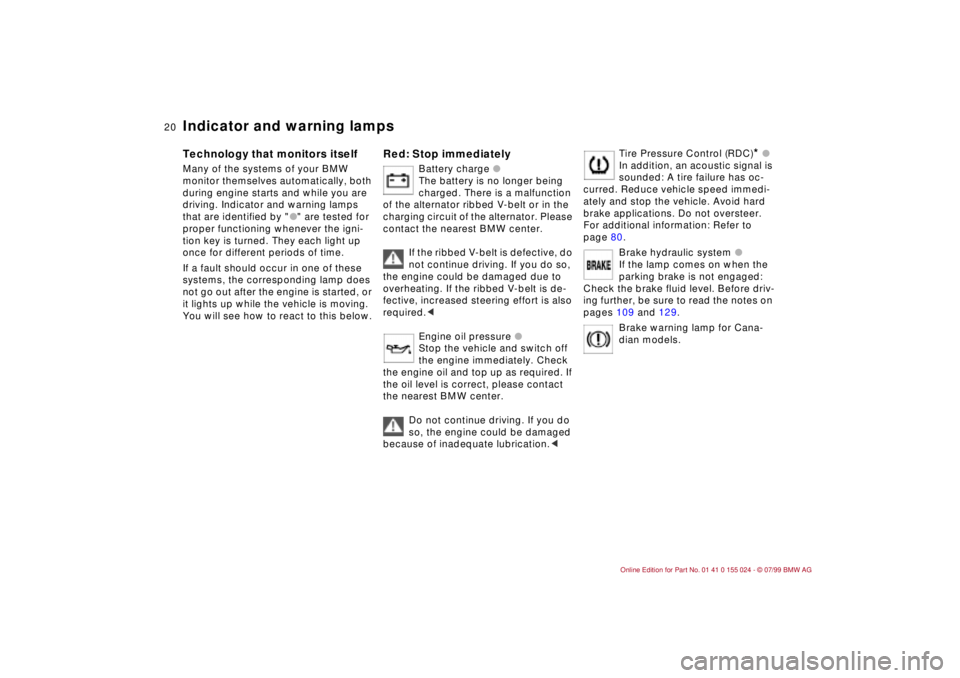
Red: Stop immediately
Battery charge
l
The battery is no longer being
charged. There is a malfunction
of the alternator ribbed V-belt or in the
charging circuit of the alternator. Please
contact the nearest BMW center.
If the ribbed V-belt is defective, do
not continue driving. If you do so,
the engine could be damaged due to
overheating. If the ribbed V-belt is de-
fective, increased steering effort is also
required.<
Engine oil pressure l
Stop the vehicle and switch off
the engine immediately. Check
the engine oil and top up as required. If
the oil level is correct, please contact
the nearest BMW center.
Do not continue driving. If you do
so, the engine could be damaged
because of inadequate lubrication.<
Tire Pressure Control (RDC)
* l
In addition, an acoustic signal is
sounded: A tire failure has oc-
curred. Reduce vehicle speed immedi-
ately and stop the vehicle. Avoid hard
brake applications. Do not oversteer.
For additional information: Refer to
page 80.
Brake hydraulic system l
If the lamp comes on when the
parking brake is not engaged:
Check the brake fluid level. Before driv-
ing further, be sure to read the notes on
pages 109 and 129.
Brake warning lamp for Cana-
dian models.
Page 22 of 189
22n
Indicator and warning lampsOrange: Consult the nearest BMW
center
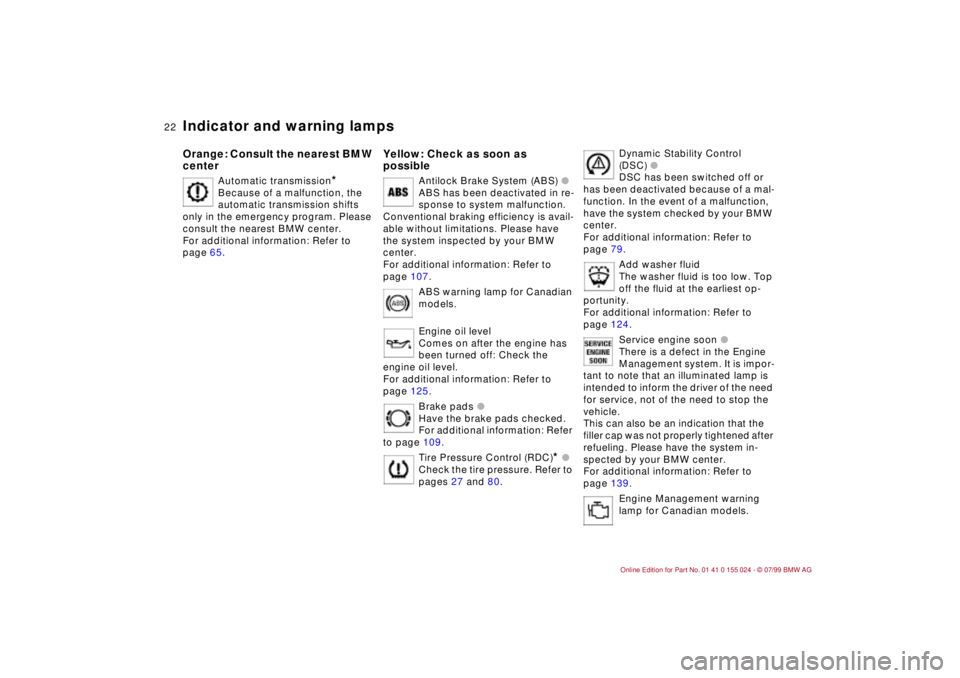
Automatic transmission
*
Because of a malfunction, the
automatic transmission shifts
only in the emergency program. Please
consult the nearest BMW center.
For additional information: Refer to
page 65.
Yellow: Check as soon as
possible
Antilock Brake System (ABS) l
ABS has been deactivated in re-
sponse to system malfunction.
Conventional braking efficiency is avail-
able without limitations. Please have
the system inspected by your BMW
center.
For additional information: Refer to
page 107.
ABS warning lamp for Canadian
models.
Engine oil level
Comes on after the engine has
been turned off: Check the
engine oil level.
For additional information: Refer to
page 125.
Brake pads l
Have the brake pads checked.
For additional information: Refer
to page 109.
Tire Pressure Control (RDC)
* l
Check the tire pressure. Refer to
pages 27 and 80.
Dynamic Stability Control
(DSC) l
DSC has been switched off or
has been deactivated because of a mal-
function. In the event of a malfunction,
have the system checked by your BMW
center.
For additional information: Refer to
page 79.
Add washer fluid
The washer fluid is too low. Top
off the fluid at the earliest op-
portunity.
For additional information: Refer to
page 124.
Service engine soon l
There is a defect in the Engine
Management system. It is impor-
tant to note that an illuminated lamp is
intended to inform the driver of the need
for service, not of the need to stop the
vehicle.
This can also be an indication that the
filler cap was not properly tightened after
refueling. Please have the system in-
spected by your BMW center.
For additional information: Refer to
page 139.
Engine Management warning
lamp for Canadian models.
Page 47 of 189
47n
IndexDataTechnologyRepairsCar careControlsOverview
For your personal safety when adjusting
the seat position, please follow the in-
structions below carefully:
Never try to adjust your seat while
operating the vehicle. The seat
could respond with an unexpected
movement, and the ensuing loss of ve-
hicle control could lead to an accident.
Be sure that the safety belt remains
firmly against your body at all times. In
the event of a frontal impact, a loose lap
belt could slide over the hips, leading to
abdominal injury. In addition, the safety
belt's restraint effectiveness is reduced
if the belt is worn loosely.
Never ride with the backrest reclined to
an extreme angle (especially important
for the front passenger to remember).
If you do so, there is a risk that you will
slide under the safety belt in an acci-
dent, thus reducing the protection pro-
vided by the safety belt.<
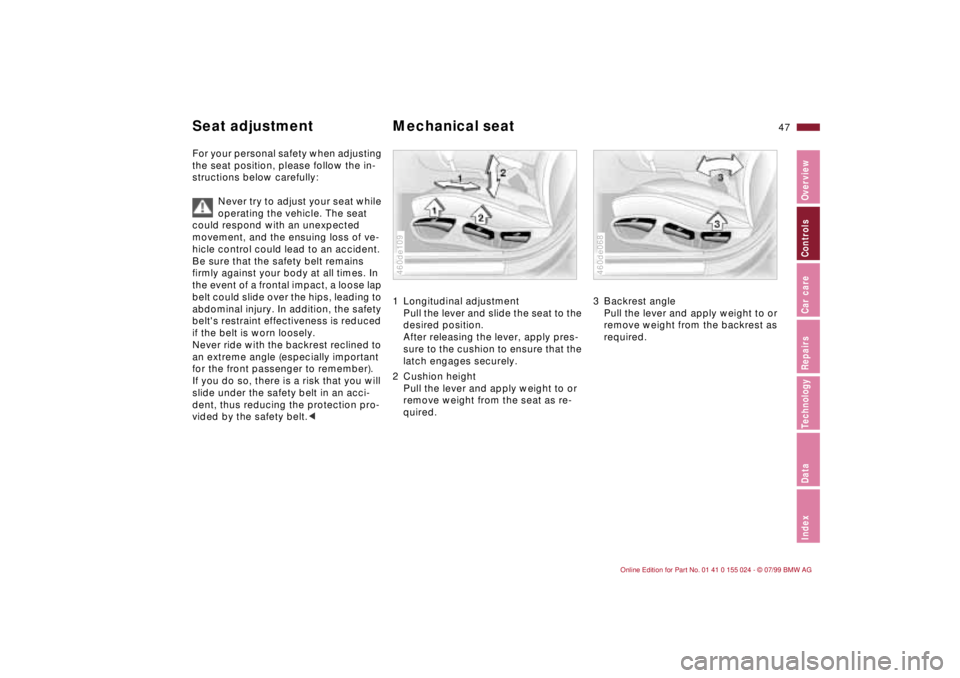
1 Longitudinal adjustment
Pull the lever and slide the seat to the
desired position.
After releasing the lever, apply pres-
sure to the cushion to ensure that the
latch engages securely.
2 Cushion height
Pull the lever and apply weight to or
remove weight from the seat as re-
quired.460de109
3 Backrest angle
Pull the lever and apply weight to or
remove weight from the backrest as
required.460de068
Seat adjustment Mechanical seat
Page 103 of 189
Overview
Controls and features
Operation, care
and maintenance
Owner service procedures
Technical data
Index Advanced technology
103n
IndexDataTechnologyRepairsCar careControlsOverview
Special operating instructions:
Break-in procedures104
Driving notes104
Catalytic converter105
Antilock Brake System
(ABS)106
Disc brakes108
Brake system109
Winter operation110
Power steering111
Cellular phones112
Radio reception112
Wheels and tires:
Tire inflation pressures113
Tire condition113
Tire replacement114
Tire rotation115
Wheel and tire
combinations116
Winter tires117
Snow chains117
Approved wheel and tire
specifications118Under the hood:
Hood120
Engine compartment122
Washer fluids124
Washer nozzles124
Engine oil125
Coolant128
Brake fluid129
Vehicle Identification
Number130
Care and maintenance:
The BMW Maintenance
System131
Caring for your car132
Airbags137
Vehicle storage137
Laws and regulations:
Technical modifications to the
vehicle138
OBD interface socket139
Car care
Page 109 of 189

109n
IndexDataTechnologyRepairsCar careControlsOverview
Brake systemBrake fluid level
If the brake warning lamp
comes on and the parking brake
has been released:
The brake fluid level is too low in the
reservoir (refer to page 129).
If the brake fluid level is too low and
brake pedal travel has become notice-
ably longer, there may be a defect in
one of the hydraulic circuits of the brake
system.
Brake warning lamp for Cana-
dian models.
Proceed to the nearest BMW
center. Higher brake application
pressure may be necessary under these
conditions, and brake pedal travel may
be significantly longer. Please remem-
ber to adapt your driving style accord-
ingly.<
Brake pads
If the warning lamp for the brake
pads lights up:
The brake pads have reached
their minimum pad thickness. Proceed
to the nearest BMW center as soon as
possible to have the pads replaced.
For your own safety: Use only
brake pads that BMW has ap-
proved for your particular vehicle
model. BMW cannot evaluate non-
approved brake pads to determine if
they are suited for use, and therefore
cannot ensure the operating safety of
the vehicle if they are installed.<
Page 114 of 189

114n
To maintain good handling and vehicle
response, use only tires of a single
tread configuration from a single manu-
facturer. BMW tests and approves
wheel/tire combinations. Refer to
page 118.
DOT Quality GradesTreadwear
Traction AA A B C
Temperature A B C
All passenger car tires must con-
form to Federal Safety Require-
ments in addition to these grades.
when tested under controlled condi-
tions on a specified government test
course.
For example, a tire graded 150 would
wear one and one-half (1 1/2) times as
well on the government course as a tire
graded 100. The relative performance
of tires depends upon the actual condi-
tions of their use, however, and may
depart significantly from the norm due
to variations in driving habits, service
practices and differences in road char-
acteristics and climate.
TractionThe traction grades, from highest to
lowest, are AA, A, B and C.
Those grades represent the tire's ability
to stop on wet pavement as measured
under controlled conditions on speci-
fied government test surfaces of as-
phalt and concrete. A tire marked C
may have poor traction performance.
The traction grade assigned to
this tire is based on straight-
ahead braking traction tests, and does
not include acceleration, cornering, hy-
droplaning, or peak traction character-
istics.
tire's resistance to the generation of
heat and its ability to dissipate heat
when tested under controlled condi-
tions on a specified indoor laboratory
test wheel.
Sustained high temperature can cause
the material of the tire to degenerate
and reduce tire life, and excessive tem-
perature can lead to sudden tire failure.
The grade C correspods to a level of
performance which all passenger car
tires must meet under the Federal
Motor Vehicle Safety Standard No. 109.
Grades B and A represent higher levels
of performance on the laboratory test
wheel than the minimum required by
law.
The temperature grade for this tire
is established for a tire that is
properly inflated and not overloaded.
Excessive speed, underinflation, or ex-
cessive loading, either separately or in
combination, can cause heat buildup
and possible tire failure.
tread shoulder and maximum section
width. For example:
Treadwear 200 Traction AA
Temperature A
Tire replacement
Page 129 of 189
129n
IndexDataTechnologyRepairsCar careControlsOverview
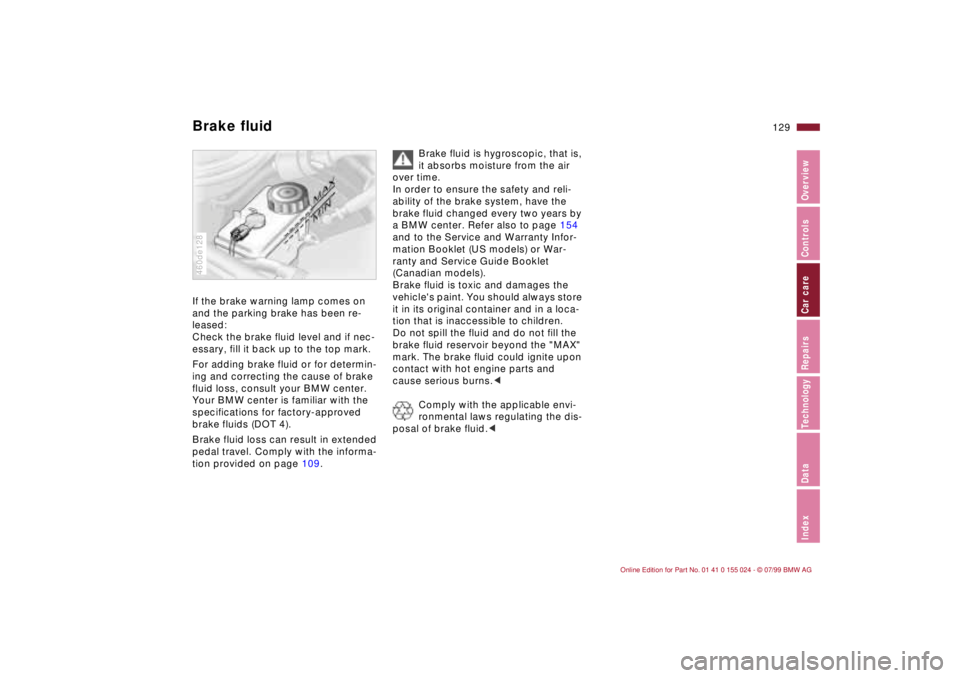
Brake fluidIf the brake warning lamp comes on
and the parking brake has been re-
leased:
Check the brake fluid level and if nec-
essary, fill it back up to the top mark.
For adding brake fluid or for determin-
ing and correcting the cause of brake
fluid loss, consult your BMW center.
Your BMW center is familiar with the
specifications for factory-approved
brake fluids (DOT 4).
Brake fluid loss can result in extended
pedal travel. Comply with the informa-
tion provided on page 109.460de128
Brake fluid is hygroscopic, that is,
it absorbs moisture from the air
over time.
In order to ensure the safety and reli-
ability of the brake system, have the
brake fluid changed every two years by
a BMW center. Refer also to page 154
and to the Service and Warranty Infor-
mation Booklet (US models) or War-
ranty and Service Guide Booklet
(Canadian models).
Brake fluid is toxic and damages the
vehicle's paint. You should always store
it in its original container and in a loca-
tion that is inaccessible to children.
Do not spill the fluid and do not fill the
brake fluid reservoir beyond the "MAX"
mark. The brake fluid could ignite upon
contact with hot engine parts and
cause serious burns.<
Comply with the applicable envi-
ronmental laws regulating the dis-
posal of brake fluid.<