2000 BMW 323i ECU
[x] Cancel search: ECUPage 97 of 189
97n
IndexDataTechnologyRepairsCar careControlsOverview
Through-loading system
*
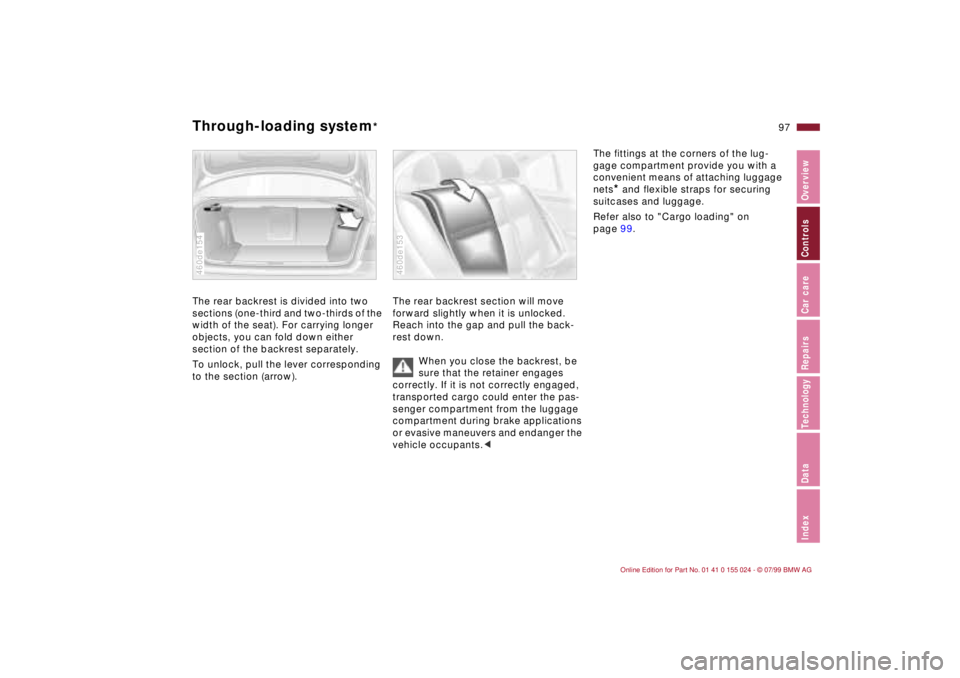
The rear backrest is divided into two
sections (one-third and two-thirds of the
width of the seat). For carrying longer
objects, you can fold down either
section of the backrest separately.
To unlock, pull the lever corresponding
to the section (arrow).460de154
The rear backrest section will move
forward slightly when it is unlocked.
Reach into the gap and pull the back-
rest down.
When you close the backrest, be
sure that the retainer engages
correctly. If it is not correctly engaged,
transported cargo could enter the pas-
senger compartment from the luggage
compartment during brake applications
or evasive maneuvers and endanger the
vehicle occupants.<460de153
The fittings at the corners of the lug-
gage compartment provide you with a
convenient means of attaching luggage
nets
* and flexible straps for securing
suitcases and luggage.
Refer also to "Cargo loading" on
page 99.
Page 98 of 189
98n
Ski bag
*
The ski bag allows the safe and clean
transport of four pairs of skis or two
snowboards.
The length of the ski bag and the addi-
tional space provided in the luggage
compartment make it possible to carry
skis with a length of up to 6.8 feet
(2.1 meters). The ski bag can only
accommodate two pairs of skis with a
length of 6.8 feet (2.1 meters) because
of the tapered shape of the bag.
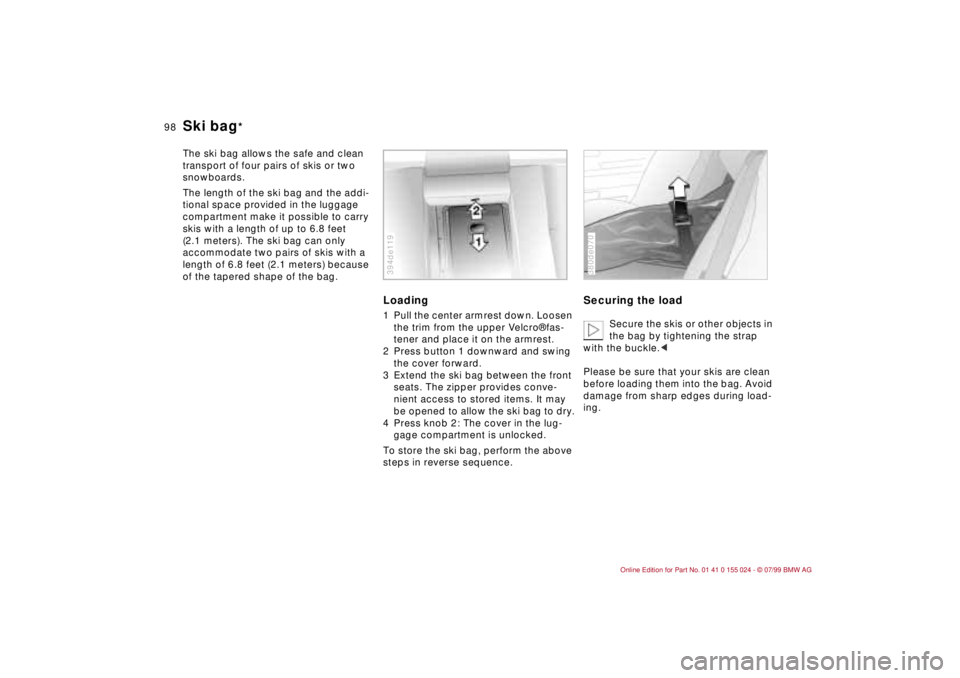
Loading1 Pull the center armrest down. Loosen
the trim from the upper Velcro¨ fas-
tener and place it on the armrest.
2 Press button 1 downward and swing
the cover forward.
3 Extend the ski bag between the front
seats. The zipper provides conve-
nient access to stored items. It may
be opened to allow the ski bag to dry.
4 Press knob 2: The cover in the lug-
gage compartment is unlocked.
To store the ski bag, perform the above
steps in reverse sequence.394de119
Securing the load
Secure the skis or other objects in
the bag by tightening the strap
with the buckle.<
Please be sure that your skis are clean
before loading them into the bag. Avoid
damage from sharp edges during load-
ing.
380de070
Page 99 of 189
99n
IndexDataTechnologyRepairsCar careControlsOverview
Cargo loadingStowing cargo If you are transporting a load in your
BMW
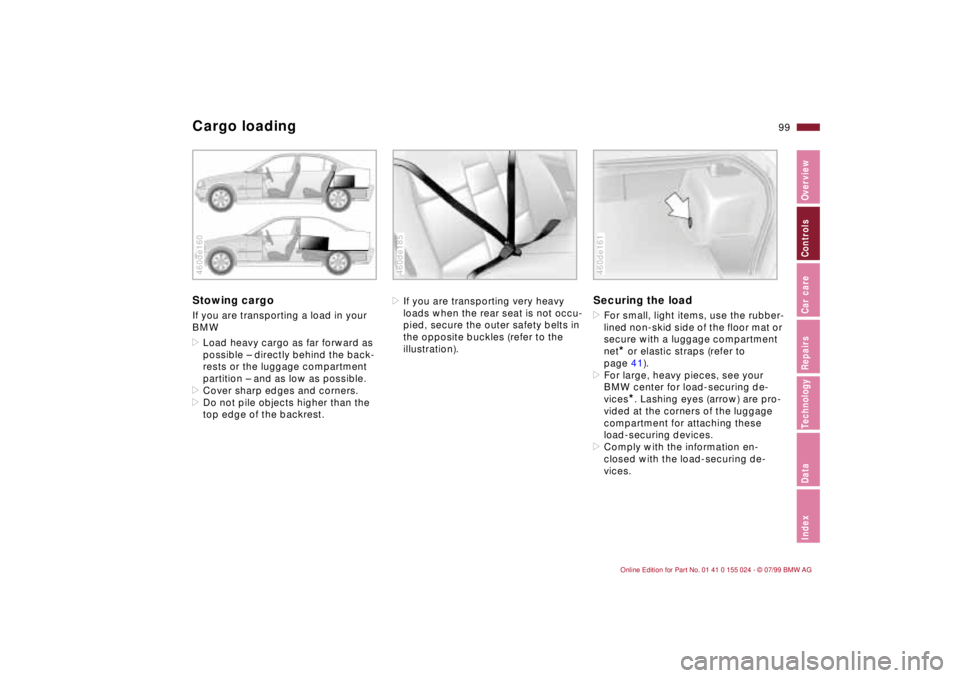
>Load heavy cargo as far forward as
possible Ð directly behind the back-
rests or the luggage compartment
partition Ð and as low as possible.
>Cover sharp edges and corners.
>Do not pile objects higher than the
top edge of the backrest.460de160
>If you are transporting very heavy
loads when the rear seat is not occu-
pied, secure the outer safety belts in
the opposite buckles (refer to the
illustration).460de185
Securing the load >For small, light items, use the rubber-
lined non-skid side of the floor mat or
secure with a luggage compartment
net
* or elastic straps (refer to
page 41).
>For large, heavy pieces, see your
BMW center for load-securing de-
vices*. Lashing eyes (arrow) are pro-
vided at the corners of the luggage
compartment for attaching these
load-securing devices.
>Comply with the information en-
closed with the load-securing de-
vices.
460de161
Page 100 of 189

100n
Cargo loading Roof-mounted luggage rack
*
Always position and secure the
load correctly. If you do not, it can
endanger the passengers during brak-
ing or evasive maneuvers.
Do not exceed the permissible gross
vehicle weight and the permissible axle
loads (refer to page 174). If you do, the
operating safety of the vehicle is no
longer ensured and you are in violation
of the law.
Do not carry hard or heavy objects un-
secured in the passenger compartment.
If you do so, they may be projected
through the air during braking and eva-
sive maneuvers, thus endangering vehi-
cle occupants.<
AnchorsAccess to the anchors:
To open the cover (arrow), please use
the tool included with the luggage rack
system.
A special roof-rack system is available
for your BMW as an optional extra.
Please comply with the precautions in-
cluded with the installation instructions.
Because roof racks raise the center of
gravity of the car when loaded, they
exercise a major effect on its handling
and steering response.
You should therefore always remember
not to exceed the approved roof weight,
the approved gross vehicle weight or
the axle weights when loading the rack.
You will find the specifications under
"Technical Data" on page 174.462de271
Make sure that the load is not too heavy,
and attempt to distribute it evenly.
Always load the heaviest pieces first (on
the bottom). Be sure that adequate
clearance is maintained for raising the
sliding/tilt sunroof
*, and that objects do
not project into the opening path of the
luggage compartment lid.
Secure the roof luggage correctly and
securely to prevent it from shifting or
being lost during driving (danger to fol-
lowing traffic).
Drive smoothly and avoid sudden ac-
celeration or braking. Do not corner at
high speeds.
The roof load increases the aerody-
namic resistance. Increased fuel con-
sumption and additional stresses on the
vehicle's body result from this.
Page 106 of 189

106n
Antilock Brake System (ABS)The concept ABS enhances active safety by helping
to prevent the wheels from locking un-
der braking. This is because locked
wheels are dangerous. When the front
wheels slide, the driver loses steering
control over the vehicle. Traction loss at
the rear wheels can cause the rear end
to break into an uncontrolled skid.
ABS is designed to meet two essential
requirements during every brake appli-
cation:
>To help provide vehicle stability
>To help maintain steering control and
maneuverability Ð on all types of road
surfaces (asphalt, concrete, mud, wet,
snow, ice).
The system can achieve the shortest
braking distances possible under most
conditions (on straight-aways and in
curves, on asphalt, ice, wet road sur-
faces, etc.).
Braking with ABSThe system becomes operative once
the vehicle exceeds a speed of approx.
6 mph (10 km/h). Below approx. 3 mph
(6 km/h), it is once again deactivated.
This means that the wheels can lock in
the final phase of a panic stop Ð a factor
of no significance in actual use.
If you are in a situation that requires full
braking, you will exploit the full benefits
of the ABS system if you apply maxi-
mum brake pressure ("panic stop").
Since the vehicle maintains steering re-
sponsiveness, you can avoid possible
obstacles with a minimum of steering
effort, despite the full brake application.
The ABS system closed-loop control
circuit cycles in fractions of a second.
A pulsation at the brake pedal indicates
to the driver that ABS is active, that is,
that the vehicle is within its maximum
braking range. In addition, a pulsation Ð
a result of the control function cycles Ð
indicates to the driver that vehicle
speed should be reduced to adapt to
road surface conditions when there is
reduced traction and grip between tires
and road surface (slippery road sur-
face).
On road surfaces that have a loose sur-
face layer on a firm base with good
traction (on gravel or snow, for exam-ple), or when snow chains are mounted,
braking distances may be longer than
with locked wheels. However, ABS
continues to provide enhanced vehicle
stability and steering response under
these conditions.
Information for your safetyNot even ABS can suspend the laws of
physics. ABS cannot prevent the con-
sequences of brake applications with
inadequate clearances for safety be-
tween vehicles, when exceeding the
speed limit in curves, or the risks in-
volved when aquaplaning occurs. Re-
sponsibility for these types of situations
remains in the hands (and at the feet) of
the driver. You should never allow the
added safety of ABS to lull you into a
false sense of security, or mislead you
into taking increased risks that could af-
fect your own safety and that of others.
Do not make any modifications to
the ABS system.
Service procedures on ABS are to be
performed by authorized technicians
only.<
Page 121 of 189
121n
IndexDataTechnologyRepairsCar careControlsOverview
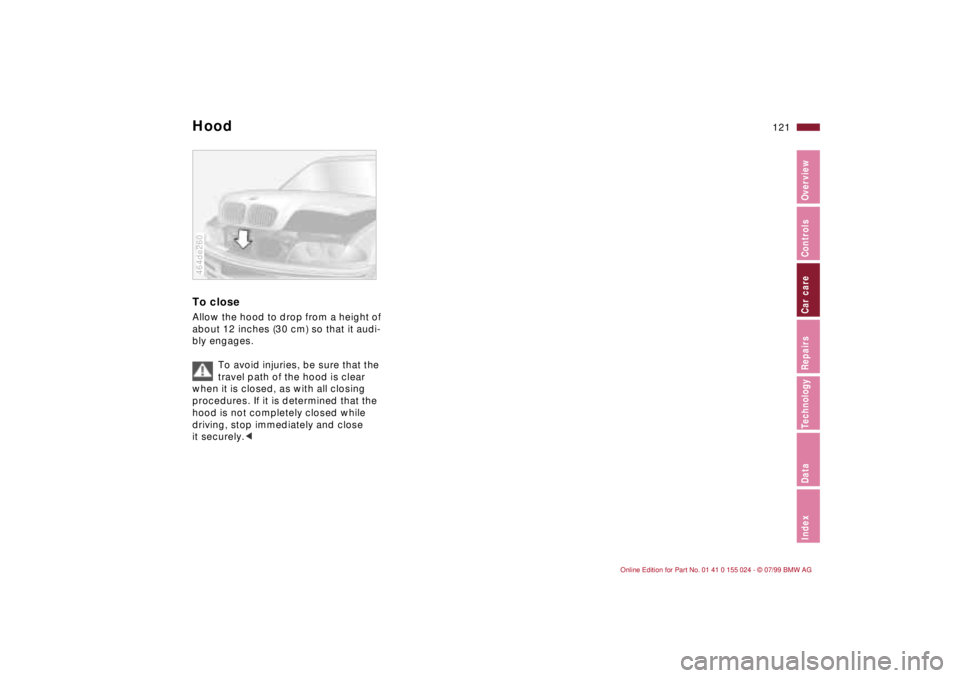
HoodTo closeAllow the hood to drop from a height of
about 12 inches (30 cm) so that it audi-
bly engages.
To avoid injuries, be sure that the
travel path of the hood is clear
when it is closed, as with all closing
procedures. If it is determined that the
hood is not completely closed while
driving, stop immediately and close
it securely.<464de260
Page 136 of 189

136n
Caring for your carThe buildup of an electrostatic charge
on the seat covers, particularly if atmo-
spheric humidity is low, can give the
occupants an unpleasant electric shock
if they touch metal body parts after leav-
ing the vehicle. Although this not dan-
gerous in any way, it can be avoided by
touching a bare or polished metal part
of the car while getting out.Leather care The leather upholstery
* used by BMW
is a natural product of the highest qual-
ity, processed using state-of-the-art
methods to ensure that it will maintain
its high quality for years to come, pro-
vided that it is properly cared for.
Because this product is manufactured
using natural materials, you must make
allowance for its special characteristics
and for the peculiarities of its use and
care.
Regular periodic cleaning and care are
essential, as dust and road dirt act as
abrasives in the pores and creases of
the material. This leads to wear spots
and premature brittleness on the sur-
face of the leather. We therefore sug-
gest that you clean the leather with a
vacuum cleaner or cloth at frequent
intervals.For cleaning, use BMW leather cleaning
foam.
Since dirt and grease gradually attack
the protective layer of the leather, the
cleaned surfaces should be treated
with BMW leather care agent. This also
acts as an antistatic agent.
For protection against dampness or
moisture, treat the leather with a BMW
impregnating agent.
We recommend that you perform this
procedure twice a year on leather ex-
posed to normal use.
Spills should be wiped up immediately.
Remove grease and oil stains without
rubbing, but rather by dabbing with
spot remover.
If the upholstery will be exposed to in-
tense sunlight, or if the vehicle is to be
stored for an extended period, cover all
leather surfaces to prevent fading (or
better yet, cover the windows).
Use cleaning and car-care
products that you can obtain at
your BMW center.<
Cleaning agents can contain sub-
stances that are dangerous or that
pose health risks. For this reason, al-
ways comply with the warnings and
danger notices on the packaging.
Open the doors or windows on your ve-
hicle when cleaning the interior. Never
clean your vehicle with solvents or other
materials not specifically intended for
this purpose.<
Page 150 of 189
150n
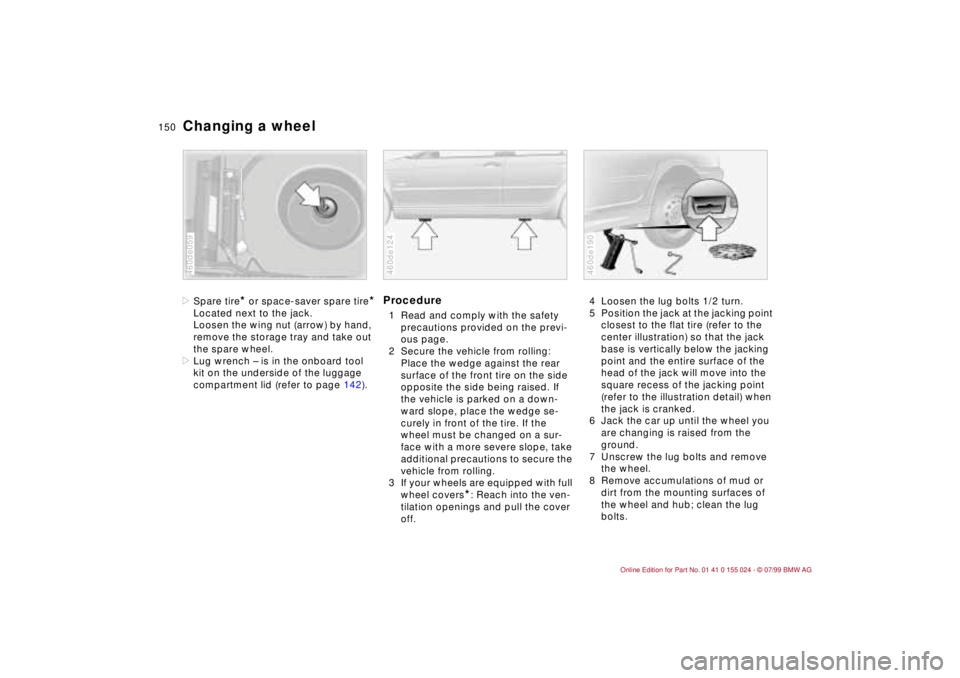
Changing a wheel>Spare tire
* or space-saver spare tire
*
Located next to the jack.
Loosen the wing nut (arrow) by hand,
remove the storage tray and take out
the spare wheel.
>Lug wrench Ð is in the onboard tool
kit on the underside of the luggage
compartment lid (refer to page 142).460de059
Procedure1 Read and comply with the safety
precautions provided on the previ-
ous page.
2 Secure the vehicle from rolling:
Place the wedge against the rear
surface of the front tire on the side
opposite the side being raised. If
the vehicle is parked on a down-
ward slope, place the wedge se-
curely in front of the tire. If the
wheel must be changed on a sur-
face with a more severe slope, take
additional precautions to secure the
vehicle from rolling.
3 If your wheels are equipped with full
wheel covers
*: Reach into the ven-
tilation openings and pull the cover
off.
460de124
4 Loosen the lug bolts 1/2 turn.
5 Position the jack at the jacking point
closest to the flat tire (refer to the
center illustration) so that the jack
base is vertically below the jacking
point and the entire surface of the
head of the jack will move into the
square recess of the jacking point
(refer to the illustration detail) when
the jack is cranked.
6 Jack the car up until the wheel you
are changing is raised from the
ground.
7 Unscrew the lug bolts and remove
the wheel.
8 Remove accumulations of mud or
dirt from the mounting surfaces of
the wheel and hub; clean the lug
bolts.460de190