2000 BMW 323i ABS
[x] Cancel search: ABSPage 108 of 189

108n
Disc brakesDisc brakes furnish optimum decelera-
tion and braking control and greater
fade resistance under heavy use.
When the vehicle is driven only occa-
sionally, during extended periods when
the vehicle is not used at all, and in oper-
ating conditions where brake applica-
tions are less frequent, there is an
increased tendency for corrosion of the
rotors and accumulation of contamina-
tion on the brake pads. This occurs
because the minimal pressure that must
be exerted by the pads to clean the
rotors by brake applications is not
reached.
If the brake rotors are corroded, they
will tend to respond to braking with a
pulsating effect that even extended
brake applications will fail to cure.
For your own safety: Use only
brake pads that BMW has ap-
proved for your particular vehicle
model. BMW cannot evaluate non-
approved brake pads to determine if
they are suited for use, and therefore
cannot ensure the operating safety of
the vehicle if they are installed.<
Driving notesWhen driving in wet conditions and in
heavy rain, it is effective to apply light
pressure to the brakes every few miles
or kilometers. Be aware of traffic condi-
tions to ensure that this maneuver does
not endanger other road users. The
heat that is generated by the brake ap-
plications helps to dry the brake pads
and rotors.
Maximum braking force is obtained
while the wheels are not locked, but
rather when they are still barely turning
immediately prior to locking. ABS main-
tains this state automatically. If the ABS
fails, you should revert to the staggered
braking technique described above on
page 110.
Long or steep mountain descents do
not necessarily lead to reduced braking
efficiency if you drive downhill with the
transmission in a gear that allows mini-
mal brake applications (or, with an au-
tomatic transmission, in an appropriate
lower range).
You can further increase the engine's
braking effect by selecting a lower gear,
downshifting as far as first gear or plac-
ing the selector lever in position 1.Should engine braking prove inade-
quate, you should still avoid extended,
continuous braking. Instead of main-
taining low to moderate pressure over
an extended period of time, you should
decelerate by applying more substantial
pressure to the brake pedal (watch for
following traffic), releasing the pedal,
and then repeating the application
(staggered braking). The cooling phases
between active braking intervals pre-
vent the brakes from overheating, thus
ensuring that full braking capacity re-
mains available at all times.
Do not coast with the clutch de-
pressed or with the shift lever or
selector lever in neutral. Do not drive
with the engine shut off. The engine
provides no braking effect when the
clutch is depressed or the transmission
is in neutral, and there is no power-
assist for braking or steering when the
engine is not running.
Do not allow floor mats, carpets or any
other objects to protrude into the area
around the brake pedal, the clutch or
the accelerator which could obstruct
their freedom of movement.<
Page 110 of 189

110n
Winter operationThe onset of winter is often accompa-
nied by rapid changes in weather.
Adaptations in driving style should be
accompanied by preparations on the
vehicle itself to ensure that your
progress through the winter remains
safe and trouble-free.CoolantBe sure that the coolant mixture con-
tains the year-round ratio of 50:50
water and extended-duty antifreeze/
corrosion protection. This mixture pro-
vides protection against freezing down
to approx. Ð 34 7 (Ð 37 6). Replace
the coolant every four years.LocksBMW door lock deicer can be used to
free them if frozen. This deicer also
contains lubricant.
After its use, treatment with BMW lock
barrel grease is recommended.Rubber seals and components To prevent the weather-stripping from
freezing, apply a spray-on rubber treat-
ment or silicone spray to the door, hood
and luggage compartment lid seals.
A full range of car care products is
available from your BMW center.<
Snow chains BMW snow chains
* can be mounted on
both summer and winter tires. Mount
them in pairs on the rear wheels only
and comply with the manufacturer's
safety precautions. Do not exceed a
maximum speed of 30 mph (50 km/h).
For best performance, deactivate the
DSC when snow chains are mounted.
Refer to page 79.
Starting offWhen starting from a full stop in deep
snow or for "rocking" the vehicle to free
it, we recommend that you deactivate
the DSC system. Refer to page 79.Driving on low-traction road
surfacesUse smooth, gentle pressure to control
the accelerator pedal. Avoid excessive
engine speeds and shift to the next
higher gear at an early point. On down-
grades or slopes, shift down to the next
lower gear at an early point. Maintain an
adequate distance between yourself
and the car ahead.
BrakesWinter road conditions substantially re-
duce the traction available between the
tires and the road surface. Remember
that braking distances will be signifi-
cantly longer as a result.
ABS is intended to prevent the wheels
from locking during brake applications,
thus helping to maintain vehicle stability
and steering response.
If the ABS does not respond in a critical
braking situation and the wheels lock:
Reduce the pressure on the brake pedal
until the wheels just start to roll again
while still maintaining enough force to
continue braking.
Following that, increase pedal pressure
again. Reduce the pressure as the
wheels lock, then reapply pressure.
Repeat this procedure. This type of
staggered braking will reduce the brak-
ing distance, and the vehicle still re-
mains responsive to steering. It allows
you to steer around hazards once you
have reduced the pressure on the brake
pedal.
Page 116 of 189

116n
Wheel and tire combinations The right choice Use only BMW-approved tires. Refer to
page 118.
Due to the high speeds this vehicle can
reach, the use of specific brands, spec-
ifications and sizes is mandatory. Con-
sult any BMW center for details. Com-
ply with local/national regulations.
The correct wheel-tire combina-
tion affects different systems such
as ABS, ATC and DSC. The function of
these systems is impaired if improper
wheel-tire combinations are used.
For this reason, use only tires of the
same brand and tread pattern. In the
event of a flat tire, for example, remount
the approved wheel-tire combination as
soon as possible.<
Codes on tires and wheels The tire codes will aid you in selecting
the correct tire.
The codes on radial tires:
The speed rating indicates the approved
maximum speed for the tire.
Summer tires:
S = up to 112 mph (180 km/h)
T = up to 118 mph (190 km/h)
H = up to 130 mph (210 km/h)
V = up to 150 mph (240 km/h)
W = up to 167 mph (270 km/h)
Y = above 167 mph (270 km/h)
ZR = above 150 mph (240 km/h) Example:
Nominal width
in mm
Aspect ratio in %
Radial tire ID code
Rim diameter in inches
Load rating
(not on ZR tires)
Speed rating
(before R on ZR tires)
205/60 R
1591W
Winter tires:
Q M+S = up to 100 mph (160 km/h)
T M+S = up to 118 mph (190 km/h)
H M+S = up to 130 mph (210 km/h)
Codes stamped on light-alloy wheels:
Protect tire valve from dirt by using
screw-on valve stem caps. Dirt in the
valves frequently leads to slow leaks. Example:
Rim width
in inches
Code letter for
flange type
Symbol for full-drop
center rim
Rim diameter in inches
Hump on the 2 rim shoulders
7 x 15 H 2
J
Page 129 of 189
129n
IndexDataTechnologyRepairsCar careControlsOverview
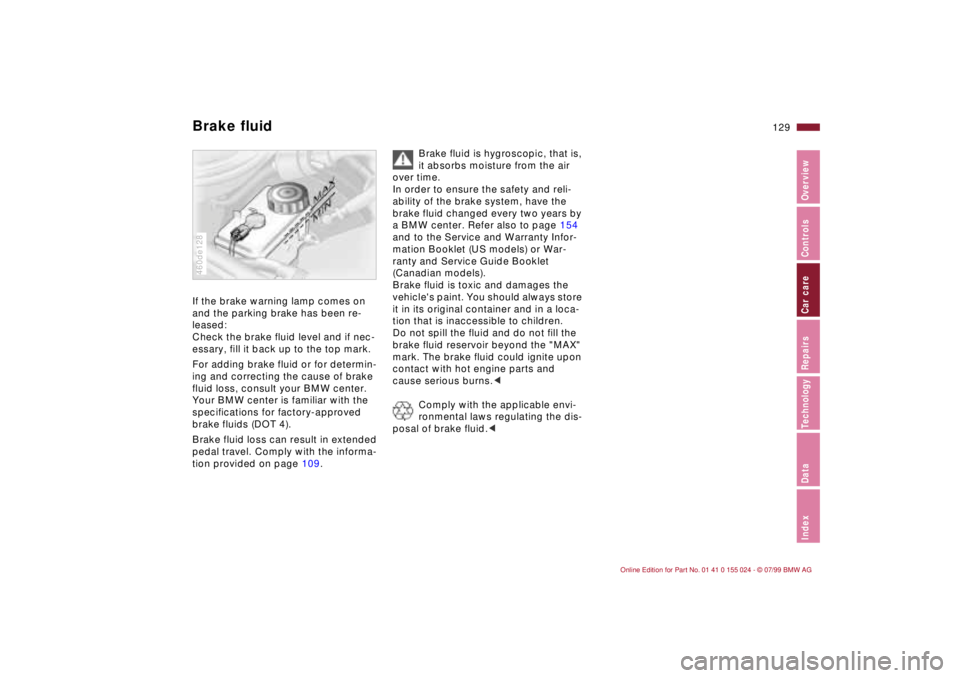
Brake fluidIf the brake warning lamp comes on
and the parking brake has been re-
leased:
Check the brake fluid level and if nec-
essary, fill it back up to the top mark.
For adding brake fluid or for determin-
ing and correcting the cause of brake
fluid loss, consult your BMW center.
Your BMW center is familiar with the
specifications for factory-approved
brake fluids (DOT 4).
Brake fluid loss can result in extended
pedal travel. Comply with the informa-
tion provided on page 109.460de128
Brake fluid is hygroscopic, that is,
it absorbs moisture from the air
over time.
In order to ensure the safety and reli-
ability of the brake system, have the
brake fluid changed every two years by
a BMW center. Refer also to page 154
and to the Service and Warranty Infor-
mation Booklet (US models) or War-
ranty and Service Guide Booklet
(Canadian models).
Brake fluid is toxic and damages the
vehicle's paint. You should always store
it in its original container and in a loca-
tion that is inaccessible to children.
Do not spill the fluid and do not fill the
brake fluid reservoir beyond the "MAX"
mark. The brake fluid could ignite upon
contact with hot engine parts and
cause serious burns.<
Comply with the applicable envi-
ronmental laws regulating the dis-
posal of brake fluid.<
Page 153 of 189
153n
IndexDataTechnologyRepairsCar careControlsOverview
BatteryBattery careThe battery is absolutely maintenance-
free, that is, the original electrolyte will
normally last for the service life of the
battery under moderate climatic condi-
tions.
For all questions that regard the
battery, please consult your BMW
center. Since the battery is mainte-
nance-free, the following is for your
information only.
comply with the corresponding precau-
tions whenever you work with or near
the battery.
Before handling the battery,
please read the following infor-
mation.
Wear eye protection. Do not
allow particles containing bat-
tery acid or lead to come into
contact with your eyes, your skin, or
your clothing.
Battery acid is extremely corro-
sive. Wear eye protection and
protective gloves. Do not tip the
battery. Battery acid can leak from the
ventilation openings.
Do not allow children access to
batteries and battery acid.
Never allow sparks or open
flame in the vicinity of the bat-
tery. Avoid sparks from electri-
cal cables or electrical equipment. Turn
the key to position 0 in the steering lock
when disconnecting or connecting the
battery. Do not short-circuit the battery
terminals. This creates a risk of injury
from high-energy sparks.
A highly-explosive gas is gener-
ated when the battery is charged.
If battery acid is splashed into
your eyes, rinse them thor-
oughly with clear water for at
least 15 minutes. Consult a physician
immediately. If your skin or clothing are
splashed by acid, rinse immediately
with ample clear water. If electrolyte is
accidentally swallowed, consult a phy-
sician immediately.
In order to protect the battery
case from ultraviolet radiation,
do not place it in direct sunlight.
A discharged battery can freeze. Store
the battery in areas where temperature
remains above freezing.
Removal and installation
Do not disconnect the battery
when the engine is running. If you
do so, the ensuing voltage surge will
damage the vehicle's onboard electron-
ics.
Do not make any modifications in the
wires to the positive terminal. If you do
so, the protective function of the safety
battery terminal is no longer ensured.
Repair and disposal must be performed
by trained technicians only.<
When removing the battery, disconnect
the cable on the negative terminal first,
then the cable on the positive terminal.
Loosen the center adjusting screw on
the battery retaining strap (use the
screwdriver included with the onboard
tool kit) and disconnect the strap.
When installing a battery, connect the
positive terminal first, then connect the
negative terminal.
When installing a battery, be sure
that it is mounted properly and
that the retaining bracket is installed
with the center adjustment screw. If this
is not done, the battery will not be ade-
quately secured in case of an acci-
dent.<
Page 180 of 189

Everything from A to ZAABS (Antilock Brake
System)22, 106
Accessories6
Activated-charcoal
filter90, 155
Adaptive Transmission
Control (ATC)65, 162
Adding engine oil125
Adding washer
fluid124, 175
Adjusting the backrest47
Adjusting the steering
wheel51
Adjusting the thigh support
area49
Air distribution88
Air nozzles86
Air outlets86
ventilation86
Air pressure113
Air supply89
Airbags21, 56, 137, 163
Alarm system42
Antenna112
Antenna, Diversity164
Antifreeze128
radiator110
Antilock Brake System
(ABS)22, 106
Anti-theft alarm system42
Aquaplaning104, 113
Armrest93Ashtray95
front95
rear96
ATC (Adaptive Transmission
Control)65, 162
AUC (Automatic
recirculated-air
control)89
Automatic car washes132
Automatic climate
control86
removing condensation
from the windows89
Automatic cruise control71
Automatic dimming, interior
rearview mirror53
Automatic recirculated-air
control (AUC)89
Automatic transmission with
Steptronic22, 65
Automatic windshield
washer69
Average consumption77
Average speed77
Axle loads174
BBackup lamps64
bulb replacement145
Battery152, 176
capacity176
charge154discharged157
removal and
installation153
Battery charge current20
Battery Safety Terminal
(BST)153
Belts54
Blower89
BMW High Performance
Synthetic Oils126
BMW Sports Seat49
Bore172
Brake fluid129
Brake hydraulic system20
Brake lamps
bulb replacement145
Brake pads22
Brakes108
malfunctions109
Break-in procedure104
Breaking in the vehicle104
BST (Battery Safety
Terminal)153
Bulb replacement142
CCapacities175
Car Memory53
Car radio112
refer also to the separate
Owner's ManualCar radio
reception112, 164
Car vacuum cleaner,
connecting96
Car wash132
Care
exterior133
interior134
Care of upholstery135
Care of wool velour135
Cargo loading99
Caring for the vehicle
finish133
Catalytic converter105
CBC (Cornering Brake
Control)21, 107
Cellular phone95, 112
refer also to the separate
Owner's Manual
Center (high-mount) brake
lamp147
Center armrest93
Central locking system34
button38
Changing a tire149
Changing a wheel149
Charge indicator lamp20
Check Control75
Child restraint
systems55, 59
Child seat59
Child-safety locks56
Cigarette lighter96
Everything from A-Z
Page 181 of 189

Everything from A to Z
181n
IndexDataTechnologyRepairsCar careControlsOverview
Clock75
refer also to the Radio
or Onboard Computer
Owner's Manual
Cockpit16
Coin holder, cup holder93
Combination switch68
Compression172
Computer76
Configure settings53
Consumption77
Consumption display74
Coolant110, 128, 175
antifreeze110
Coolant temperature
gauge74
Cooling system175
Cornering Brake Control
(CBC)21, 107
Cruise control71
Cruising range77
Curb weight174DDash lighting82
Dashboard16
Data
dimensions173
engine172
weights174
Daytime-driving lamp
switch82
Defrost position89Defroster, rear window90
Defrosting the windows89
Digital clock75
Dimensions173
Dipstick125
Disc brakes108
Displacement172
Display lighting82
Displays18
Distance warning78
Diversity Antenna164
Divided rear backrest97
Door key32
Door locks, care110
Doors
child-safety locks56
emergency operation34
unlocking and locking34
Draft-free ventilation90
Driving hints104
Driving in winter110
Driving lamps82
Dynamic Stability Control
(DSC)22, 79, 163
EElectric power windows44
Electrical accessories,
failure154
Electrical system176
Electronic vehicle
immobilizer33
Elements of operation16Emergency operation,
doors34
Energy Control73
Engine
starting61
Engine compartment122
Engine coolant128, 175
Engine data172
Engine oil
capacity175
consumption125
pressure20
quality126
specifications126
viscosity126
Engine oil level21, 22
check125
Engine speed172
Exterior mirrors52
FFailure messages75
Fault
ABS107
Fault displays75
Filler cap cover26
Filling capacities175
Filling the washer
reservoir175
First aid25
First-aid kit25
Fittings, towing and
tow-starting158Flashlight92
Flat tire113, 149
Fog lamps83
Folding rear backrest97
Footbrake108
Footwell lamps83
bulb replacement148
Front fog lamps83
bulb replacement145
Front seat-adjustment47
Frost protection,
radiator128
Fuel26
fuel injection172
Fuel consumption77
Fuel consumption
display74
Fuel filler door
releasing following an
electrical malfunction156
Fuel gauge74
Fuel quality26
Fuel reserve indicator
lamp74
Fuel tank capacity175
Fuel tank gauge74
Functional status168
Fuses154
GGasoline26
Gasoline gauge74
Glove compartment92