Page 131 of 189
129n
RepairsIndexOverview Controls Car care Technology Data
The BMW Maintenance System has
been designed as a reliable means of
providing maximum driving and operat-
ing safety – and as cost-effectively as
possible for you. With respect to the
previous version, maintenance costs
can clearly be reduced due to technical
innovations.
Please keep in mind that regular main-
tenance is not only necessary for the
safety of your vehicle, but also plays a
significant role in maintaining the resale
value of the vehicle. 462us022
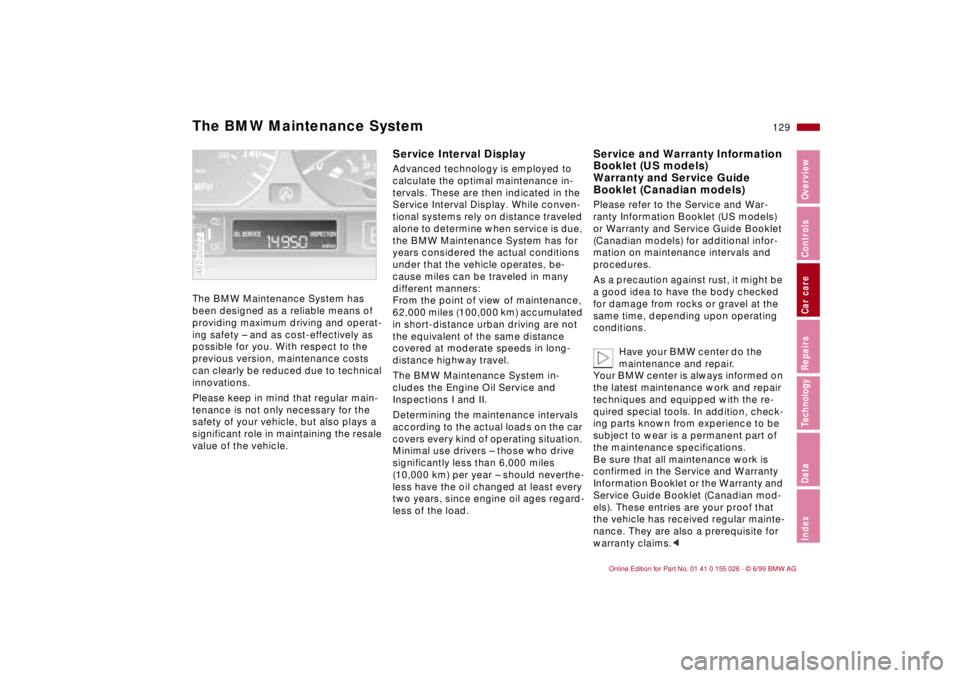
Service Interval DisplayAdvanced technology is employed to
calculate the optimal maintenance in-
tervals. These are then indicated in the
Service Interval Display. While conven-
tional systems rely on distance traveled
alone to determine when service is due,
the BMW Maintenance System has for
years considered the actual conditions
under that the vehicle operates, be-
cause miles can be traveled in many
different manners:
From the point of view of maintenance,
62,000 miles (100,000 km) accumulated
in short-distance urban driving are not
the equivalent of the same distance
covered at moderate speeds in long-
distance highway travel.
The BMW Maintenance System in-
cludes the Engine Oil Service and
Inspections I and II.
Determining the maintenance intervals
according to the actual loads on the car
covers every kind of operating situation.
Minimal use drivers – those who drive
significantly less than 6,000 miles
(10,000 km) per year – should neverthe-
less have the oil changed at least every
two years, since engine oil ages regard-
less of the load.
Service and Warranty Information
Booklet (US models)
Warranty and Service Guide
Booklet (Canadian models)Please refer to the Service and War-
ranty Information Booklet (US models)
or Warranty and Service Guide Booklet
(Canadian models) for additional infor-
mation on maintenance intervals and
procedures.
As a precaution against rust, it might be
a good idea to have the body checked
for damage from rocks or gravel at the
same time, depending upon operating
conditions.
Have your BMW center do the
maintenance and repair.
Your BMW center is always informed on
the latest maintenance work and repair
techniques and equipped with the re-
quired special tools. In addition, check-
ing parts known from experience to be
subject to wear is a permanent part of
the maintenance specifications.
Be sure that all maintenance work is
confirmed in the Service and Warranty
Information Booklet or the Warranty and
Service Guide Booklet (Canadian mod-
els). These entries are your proof that
the vehicle has received regular mainte-
nance. They are also a prerequisite for
warranty claims.<
The BMW Maintenance System
Page 154 of 189
152n
Battery
A highly-explosive gas is gener-
ated when the battery is
charged.
If you happen to get acid in your
eyes, rinse thoroughly for 15 min-
utes with clear water. Consult a
physician immediately. Rinse your skin
or clothing with plenty of water if you get
acid spray on them. If electrolyte is acci-
dentally ingested, consult a physician
immediately.
In order to protect the battery
case from ultraviolet radiation,
do not place it in direct sunlight.
A discharged battery can freeze. Store
the battery in areas where temperature
remains above freezing.
Battery careThe battery is completely maintenance-
free, as per DIN 43 539/2; that is, the
amount of acid put in the battery origi-
nally will normally last for the service life
of the battery.
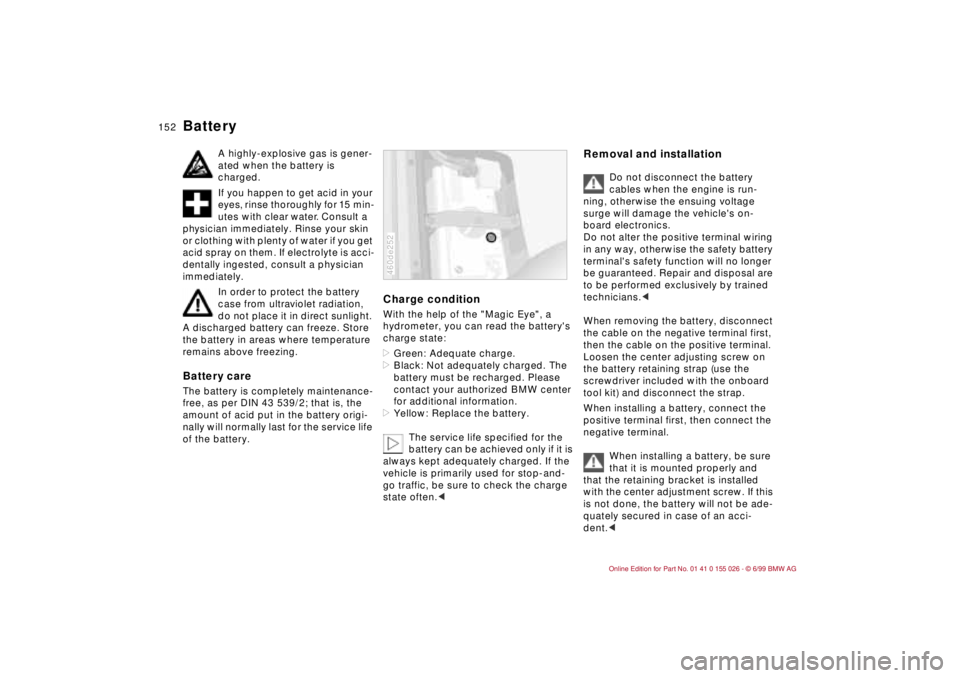
Charge conditionWith the help of the "Magic Eye", a
hydrometer, you can read the battery's
charge state:
>Green: Adequate charge.
>Black: Not adequately charged. The
battery must be recharged. Please
contact your authorized BMW center
for additional information.
>Yellow: Replace the battery.
The service life specified for the
battery can be achieved only if it is
always kept adequately charged. If the
vehicle is primarily used for stop-and-
go traffic, be sure to check the charge
state often.<460de252
Removal and installation
Do not disconnect the battery
cables when the engine is run-
ning, otherwise the ensuing voltage
surge will damage the vehicle's on-
board electronics.
Do not alter the positive terminal wiring
in any way, otherwise the safety battery
terminal's safety function will no longer
be guaranteed. Repair and disposal are
to be performed exclusively by trained
technicians.<
When removing the battery, disconnect
the cable on the negative terminal first,
then the cable on the positive terminal.
Loosen the center adjusting screw on
the battery retaining strap (use the
screwdriver included with the onboard
tool kit) and disconnect the strap.
When installing a battery, connect the
positive terminal first, then connect the
negative terminal.
When installing a battery, be sure
that it is mounted properly and
that the retaining bracket is installed
with the center adjustment screw. If this
is not done, the battery will not be ade-
quately secured in case of an acci-
dent.<
Page 163 of 189
161n
RepairsIndexOverview Controls Car care Technology Data
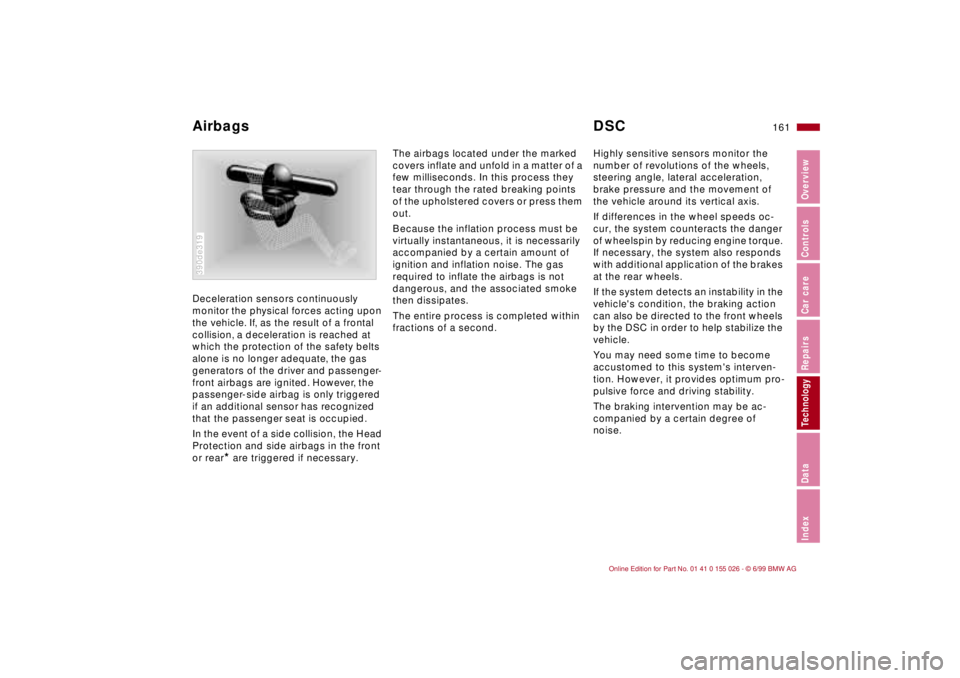
Deceleration sensors continuously
monitor the physical forces acting upon
the vehicle. If, as the result of a frontal
collision, a deceleration is reached at
which the protection of the safety belts
alone is no longer adequate, the gas
generators of the driver and passenger-
front airbags are ignited. However, the
passenger-side airbag is only triggered
if an additional sensor has recognized
that the passenger seat is occupied.
In the event of a side collision, the Head
Protection and side airbags in the front
or rear
* are triggered if necessary.
390de319
The airbags located under the marked
covers inflate and unfold in a matter of a
few milliseconds. In this process they
tear through the rated breaking points
of the upholstered covers or press them
out.
Because the inflation process must be
virtually instantaneous, it is necessarily
accompanied by a certain amount of
ignition and inflation noise. The gas
required to inflate the airbags is not
dangerous, and the associated smoke
then dissipates.
The entire process is completed within
fractions of a second.Highly sensitive sensors monitor the
number of revolutions of the wheels,
steering angle, lateral acceleration,
brake pressure and the movement of
the vehicle around its vertical axis.
If differences in the wheel speeds oc-
cur, the system counteracts the danger
of wheelspin by reducing engine torque.
If necessary, the system also responds
with additional application of the brakes
at the rear wheels.
If the system detects an instability in the
vehicle's condition, the braking action
can also be directed to the front wheels
by the DSC in order to help stabilize the
vehicle.
You may need some time to become
accustomed to this system's interven-
tion. However, it provides optimum pro-
pulsive force and driving stability.
The braking intervention may be ac-
companied by a certain degree of
noise.
Airbags DSC
Page 169 of 189
167n
RepairsIndexOverview Controls Car care Technology Data
Xenon lamp
*
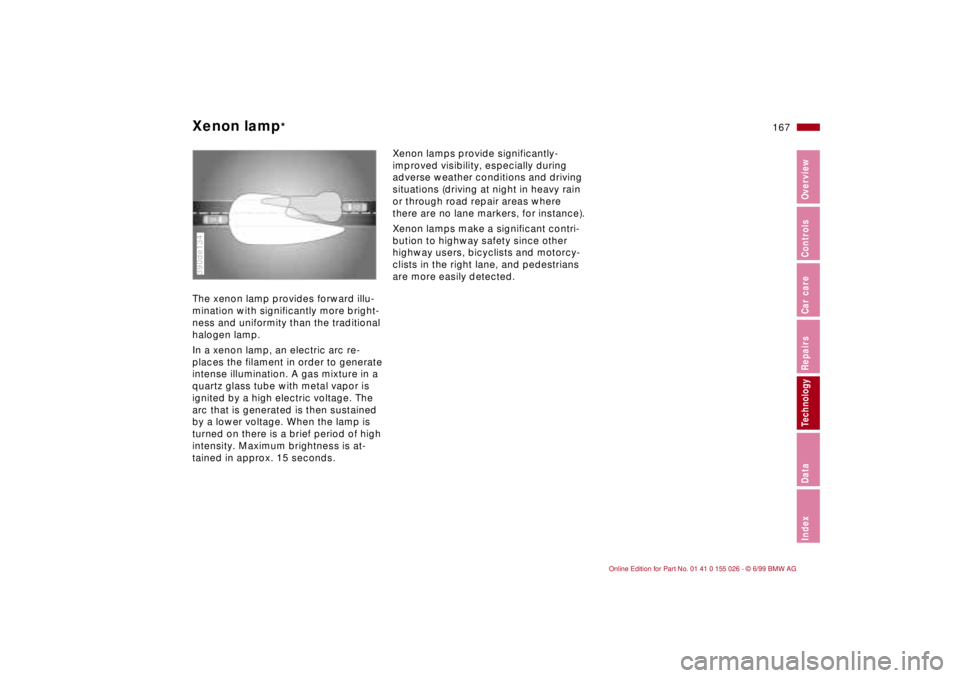
The xenon lamp provides forward illu-
mination with significantly more bright-
ness and uniformity than the traditional
halogen lamp.
In a xenon lamp, an electric arc re-
places the filament in order to generate
intense illumination. A gas mixture in a
quartz glass tube with metal vapor is
ignited by a high electric voltage. The
arc that is generated is then sustained
by a lower voltage. When the lamp is
turned on there is a brief period of high
intensity. Maximum brightness is at-
tained in approx. 15 seconds.390de134
Xenon lamps provide significantly-
improved visibility, especially during
adverse weather conditions and driving
situations (driving at night in heavy rain
or through road repair areas where
there are no lane markers, for instance).
Xenon lamps make a significant contri-
bution to highway safety since other
highway users, bicyclists and motorcy-
clists in the right lane, and pedestrians
are more easily detected.
Page:
< prev 1-8 9-16 17-24