2000 BMW 323Ci check engine
[x] Cancel search: check enginePage 125 of 189
123n
RepairsIndexOverview Controls Car care Technology Data
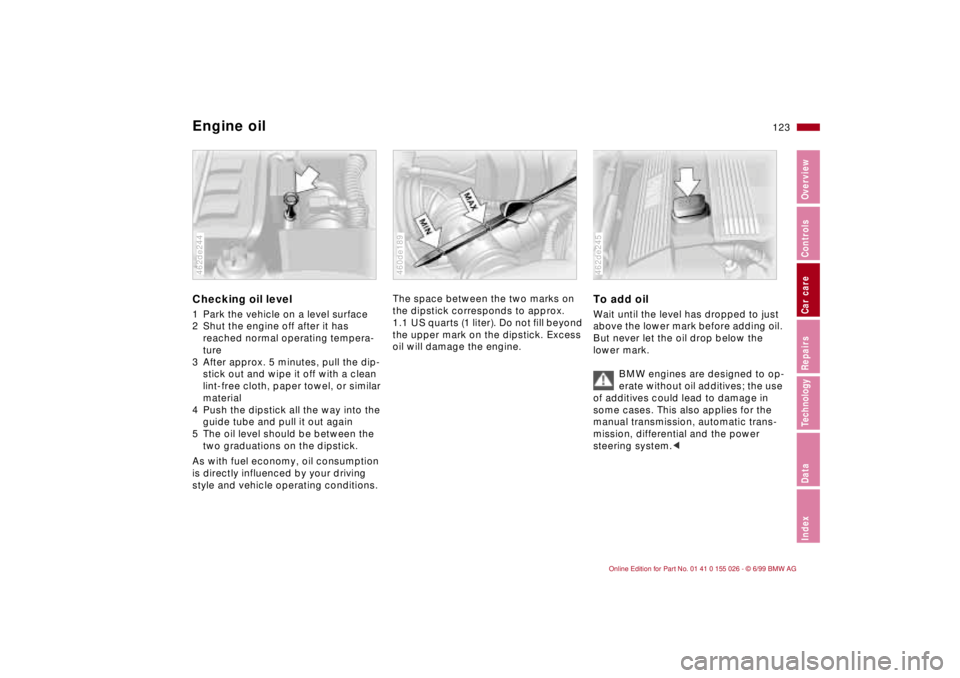
Engine oilChecking oil level 1 Park the vehicle on a level surface
2 Shut the engine off after it has
reached normal operating tempera-
ture
3 After approx. 5 minutes, pull the dip-
stick out and wipe it off with a clean
lint-free cloth, paper towel, or similar
material
4 Push the dipstick all the way into the
guide tube and pull it out again
5 The oil level should be between the
two graduations on the dipstick.
As with fuel economy, oil consumption
is directly influenced by your driving
style and vehicle operating conditions.462de244
The space between the two marks on
the dipstick corresponds to approx.
1.1 US quarts (1 liter). Do not fill beyond
the upper mark on the dipstick. Excess
oil will damage the engine.460de189
To add oil Wait until the level has dropped to just
above the lower mark before adding oil.
But never let the oil drop below the
lower mark.
BMW engines are designed to op-
erate without oil additives; the use
of additives could lead to damage in
some cases. This also applies for the
manual transmission, automatic trans-
mission, differential and the power
steering system.<462de245
Page 128 of 189
126n
Coolant
Do not add coolant to the cooling
system when the engine is hot,
since escaping coolant can cause
burns.
To avoid the possibility of damage later
on, never use anything other than fac-
tory-approved, nitrite- and amino-free
extended-duty antifreeze with corrosion
inhibitor. Your authorized BMW center
is familiar with the official specifica-
tions.
Antifreeze and anticorrosion agents are
hazardous to health. Store antifreeze
and anticorrosion agents in their origi-
nal containers and inaccessible to chil-
dren. Extended-duty antifreeze with
corrosion inhibitor contains the flamma-
ble substance ethyleneglycol. Do not
spill antifreeze containing corrosion
inhibitor on hot engine components,
since it could catch fire and cause seri-
ous burns.<
Comply with the applicable envi-
ronmental laws regulating the dis-
posal of extended-duty antifreeze with
corrosion inhibitor.<
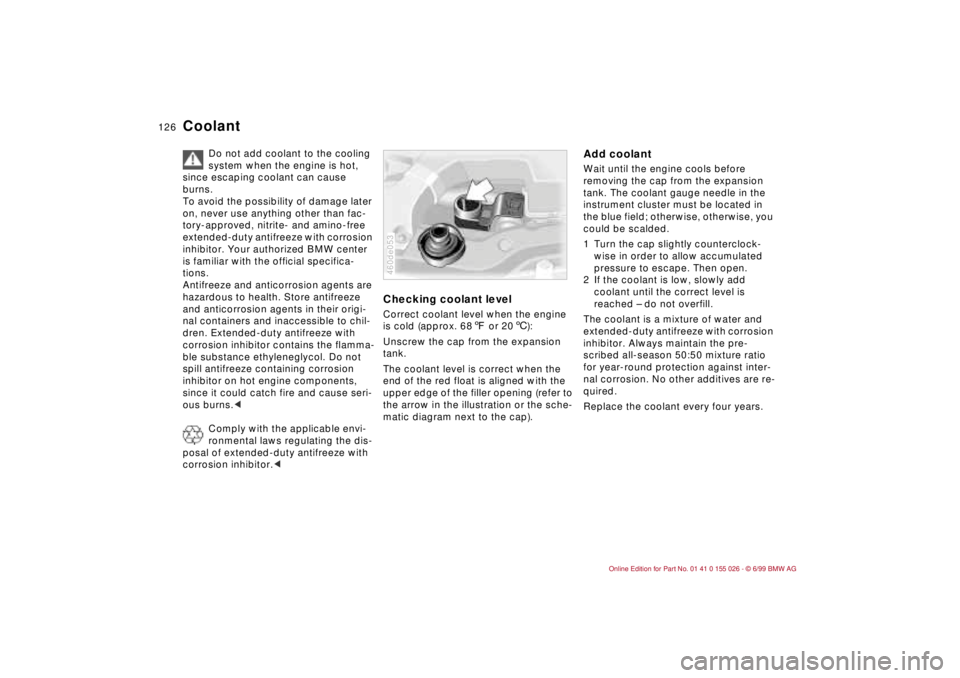
Checking coolant levelCorrect coolant level when the engine
is cold (approx. 687 or 206):
Unscrew the cap from the expansion
tank.
The coolant level is correct when the
end of the red float is aligned with the
upper edge of the filler opening (refer to
the arrow in the illustration or the sche-
matic diagram next to the cap).460de053
Add coolant Wait until the engine cools before
removing the cap from the expansion
tank. The coolant gauge needle in the
instrument cluster must be located in
the blue field; otherwise, otherwise, you
could be scalded.
1 Turn the cap slightly counterclock-
wise in order to allow accumulated
pressure to escape. Then open.
2 If the coolant is low, slowly add
coolant until the correct level is
reached – do not overfill.
The coolant is a mixture of water and
extended-duty antifreeze with corrosion
inhibitor. Always maintain the pre-
scribed all-season 50:50 mixture ratio
for year-round protection against inter-
nal corrosion. No other additives are re-
quired.
Replace the coolant every four years.
Page 129 of 189
127n
RepairsIndexOverview Controls Car care Technology Data
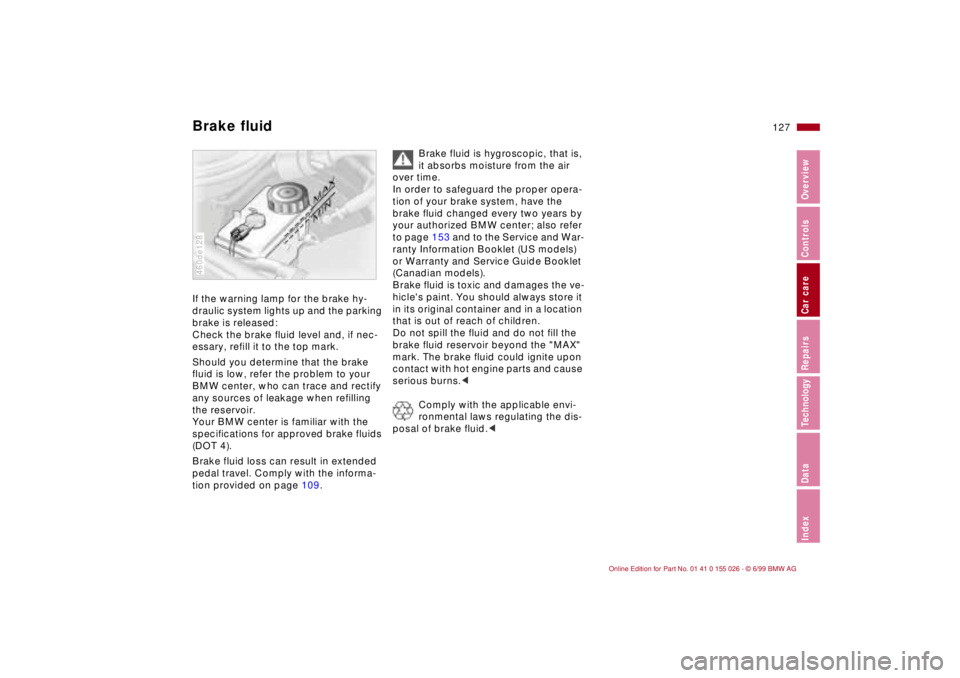
Brake fluidIf the warning lamp for the brake hy-
draulic system lights up and the parking
brake is released:
Check the brake fluid level and, if nec-
essary, refill it to the top mark.
Should you determine that the brake
fluid is low, refer the problem to your
BMW center, who can trace and rectify
any sources of leakage when refilling
the reservoir.
Your BMW center is familiar with the
specifications for approved brake fluids
(DOT 4).
Brake fluid loss can result in extended
pedal travel. Comply with the informa-
tion provided on page 109.460de128
Brake fluid is hygroscopic, that is,
it absorbs moisture from the air
over time.
In order to safeguard the proper opera-
tion of your brake system, have the
brake fluid changed every two years by
your authorized BMW center; also refer
to page 153 and to the Service and War-
ranty Information Booklet (US models)
or Warranty and Service Guide Booklet
(Canadian models).
Brake fluid is toxic and damages the ve-
hicle's paint. You should always store it
in its original container and in a location
that is out of reach of children.
Do not spill the fluid and do not fill the
brake fluid reservoir beyond the "MAX"
mark. The brake fluid could ignite upon
contact with hot engine parts and cause
serious burns.<
Comply with the applicable envi-
ronmental laws regulating the dis-
posal of brake fluid.<
Page 131 of 189
129n
RepairsIndexOverview Controls Car care Technology Data
The BMW Maintenance System has
been designed as a reliable means of
providing maximum driving and operat-
ing safety – and as cost-effectively as
possible for you. With respect to the
previous version, maintenance costs
can clearly be reduced due to technical
innovations.
Please keep in mind that regular main-
tenance is not only necessary for the
safety of your vehicle, but also plays a
significant role in maintaining the resale
value of the vehicle. 462us022
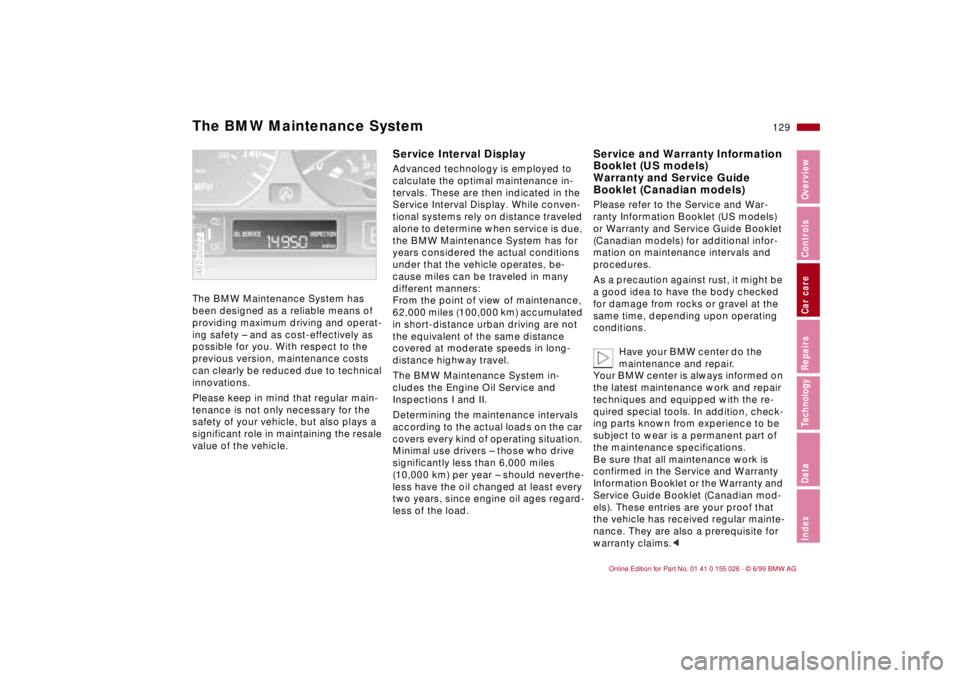
Service Interval DisplayAdvanced technology is employed to
calculate the optimal maintenance in-
tervals. These are then indicated in the
Service Interval Display. While conven-
tional systems rely on distance traveled
alone to determine when service is due,
the BMW Maintenance System has for
years considered the actual conditions
under that the vehicle operates, be-
cause miles can be traveled in many
different manners:
From the point of view of maintenance,
62,000 miles (100,000 km) accumulated
in short-distance urban driving are not
the equivalent of the same distance
covered at moderate speeds in long-
distance highway travel.
The BMW Maintenance System in-
cludes the Engine Oil Service and
Inspections I and II.
Determining the maintenance intervals
according to the actual loads on the car
covers every kind of operating situation.
Minimal use drivers – those who drive
significantly less than 6,000 miles
(10,000 km) per year – should neverthe-
less have the oil changed at least every
two years, since engine oil ages regard-
less of the load.
Service and Warranty Information
Booklet (US models)
Warranty and Service Guide
Booklet (Canadian models)Please refer to the Service and War-
ranty Information Booklet (US models)
or Warranty and Service Guide Booklet
(Canadian models) for additional infor-
mation on maintenance intervals and
procedures.
As a precaution against rust, it might be
a good idea to have the body checked
for damage from rocks or gravel at the
same time, depending upon operating
conditions.
Have your BMW center do the
maintenance and repair.
Your BMW center is always informed on
the latest maintenance work and repair
techniques and equipped with the re-
quired special tools. In addition, check-
ing parts known from experience to be
subject to wear is a permanent part of
the maintenance specifications.
Be sure that all maintenance work is
confirmed in the Service and Warranty
Information Booklet or the Warranty and
Service Guide Booklet (Canadian mod-
els). These entries are your proof that
the vehicle has received regular mainte-
nance. They are also a prerequisite for
warranty claims.<
The BMW Maintenance System
Page 139 of 189
137n
RepairsIndexOverview Controls Car care Technology Data
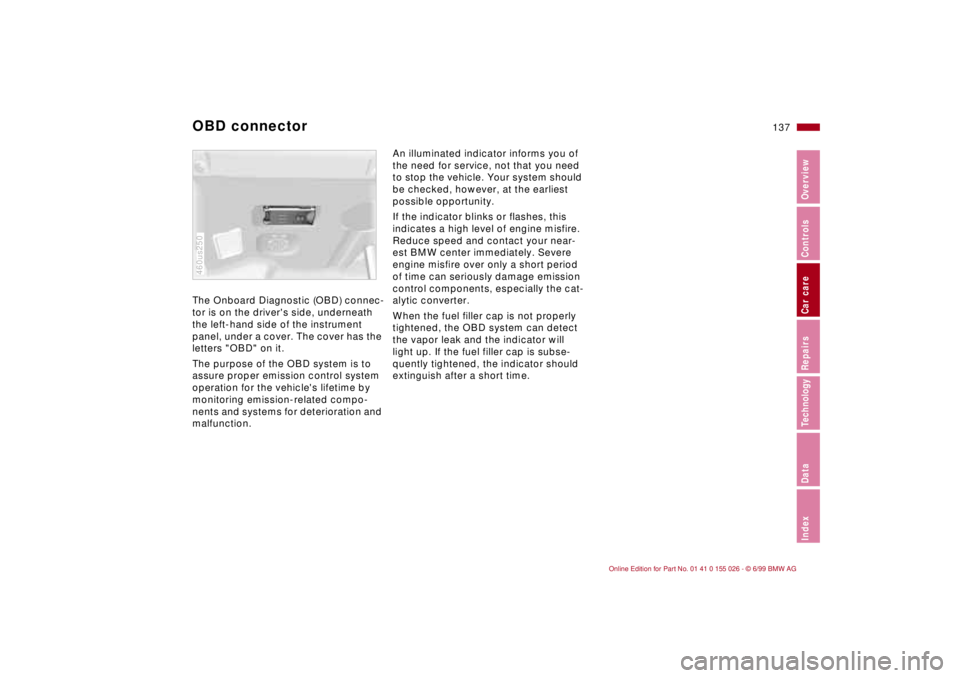
OBD connector The Onboard Diagnostic (OBD) connec-
tor is on the driver's side, underneath
the left-hand side of the instrument
panel, under a cover. The cover has the
letters "OBD" on it.
The purpose of the OBD system is to
assure proper emission control system
operation for the vehicle's lifetime by
monitoring emission-related compo-
nents and systems for deterioration and
malfunction.460us250
An illuminated indicator informs you of
the need for service, not that you need
to stop the vehicle. Your system should
be checked, however, at the earliest
possible opportunity.
If the indicator blinks or flashes, this
indicates a high level of engine misfire.
Reduce speed and contact your near-
est BMW center immediately. Severe
engine misfire over only a short period
of time can seriously damage emission
control components, especially the cat-
alytic converter.
When the fuel filler cap is not properly
tightened, the OBD system can detect
the vapor leak and the indicator will
light up. If the fuel filler cap is subse-
quently tightened, the indicator should
extinguish after a short time.
Page 154 of 189
152n
Battery
A highly-explosive gas is gener-
ated when the battery is
charged.
If you happen to get acid in your
eyes, rinse thoroughly for 15 min-
utes with clear water. Consult a
physician immediately. Rinse your skin
or clothing with plenty of water if you get
acid spray on them. If electrolyte is acci-
dentally ingested, consult a physician
immediately.
In order to protect the battery
case from ultraviolet radiation,
do not place it in direct sunlight.
A discharged battery can freeze. Store
the battery in areas where temperature
remains above freezing.
Battery careThe battery is completely maintenance-
free, as per DIN 43 539/2; that is, the
amount of acid put in the battery origi-
nally will normally last for the service life
of the battery.
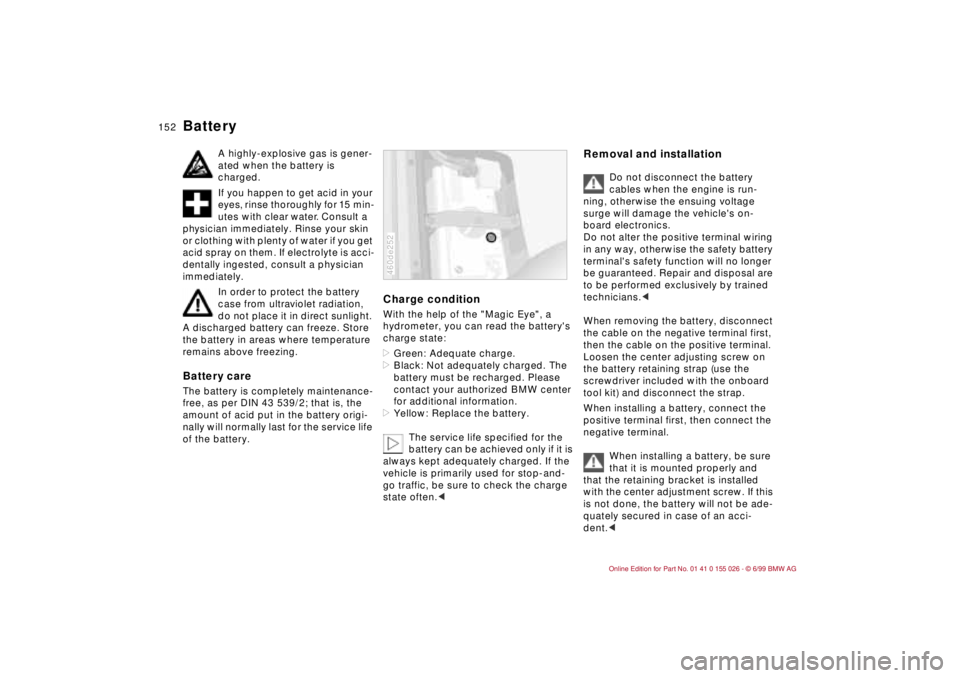
Charge conditionWith the help of the "Magic Eye", a
hydrometer, you can read the battery's
charge state:
>Green: Adequate charge.
>Black: Not adequately charged. The
battery must be recharged. Please
contact your authorized BMW center
for additional information.
>Yellow: Replace the battery.
The service life specified for the
battery can be achieved only if it is
always kept adequately charged. If the
vehicle is primarily used for stop-and-
go traffic, be sure to check the charge
state often.<460de252
Removal and installation
Do not disconnect the battery
cables when the engine is run-
ning, otherwise the ensuing voltage
surge will damage the vehicle's on-
board electronics.
Do not alter the positive terminal wiring
in any way, otherwise the safety battery
terminal's safety function will no longer
be guaranteed. Repair and disposal are
to be performed exclusively by trained
technicians.<
When removing the battery, disconnect
the cable on the negative terminal first,
then the cable on the positive terminal.
Loosen the center adjusting screw on
the battery retaining strap (use the
screwdriver included with the onboard
tool kit) and disconnect the strap.
When installing a battery, connect the
positive terminal first, then connect the
negative terminal.
When installing a battery, be sure
that it is mounted properly and
that the retaining bracket is installed
with the center adjustment screw. If this
is not done, the battery will not be ade-
quately secured in case of an acci-
dent.<
Page 155 of 189
153n
RepairsIndexOverview Controls Car care Technology Data
Battery FusesCharging the battery Charge the battery in the vehicle only
when the engine is not running.
Before doing any work on the
electrical system, be sure to
unclamp the cable from the battery's
negative terminal, or it could cause
short-circuiting, a fire or personal
injury.<
If the vehicle is to be parked longer than
4 weeks, disconnect the battery from
the vehicle's electrical system by dis-
connecting the negative terminal cable.
If you intend to store your car for longer
than six weeks: Remove the battery,
charge it and store it in a cool (but frost-
free) room. Recharge the battery every
6 months at the latest, at the very least
before each installation, or else it will be
unusable. Every time the battery is dis-
charged, especially over extended peri-
ods, its service life is reduced.
Return used batteries to a recy-
cling point or your authorized
BMW center. Maintain the battery in an
upright position for transport and stor-
age. Secure the battery against tilting in
transit.<
Storage periods during which the
battery is disconnected are not
taken into consideration by the Service
Interval Display for changing the brake
fluid.
Therefore, make sure that the brake
fluid is changed every two years at the
latest, regardless of the display. Com-
ply with the information provided on
page 127.<
If an electrical accessory should fail,
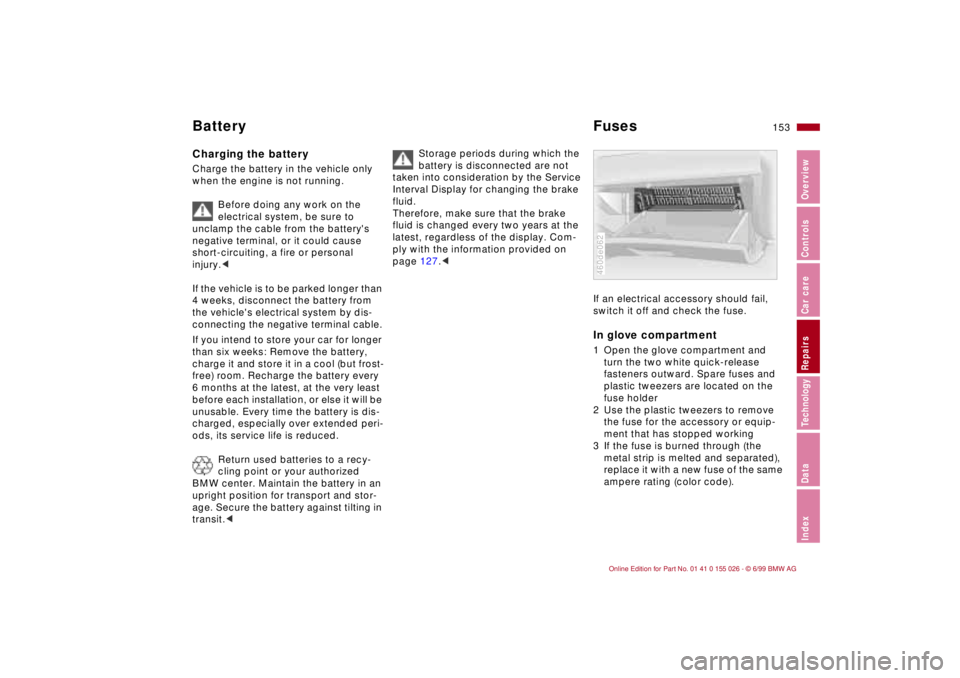
switch it off and check the fuse. In glove compartment1 Open the glove compartment and
turn the two white quick-release
fasteners outward. Spare fuses and
plastic tweezers are located on the
fuse holder
2 Use the plastic tweezers to remove
the fuse for the accessory or equip-
ment that has stopped working
3 If the fuse is burned through (the
metal strip is melted and separated),
replace it with a new fuse of the same
ampere rating (color code).460de062
Page 168 of 189
166n
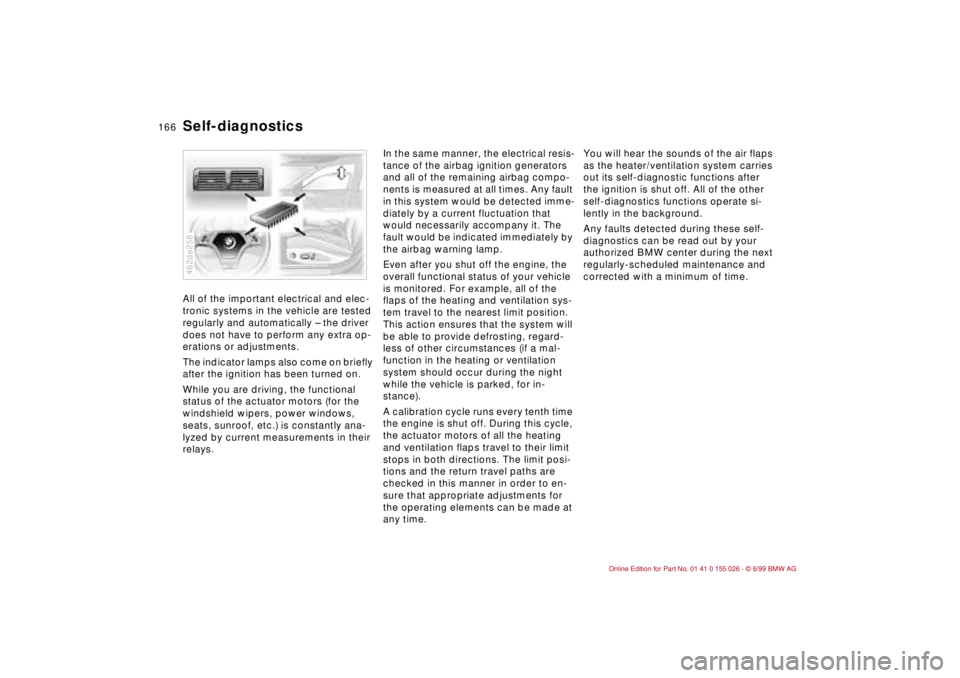
Self-diagnostics All of the important electrical and elec-
tronic systems in the vehicle are tested
regularly and automatically – the driver
does not have to perform any extra op-
erations or adjustments.
The indicator lamps also come on briefly
after the ignition has been turned on.
While you are driving, the functional
status of the actuator motors (for the
windshield wipers, power windows,
seats, sunroof, etc.) is constantly ana-
lyzed by current measurements in their
relays. 462de258
In the same manner, the electrical resis-
tance of the airbag ignition generators
and all of the remaining airbag compo-
nents is measured at all times. Any fault
in this system would be detected imme-
diately by a current fluctuation that
would necessarily accompany it. The
fault would be indicated immediately by
the airbag warning lamp.
Even after you shut off the engine, the
overall functional status of your vehicle
is monitored. For example, all of the
flaps of the heating and ventilation sys-
tem travel to the nearest limit position.
This action ensures that the system will
be able to provide defrosting, regard-
less of other circumstances (if a mal-
function in the heating or ventilation
system should occur during the night
while the vehicle is parked, for in-
stance).
A calibration cycle runs every tenth time
the engine is shut off. During this cycle,
the actuator motors of all the heating
and ventilation flaps travel to their limit
stops in both directions. The limit posi-
tions and the return travel paths are
checked in this manner in order to en-
sure that appropriate adjustments for
the operating elements can be made at
any time.You will hear the sounds of the air flaps
as the heater/ventilation system carries
out its self-diagnostic functions after
the ignition is shut off. All of the other
self-diagnostics functions operate si-
lently in the background.
Any faults detected during these self-
diagnostics can be read out by your
authorized BMW center during the next
regularly-scheduled maintenance and
corrected with a minimum of time.