Page 146 of 189
144n
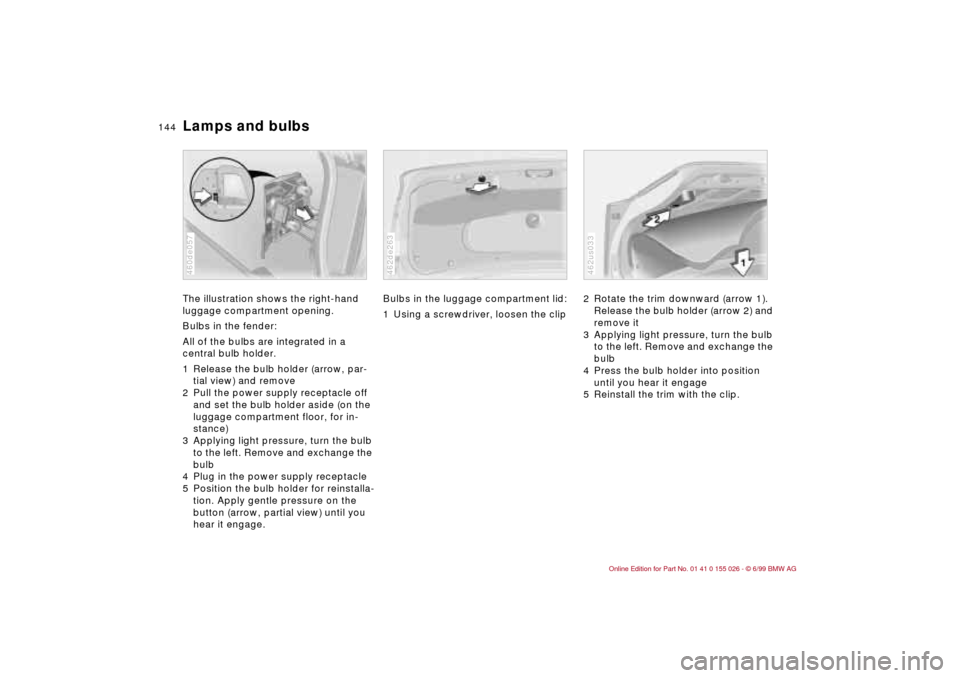
Lamps and bulbsThe illustration shows the right-hand
luggage compartment opening.
Bulbs in the fender:
All of the bulbs are integrated in a
central bulb holder.
1 Release the bulb holder (arrow, par-
tial view) and remove
2 Pull the power supply receptacle off
and set the bulb holder aside (on the
luggage compartment floor, for in-
stance)
3 Applying light pressure, turn the bulb
to the left. Remove and exchange the
bulb
4 Plug in the power supply receptacle
5 Position the bulb holder for reinstalla-
tion. Apply gentle pressure on the
button (arrow, partial view) until you
hear it engage.460de057
Bulbs in the luggage compartment lid:
1 Using a screwdriver, loosen the clip462de263
2 Rotate the trim downward (arrow 1).
Release the bulb holder (arrow 2) and
remove it
3 Applying light pressure, turn the bulb
to the left. Remove and exchange the
bulb
4 Press the bulb holder into position
until you hear it engage
5 Reinstall the trim with the clip.462us033
Page 150 of 189
148n
Changing tires
Take these precautionary mea-
sures if you have either a flat tire
or are changing the tire:
Park the vehicle as far from the flow of
traffic as possible and on firm ground.
Switch on the hazard flashers. Turn the
steering wheel to the straight-ahead
position, remove the key and engage
the steering lock. Shift into 1st or re-
verse (selector lever in "Park" with auto-
matic) and engage the parking brake.
All passengers should be outside the
car and well away from your immediate
working area (behind the guardrail, for
instance).
If a warning triangle or portable hazard
warning lamp is available, set it up on
the roadside at an appropriate distance
from the rear of the vehicle. Comply
with all safety guidelines and regula-
tions.
Change the wheel only on a level, firm
surface that is not slippery. Avoid jack-
ing the car on a soft or slippery support
surface (snow, ice, loose gravel, etc.),
as it could slide sideways.
Ensure that the jack is positioned on a
solid support surface.
Do not place wooden blocks or similar
objects under the jack. If this done, the
jack might not be able to reach its full
support capacity because of the limited
height.
Do not lie under the vehicle or start the
engine when the vehicle is supported
by the jack – risk of fatal injury.<
Your BMW has either a spare
* or
space-saver tire
* for temporary use and
to ensure your mobility.
Take the luggage compartment
floor panel completely out to
remove the spare tire
* (refer to
page 41).<
You will the need the followingIn order to avoid rattling noises later,
note the position of the tools when you
remove them and return them to their
original position when you are through
using them.
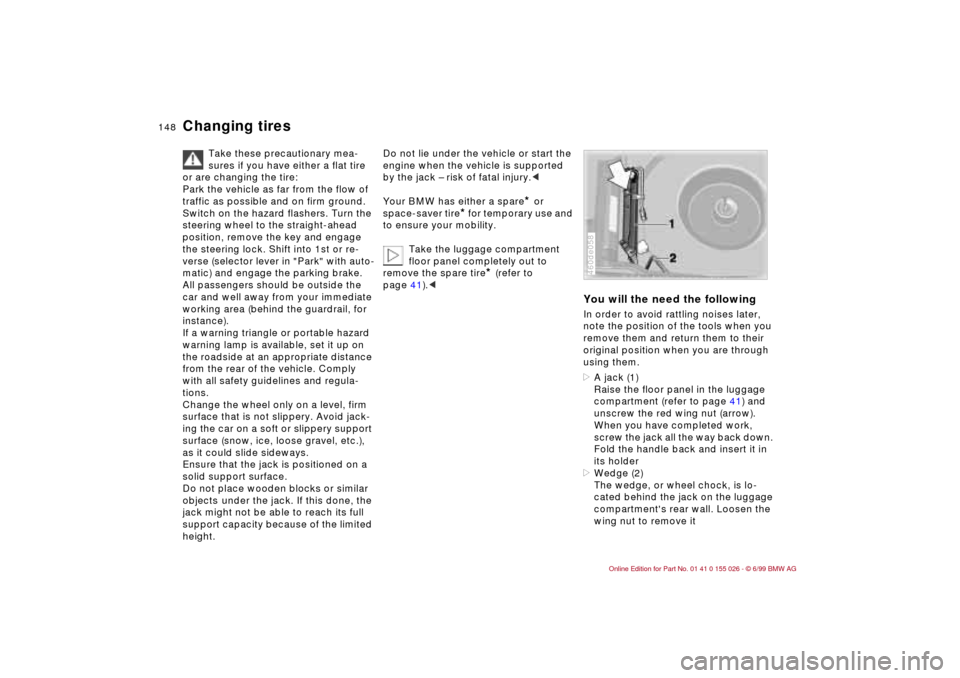
>A jack (1)
Raise the floor panel in the luggage
compartment (refer to page 41) and
unscrew the red wing nut (arrow).
When you have completed work,
screw the jack all the way back down.
Fold the handle back and insert it in
its holder
>Wedge (2)
The wedge, or wheel chock, is lo-
cated behind the jack on the luggage
compartment's rear wall. Loosen the
wing nut to remove it460de058
Page 151 of 189
149n
RepairsIndexOverview Controls Car care Technology Data
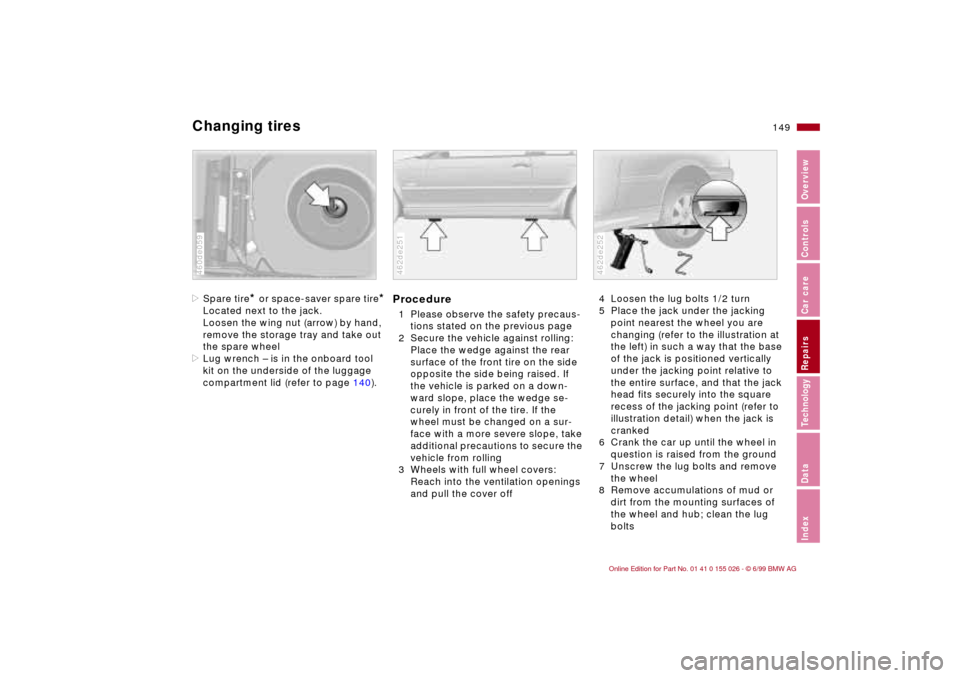
Changing tires>Spare tire
* or space-saver spare tire
*
Located next to the jack.
Loosen the wing nut (arrow) by hand,
remove the storage tray and take out
the spare wheel
>Lug wrench – is in the onboard tool
kit on the underside of the luggage
compartment lid (refer to page 140).460de059
Procedure1 Please observe the safety precaus-
tions stated on the previous page
2 Secure the vehicle against rolling:
Place the wedge against the rear
surface of the front tire on the side
opposite the side being raised. If
the vehicle is parked on a down-
ward slope, place the wedge se-
curely in front of the tire. If the
wheel must be changed on a sur-
face with a more severe slope, take
additional precautions to secure the
vehicle from rolling
3 Wheels with full wheel covers:
Reach into the ventilation openings
and pull the cover off462de251
4 Loosen the lug bolts 1/2 turn
5 Place the jack under the jacking
point nearest the wheel you are
changing (refer to the illustration at
the left) in such a way that the base
of the jack is positioned vertically
under the jacking point relative to
the entire surface, and that the jack
head fits securely into the square
recess of the jacking point (refer to
illustration detail) when the jack is
cranked
6 Crank the car up until the wheel in
question is raised from the ground
7 Unscrew the lug bolts and remove
the wheel
8 Remove accumulations of mud or
dirt from the mounting surfaces of
the wheel and hub; clean the lug
bolts462de252
Page 159 of 189
157n
RepairsIndexOverview Controls Car care Technology Data
Towing the vehicleTow fittingThe screw-in tow fitting is stored in the
onboard tool kit; be sure that it remains
in the vehicle at all times. This fitting is
designed for installation in the tow
sockets located at the front and rear of
the vehicle, and is intended for towing
on proper road surfaces only. This fit-
ting should not be used to pull a vehicle
out of deep snow, mud, sand, etc.
Allways observe all applicable towing
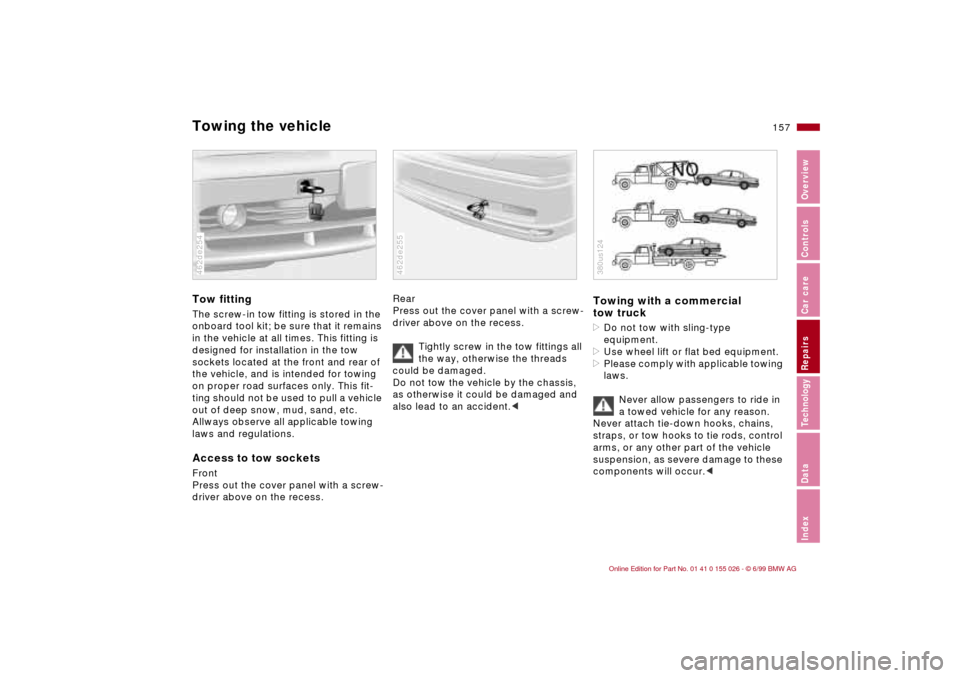
laws and regulations.Access to tow socketsFront
Press out the cover panel with a screw-
driver above on the recess.462de254
Rear
Press out the cover panel with a screw-
driver above on the recess.
Tightly screw in the tow fittings all
the way, otherwise the threads
could be damaged.
Do not tow the vehicle by the chassis,
as otherwise it could be damaged and
also lead to an accident.<462de255
Towing with a commercial
tow truck>Do not tow with sling-type
equipment.
>Use wheel lift or flat bed equipment.
>Please comply with applicable towing
laws.
Never allow passengers to ride in
a towed vehicle for any reason.
Never attach tie-down hooks, chains,
straps, or tow hooks to tie rods, control
arms, or any other part of the vehicle
suspension, as severe damage to these
components will occur.c380us124
Page 162 of 189
160n
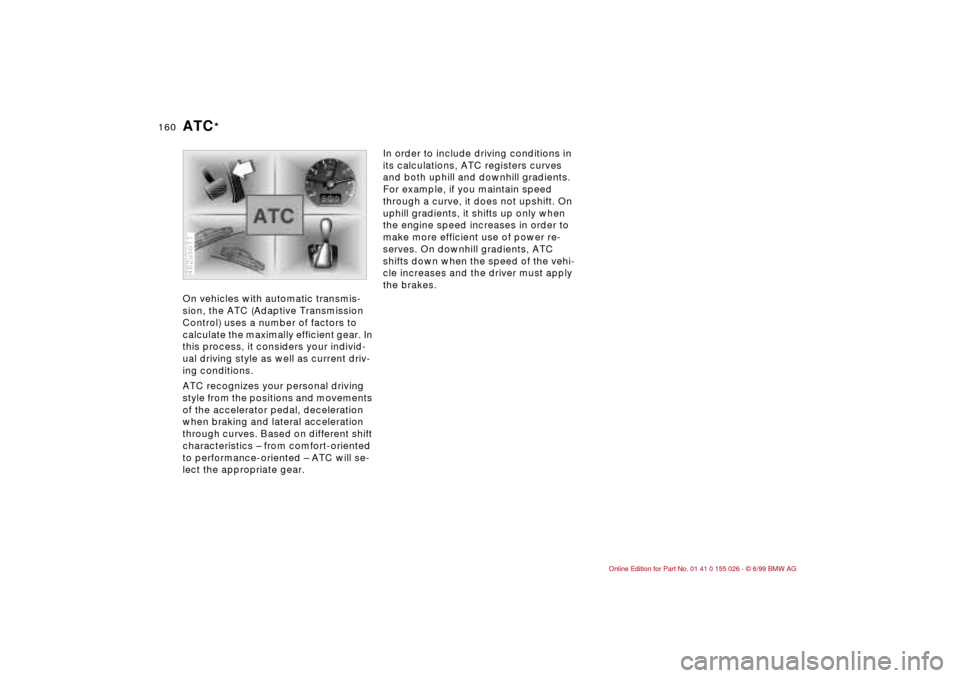
On vehicles with automatic transmis-
sion, the ATC (Adaptive Transmission
Control) uses a number of factors to
calculate the maximally efficient gear. In
this process, it considers your individ-
ual driving style as well as current driv-
ing conditions.
ATC recognizes your personal driving
style from the positions and movements
of the accelerator pedal, deceleration
when braking and lateral acceleration
through curves. Based on different shift
characteristics – from comfort-oriented
to performance-oriented – ATC will se-
lect the appropriate gear.
462uso11
In order to include driving conditions in
its calculations, ATC registers curves
and both uphill and downhill gradients.
For example, if you maintain speed
through a curve, it does not upshift. On
uphill gradients, it shifts up only when
the engine speed increases in order to
make more efficient use of power re-
serves. On downhill gradients, ATC
shifts down when the speed of the vehi-
cle increases and the driver must apply
the brakes.
ATC
*