Page 15 of 311

Protecting Adults
Introduction
The following pages provide instructions on how to properly
protect the driver and other adult occupants.
These instructions also apply to children who have outgrown child
seats and are large enough to wear
lap/shoulder belts. (See page 35 for important additional guidelines on
how to properly protect larger children.)
1.Close and Lock the Doors
After everyone has entered the car, be sure the doors are closed and
locked. Your car has a door monitor light on
the instrument panel to indicate
when a specific door is not tightly closed.
For safety, locking the doors reduces
the chance that a passenger, especially a child, will open a door
while the car is moving and accidentally fall out. It also reduces
the chance of someone being thrown out of the car during a crash.
For security, locked doors can
prevent an outsider from
unexpectedly opening a door when
you come to a stop.
See page 77 for how to lock the
doors. 2.Adjust the Front Seats
Any driver who sits too close to the steering wheel is at risk of being
seriously injured or killed by striking
the steering wheel or from being struck by an inflating front airbag
during a crash.
Driver and Passenger Safety
Page 16 of 311
Protecting Adults
To reduce the chance of injury, wearyour seat belt properly, sit upright
with your back against the seat, and
move the seat as far back as possible
from the steering wheel while stillmaintaining full control of the car.
Also make sure your front seat passenger moves the seat as far to
the rear as possible.
Sitting too close to a front
airbag can result in seriousinjury or death if the front
airbags inflate.
Always sit as far back from the
front airbags as possible. Most shorter drivers can get far
enough away from the steering
wheel and still reach the pedals. However, if you are concerned about
sitting too close, we recommend that
you investigate whether some type of adaptive equipment may help.
Once your seat is adjusted correctly,
rock it back and forth to make sure
the seat is locked in position.
See page 89 for how to adjust the
front seats.
3.Adjust the Seat-Backs
Adjust the driver's seat-back to a comfortable, upright position,
leaving ample space between your chest and the airbag cover in the
center of the steering wheel. If yousit too close to the steering wheel,
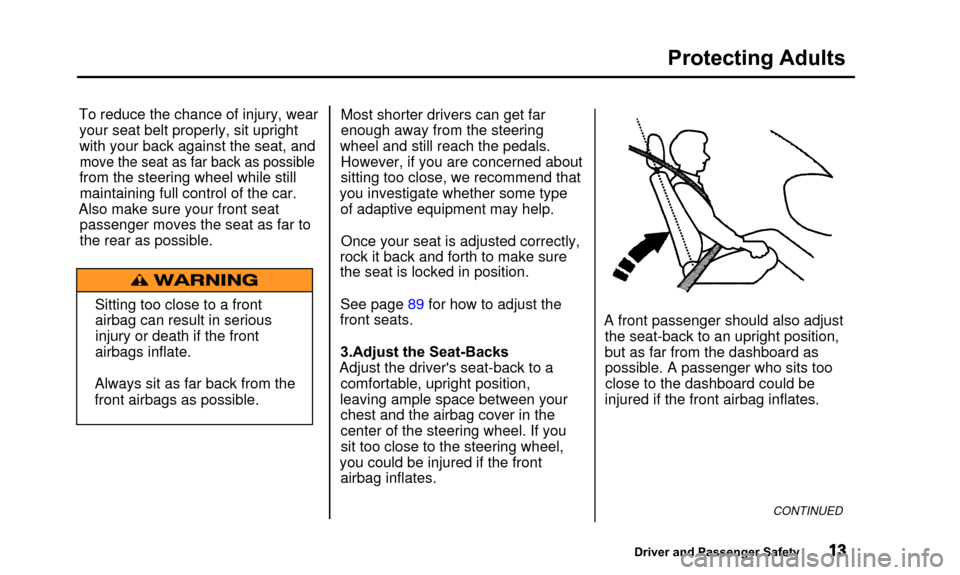
you could be injured if the front airbag inflates. A front passenger should also adjust
the seat-back to an upright position,
but as far from the dashboard as
possible. A passenger who sits tooclose to the dashboard could be
injured if the front airbag inflates.
CONTINUED
Driver and Passenger Safety
Page 17 of 311

Protecting Adults
Reclining a seat-back so that the
shoulder part of the belt no longer
rests against the occupant's chest
reduces the protective capability of
the belt. It also increases the chance of sliding under the belt in a crash
and being seriously injured. The
farther a seat-back is reclined, the greater the risk of injury.
Reclining the seat-back too far
can result in serious injury or
death in a crash.
Adjust the seat-back to an upright position and sit well
back in the seat.
See page 90 for how to adjust seat-
backs. 4.Adjust the Head Restraints
Before driving, make sure everyone
with an adjustable head restraint has properly positioned the headrestraint. The restraint should be
positioned so the back of theoccupant's head rests against the
center of the restraint. A taller
person should adjust the restraint as
high as possible. Improperly positioning head
restraints reduces their
effectiveness and you can be
seriously injured in a crash.
Make sure head restraints are
in place and positioned properly
before driving.
Properly adjusted head restraints
will help protect occupants from
whiplash and other crash injuries.
See page 91 for how to adjust the
head restraints.
Driver and Passenger Safety
Page 18 of 311
Protecting Adults
5.Fasten and Position the SeatBelts
Insert the latch plate into the buckle,
then tug on the belt to make sure the
belt is securely latched. Also check that the belt is not twisted, because a
twisted belt can cause serious
injuries in a crash.
Position the lap part of the belt as
low as possible across your hips,
then pull up on the shoulder part of
the belt so the lap part fits snugly.
This lets your strong pelvic bones take the force of a crash and reduces
the chance of internal injuries. If necessary, pull up on the belt again
to remove any slack from the shoulder part, then check that the
belt rests across the center of your chest and over your shoulder. This
spreads the forces of a crash over
the strongest bones in your upper
body.
Improperly positioning the seat
belts can cause serious injury
or death in a crash.
Make sure all seat belts are
properly positioned before
driving.
CONTINUED
Driver and Passenger Safety
Page 19 of 311
Protecting Adults
If the seat belt touches or crosses
your neck, or if it crosses your arm instead of your shoulder, you need to
adjust the seat belt anchor height.
To adjust the height of a front seatbelt anchor, press the release button
and slide the anchor up or down as
needed (it has four positions).
Never place the shoulder portion of a
lap/shoulder belt under your arm or
behind your back. This could cause
very serious injuries in a crash
. If a seat belt does not seem to work
as it should, it may not protect the
occupant in a crash. No one should
sit in a seat with an inoperative seat
belt. Anyone using a seat belt that is
not working properly can be seriously injured or killed. Have your
Acura dealer check the belt as soon as possible.
See page 40 for additional
information about your seat belt system and how to take care of your
belts.
Driver and Passenger Safety
Page 20 of 311
Protecting Adults
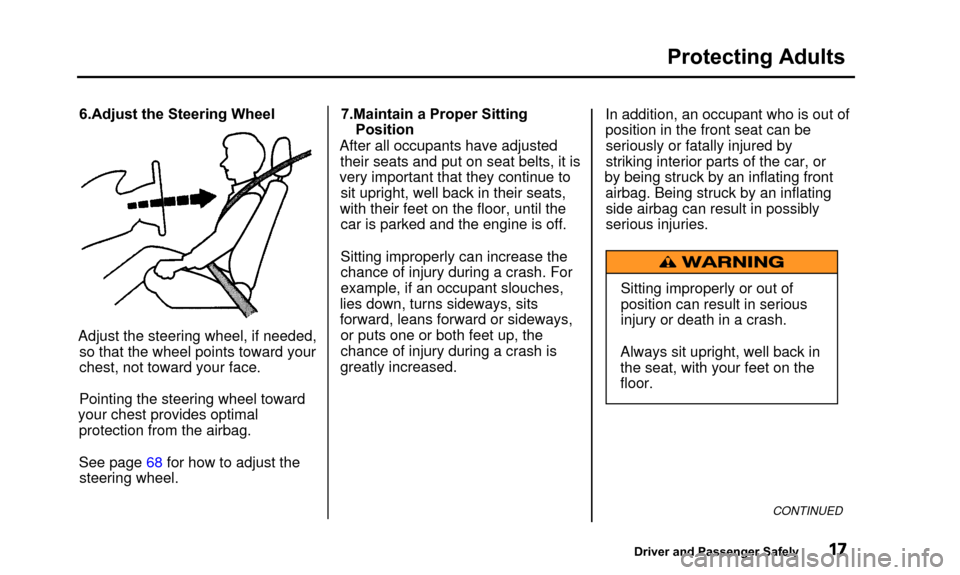
6.Adjust the Steering Wheel
Adjust the steering wheel, if needed, so that the wheel points toward your
chest, not toward your face.
Pointing the steering wheel toward
your chest provides optimal protection from the airbag.
See page 68 for how to adjust thesteering wheel. 7.Maintain a Proper Sitting
Position
After all occupants have adjusted their seats and put on seat belts, it is
very important that they continue to sit upright, well back in their seats,
with their feet on the floor, until the car is parked and the engine is off.
Sitting improperly can increase the
chance of injury during a crash. For
example, if an occupant slouches,
lies down, turns sideways, sits
forward, leans forward or sideways, or puts one or both feet up, the
chance of injury during a crash is
greatly increased. In addition, an occupant who is out of
position in the front seat can be
seriously or fatally injured by
striking interior parts of the car, or
by being struck by an inflating front airbag. Being struck by an inflatingside airbag can result in possibly
serious injuries.
Sitting improperly or out of
position can result in serious
injury or death in a crash.
Always sit upright, well back in
the seat, with your feet on the floor.
CONTINUED
Driver and Passenger Safely
Page 21 of 311
Protecting Adults
Remember, to get the best
protection from your car's airbags and other safety features, you mustsit properly and wear your seat belt
properly. Advice for Pregnant Women
Because protecting the mother is the
best way to protect her unborn child, a pregnant woman should always
wear a seat belt whenever she drives or rides in a car.
Remember to keep the lap portion of
the belt as low as possible across
your hips. Pregnant women should also sit
upright and as far back as possible
from the steering wheel or dashboard. This will reduce the risk
of injuries to both the mother and
her unborn child that can be caused
by a crash or an inflating airbag.
Each time you have a check-up, ask
your doctor if it's okay for you to drive.
Driver and Passenger Safety
Page 22 of 311

Protecting Adults
Additional Safety Precautions
• Two people should never use thesame seat belt. If they do, they
could be very seriously injured in a
•
Do not put any accessories on seat
belts. Devices intended to improve occupant comfort or reposition the
shoulder part of a seat belt can
severely compromise the
protective capability of the seat
belt and increase the chance of serious injury in a crash.
• Do not place hard or sharp objects
between yourself and a front
airbag. Carrying hard or sharp
objects on your lap, or driving with
a pipe or other sharp object in
your mouth, can result in injuries if your front airbag inflates.
• Do not attach or place objects on
the front airbag covers. Any object
attached to or placed on the covers
marked "SRS AIRBAG," in the
center of the steering wheel and on top of the dashboard could
interfere with the proper operation of the airbags. Or, if the airbags
inflate, the objects could be
propelled inside the car and hurt someone. • Do not attach hard objects on or
near a front door. If a side airbag
inflates, a cup holder or other hard object attached on or near the
door could be propelled inside the
car and hurt someone.
• Keep your hands and arms away from the airbag covers. If your
hands or arms are close to the airbag cover in the center of thesteering wheel or on top of the
dashboard, they could be injured if
the front airbags inflate.
Driver and Passenger Safety
crash.


