Page 81 of 273
Foldin
g Rea r Sea t
To fold down the seat-back from
inside the car, insert the master key
in the lock on the rear shelf. Turn
the key clockwise, pull down the top of the seat-back, then release the
key. To release the seat-back from inside
the trunk, pull the release loop under
the rear shelf.
To lock the seat-back upright, push it
firmly against the rear shelf. Make
sure it is latched in place by pulling
on the top of the seat. Make sure all items in the trunk, or
items extending through the opening
into the back seat, are secured.
Loose items can fly forward and
cause injury if you have to brake
hard. See Carryin
g Carg o on page
127.
Never drive with the seat-back
folded down and the trunk lid open. See Carbo n Monoxid e Hazar d on
page 49 .
Instrument s an d Control s RELEAS
E
Pul
l
MASTE
R KE Y
Page 124 of 273
Servic
e Statio n Procedure s
If you can open the hood without
lifting the hood latch handle, or the hood latch handle moves stiffly ordoes not spring back as before, the
mechanism should be cleaned and
lubricated (see page 183 ).
3. Pull the support rod out of its clipand insert the end into the hole on
the left side of the hood. To close the hood, lift it up slightly to
remove the support rod from the
hole. Put the support rod back into
its holding clip. Lower the hood toabout a foot (30 cm) above the
fender, then let it drop.
After closing the hood, make sure it is securely latched.
CONTINUED
Befor e Drivin g
SUPPOR
T RO D
Page 131 of 273

Carrying
Cargo
Loa d Limi t
The maximum load for your car is 850
lbs
(395 kg).
This figure includes the total weight of all occupants, cargo, accessories,
and the tongue weight if you are towing a trailer.
To figure out how much cargo you
can carry:
Add up the weight of all occupants. If you are towing a trailer, add the
tongue weight to the number
above.
Subtract the total from 850 lbs
(395 kg).
The final number is the total weight
of cargo you can carry.
Carryin
g Item s i n th e Passenge r
Compartmen t Store or secure all items that could
be thrown around and hurt
someone during a crash. Do not put any items on top of the
rear shelf. They can block your
view and be thrown around the car during a crash.
Be sure items placed on the floor
behind the front seats cannot rollunder the seats and interfere with
the driver's ability to operate the
pedals, or with the proper
operation of the seats. Keep the glove box closed while
driving. If the lid is open, a passenger could injure their knees
during a crash or sudden stop.
Befor e Drivin g
Overloading or improper
loading can affect handling and
stability and cause a crash in
which you can be hurt or killed.
Follow all load limits and other
loading guidelines in this
manual.
Page 135 of 273
Preparin
g to Driv e
You should do the following checks and adjustments every day before
you drive your car.
1. Make sure all windows, mirrors, and outside lights are clean and
unobstructed. Remove frost, snow,
or ice.
2. Check that the hood and trunk are fully closed.
3. Visually check the tires. If a tire looks low, use a gauge to check its
pressure.
4. Check that any items you may be carrying with you inside are stored
properly or fastened down
securely.
5. Check the adjustment of the seat
(see page 75 ).
6. Check the adjustment of the inside and outside mirrors (see
page 81 ).
7. Check the adjustment of the steering wheel (see page 65 ).
8. Make sure the doors are securely
closed and locked.
9. Fasten your seat belt. Check that
your passengers have fastened
their seat belts (see page 15 ). 10.Turn the ignition switch ON (II).
Check the indicator lights in the
instrument panel.
11.Start the engine (see page 133 ).
12.Check the gauges and indicator lights in the instrument panel (see
page 53 ).
Drivin g
Page 152 of 273
Towin
g a Traile r
Safety Chain
Always use a safety chain. Make
sure that it is secured to both the trailer and hitch, and that it crosses
under the tongue so it can catch the
trailer if it becomes unhitched. Leave enough slack to allow the
trailer to turn corners easily, but do not let the chain drag on the ground.
Trailer Brakes
Acura recommends that any trailer having a total weight of 1,000 lbs (450 kg) or more be equipped with
its own electric or surge-type brakes.
If you choose electric brakes, be sure they are electronically actuated.
Do not attempt to tap into your
vehicle's hydraulic system. No matter how successful it may seem,
any attempt to attach trailer brakes
to your vehicle's hydraulic system
will lower braking effectiveness and
create a potential hazard.
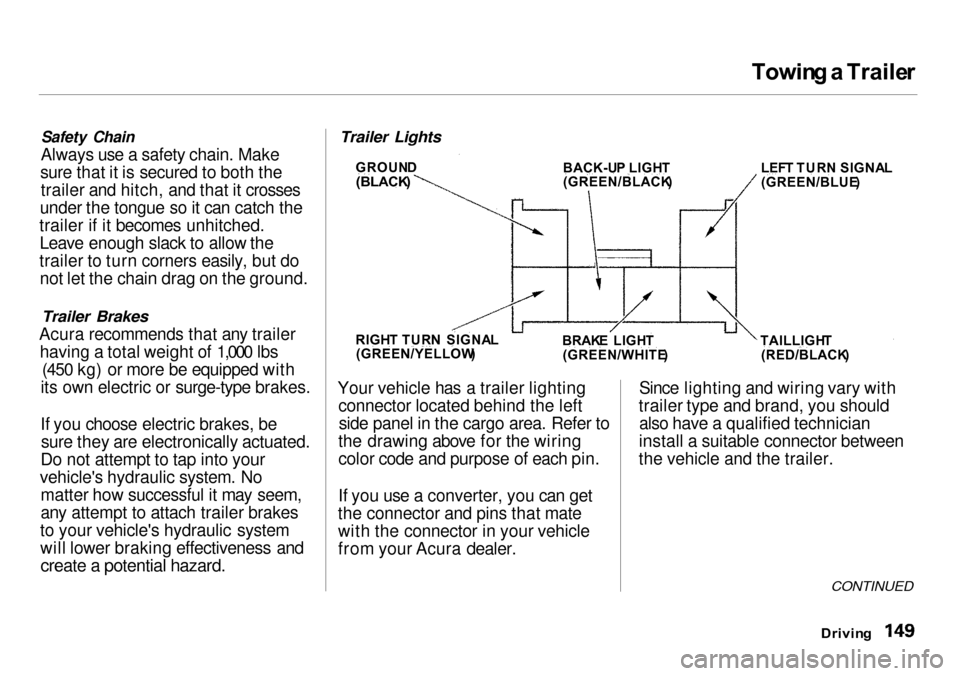
Trailer Lights
Your vehicle has a trailer lighting connector located behind the leftside panel in the cargo area. Refer to
the drawing above for the wiring
color code and purpose of each pin.
If you use a converter, you can get
the connector and pins that mate
with the connector in your vehicle
from your Acura dealer. Since lighting and wiring vary with
trailer type and brand, you should also have a qualified technician
install a suitable connector between
the vehicle and the trailer.
CONTINUED
Drivin g
GROUN
D
(BLACK )
BACK-U
P LIGH T
(GREEN/BLACK )LEF
T TUR N SIGNA L
(GREEN/BLUE )
RIGH T TUR N SIGNA L
(GREEN/YELLOW )BRAK
E LIGH T
(GREEN/WHITE )TAILLIGH
T
(RED/BLACK )
Page 153 of 273

Towin
g a Traile r
Additional Trailer equipment
Many states and Canadian provinces
require special outside mirrors when
towing a trailer. Even if they don't,
you should install special mirrors if you cannot clearly see behind you, orif the trailer creates a blind spot.
Ask your trailer sales or rental
agency if any other items are recommended or required for your
towing situation. Pre-To
w Checklis t
When preparing to tow, and before driving away, be sure to check the
following:
The vehicle has been properlyserviced, and the tires, brakes,
suspension, and cooling system
are in good operating condition. All weights and loads are within
limits (see page 147).
The hitch, safety chain, and any other attachments are sucure. All items on and in the trailer are
properly secured and cannot shift
while you drive. The lights and brakes on your
vehicle and the trailer are working
properly. Your vehicle tires and spare are
properly inflated (see page 192 ),and the trailer tires and spare are
inflated as recommended by the trailer maker.
Drivin g
Page 170 of 273
Engin
e Oi l
Addin g Oi l
To add oil, unscrew and remove the engine oil fill cap on top of the valve
cover. Pour in the oil, and install the
engine oil fill cap. Tighten it securely.
Wait a few minutes and recheck the oil level. Do not fill above the upper
mark; you could damage the engine. Recommende
d Oi l
Oil is a major contributor to your
engine's performance and longevity.
Always use a premium-grade deter- gent oil. It is highly recommended
that you use Genuine Honda Motor Oil in your vehicle for as long as you
own it. You can determine an oil's SAE
viscosity and Service Classification
from the API Service label on the oilcontainer.
CONTINUED
Maintenanc e
ENGIN
E OI L FIL L CA P
Page 178 of 273
Coolin
g Syste m
5. Remove the reserve tank from its holder by pulling it straight up.
Drain the coolant, then put the
tank back in its holder.
6. When the coolant stops draining,
tighten the drain plug at the
bottom of the radiator. Put a new
washer on the drain bolt, then reinstall the drain bolt in theengine block. Tighten it securely.Tightening torque:
58 Ibf .
ft (78 N .
m , 8.0 kgf .
m)
7. Mix the recommended antifreeze
with an equal amount of purifiedor distilled water in a clean
container. The cooling system
capacity is:
With 5-speed manual transmission:
(LS,
GS)
1.16 US gal (4.4 l ,0.97 Imp gal)
(GS-R)
1.24 US gal (4.7 l ,1.03 Imp gal)
With automatic transmission:
1.24 US gal (4.7 l ,1.03 Imp gal)
8. Pour coolant into the radiator up to the base of the filler neck.
9. Start the engine and let it run for about 30 seconds. Then turn off
the engine.
CONTINUED
Maintenanc e
RESERV
E TAN K
RESERVE
TAN K CA P
HOLDE R
FILLE
R NEC K
Fill u p t o her e


