1999 VOLVO S80 ECU
[x] Cancel search: ECUPage 6 of 96

Always fasten the seat belts before you drive or ride. A chime will sound several times if the driver has not
fastened his seat belt.
To buckle:
Pull the belt out far enough to insert the latch plate into the receptacle until a distinct click is heard. The seat belt
retractor is normally "unlocked" and you can move freely, provided that the shoulder belt is not pulled out too far. The
retractor will lock up as follows:
· if the belt is pulled out rapidly
· during braking and acceleration
· if the vehicle is leaning excessively
· when driving in turns
For the seat belt to provide maximum protection in the event of an accident, it must be worn correctly. When wearing
the seat belt remember:
· The belt should not be twisted or turned.
· The lap belt must be positioned low on the hips (not pressing against the abdomen).
Make sure that the shoulder belt is rolled up into its retractor and that the shoulder and lap
belts are taut.
Before exiting the car, check that the seat belt retracts fully after being unbuckled.
If necessary, guide the belt back into the retractor slot.
NOTE: Legislation in your state or province may mandate seat belt usage.
Adjusting shoulder belt
Lap portion of the belt should sit low
Child seats: Please refer to page 14
for information on securing child seats with the seat belts.
During pregnancy Pregnant women should always wear seat belts. Remember that the belt should always be
positioned in such a way as to avoid any possible pressure on the abdomen. The lap portion of the belt should be
located low, as shown in the above illustration.
ProCarManuals.com
Page 30 of 96
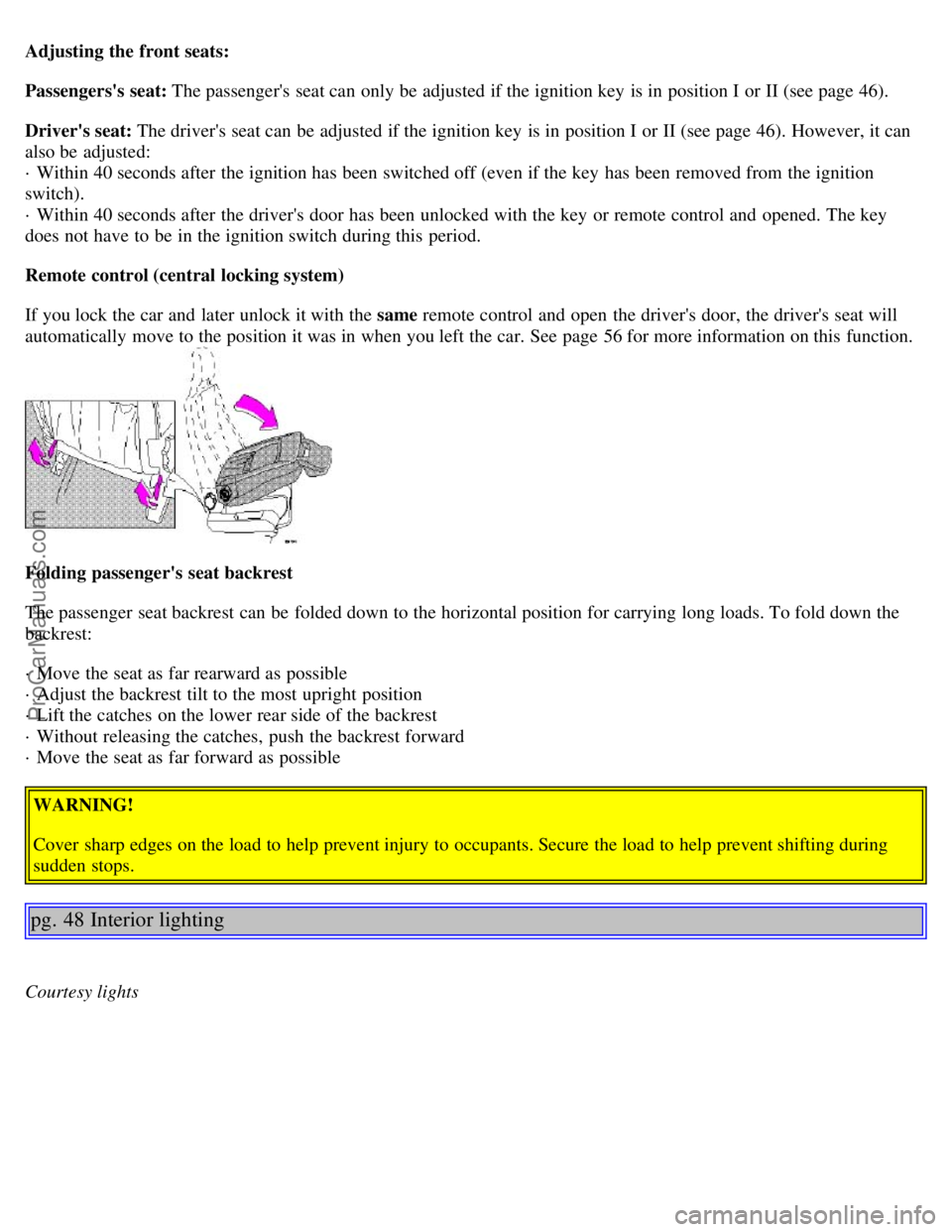
Adjusting the front seats:
Passengers's seat: The passenger's seat can only be adjusted if the ignition key is in position I or II (see page 46).
Driver's seat: The driver's seat can be adjusted if the ignition key is in position I or II (see page 46). However, it can
also be adjusted:
· Within 40 seconds after the ignition has been switched off (even if the key has been removed from the ignition
switch).
· Within 40 seconds after the driver's door has been unlocked with the key or remote control and opened. The key
does not have to be in the ignition switch during this period.
Remote control (central locking system)
If you lock the car and later unlock it with the same remote control and open the driver's door, the driver's seat will
automatically move to the position it was in when you left the car. See page 56 for more information on this function.
Folding passenger's seat backrest
The passenger seat backrest can be folded down to the horizontal position for carrying long loads. To fold down the
backrest:
· Move the seat as far rearward as possible
· Adjust the backrest tilt to the most upright position
· Lift the catches on the lower rear side of the backrest
· Without releasing the catches, push the backrest forward
· Move the seat as far forward as possible
WARNING!
Cover sharp edges on the load to help prevent injury to occupants. Secure the load to help prevent shifting during
sudden stops.
pg. 48 Interior lighting
Courtesy lights
ProCarManuals.com
Page 33 of 96

Spare tire
The spare tire, jack and tool bag are located under the floor of the trunk. To access the spare tire: · Lift the rear edge of
the floor of the trunk and fold it back toward the rear seat backrest.
· Lift out the trunk floor support (certain models) from the spare tire securing bracket.
· Release the strap to lift out the jack and tool bag.
· Unscrew the securing bracket and lift out the spare tire.
· To return the spare tire to the trunk, follow the reverse procedure.WARNING!
Make sure that the spare tire, jack and tool bag are properly secured with the securing bracket and strap to help keep
these components in place in the event of a sudden stop.
NOTE: See page 84
for information on how the jack should be used.
Cargo net in the trunk
The cargo net in the trunk can be used to secure light objects. Pull the release tab, pull the net out and slide the runner
in the handle down into one of the two slots provided at the rear edge of the trunk. Use the release tab to release
tension on the net while it is being placed around an object. Be sure the net is then pulled taut around the object.
The net can be retracted when not in use.
NOTE: If you have purchased the accessory plastic floor cover for the trunk, it may be necessary to cut notches in the
rear edge of this cover so that the runner on the cargo net can be securely pressed into the slots provided.
ProCarManuals.com
Page 34 of 96

WARNING!
Never use this net to secure sharp or heavy objects. In such cases, tie down the object using the cargo eyelets
provided. Both rear seat backrests should be secured in the upright position when the cargo net is in use.
pg. 52 Folding rear seat backrests, Carrying long loads
Backrest controls (on opposite sides of trunk)
Folding rear seat backrest The rear seat backrest is split into two sections. Each section can be folded independently
to allow you to transport long objects.
To fold down the backrest(s):
· Pull the release control handle(s) in the trunk to release the backrest(s) (see illustration above). If the outboard rear
head restraints are folded down, they should be returned to the upright position before folding the backrest down. It
may be necessary to manually adjust the center head restraint.
· Fold the backrest down.
WARNING!
· When the backrest is returned to the upright position, check that it is properly locked in place. Return the head
restraints to the upright position.
· Long loads should always be securely anchored to help avoid injury in the event of a sudden stop.
· Always turn the engine off and apply the parking brake when loading/unloading the vehicle.
· Place the transmission in the P (PARK) position to help prevent inadvertent movement of the gear selector.
ProCarManuals.com
Page 35 of 96

Secure long loads with the seat belt
Carrying long loads
There is a flap in the right section of the rear seat backrest for transporting long, light objects such as skis, etc. To
open the flap:
· Pull the right release control handle in the trunk to release the backrest.
· From the rear seat, fold down the right section of the backrest slightly *.
· Release the flap by pushing the catch (located on the rear side of the backrest) upward and pulling the flap forward.
· Return the backrest to the upright position.
* If your car is equipped with the optional integrated child booster cushion, this cushion must be folded down before
you fold down the backrest (see page 13
).
Contents | Top of Page
ProCarManuals.com
Page 39 of 96

"Trunk lock" function
Pressing this switch locks the trunk, even if the
doors are unlocked. The trunk will remain locked even if the doors are locked/unlocked using the master key or the
remote control.
To use this function:
· Turn the master key to position II.
· Press the "trunk lock" button. An LED in the button will light up and a message will be displayed in the text window
to indicate that this function is activated.
· The function can be turned off (deactivated) by turning the ignition key to position II and pressing the "trunk lock"
button again (the LED in the button will go out).
* The position of this button may vary, depending on the specifications of your car.
pg. 56 Remote keyless entry system
Remote keyless entry system
Your car is equipped with a remote control transmitter. This transmitter uses a radio frequency which will allow
"keyless" entry into the passenger compartment or the trunk. You will be supplied with two coded key ring
transmitters, which will enable you to lock/unlock all doors and the trunk from a distance of 10-15 feet (3-5 meters).
On vehicles equipped with an alarm, the alarm will also be activated/deactivated by this system.
The car can also be locked/unlocked with the key.
As an extra security precaution in certain situations (valet parking, etc.), Volvo recommends that the transmitter not be
included when the keys are given to anyone. The service key can be used instead. If one of the transmitters is
misplaced, contact the nearest authorized Volvo retailer for assistance.
Buttons in remote control
1 - Lock, 2 - Unlock, 3 - Open trunk
4 - "Panic" function *, 5 - Exterior courtesy lights
ProCarManuals.com
Page 58 of 96

The traction grades, from highest to lowest, are AA, A, B, and C, as measured under controlled conditions on specified
government test surfaces of asphalt and concrete. A tire marked C may have poor traction performance.WARNING!
The traction grade assigned to this tire is based on braking (straight-ahead) traction tests and does not include
cornering (turning) traction.
TEMPERATURE
The temperature grades are AA (the highest), A, B, and C, representing the tire's resistance to the generation of heat
and its ability to dissipate heat when tested under controlled conditions on a specified indoor laboratory test wheel.
Sustained high temperature can cause the material of the tire to degenerate and reduce tire life, and excessive
temperature can lead to sudden tire failure. The grade C corresponds to a level of performance which all passenger car
tires must meet under the Federal Motor Safety Standard No. 109. Grades B and A represent higher levels of
performance on the laboratory test wheel than the minimum required by law. WARNING!
The temperature grade for this tire is established for a tire that is properly inflated and not overloaded. Excessive
speed, under-inflation, or excessive loading, either separately or in combination, can cause heat buildup and possible
tire failure.
pg. 84 Changing wheels
Insert flat end of lug wrench and turn/pull straight out
Changing wheels
The spare wheel is located under the carpet on the trunk floor. The jack and crank are secured in the wheel recess.
There are two jack attachment points on each side of the car.
To change a wheel:
· Engage the parking brake.
· Put the gear selector in (P)ark.
· Remove the wheel cap (where applicable) using the lug wrench in the tool kit.
· With the car still on the ground, use the lug wrench to loosen the wheel bolts 1/2 1 turn. Turn the bolts
counterclockwise to loosen.
ProCarManuals.com