Page 141 of 203
'99 TERCEL (U)
140
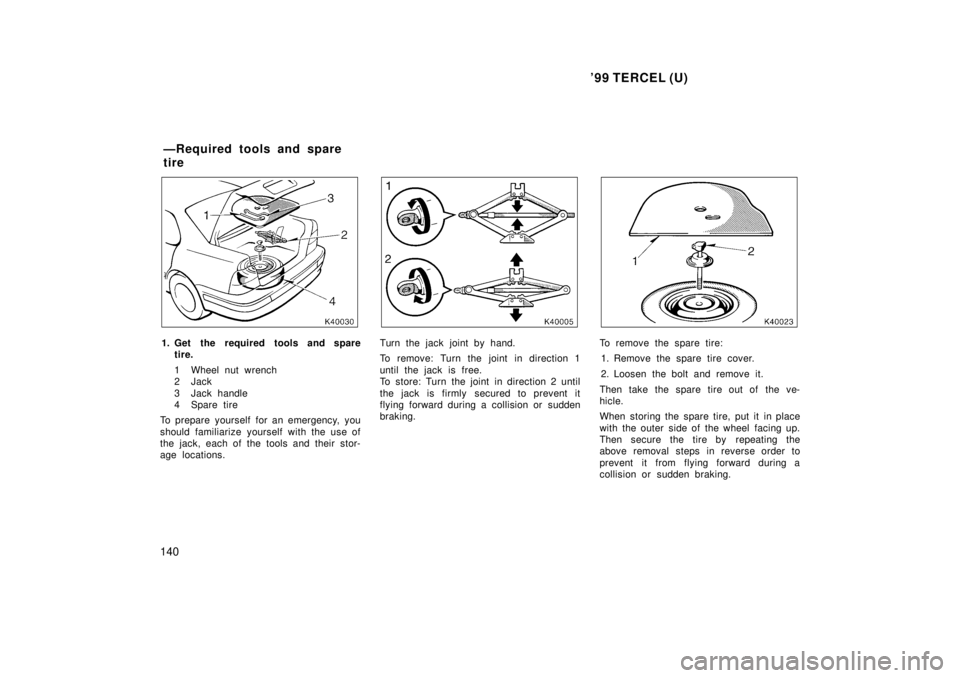
1. Get the required tools and spare tire.
1 Wheel nut wrench
2 Jack
3 Jack handle
4 Spare tire
To prepare yourself for an emergency, you
should fam iliarize yourself with the use of
the jack, each of the tools and their stor-
age locations.Turn the jack joint by hand.
To remove: Turn the joint in direction 1
until the jack is free.
To store: Turn the joint in direction 2 until
the jack is firmly secured to prevent it
flying forward during a collision or s udden
braking.To remove the spare tire:
1. Remove the spare tire cover.
2. Loosen the bolt and remove it.
Then take the spare tire out of the ve-
hicle.
When storing the spare tire, put it in place
with the outer side of the wheel facing up.
Then secure the tire by repeating the
above removal steps in reverse order to
prevent it from flying forward during a
collision or s udden braking.
ÐRequired tools and spare
tire
Page 146 of 203

'99 TERCEL (U)145
ÐReinstalling wheel ornament
10. Reinstall the wheel ornament.
Align the cutout of the wheel ornament
with the valve stem as shown. Then tap
it firmly with the side or heel of your hand
to snap it into place.
CAUTION
Take due care in handling the orna-
ment to avoid unexpected personal
injury.
ÐAfter changing wheels
11. Check the air pressure of the re- placed tire.
Adjust the air pressure to the specification
designed in Part 8. If the pressure is low-
er, drive slowly to the nearest service sta-
tion and fill to the correct pressure.
Do not forget to reinstall the tire inflation
valve cap as dirt and moisture could get
into the valve core and possibly cause air
leakage. If the cap is missing, have a new
one put on as soon as possible.
12. Restow all the tools, jack and flat tire securely.
As soon after changing wheels as pos-
sible, tighten the wheel nuts to the torque
specified in Part 8 with a torque wrench,
have a technician repair the flat tire and
replace the spare tire with it.
CAUTION
Before driving, make sure all the
tools, jack and flat tire are securely
in place in their storage location to
reduce the possibility of personal in-
jury during a collision or s udden
braking.
ÐFrom front
ÐFrom rear
(a) Towing with wheel lift type truckÐ
(b) Using flat bed truck
If your vehicle needs to be
towedÐ
Page 179 of 203

'99 TERCEL (U)
178
CAUTION
Do not include a compact spare tire
when rotating the tires. It is designed
for temporary use only.
WHEN TO USE SNOW TIRES OR
CHAINS
Snow tires or chains are recommended
when driving on snow or ice.
On wet or dry roads, conventional tires
provide better traction than snow tires.
SNOW TIRE SELECTION
If you need snow tires, select the same
size, construction and load capacity as
the original tires on your Toyota.
Do not use tires other than those men-
tioned above. Do not install studded tires
without first checking local regulations for
possible restrictions.
SNOW TIRE INSTALLATION
Snow tires should be installed on all
wheels.
Installing snow tires on the front w heels
only can lead to an excessive difference
in road grip capab ility between the front
and rear tires which could cause loss of
vehicle control.
When storing removed tires, you should
store them in a cool dry place. Mark the direction of rotation and be sure
to install them in the same direction when
replacing.
CAUTION
Do not drive with the snow tires
incorrectly inflated.
Never drive over 120 km/h (75 mph)
with any type of snow tires.
TIRE CHAIN SELECTION
Use the tire chains of correct size and
type.
Use SAE Class ºSº type radial tire chains
except radial cable chains or V- bar type
chains.
Regulations regarding the use of tire
chains vary according to location or
type of road, so always check them
before installing chains.
CHAIN INSTALLATION
Install the chains on the front tires as
tightly as possible. Do not use tire
chains on the rear tires. Retighten
chains after driving 0.5Ð1.0 km
(1/4Ð1/2 mile).
Installing snow tires and
chains