Page 167 of 203
'99 TERCEL (U)
166
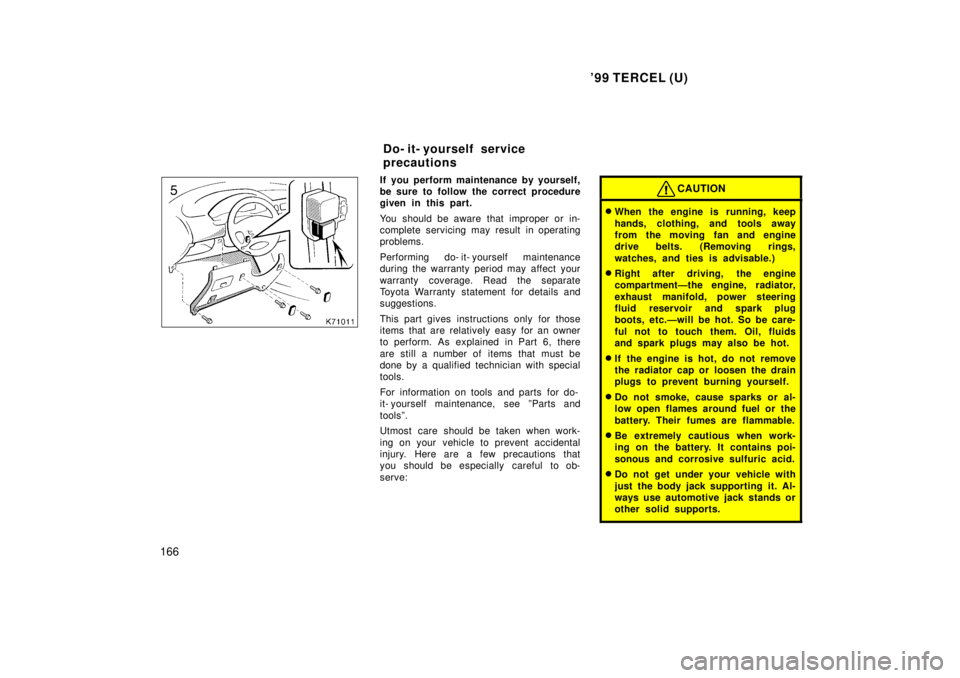
If you perform maintenance by yourself,
be sure to follow the correct procedure
given in this part.
You should be aware that improper or in-
complete servicing may result in operating
problems.
Performing do- it- yourself maintenance
during the warranty period may affect your
warranty coverage. Read the separate
Toyota Warranty statement for details and
suggestions.
This part gives instructions only for those
items that are relatively easy for an owner
to perform. As explained in Part 6, there
are still a number of items that must be
done by a qualified technician with special
tools.
For information on tools and parts for do-
it- yourself maintenance, see ºParts and
toolsº.
Utmost care should be taken when work-
ing on your vehicle to prevent accidental
injury. Here are a few precautions that
you should be especially careful to ob-
serve:CAUTION
When the engine is running, keep
hands, clothing, and tools away
from the moving fan and engine
drive belts. (Removing rings,
watches, and ties is advisable.)
Right after driving, the engine
compartmentÐthe engine, radiator,
exhaust manifold, power steering
fluid reservoir and spark plug
boots, etc.Ðwill be hot. So be care-
ful not to touch them. Oil, fluids
and spark plugs may also be hot.
If the engine is hot, do not remove
the radiator cap or loosen the drain
plugs to prevent burning yourself.
Do not smoke, cause sparks or al-
low open flames around fuel or the
battery. Their fumes are flammable.
Be extremely cautious when work-
ing on the battery. It contains poi-
sonous and corrosive sulfuric acid.
Do not get under your vehicle with
just the body jack supporting it. Al-
ways use automotive jack stands or
other solid supports.
Do- it- yourself service
precautions
Page 177 of 203

'99 TERCEL (U)
176
Low tire pressure results in excessive
wear, poor handling, reduced fuel econo-
my, and the possibility of blowouts from
overheated tires. Also, low tire pressure
can cause poor sealing of the tire bead.
If the tire pressure is excessively low,
there is the possibility of w
heel deforma-
tion and/or tire separation.
High tire pressure produces a harsh ride,
handling problems, excessive wear at the
center of the tire tread, and a greater
possibility of tire damage from road haz-
ards.
If a tire frequently needs ref illing, have it
checked by your Toyota dealer.
The following instructions for checking
tire pressure should be observed:
The pressure should be checked only
when the tires are cold. If your ve-
hicle has been packed for at least 3
hours and has not been driven for
more than 1.5 km or 1 mile since, you
will get an accurate cold tire pressure
reading.
Always use a tire pressure gauge.
The appearance of a tire can be mis-
leading. Besides, tire pressures that
are even just a few pounds off can
degrade handling and ride.
Take special care when adding air to
the compact spare tire. The smaller
tire size can gain pressure very quick-
ly. Add compressed air in small quanti-
ties and check the pressure often until
it reaches the specified pressure.
Do not bleed or reduce tire pressure
after driving. It is normal for the tire
pressure to be higher after driving.
Never exceed the vehicle capacity
weight. The passenger and luggage
weight should be located so that the
vehicle is balanced.
Be sure to reinstall the tire inflation
valve caps. Without the valve caps,
dirt or moisture could get into the valve
core and cause air leakage. If the caps
have been lost, have new ones put on
as soon as possible. Checking and replacing tires
Tread wear indicator
CHECKING YOUR TIRES
Check the tire tread for the tread wear
indicators. If the indicators show, re-
place the tires.
The tires on your Toyota have built- in
tread wear indicators to help you know
when the tires need replacement. When
the tread depth wears to 1.6 mm (0.06
in.) or less, the indicators will appear. If
you can see the indicators in two or more
adjacent grooves, the tire should be re-
placed. The lower the tread, the higher
the risk of skidding.
The effectiveness of snow tires is lost
if the tread wears down below 4 mm
(0.16 in.).
Page 192 of 203
'99 TERCEL (U)191
Part 8
SPECIFICATIONS
Dimensions and weight
Engine
Fuel
Service specifications
Ti r es
Fuses
Dimensions and weight
Overall length mm (in.) 4130 (162.6)
Overall width mm (in.) 1660 ( 65.4)
Overall height mm (in.) 1375 ( 54.1)
*
Wheelbase mm (in.) 2380 ( 93.7)
Front tread mm (in.) 1400 ( 55.1)
Rear tread mm (in.) 1395 ( 54.9)
Vehicle capacity weight
(occupants + luggage) kg (lb.) 352 (775)
* : Unladen vehicle Engine
Model:
5E- FE
Type: 4 cylinder in line, 4 cycle, gasoline
Bore and stroke, mm (in.): 74.0 87.0 (2.91 3.43)
Displacement, cm 3
(cu. in.):
1497 (91.3)
Page 193 of 203

'99 TERCEL (U)
192
Fuel
Fuel type:
Unleaded gasoline, Octane Rating 87
(Research Octane Number 91) or higher
Fuel tank capacity, L (gal., Imp. gal.): 45 (11.9, 9.9) Service specifications
ENGINE
Valve clearance (engine cold), mm (in.):
Intake 0.15Ð0.25 (0.006Ð0.010)
Exhaust 0.31Ð0.41 (0.012Ð0.016)
Spark plug type: DENSO K16TR11
NGK BKR5EKB11
Spark plug gap, mm (in.): 1.1 (0.043)
Drive belt tension measured with Borroughs
drive belt tension gauge No.BT- 33- 73F
(used belt), Ibf: 100 20
ENGINE LUBRICATION
Oil capacity (drain and refill), L (qt., Imp. qt.):
With filter 2.8 (3.0, 2.5)
Without filter 2.6 (2.7, 2.3)
Oil grade: API grade SJ, ºEnergy- Conservingº or
ILSAC multigrade engine oil is recom-
mended. Recommended oil viscosity (SAE):
COOLING SYSTEM
Total capacity, L (qt., Imp. qt.):
Automatic transmission Vehicles sold in Puerto Rico
4.8 (5.1, 4.2)
Vehicles sold outside Puerto Rico 5.3 (5.6, 4.7)
Manual transmission 4.9 (5.2, 4.3)
Coolant type: ºToyota Long Life Coolantº or equivalent
With ethylene- glycol type coolant for a
proper corrosion protection of aluminum
components
Do not use alcohol type antifreeze or
plain water alone.
