1999 TOYOTA TACOMA weight
[x] Cancel search: weightPage 152 of 247
'99 Tacoma (U)
152
Brake pad wear limit indicators
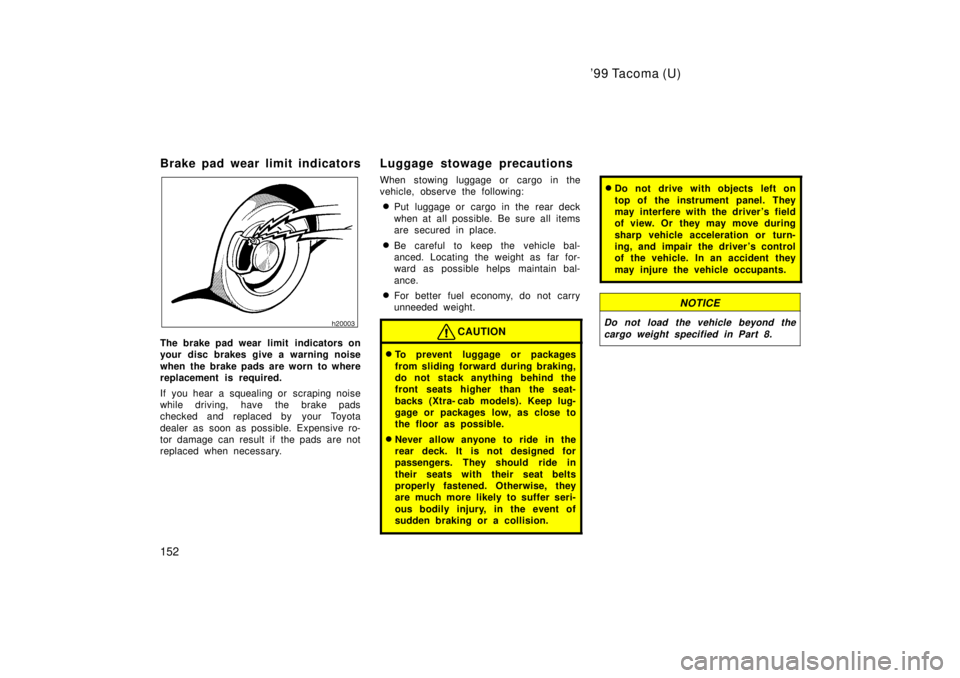
The brake pad wear limit indicators on
your disc brakes give a warning noise
when the brake pads are worn to where
replacement is required.
If you hear a squealing or scraping noise
while driving, have the brake pads
checked and replaced by your Toyota
dealer as soon as possible. Expensive ro-
tor damage can result if the pads are not
replaced when necessary.
Luggage stowage pr
ecautions
When stowing luggage or cargo in the
vehicle, observe the following: Put luggage or cargo in the rear deck
when at all possible. Be sure all items
are secured in place.
Be careful to keep the vehicle bal-
anced. Locating the weight as far for-
ward as possible helps maintain bal-
ance.
For better fuel economy, do not carry
unneeded weight.CAUTION
To prevent luggage or packages
from sliding forward during braking,
do not stack anything behind the
front seats higher than the seat-
backs (Xtra- cab models). Keep lug-
gage or packages low, as close to
the floor as possible.
Never allow anyone to ride in the
rear deck. It is not designed for
passengers. They should ride in
their seats with their seat belts
properly fastened. Otherwise, they
are much more likely to suffer seri-
ous bodily injury, in the event of
sudden braking or a co llision.
Do not drive with objects left on
top of the instrument panel. They
may interfere with the driver's field
of view. Or they may move during
sharp vehicle acceleration or turn-
ing, and impair the driver's control
of the vehicle. In an accident they
may injure the vehicle occupants.
NOTICE
Do not load the vehicle beyond the
cargo weight specified in Part 8.
Page 162 of 247
'99 Tacoma (U)
162
Do not use your parking brake when
there is a possibility it could freeze.
When parking, put the transmission into
ºPº (automatic) or into first or reverse
(manual) and block the front wheels. Do
not use the parking brake, or snow or
water accumulated in and around the
parking brake mechanism may freeze,
making it hard to release.
Keep ice and snow from accumulating
under the fenders.
Ice and snow built up under your fenders
can make steering difficult. During bad
winter driving, stop and check under the
fenders occasionally.
Depending on where you are driving,
we recommend you carry some emer-
gency equipment.
Some of the things you might put in the
vehicle are tire chains, window scraper,
bag of sand or salt, flares, small shovel,
jumper cables, etc.
Trailer towing
Your vehicle is designed primarily as a
passenger- and- load- carrying vehicle. Tow-
ing a trailer will have an adverse effect on
handling, performance, braking, durab
ility
and driving economy (fuel consumption,
etc.). Your safety and satisfaction depend
on the proper use of correct equipment
and cautious driving habits. For your safe-
ty and the safety of others, you must not
overload your vehicle or trailer. Ask your
local Toyota dealer for further details be-
fore towing.
WEIGHT LIMITS
Before towing, make sure the total trail-
er weight, gross combination weight,
gross vehicle weight, gross axle weight
and trailer tongue load are all within
the limits.
The total trailer weight and tongue load
can be measured with platform scales
found at a highway weighing station, build-
ing supply company, trucking company,
junk yard, etc.
CAUTION
The maximum gross trailer weight
(trailer weight plus cargo weight)
must never exceed the following.
2RZ- FE and 3RZ- FE engines
1587 kg (3500 lb.)
5VZ- FE engine 2267 kg (5000 lb.)
If towing a trailer and cargo weigh-
ing over 907 kg (2000 lb.), it is
necessary to use a sway control
device with sufficient capacity. The
combination of the gross trailer
weight added to the total weight of
the vehicle, occupants and vehicle
cargo must never exceed a total of
the following.
Page 163 of 247
'99 Tacoma (U)
163
Two- wheel drive models except Pre Runner2RZ- FE engine 3038 kg (6700 lb.)
5VZ- FE engine 3764 kg (8300 lb.)
Four- wheel drive models and PreRunner 3RZ- FE engine 3355 kg (7400 lb.)
5VZ- FE engine 4081 kg (9000 lb.)
Exceeding the maximum weight of
the trailer, the vehicle, or the ve-
hicle and trailer combination, can
cause an accident resulting in seri-
ous personal injuries.
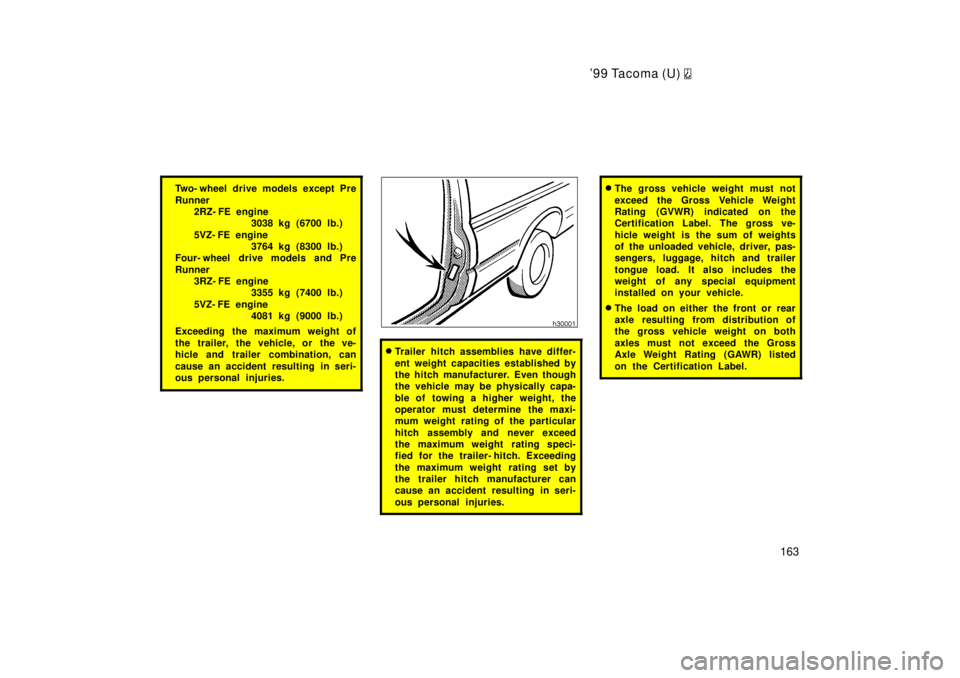
Trailer hitch assemblies have differ-
ent weight capacities established by
the hitch manufacturer. Even though
the vehicle may be physically capa-
ble of towing a higher weight, the
operator must determine the maxi-
mum weight rating of the particular
hitch assembly and never exceed
the maximum weight rating speci-
fied for the trailer- hitch. Exceeding
the maximum weight rating set by
the trailer hitch manufacturer can
cause an accident resulting in seri-
ous personal injuries.
The gross vehicle weight must not
exceed the Gross Vehicle Weight
Rating (GVWR) indicated on the
Certification Label. The gross ve-
hicle weight is the sum of weights
of the unloaded vehicle, driver, pas-
sengers, luggage, hitch and trailer
tongue load. It also includes the
weight of any special equipment
installed on your vehicle.
The load on either the front or rear
axle resulting from distribution of
the gross vehicle weight on both
axles must not exceed the Gross
Axle Weight Rating (GAWR) listed
on the Certification Label.
Page 164 of 247
'99 Tacoma (U)
164
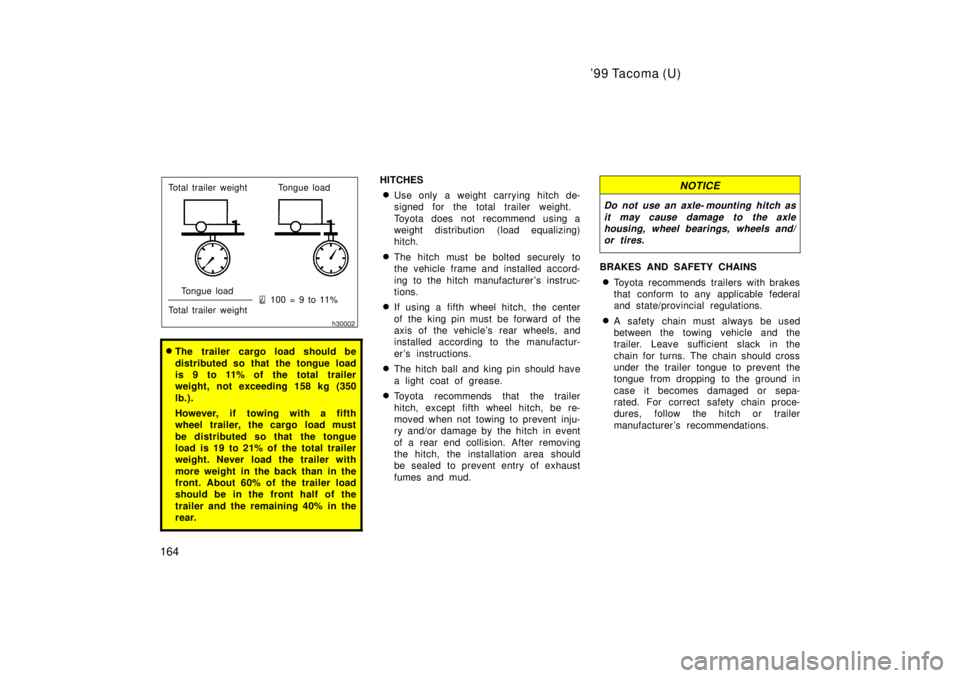
Total trailer weight
Total trailer weight Tongue load
Tongue load
100 = 9 to 11%
The trailer cargo load should be
distributed so that the tongue load
is 9 to 11% of the total trailer
weight, not exceeding 158 kg (350
lb.).
However, if towing with a fifth
wheel trailer, the cargo load must
be distributed so that the tongue
load is 19 to 21% of the total trailer
weight. Never load the trailer with
more weight in the back than in the
front. About 60% of the trailer load
should be in the front half of the
trailer and the remaining 40% in the
rear.
HITCHES
Use only a weight carrying hitch de-
signed for the total trailer weight.
Toyota does not recommend using a
weight distribution (load equalizing)
hitch.
The hitch must be bolted securely to
the vehicle frame and installed accord-
ing to the hitch manufacturer 's instruc-
tions.
If using a fifth wheel hitch, the center
of the king pin must be forward of the
axis of the vehicle's rear wheels, and
installed according to the manufactur-
er 's instructions.
The hitch ball and king pin should have
a light coat of grease.
Toyota recommends that the trailer
hitch, except fifth wheel hitch, be re-
moved when not towing to prevent inju-
ry and/or damage by the hitch in event
of a rear end collision. After removing
the hitch, the installation area should
be sealed to prevent entry of exhaust
fumes and mud.NOTICE
Do not use an axle- mounting hitch as
it may cause damage to the axlehousing, wheel bearings, wheels and/ or tires.
BRAKES AND SAFETY CHAINS
Toyota recommends trailers with brakes
that conform to any applicable federal
and state/provincial regulations.
A safety chain must always be used
between the towing vehicle and the
trailer. Leave sufficient slack in the
chain for turns. The chain should cross
under the trailer tongue to prevent the
tongue from dropping to the ground in
case it becomes damaged or sepa-
rated. For correct safety chain proce-
dures, follow the hitch or trailer
manufacturer 's recommendations.
Page 165 of 247
'99 Tacoma (U)
165
CAUTION
If the total trailer weight exceeds
453 kg (1000 lb.), trailer brakes are
required.
Never tap into your vehicle's hy-
draulic system as it would lower its
braking effectiveness.
Never tow a trailer without using a
safety chain securely attached to
both the trailer and the vehicle. If
damage occurs to the coupling unit
or hitch ball, there is danger of the
trailer wandering over into another
lane.
TIRES
Ensure that your vehicle's tires are
properly inflated. See Chapter 7- 2 for
instructions.
The trailer tires should be inflated to
the pressure recommended by the trail-
er manufacturer in respect to the total
trailer weight. TRAILER LIGHTS
Trailer lights must comply with federal,
state/provincial and local regulations.
See your local recreational vehicle
dealer or rental agency for the correct
type of wiring and relays for your trail-
er. Check for correct operation of the
turn signals and stop lights each time
you hitch up. Direct splicing may dam-
age your vehicle's electrical system
and cause a malfunction of your lights.
BREAK- IN SCHEDULE Toyota recommends that you do not
tow a trailer with a new vehicle or a
vehicle with any new power train com-
ponent (engine, transmission, differen-
tial, wheel bearing, etc.) for the first
800 km (500 miles) of driving.
MAINTENANCE
If you tow a trailer, your vehicle will
require more frequent maintenance due
to the additional load. For this informa-
tion, please refer to the scheduled
maintenance information in the ºSched-
uled Maintenance Guideº or ºOwner 's
Manual Supplementº.
Retighten all fixing bolts of the towing
ball and bracket after approximately
1000 km (600 miles) of trailer driving.
PRE- TOWING SAFETY CHECK Check that your vehicle remains level
when a loaded or unloaded trailer is
hitched. Do not drive if the vehicle has
an abnormal nose- up or nose- down
condition, and check for improper
tongue load, overload, worn suspension
or other possible causes.
Make sure the trailer cargo is securely
loaded so that it cannot shift.
Check that your rear view mirrors con-
form to any applicable federal, state/
provincial or local regulation. If not,
install the rear view mirrors required
for towing purpose.
Page 168 of 247
'99 Tacoma (U)
168
CAUTION
Do not exceed 72 km/h (45 mph) or
the posted towing speed limit,
whichever is lower. Because insta-
bility (swaying) of a towing vehicle-
trailer combination usually in-
creases as the speed increases, ex-
ceeding 72 km/h (45 mph) may
cause loss of control.
Slow down and downshift before
descending steep or long downhill
grades. Do not make sudden down-
shifts.
Avoid holding the brake pedal down
too long or too frequently. This
could cause the brakes to overheat
and result in reduced braking effi-
ciency.
Getting more kilometers/mileage from a
liter/gallon of fuel is easyÐjust take it
easy. It will help make your vehicle last
longer, too. Here are some specific tips
on how to save money on both fuel and
repairs:
Keep your tires inflated at the cor-
rect pressure. Underinflation causes
tire wear and wastes fuel. See Chapter
7- 2 for instructions.
Do not carry unneeded weight in
your vehicle. Excess weight puts a
heavier load on the engine, causing
greater fuel consumption.
Avoid lengthy warm- up idling. Once
the engine is running smoothly, begin
drivingÐbut gently. Remember, howev-
er, that on cold winter days this may
take a little longer.
Accelerate slowly and smoothly.
Avoid jackrabbit starts. Get into high
gear as quickly as possible.
Avoid long engine idling. If you have
a long wait and you are not in traffic,
it is better to turn off the engine and
start again later.
Avoid engine lug or overrevving. Use
a gear position suitable for the road on
which you are travelling.
Avoid continuous speeding up and
slowing down. Stop- and- go driving
wastes fuel.
Avoid unnecessary stopping and
braking. Maintain a steady pace. Try
to time the traffic signals so you only
need to stop as little as possible or
take advantage of through streets to
avoid traffic lights. Keep a proper dis-
tance from other vehicles to avoid sud-
den braking. This will also reduce wear
on your brakes.
Avoid heavy traffic or traffic jams
whenever possible.
Do not rest your foot on the clutch
or brake pedal. This causes needless
wear, overheating and poor fuel econo-
my.
Maintain a moderate speed on high-ways. The faster you drive, the greater
the fuel consumption. By reducing your
speed, you will cut down on fuel con-
sumption.
How to save fuel and make
your vehicle last longer, too
Page 169 of 247
'99 Tacoma (U)
169
Keep the front wheels in proper
alignment. Avoid hitting the curb and
slow down on rough roads. Improper
alignment not only causes faster tire
wear but also puts an extra load on
the engine, which, in turn, wastes fuel.
Keep the bottom of your vehicle free
from mud, etc. This not only lessens
weight but also helps prevent corrosion
Keep your vehicle tuned- up and in
top shape. A dirty air cleaner, improp-
er valve clearance, dirty plugs, dirty oil
and grease,brakes not adjusted, etc. all
lower engine performance and contrib-
ute to poor fuel economy. For longer
life of all parts and lower operating
costs, keep all maintenance work on
schedule, and if you often drive under
severe conditions, see that your vehicle
receives more frequent maintenance.
(For scheduled maintenance informa-
tion, please refer to the separate
ºScheduled Maintenance Guideº or
ºOwner 's Manual Supplementº).
CAUTION
Never turn off the engine to coast
down hills. Your power steering and
brake booster will not function with-
out the engine running. Also, the
emission control system operates
properly only when the engine is run-
ning.
Page 217 of 247
'99 Tacoma (U)
217
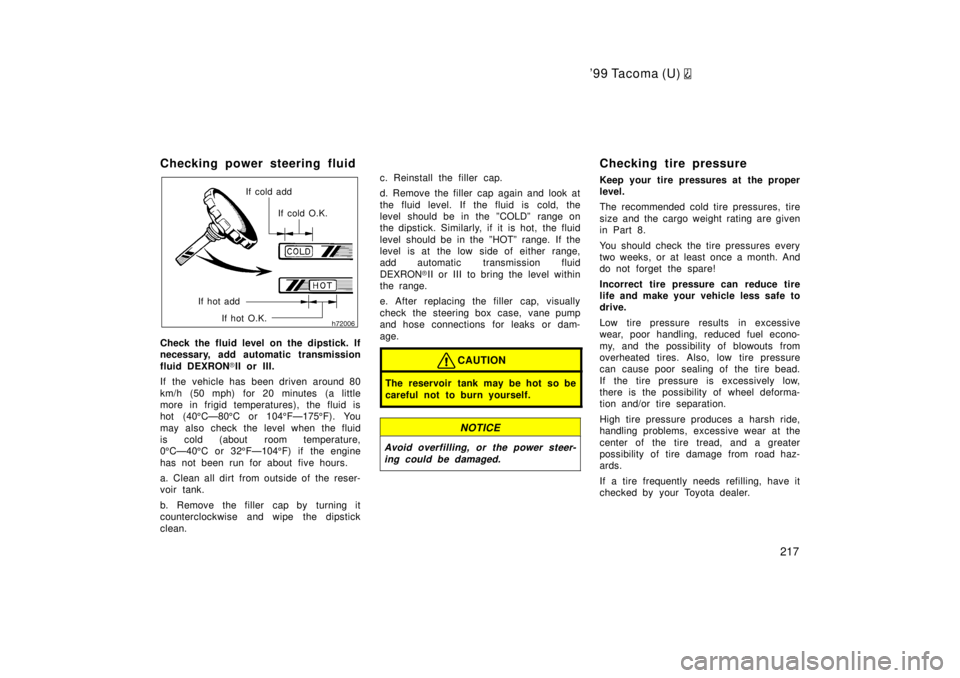
Checking power steering fluid
If cold add
If cold O.K.
If hot add If hot O.K.
Check the fluid level on the dipstick. If
necessary, add automatic transmission
fluid DEXRON II or III.
If the vehicle has been driven around 80
km/h (50 mph) for 20 minutes (a little
more in frigid temperatures), the fluid is
hot (40 5CÐ80 5C or 104 5FÐ175 5F). You
may also check the level when the fluid
is cold (about room temperature,0 5CÐ40 5C or 32 5FÐ104 5F) if the engine
has not been run for about five hours.
a. Clean all dirt from outside of the reser-
voir tank.
b. Remove the filler cap by turning it
counterclockwise and wipe the dipstick
clean. c. Reinstall the filler cap.
d. Remove the filler cap again and look at
the fluid level. If the fluid is cold, the
level should be in the ºCOLDº range on
the dipstick. Similarly, if it is hot, the fluid
level should be in the ºHOTº range. If the
level is at the low side of either range,
add automatic transmission fluid DEXRON
II or III to bring the level within
the range.
e. After replacing the filler cap, visually
check the steering box case, vane pump
and hose connections for leaks or dam- age.
CAUTION
The reservoir tank may be hot so be
careful not to burn yourself.
NOTICE
Avoid overfilling, or the power steer-
ing could be damaged.
Checking tire pressure
Keep your tire pressures at the proper
level.
The recommended cold tire pressures, tire
size and the cargo weight rating are given
in Part 8.
You should check the tire pressures every
two weeks, or at least once a month. And
do not forget the spare!
Incorrect tire pressure can reduce tire
life and make your vehicle less safe to
drive.
Low tire pressure results in excessive
wear, poor handling, reduced fuel econo-
my, and the possibility of blowouts from
overheated tires. Also, low tire pressure
can cause poor sealing of the tire bead.
If the tire pressure is excessively low,
there is the possibility of w heel deforma-
tion and/or tire separation.
High tire pressure produces a harsh ride,
handling problems, excessive wear at the
center of the tire tread, and a greater
possibility of tire damage from road haz-
ards.
If a tire frequently needs ref illing, have it
checked by your Toyota dealer.