1999 TOYOTA SOLARA light
[x] Cancel search: lightPage 29 of 244
SOLARA_U29
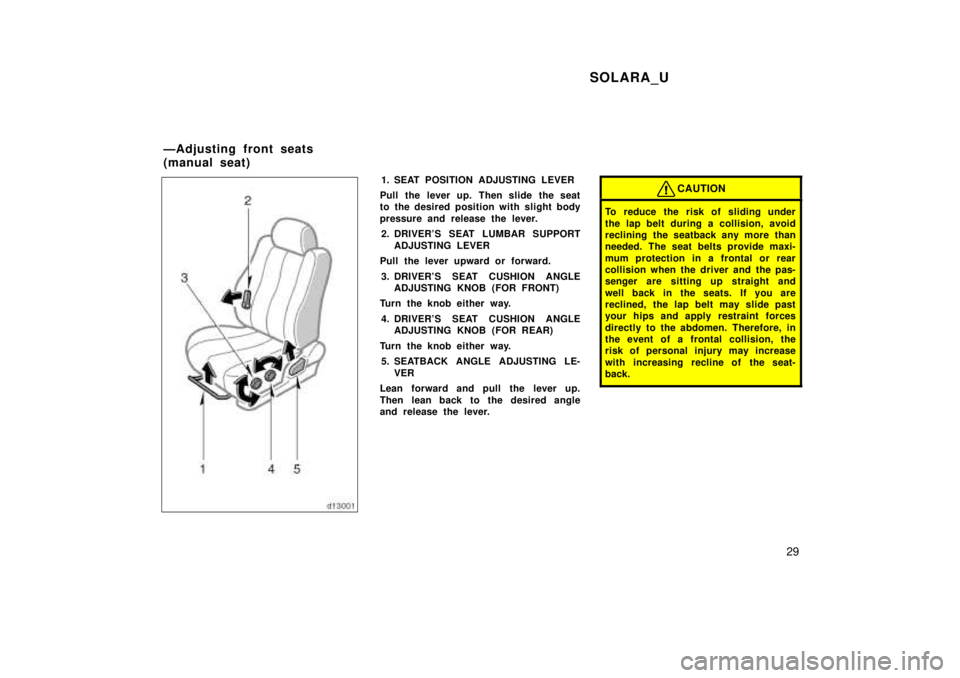
1. SEAT POSITION ADJUSTING LEVER
Pull the lever up. Then slide the seat
to the desired position with slight body
pressure and release the lever. 2. DRIVER'S SEAT LUMBAR SUPPORT ADJUSTING LEVER
Pull the lever upward or forward.
3. DRIVER'S SEAT CUSHION ANGLE ADJUSTING KNOB (FOR FRONT)
Turn the knob either way.
4. DRIVER'S SEAT CUSHION ANGLE ADJUSTING KNOB (FOR REAR)
Turn the knob either way. 5. SEATBACK ANGLE ADJUSTING LE- VER
Lean forward and pull the lever up.
Then lean back to the desired angle
and release the lever.CAUTION
To reduce the risk of sliding under
the lap belt during a collision, avoid
reclining the seatback any more than
needed. The seat belts provide maxi-
mum protection in a frontal or rear
collision when the driver and the pas-
senger are sitting up straight and
well back in the seats. If you are
reclined, the lap belt may slide past
your hips and apply restraint forces
directly to the abdomen. Therefore, in
the event of a frontal collision, the
risk of personal injury may increase
with increasing recline of the seat- back.
ÐAdjusting front seats
(manual seat)
Page 37 of 244
SOLARA_U37
If the seat belt cannot be pulled out of the
retractor, firmly pull the belt and release
it. You will then be able to smoothly pull
the belt out of the retractor.
When a passenger 's shoulder belt is com-
pletely extended and is then retracted
even slightly, the belt is locked in that
position and cannot be extended. This fea-
ture is used to hold the child restraint
system securely. (For details, see ºChild
restraintº in this chapter.) To free the belt
again, fully retract the belt and then pull
the belt out once more.
CAUTION
After inserting the tab, make sure
the tab and buckle are locked and
that the belt is not twisted.
Do not insert coins, clips, etc. in
the buckle as this may prevent you
from properly latching the tab and
buckle.
If the seat belt does not function
normally, immediately contact your
Toyota dealer. Do not use the seat
until the seat belt is fixed. It cannot
protect an adult occupant or your
child from injury.
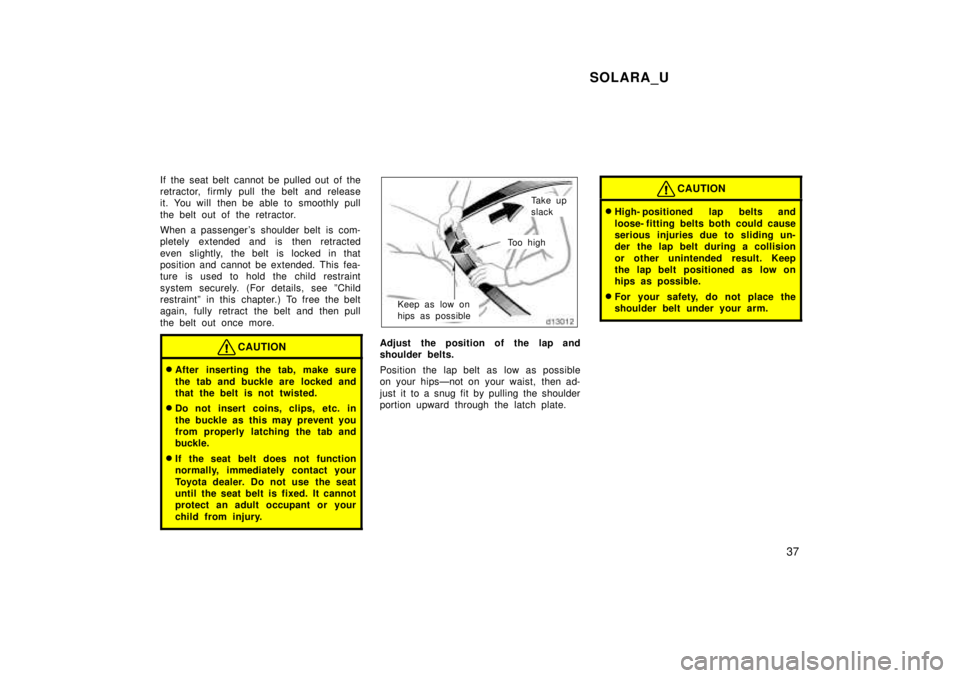
Ta k e u p
slack
To o h i g h
Keep as low on
hips as possible
Adjust the position of the lap and
shoulder belts.
Position the lap belt as low as possible
on your hipsÐnot on your waist, then ad-
just it to a snug fit by pulling the s houlder
portion upward through the latch plate.
CAUTION
High- positioned lap belts and
loose- fitting belts both could cause
serious injuries due to sliding un-
der the lap belt during a collision
or other unintended result. Keep
the lap belt positioned as low on
hips as possible.
For your safety, do not place the
shoulder belt under your arm.
Page 41 of 244

SOLARA_U41
This indicator comes on when the igni-
tion key is turned to the ºACCº or
ºONº position. It goes off after about
6 seconds. This means the front seat
belt pretensioners are operating proper-
ly.
This warning light system monitors airbag
sensor assembly, seat belt pretensioner
assembly, warning light, interconnecting
wiring and power sources. (For details,
see ºService reminder indicators and
warning buzzersº in Chapter 1- 5.)The seat belt pretensioner system mainly
consists of the following components and
their locations are shown in the illustra-
tion.1. Front airbag sensor
2. SRS airbag warning light
3. Seat belt pretensioner assembly
4. Airbag sensor assembly
The seat belt pretensioner is controlled by
the airbag sensor assembly. The airbag
sensor assembly consists of a safing sen-
sor and airbag sensor. When a seat belt pretensioner is acti-
vated, an operating noise may be heard
and a small amount of smoke- like gas
may be released. This gas is harmless
and does not indicate that a fire is occur-
ring.
Once the seat belt pretensioner has been
activated, the seat belt retractor remains
locked.
CAUTION
Do not modify, remove, strike or open
the front seat belt pretensioner as-
semblies, airbag sensor or surround-
ing area or wiring. Doing any of
these may cause sudden operation of
the front seat belt pretensioners or
disable the system, which could re-
sult in serious injury.
Failure to follow these instructions
can result in serious injuries.
Page 42 of 244

SOLARA_U
42
NOTICE
Do not perform any of the following changes without consulting yourToyota dealer. Such changes caninterfere with proper operation of the
seat belt pretensioners in some
cases.
Installation of electronic items such
as a mobile two- way radio, cassette
tape player or compact disc player
Repairs on or near the front seatbelt retractor assemblies
Modification of the suspension sys-tem
Modification of the front end struc-ture
Attachment of a grille guard (bull
bar, kangaroo bar, etc.), snowplow,winches or any other equipment tothe front end
Repairs made on or near the front
fenders, front end structure or con- sole
This front seat belt pretensioner system
has a service reminder indicator to inform
the driver of operating problems. If either
of the following conditions occurs, this
indicates a malfunction of the airbags or
pretensioners. Contact your Toyota dealer
as soon as possible to service the
vehicle.
The light does not come on when the
ignition key is turned to the ºACCº or
ºONº position, or remains on.
The light comes on or flashes while
driving.
If either front seat belt does not retract
or can not be pulled out due to a
malfunction or activation of the preten-
sioner.
The front seat belt pretensioner assem-
bly or surrounding area has been dam-aged.
The front and side parts of the vehicle
(shaded in the illustration) were in-
volved in an accident that did not
cause the seat belt pretensioners to
operate.
The front seat belt pretensioner assem-
bly is scratched, cracked, or otherwise
damaged.
Page 43 of 244

SOLARA_U43
The SRS (Supplemental Restraint Sys-
tem) airbags are designed to provide
further protection for the driver and
front passenger when added to the pri-
mary protection provided by the seat
belts.
In response to a severe frontal impact,
the SRS airbags work together with the
seat belts to help prevent or reduce injury
by inflating, in order to decrease the likeli-
hood of the driver 's or front passenger 's
head or chest directly hitting the steering
wheel or dashboard. The passenger airbag
is activated even with no passenger in the
front seat.
Be sure to wear your seat belt.
CAUTION
A driver or front passenger too close
to the steering wheel or dashboard
during airbag deployment can be
killed or seriously injured. Toyota
strongly recommends that: The driver sit as far back as pos-
sible from the steering wheel while
still maintaining control of the ve-
hicle.
The front passenger sit as far back
as possible from the dashboard.
All vehicle occupants be properly
restrained using the available seat
belts.
This indicator comes on when the igni-
tion key is turned to the ºACCº or
ºONº position. It goes off after about
6 seconds. This means the SRS airbags
are operating properly.
The SRS airbag warning light system
monitors the airbag sensor assembly, in-
flators, warning light, interconnecting wir-
ing and power sources. (For details, see
ºService reminder indicators and warning
buzzersº in Chapter 1- 5.)
SRS driver and front
passenger airbags
Page 45 of 244
SOLARA_U45
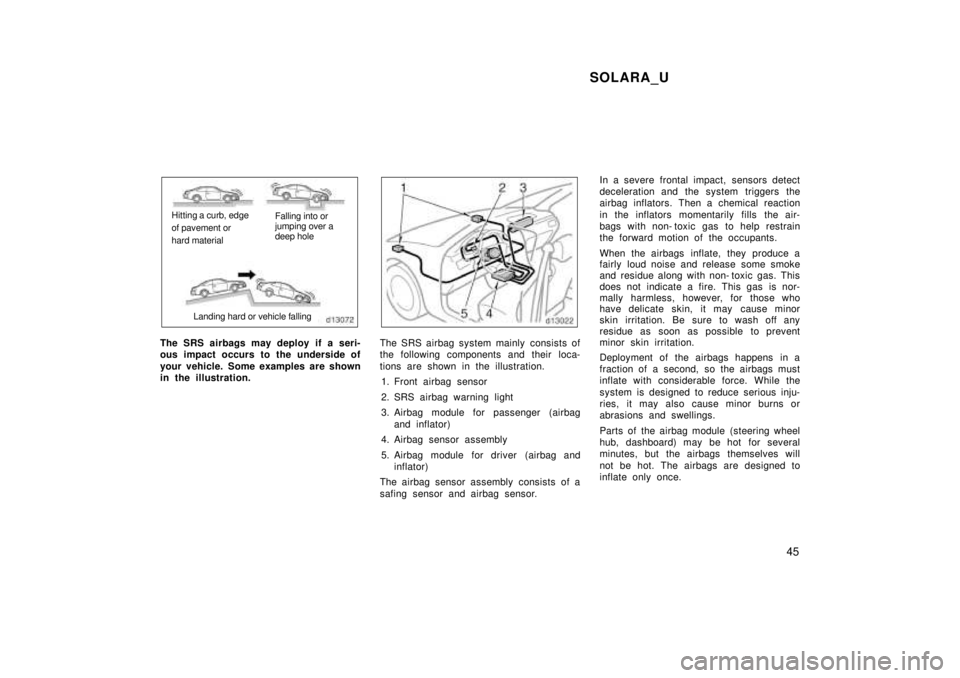
Hitting a curb, edge
of pavement or hard material Falling into or jumping over adeep hole
Landing hard or vehicle falling
The SRS airbags may deploy if a seri-
ous impact occurs to the underside of
your vehicle. Some examples are shown
in the illustration.
The SRS airbag system mainly consists of
the following components and their loca-
tions are shown in the illustration. 1. Front airbag sensor
2. SRS airbag warning light
3. Airbag module for passenger (airbag and inflator)
4. Airbag sensor assembly
5. Airbag module for driver (airbag and inflator)
The airbag sensor assembly consists of a
safing sensor and airbag sensor. In a severe frontal impact, sensors detect
deceleration and the system triggers the
airbag inflators. Then a chemical reaction
in the inflators momentarily fills the air-
bags with non- toxic gas to help restrain
the forward motion of the occupants.
When the airbags inflate, they produce a
fairly loud noise and release some smoke
and residue along with non- toxic gas. This
does not indicate a fire. This gas is nor-
mally harmless, however, for those who
have delicate skin, it may cause minor
skin irritation. Be sure to wash off any
residue as soon as possible to prevent
minor skin irritation.
Deployment of the airbags happens in a
fraction of a second, so the airbags must
inflate with considerable force. While the
system is desi
gned to reduce serious inju-
ries, it may also cause minor burns or
abrasions and swellings.
Parts of the airbag module (steering wheel
hub, dashboard) may be hot for several
minutes, but the airbags themselves will
not be hot. The airbags are designed to
inflate only once.
Page 49 of 244

SOLARA_U49
Do not modify or remove any wir-
ing. Do not modify, remove, strike
or open any components such as
the steering wheel column cover,
front passenger airbag cover, front
passenger airbag, airbag sensor as-
sembly. Doing any of these may
cause sudden SRS airbag inflation
or disable the system, which could
result in death or serious injury.
Failure to follow these instructions
can result in death or serious inju-
ries.
NOTICE
Do not perform any of the following changes without consulting yourToyota dealer. Such changes can interfere with proper operation of the
SRS airbag system in some cases.
Installation of electronic items suchas a mobile two- way radio, cassette
tape player or compact disc player
Modification of the suspension sys-tem
Modification of the front end struc-ture
Attachment of a grille guard (bullbar, kangaroo bar, etc.), snowplow,
winches or any other equipment tothe front end
Repairs made on or near the front fenders front end structure, con-
sole, steering column, steering
wheel or dashboard near the frontpassenger 's airbag
This SRS airbag system has a service
reminder indicator to inform the driver of
operating problems. If either of the
following conditions occurs, this indicates
a malfunction of the airbags. Contact your
Toyota dealer as soon as possible to
service the vehicle.
The light does not come on when the
ignition key is turned to the ºACCº or
ºONº position, or remains on.
The light comes on while driving.
Page 51 of 244

SOLARA_U51
CAUTION
SRS side airbags inflate with consid-
erable force. To avoid potential death
or serious injury during inflation of a
side airbag, Toyota strongly recom-
mends that the driver and front pas-
senger; Wear their seat belt
Remain properly seated with their
back against the seat at all times.
This indicator comes on when the igni-
tion key is turned to the ºACCº or
ºONº position. It goes off after about
6 seconds. This means the SRS side
airbags are operating properly.
The warning light system monitors the air-
bag sensor assembly, inflators, warning
light, interconnecting wiring and power
sources. (For details, see ºService remind-
er indicators and warning buzzersº in
Chapter 1- 5.)The SRS side airbag system may not
inflate if the vehicle is subjected to a
collision from the side at an angle, or
a collision to the side of the vehicle
body other than the passenger compart-
ment shown in the illustration, which
impact is not severe enough for the
passenger compartment.